Richibi’s Weblog

Just another WordPress.com weblog

Tag: Phoebus / Apollo

“Ocyrrhoe transform’d into a Mare” (II) – Ovid

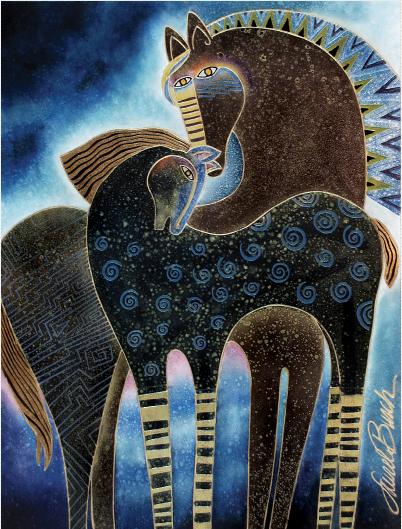
indigo-sky-mares

      Indigo Sky Mares


             Laurel Burch


                     ______


         Thus entring into destiny, the maid

         The secrets of offended Jove betray’d:


the maid, Ocyrrhoe, daughter of Chiron

and [t]he nymph Charicle


Ocyrrhoe had offended Jove, but

especially Hades, Jove’s brother,

ruler of the Underworld, when she

had prophesied that Apollo‘s child

with Coronis would be an acclaimed

healer, thus defraud[ing] the tomb,

thereby saving people from the 

clutches of Hades, the especially 

aggrieved god


         More had she still to say; but now appears

         Oppress’d with sobs and sighs, and drown’d in tears.


Occhyroe would have had more

to prophesy, but was impeded by

involuntary physical spasms


         “My voice,” says she, “is gone, my language fails;

         Through ev’ry limb my kindred shape prevails:


kindred shape, the bodily

characteristics of her father,

her kin, the centaur Chiron 


         Why did the God this fatal gift impart,

         And with prophetick raptures swell my heart!


prophetick raptures, Occhyroe, who

knew her father’s arts, and could

rehearse The depths of prophecy,

had inherited through her father,

Chiron, who had himself received

it from Apollo, his own father, the 

gift of divination, for better, for 

either, we’ll learn, or for worse


         What new desires are these? I long to pace

         O’er flow’ry meadows, and to feed on grass;

         I hasten to a brute, a maid no more;


what’s happening, What new desires

are these?, Occhyroe cries, or nearly

neighs, rather, at this point, I’m

becoming a brute, she groans, an

animal, a maid, no more, she objects


         But why, alas! am I transform’d all o’er?

         My sire does half a human shape retain,

         And in his upper parts preserve the man.”


why, Occhyroe asks, since my

father, Chiron, is partially a man,

am I transform’d all o’er?, why

is there nothing left of me that

is human


         Her tongue no more distinct complaints affords,


distinct, clear, easy to decipher


affords, allows, permits


         But in shrill accents and mis-shapen words

         Pours forth such hideous wailings, as declare

         The human form confounded in the mare:


Occhyroe has become a horse,

the proof is in her braying


         ‘Till by degrees accomplish’d in the beast,

         She neigh’d outright, and all the steed exprest.


all the steed exprest, was

everywhere the very picture 

of a horse


         Her stooping body on her hands is born,


born, borne, carried


         Her hands are turn’d to hoofs, and shod in horn,

         Her yellow tresses ruffle in a mane,

         And in a flowing tail she frisks her train,

         The mare was finish’d in her voice and look,

         And a new name from the new figure took.


Occhyroe can no longer be called

Occhyroe, she is no longer she,

but a new figure, needing to be

identified as something else


R ! chard

Story of Phaeton (VIII) – Ovid

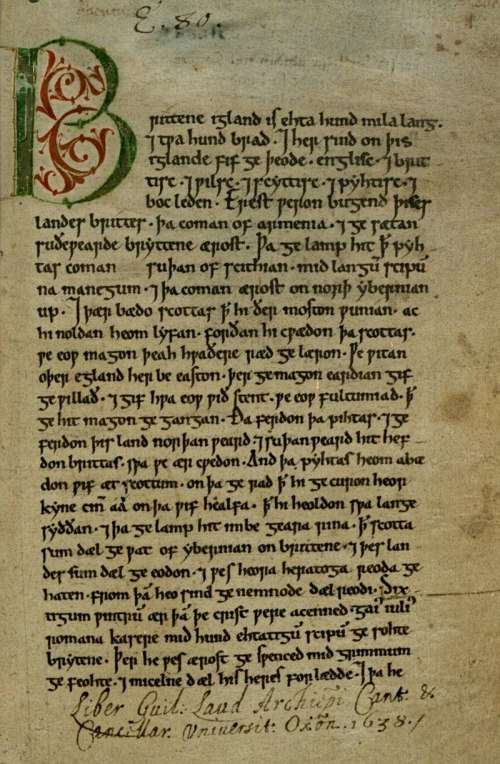
800px-Peterborough.Chronicle.firstpage

  the initial page of the Peterborough Chronicle (14th Century CE)


           ___________


                  Jove call’d to witness ev’ry Pow’r above, 
                  And ev’n the God, whose son the chariot drove, 
                  That what he acts he is compell’d to do, 
                  Or universal ruin must ensue. 


had Dryden applied commas above,

as I am, you might’ve noted, nearly

compulsively wont to do, commas 

being a significant part of my religion, 

the verses might’ve been more easily 

understood, put a comma after 

witness and the object of the 

witnessing, in this case an entire 

independent clause, That what he 

acts he is compell’d to do, finds its 

natural position, clarity, Jove has to 

do, he says, what Jove has to do


I cannot too much blame Dryden for 

this literary indiscretion, this peccadillo,

to my mind, for punctuation has been 

an evolving thing, there was a time 

when there was no punctuation at all, 

not even spaces between the words, 

see abovethis translation, of 1717, 

stands somewhere within the gamut 

of our ever evolving English grammar


the God, meanwhile, whose son the 

chariot drove, in, above, the second 

pentameter, is Phoebus / Apollo

Phaeton‘s father


                  Strait he ascends the high aetherial throne, 


Jove does


                  From whence 
he us’d to dart his thunder down,  
                From whence his show’rs and storms he us’d to pour, 
                But now cou’d meet with neither storm nor show’r. 


Jove, being rendered impotent by the 

raging fires, the immutable trajectory 

of the very Sun having been 

catastrophically, however improbably, 

distorted, is left, at that time, or Then, 

as the next line starts up, with no 

option


                  Then, aiming at the youth, with lifted hand, 
                  Full at his head he hurl’d the forky brand, 
                  In dreadful thund’rings. 


forky brand, a forklike piece of burning 

wood, Jove’s trident


                                                  Thus th’ almighty sire   
                  Suppress’d the raging of the fires with fire. 


I’m reminded of the planned explosions 

at the mouth of the oil wells in Kuwait,

wellheads, after the Gulf War, that were 

meant to still for a critical moment the 

fires, that would otherwise burn out 

of control, in order to squelch the

disastrous conflagrations 


                  At once from life and from the chariot driv’n, 
                  Th’ ambitious boy fell thunder-struck from Heav’n. 
                  The horses started with a sudden bound, 
                  And flung the reins and chariot to the ground: 
                  The studded harness from their necks they broke, 
                  Here fell a wheel, and here a silver spoke, 
                  Here were the beam and axle torn away; 
                  And, scatter’d o’er the Earth, the shining fragments lay. 
                  The breathless Phaeton, with flaming hair, 
                  Shot from the chariot, like a falling star, 
                  That in a summer’s ev’ning from the top 
                  Of Heav’n drops down, or seems at least to drop; 
                  ‘Till on the Po his blasted corps was hurl’d, 


corps, body, from the French, or 

corpse 


the Po, a river in Italy


                   Far from his country, in the western world. 


one wonders, however, what happened

to the Earth, the Chariot of the Sun, 

upon their fiery interaction, perhaps 

the Sun, fallen behind the horizon,

beyond the western oceans, set out 

again, the following morning, with its 

usual master, Phoebus / Apollo, at 

its steady reins, for the world to 

see again another day under that 

lord’s august intervention


R ! chard


The Transformation of Syrinx into Reeds

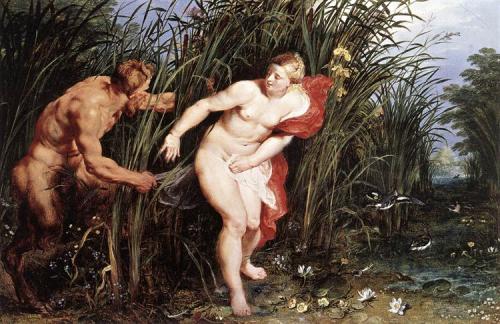
pan-and-syrinx-1619.jpg!Large

   Pan and Syrinx (1617 – 1619) 


           Peter Paul Rubens


                 __________


               Then Hermes thus: 


Hermes, messenger of the gods,

addresses Argus, keeper of Io

who’s been transformed by Jove

god of gods, into a heifer, though 

she remains daughter, ever, of 

Inachus, river god, to tell the

story of his rare, beguiling reeds


                                             A nymph of late there was
               Whose heav’nly form her fellows did surpass. 


here we go again with nymphs, 

beautiful, irresistible, however 

ever innocent, prey, due, indeed,

to their very beauty, their very

innocence, to lustful, inordinate 

desires, in these instances, 

markedly divine 


deities, I point out again, make 

up their own rules


               The pride and joy of fair Arcadia’s plains, 


Arcadia, apart from being an 

actual area of Greece, is also 

the ideal, in our historical 

imagination, of an utopia

much as is the lost island of

Atlantis 


               Belov’d by deities, ador’d by swains:
               Syrinx her name, by Sylvans oft pursu’d, 


Sylvans, could only be, though

I’ve been unable to find actual 

confirmation of my opinion, 

wood spirits, forest entities, 

satyrs, goat men, and such


               As oft she did the lustful Gods delude: 


Syrinx could often, or oft, delude, 

or fool, ward off, the lustful Gods


               The rural, and the woodland Pow’rs disdain’d; 


satyr yourself, Syrinx would’ve 

impudently taunted


               With Cynthia hunted, and her rites maintain’d:
               Like Phoebe clad, even Phoebe’s self she seems, 


Cynthia, is Phoebe, both also known

as Dianagoddess of the Hunt, you’ll

remember Phoebe / Diana from her

connection to Daphne, who earlier

here was transformed into a laurel 


Syrinx sounds an awful lot, incidentally,

like another version of Daphne


               So tall, so streight, such well-proportion’d limbs:
               The nicest eye did no distinction know,
               But that the goddess bore a golden bow: 


the only difference between Syrinx

and Cynthia / Phoebe / Diana was 

that Syrinx didn’t have, bear, 

golden bow


               Distinguish’d thus, the sight she cheated too. 


had she borne a golden bow, Syrinx

[d]istinguish’d thus, would’ve cheated 

the sight, looked identical, to the 

beautiful, it is inferred, goddess 


               Descending from Lycaeus, Pan admires
               The matchless nymph, and burns with new desires. 


Pan, god of the wild, woodlands


Lycaeus, Latin spelling of Lykaion,

is a mountain in Arcadia


               A crown of pine upon his head he wore;
               And thus began her pity to implore.
               But e’er he thus began, she took her flight
               So swift, she was already out of sight.
               Nor stay’d to hear the courtship of the God;
               But bent her course to Ladon’s gentle flood: 


Ladon, a river in Arcadia 


flood, rushing, though gentl[y], 

water, rhymes in the preceding 

verse, you’ll note, with God


               There by the river stopt, and tir’d before;
               Relief from water nymphs her pray’rs implore. 


Syrinx, once by the river stopt, seeks 

the help of, assistance, [r]elief from, 

the nearby water nymphs, her 

consorts  


               Now while the lustful God, with speedy pace,
               Just thought to strain her in a strict embrace, 


Pan, like Phoebus / Apollo, or 

Jove / Jupiter / Zeus before him,

is, as well, and characteristically,

a lustful God


               He fill’d his arms with reeds, new rising on the place.
               And while he sighs, his ill success to find, 


his ill success, his thwarted, 

ineffective, enterprise 


               The tender canes were shaken by the wind;
               And breath’d a mournful air, unheard before; 


the reeds that Pan gathered in his arms, 

shaken by the wind, create a mournful 

air, a melancholy music


               That much surprizing Pan, yet pleas’d him more. 


though Pan might’ve been much

surpriz[ed] by the sorrowful sounds 

he heard, he was more pleas’d by 

them than startled


               Admiring this new musick, Thou, he said,
               Who canst not be the partner of my bed,
               At least shall be the confort of my mind: 


Thou, Syrinx


               And often, often to my lips be joyn’d. 


in a kiss of consolation 


               He form’d the reeds, proportion’d as they are,
               Unequal in their length, and wax’d with care,
               They still retain the name of his ungrateful fair. 


the instrument Pan devised from

the tender canes he fashioned

from the unaccommodating reeds, 

what we now name the Pan flute

was called in Ancient Greece a 

syrinx, in honour of the 

recalcitrant nymph 


listen, coincidentally, to Debussy 

tell the storyfor solo flute,

however, which is to say, on a

modern instrumentfor our having 

long ago abandoned at a 

professional level the original pipe, 

though it remains, apparently, as a

folk instrument in more agrarian,

communities around the world, for 

shepherds, one would imagine, to

while away the hours while tending

to their, however wayward, sheep 


R ! chard


“The Transformation of Io into a Heyfer” (II) – Ovid

Gerbrand_van_den_Eeckhout_-_Juno,_Jupiter_and_Io

   Juno, Jupiter and Io (1672) 


          Gerbrand van den Eeckhout


                      ________________


we left Inachus in my last instalment

looking for his daughter, Io


              Her, just returning from her father’s brook


Her, Io 


              Jove had beheld, with a desiring look: 


the sentence structure, as it’s been

crafted in the verses above, has 

been an aspect of Ovid’s poem for 

some time, though, it must again 

be noted, as translated by John 

Dryden, the subject goes where 

the object should go, the sentence 

is inverted


the sentence should be, Jove had

beheld her, … just returning from 

her father’s brook


but the placement of Her at the 

top of the sentence, and even 

capitalized, is, you must admit,
arresting, and of the highest

poetic order


              And, Oh fair daughter of the flood, he said, 


the flood, the many rivers that came 

to comfort Inachus, their sovereign, 

in his distress at having lost Io, his 

daughter, their many surging 

confluences would’ve created 

overflowing torrents, the flood


              Worthy alone of Jove’s imperial bed, 


Jove thinks Io worthy of no one 

else’s mattress but his own


              Happy whoever shall those charms possess;
              The king of Gods (nor is thy lover less)
              Invites thee to yon cooler shades; to shun
              The scorching rays of the meridian sun. 


whoever might partake of her charms,

Jove tells Io, would be Happy


again an inverted sentence, note


but Jove makes his play, flashes 

his pedigree,The king of Gods, 

nothing less, and invites her to a 

shady grove, out of the noonday, 

the meridian, sun


              Nor shalt thou tempt the dangers of the grove
              Alone, without a guide; thy guide is Jove. 


Jove / Jupiter, god of gods


              No puny Pow’r, but he whose high command
              Is unconfin’d, 


Jove / Jupiter is not a nobody, but, 

rather, unconfin’d, omnipotent,

he boasts


                                    who rules the seas and land;
              And tempers thunder in his awful hand, 


Jove / Jupiter, supreme master of 

the elements


              Oh fly not: 


Jove urges Io


                                for she fled from his embrace
              O’er Lerna’s pastures: 


Lerna, a region of Ancient Greece


                                                he pursu’d the chace
              Along the shades of the Lyrcaean plain; 


Lyrcaean, after some investigation,

seems to mean from Lycaeus, the

Latin name for Lykaion, a mountain

in Greece, considered by some to

be the birthplace of Jove / Jupiter /

Zeus


otherwise, but very improbably, the 

Lyrcaean plain is a literary invention,

of Ovid, or of his translator, Dryden


              At length the God, who never asks in vain,
              Involv’d with vapours, imitating night,
              Both Air, and Earth; 


Inform’d with, having transformed 

himself into, vapours, a mist, 

imitating night, shrouding [b]oth 

Air and Earth in darkness, 

becoming himself, therefore, 

indistinct, indefinite, nebulous, 

within them


                                              and then suppress’d her flight,
              And mingling force with love, enjoy’d the full delight. 


first of all Phoebus / Apollo‘s pursuit 

of Daphne, and now Jove / Jupiter‘s 

constraint of Io, are not admirable

aspects of male deities, indeed in

our age of action against the 

harassment of women, their 

behaviour is disturbing, uncomfortable

for me even to read, I’m too reminded 

of dissolute American CEOs, not to

mention presidents, but concluding 

that this dilemma has been around 

for countless ages among vertebrates,

be they animal, human, or, as in these 

instances, divine, therefore written in 

our antediluvian, our primeval, genes, 

maybe, consequently, ineradicably


              Mean-time the jealous Juno, from on high, 


Juno, goddess of goddesses, wife

of Jupiter / Jove


              Survey’d the fruitful fields of Arcady; 


Arcady, or Arcadia, a region still 

of Greece


              And wonder’d that the mist shou’d over-run
              The face of day-light, and obscure the sun. 


which is to say, Juno, suspicious, 

asks herself, what’s up with that 


              No nat’ral cause she found, from brooks, or bogs,
              Or marshy lowlands, to produce the fogs; 


she reckons


              Then round the skies she sought for Jupiter,
              Her faithless husband; but no Jove was there: 


Juno knows her Jove / Jupiter


              Suspecting now the worst, Or I, she said,
              Am much mistaken, or am much betray’d. 


it’s one of two things, Juno figures, 

after [s]uspecting … the worst, I am 

myself in error, she concludes, I am

myself mistaken , or am, by my 

husband, much betray’d 


              With fury she precipitates her flight: 


her flight, her plan of action, both

geographical, and tactical


              Dispels the shadows of dissembled night; 


dissembled, sham, not actual, Jove / 

Jupiter, if you’ll remember, Involv’d 

with vapours, was imitating night,

not easily visible


              And to the day restores his native light. 


note that day is masculine here, 

his native light


              Th’ Almighty Leacher, careful to prevent
              The consequence, foreseeing her descent,
              Transforms his mistress in a trice; and now
              In Io’s place appears a lovely cow. 


Leacher, lecher


in a trice, very quickly, in the bat

of an eyelash


a cow 


see above


              So sleek her skin, so faultless was her make,
              Ev’n Juno did unwilling pleasure take
              To see so fair a rival of her love; 


though transformed into a cow, Io 

remains lovely, even Juno can see 

that, however be she jealous 


              And what she was, and whence, enquir’d of Jove: 


where did you get that, Juno asks 

of Jove, surely dryly


              Of what fair herd, and from what pedigree? 


and what, and when, and how, she

further inquires, probably acidly 


              The God, half caught, was forc’d upon a lye:
              And said she sprung from Earth. 


Jove, who’d had to tell a lye, a lie, 

said that the heifer, the altered Io

had sprung, spontaneously, he 

claimed, from the earth


                                                     She took the word, 


Juno accepted Jove‘s explanation


              And begg’d the beauteous heyfer of her lord. 


Juno asks of Jove that she might 

keep the heyfer for herself, the 

heifer, a virgin cow


              What should he do? ’twas equal shame to Jove
              Or to relinquish, or betray his love:
              Yet to refuse so slight a gift, wou’d be
              But more t’ increase his consort’s jealousie: 


Jove / Jupiter was in a bind, to

out Io, or to out himself


              Thus fear, and love, by turns, his heart assail’d;
              And stronger love had sure, at length, prevail’d:
              But some faint hope remain’d, his jealous queen
              Had not the mistress through the heyfer seen. 


if it weren’t for the fact that Juno

maybe, some faint hope, might 

not have recognized Io in the 

heifer, Jove / Jupiter would’ve, 

had sure, eventually, at length, 

confessed to his indiscretion, his

stronger love, having prevail’d


              The cautious Goddess, of her gift possest,
              Yet 
harbour’d anxious thoughts within her breast;
              As she who knew the falshood of her Jove;


though Juno has been granted her

request, she remains sceptical, 

knew her husband was prone to

falshood, or falsehood


              And justly fear’d some new relapse of love. 


justly, the facts would bear her out, 

were she cognizant of them


              Which to prevent, and to secure her care,
              To trusty Argus she commits the fair. 


Argus Panoptes, one of the giants 

who must’ve remained after their 

war 


Panoptes, pan optes, Greek for many 

eyes, of which only a few, it came to 

be believed, of Juno‘s entrusted

guardian, slept at a time


to be continued


R ! chard


“The Transformation of Daphne into a Lawrel” (III) – Ovid

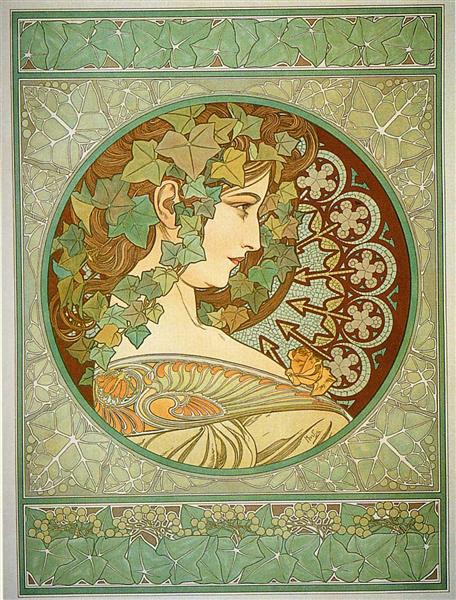
laurel-1901.jpg!Large

       Laurel”  (1901) 


             Alphonse Mucha


                         _______


however ardently might’ve Phoebus 

been pleading his case before 

Daphne, his, however recalcitrant,  

intended, flashing his divine pedigree, 

vowing to put all that aside to serve 

only her


               She heard not half; so furiously she flies;
               And on her ear th’ imperfect accent dies, 


th’ imperfect accent might be the 

unnatural tone of a divinity Daphne 

might be hearing, the unusual timbre 

of a deity’s voice, I can’t imagine Ovid 

would be suggesting that Daphne and 

Phoebus spoke different Greek dialects


perhaps th’ imperfect accent is the

unsettling manner of his entreaties,

his indecorous urgency


poets can be confounding


               Fear gave her wings; and as she fled, the wind
               Increasing, spread her flowing hair behind;
               And left her legs and thighs expos’d to view:
               Which made the God more eager to
pursue. 


the pagan gods were notoriously 

mischievous, spirited, impulsive,

quite human, never sublime and

irreproachable as is the Abrahamic 

Supreme Deity


the pagan gods lived in the fields

and streams, the hills and vales,

the seas and mountains, that 

surrounded Greek and Roman 

communities, Olympus was their 

steepest height, never the 

supernatural elevations, beyond 

even our visible heaven, that our 

present pervasive monotheism 

proclaims


               The God was young, and was too hotly bent
               To lose his time in empty compliment:
               But led by love, and fir’d with such a sight,
               Impetuously pursu’d his near delight. 


often, the gods of antiquity were

perverse, not at all blameless,

not innocent, not irreproachable, 

like the one and only god that, 

today, in its several interpretations, 

even murderously conflicting, rules,

oversees, mostly, our present, at 

least Western, faith communities


               As when th’ impatient greyhound slipt from far,

               Bounds o’er the glebe to course the fearful hare,


glebe, fields


               She in her speed does all her safety lay; 
               And he with double speed pursues the prey; 
               O’er-runs her at the sitting turn, and licks 
               His chaps in vain, and blows upon the flix: 


flix, fur, the greyhound’s pelt 


perhaps greyhounds do this, blow

upon their flix, you’ll have to ask 

Ovid, or maybe Dryden, his 

translator


               She scapes, and for the neighb’ring covert strives, 


 a covert, a bush in which to hide


               And gaining shelter, doubts if yet she lives: 


doubts if yet she lives, she can’t 

believe she made it 


               If little things with great we may compare,
               Such was the God, and such the flying fair, 


the flying fair, Daphne, the God,

Phoebus


               She urg’d by fear, her feet did swiftly move,
               But he more swiftly, who was urg’d by love. 


love, as Ovid, or is it, once again,  

Drydenwho defines it, urg’d, 

compelled by hormones, not at all 

our romantic conception of it


               He gathers ground upon her in the chace:
               Now breathes upon her hair, with nearer pace;
               And just is fast’ning on the wish’d embrace. 


Red Riding Hood and the Big

Bad Wolf


               The nymph grew pale, and in a mortal fright,
               Spent with the labour of so long a flight; 


Spent, defeated


               And now despairing, cast a mournful look
               Upon the streams of her paternal brook; 


her father, Peneus, was a river god, 

if you’ll remember, paternal brook, 

the rill, the rivulet, of her father


               Oh help, she cry’d, in this extreamest need!
               If water Gods are deities indeed: 


if there is a god, be with me, she 

cry’d, you, yourself, I’m sure, have 

been there, though Daphne‘s faith 

was grounded in help, in this case, 

from her father, god of, appropriately

in this instance, streams


               Gape Earth, and this unhappy wretch intomb; 


I’d rather die, Daphne pleads, I’d

rather the earth swallowed me up, 

I’d rather be intomb[ed]


               Or change my form, whence all my sorrows come. 


transform me, rid me of what makes 

me appealing, Daphne pleads


               Scarce had she finish’d, when her feet she found
               Benumb’d with cold, and fasten’d to the ground:
               A filmy rind about her body grows; 


a condition I’ve found not unlike the 

ravages I call, ironically, bark, crusty 

imperfections that afflict my own 

ageing body


               Her hair to leaves, her arms extend to boughs:
               The nymph is all into a lawrel gone; 


Daphne is turning into a tree,

a lawrel 


               The smoothness of her skin remains alone. 


of Daphne, only her smoothness 

remains


               Yet Phoebus loves her still, and casting round
               Her bole, his arms, some little warmth he found. 


bole, the stem of a tree


               The tree still panted in th’ unfinish’d part: 


where Daphne had not yet become

a tree, she still panted, pulsed


               Not wholly vegetive, and heav’d her heart. 


heav’d her heart, passionately

reacted


               He fixt his lips upon the trembling rind; 


rind, bark


               It swerv’d aside, and his embrace declin’d. 


kisses not at all sweeter than wine,

said the lawrel 


               To whom the God, Because thou canst not be
               My mistress, I espouse thee for my tree: 


Phoebus begins to speak directly 

here, Because thou canst not be, /

My mistress, he says, I espouse 

thee for my tree: 


espouse, marry


               Be thou the prize of honour, and renown; 


you will be, he continues, the 

prize that will represent heroes


               The deathless poet, and the poem, crown. 


honour, first of all, worthy, deathless, 

poets, Phoebus commands, let the 

laurel wreath crown deserving 

wordsmiths


Ovid had reason to champion poets,

he’d been exiled from Rome by the

Emperor, Augustus, his catering to

the Roman ruler becomes 

intermittently evident throughout 

this masterpiece


               Thou shalt the Roman festivals adorn,
               And, after poets, be by victors worn. 


victors, Olympic champions, notably


               Thou shalt returning Caesar’s triumph grace; 


Ovid curries imperial favour here with 

Augustus, by simply immortalizing in

poetry the name of Caesar, the new

Emperor’s great-uncle, and adoptive

father, making his own personal 

nemesis shine, for what it might be 

worth, by association


               When pomps shall in a long procession pass. 


the parades will be long ones


               Wreath’d on the posts before his palace wait; 


the laurel leaves will garland the 

posts, stations, before, in front of, 

the imperial palace


               And be the sacred guardian of the gate.
               Secure from thunder, and unharm’d by Jove, 


even Jove / Jupiter, god of gods,

will stand by, honour, the symbol 

of the laurel


               Unfading as th’ immortal Pow’rs above: 


Unfading, into very eternity


it’s interesting to note that the 

laurel has not lost its significance

despite the intervening centuries, 

epochs, we find reference to it even 

in the honorific title of laureate, as 

in Nobel laureate, or even in the

accolade of baccalaureate, the

bachelor’s degree, the prestigious

academic accomplishment 


Unfading indeed


               And as the locks of Phoebus are unshorn, 


Phoebus always sports perfect 

hair


               So shall perpetual green thy boughs adorn.


it would seem that, according to 

this, laurel leaves, perpetual 

green, don’t ever lose their 

colour, but I can’t attest to this,

being a poet rather than an

arborist, a gardener, though

bay leaves, laurel, even dry,

don’t turn brown, I’ve since

noticed


               The grateful tree was pleas’d with what he said;
               And shook the shady honours of her head. 


and they all lived happily ever 

after


or didn’t


myths are the enduring fairy tales 

that adults continue to believe in, 

according to their culture, about 

men and women rather than 

boys and girls, they help us, like

fairy tales, make up our moral 

order


R ! chard


“The Transformation of Daphne into a Lawrel” (II) – Ovid

daphne-1892(1).jpg!Large

           “Daphne” (1879 – 1892) 


            George Frederick Watts


                    __________


                  The God of light, aspiring to her bed, 


The God of light, Phoebus, whose

name, incidentally, finds its roots 

in the Greek word for shining, 

which I won’t inscribe here for its 

being not only in another language,

but also of a different alphabet


Phoebus, also known as Apollo

was not only god of Light, but 

too, god of the Sun, as well as of

several other things that brought

clarity, his shrine at Delphi, for

instance, was famed for providing 

oracles, intelligibility in the face of 

confusion, however cryptic the 

actual words of the presiding 

sybil commonly were 


               Hopes what he seeks, with flattering fancies fed; 


Phoebus [h]opes, indeed trusts, 

that feeding Daphne flattering 

fancies will do the trick


               And is, by his own oracles, mis-led. 


even his oracles, his sybils, his

priestesses, in this circumstance, 

fail him


               And as in empty fields the stubble burns, 


stubble, what’s left of the shaft once 

the grain has been removed, 

harvested 


               Or nightly travellers, when day returns,
               Their useless torches on dry hedges throw,
               That catch the flames, and kindle all the row; 


now that day has arrived, the nightly

travellers‘ otherwise useless torches

can serve to kindle, ignite, and burn

off, the rows of slowly smouldering 

stubble  


               So burns the God, consuming in desire, 


Phoebus is similarly, [s]o, kindled,

burns with a desire [s]o, as, 

consuming


               And feeding in his breast a fruitless fire: 


the fire, the desire, however, remains 

in his breast … fruitless, unabated, 

unquenched


               Her well-turn’d neck he view’d (her neck was bare)
               And on her shoulders her dishevel’d hair; 


Daphne‘s hair would’ve been 

dishevel’d, undone, during her 

flight, by the wind


               Oh were it comb’d, said he, with what a grace
               Wou’d every waving curl become her face! 


Phoebus begins to idealize her


               He view’d her eyes, like heav’nly lamps that shone,
               He view’d her lips, too sweet to view alone,
               Her 
taper fingers, and her panting breast; 


see above


               He praises all he sees, 


his flattering fancies at work 


                                              and for the rest
               Believes the beauties yet unseen are best: 


Phoebus has no intention of enjoying 

merely what Daphne cannot but allow, 

her beauties yet unseen, he believes, 

are best, are preferable


ahem


               Swift as the wind, the damsel fled away,
               Nor did for these alluring speeches stay: 


alluring speeches, flattering fancies


               Stay Nymph, he cry’d, I follow, not a foe. 


a nymph, a nature spirit in the form 

of a maiden, imagined frolicking by 

rivers, or woods


Phoebus calls her by this metonym,

Nymph, probably because he doesn’t 

yet know her proper name


a metonym is the word for a part

which signifies the whole, the pen, 

for instance, is mightier than the 

sword, where the pen stands for

all that is written, and the sword 

represents the much larger 

concept of war


Nymph, therefore, to metonymize,

to stand in for, any nymph


Stay Nymph, Phoebus cries, I follow,

I don’t lead, I am not coercing you, 

you are in charge, I am not a foe, 

not an enemy


               Thus from the lyon trips the trembling doe;
               Thus from the wolf the frighten’d lamb removes,
               And, from pursuing faulcons, fearful doves; 


prey flee predators [t]hus, Phoebus

explains, which is to say in the 

manner that you’re behaving


               Thou shunn’st a God, and shunn’st a God, that loves. 


but I am not a predator, I am a God,

a God who loves you, who is in love,

he concedes


               Ah, lest some thorn shou’d pierce thy tender foot,
               Or thou shou’dst fall in flying my pursuit!
               To sharp uneven ways thy steps decline;
               Abate thy speed,


slow down, he says, Abate thy speed,

you might hurt yourself, you might

pierce thy tender foot, fall, your path 

decline[s], is becoming treacherous, 

less secure, sharp uneven ways lie 

ahead


                                           and I will bate of mine. 


bate, opposite of abate, don’t you 

love it


               Yet think from whom thou dost so rashly fly;
               Nor basely born, nor shepherd’s swain am I. 


I carry a big stick, Phoebus says, think

about it 


               Perhaps thou know’st not my superior state;
               And from that ignorance proceeds thy hate. 


maybe you haven’t recognized me


               Me Claros, Delphi, Tenedos obey; 


Claros, an ancient Greek sanctuary,

site of another oracle of Phoebus /

Apollo, along with Delphi, the 

principal shrine 


Tenedos, an island off the coast of 

modern Turkey, but under the 

dominion then also of the deity


               These hands the Patareian scepter sway. 


scepter, a staff symbolic of sovereignty


but I’ve found no source at all for the

indecipherable Patareian, forgive me


               The King of Gods begot me: 


I am the son, Phoebus proclaims, of 

Jove / Jupiter / Zeus, depending on 

the local vocabulary


                                                    what shall be,
               Or is, or ever was, in Fate, I see. 


Phoebus, like all the gods, sees

everything, past, present, and 

future


               Mine is th’ invention of the charming lyre; 


the lyre, an ancient musical instrument 

often associated with Phoebus /Apollo


               Sweet notes, and heav’nly numbers, I inspire. 


Phoebus / Apollo was also god,

among many other things, of 

Music


               Sure is my bow, unerring is my dart;
               But ah! more deadly his, who pierc’d my heart. 


Phoebus has ceded to Cupid, and

acknowledges the superiority of

the stripling‘s, the youth’s, sting


               Med’cine is mine; what herbs and simples grow
               In fields, and forrests, all their pow’rs I know; 


Phoebus / Apollo is also god of 

Healing


               And am the great physician call’d, below. 


that Phoebus / Apollo is god of 

Healing is acknowledged below,

which is to say among earthlings


               Alas that fields and forrests can afford.
               No remedies to heal their love-sick lord! 


there is no cure, however, for love, 

he moans, the sickness, Alas, No

remedies, among the fields and 

forrests for it


               To cure the pains of love, no plant avails:
               And his own physick, the physician falls. 


the physician, Phoebus / Apollo

falls, which must surely be fails

here, to rhyme with avails, an

unfortunate typo, cannot derive

from the ground, from the wealth

of his own domain, the physick,

the ingredients to make up a

medication


stay tuned


R ! chard


“Metamorphoses” (The Giants’ War, XIV) – Ovid

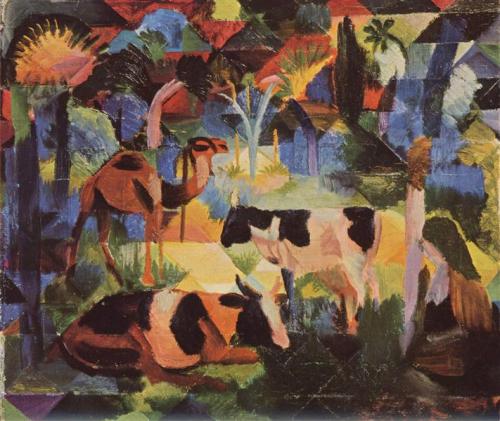
landscape-with-cows-and-a-camel.jpg!Large

    Landscape with Cows and a Camel (1914) 


               August Macke


                   ________


once Deucalion and Pyrrha had found

the way to bring humans back to life, 

it was time to turn to the creation, or

recreation, of other species


              The rest of animals, from teeming Earth
              Produc’d, in various forms receiv’d their birth. 


the rest of animals suggests that 

people were also considered to

be animals, of an however more

elevated, presumably, order


              The native moisture, in its close retreat,
              Digested by the sun’s aetherial heat,
              As in a kindly womb, began to breed: ,
              Then swell’d, and quicken’d by the vital seed. 


by means of the moisture naturally

created by the retreating flood waters, 

the native moisture, the heat of the sun, 

however aetherial, or etherial, which is 

to say of ether, which is to say invisible, 

swell[s], and quicken[s] … the vital seed

the seed which is pregnant with life, or

vital, and nurtures it, swell[s] and 

quicken[s] it, as though within a womb


              And some in less, and some in longer space, 


less, or longer space, of time


              Were ripen’d into form, and took a sev’ral face. 


different kinds of animals, animals with

sev’ral face[s], see, for instance, above

ripen’d, or evolved during longer or 

shorter periods of time, a notion that 

was decisively revisited some nearly 

two thousand years later, incidentally, 

by Charles Darwin 


              Thus when the Nile from Pharian fields is fled, 


Pharian fields, Egypt, from Pharos,

an island off the coast of Alexandria

notable for its lighthouse, itself called 

Pharos, one of the Seven Wonders of 

the Ancient World


              And seeks, with ebbing tides, his ancient bed, 


his ancient bed, the area of earth 

that the Nile had covered during 

the flood, its now exposed river 

banks


the Nile is, note, masculine here, 

his ancient bed


              The fat manure with heav’nly fire is warm’d; 


there’s the heat again


             And crusted creatures, as in wombs, are form’d; 


crusted, it is interesting to note that

apart from the animal feature of the 

womb, all of the terms to describe 

the process of coming to life refer

to plants, see also ripen’d above,

for instance, not to mention the 

vital seed


              These, when they turn the glebe, the peasants find; 


glebe, cultivated land, when the 

peasants plough their fields, they 

find [t]hese, the crusted creatures


              Some rude, and yet unfinish’d in their kind:
              Short of their limbs, a lame imperfect birth:
              One half alive; and one of lifeless earth. 


not all births are successful

              For heat, and moisture, when in bodies join’d,
              The temper that results from either kind
              Conception makes; 
 

life is the product of heat, and moisture

sparking, quicken[ing], matter, bodies, 

a succinct postulation, a metaphysical 

observation, presaging the 17th Century’s 

turn toward the natural sciences, Galileo

Isaac Newton, for instance, coming 

already, and not inaccurately, from the 

age of, at least, Julius Caesar 


it often appals me what was lost of

significant information during the

Middle, the Dark, the Annihilating,

Ages


                                             and fighting ’till they mix,
              Their mingled atoms in each other fix.
              Thus Nature’s hand the genial bed prepares
              With friendly discord, and with fruitful wars. 


generation is a struggle between 

chaos and order, at the most 

fundamental level, according to

Ovid 


              From hence the surface of the ground, with mud
              And slime besmear’d (the faeces of the flood), 


get down


              Receiv’d the rays of Heav’n: and sucking in
              The seeds of heat, 


you can hear the squelch here,

the slim[y] suction


                                             new creatures did begin:
              Some were of sev’ral sorts produc’d before,
              But of new monsters, Earth created more. 


among the new creatures, many 

had existed earlier, been already 

produc’d, but new monsters as 

well sprouted, apparently 

inescapably


              Unwillingly, but yet she brought to light
              Thee, Python too, the wondring world to fright, 


she, the Earth


Python, a mythological serpent, which

guarded Delphi, brought back to light,

or life, the wondring world to fright


              And the new nations, with so dire a sight:
              So monstrous was his bulk, so large a space
              Did his vast body, and long train embrace.
              Whom Phoebus basking on a bank espy’d; 


Phoebus, another name for Apollo

patron deity at Delphi


              E’re now the God his arrows had not try’d
              But on the trembling deer, or mountain goat; 


Phoebus had never needed to try[ ]

his arrow[ ] at anything other than 

game, trembling deer, … mountain 

goat


              At this new quarry he prepares to shoot.
              Though ev’ry shaft took place, he spent the store
              Of his full quiver; and ’twas long before
              Th’ expiring serpent wallow’d in his gore. 


it wasn’t easy


              Then, to preserve the fame of such a deed,
              For Python slain, he Pythian games decred. 


Pythian games, games installed, decreed,  

decred, to honour the slaying of the serpent


              Where noble youths for mastership shou’d strive,
              To quoit, to run, and steeds, and chariots drive. 


to quoit, to throw a ring in a game in

order to encircle at a distance a peg


              The prize was fame: in witness of renown
              An oaken garland did the victor crown. 


nothing other than a crown of oak 

leaves, an oaken garland, was the 

prize at the Pythian Games, but 

enough to assure the fame, the 

glory, of the exalted champion


              The laurel was not yet for triumphs born; 


a crown of laurel leaves, rather than 

of oak, eventually became the symbol 

of triumphs


              But every green alike by Phoebus worn,
              Did, with promiscuous grace, his flowing locks adorn. 


but until the laurel crown prevailed,

an honour associated later, notably, 

with the Ancient Greek Olympics

winners still sported with 

promiscuous grace, the green, the 

colour of Phoebus‘ chosen leaves,

in that god’s honour


later episodes of Metamorphoses

will describe the transformation of

particular people into other 

entities, trees, animals, stars, very

constellations, but for now the 

Creation is complete, the Giants’

War concluded, and the Earth 

replenished, given new life


I suspect that from now on I’ll only

intermittently comment on some 

of the stories in this extraordinary

collection, for this poem is ever as 

long as the very Bible, the only 

other Creation myth, incidentally,  

in the West, a task I expect I’ll 

follow mostly on my own, given

my admittedly idiosyncratic, often

maybe too forbidding, inclinations,

inspirations, interests


but thank you so much for having

listened in, partaken, during this, 

to my mind, fascinating exploration,

this conversation with, I think, 

enlightening, and indeed

ennobling, art


all the very best


R ! chard