Richibi’s Weblog

Just another WordPress.com weblog

“In Memoriam A. H. H.” – Alfred, Lord Tennyson

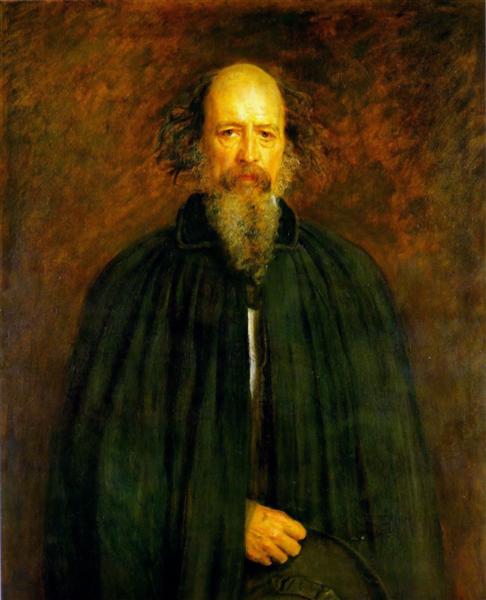
Portrait of Lord Alfred Tennyson - John Everett Millais

      Portrait of Lord Alfred Tennyson


                    John Everett Millais


                            __________


somewhere recently, this poem was recommended,

I couldn’t help but follow, maybe you’ll follow me


this first instalment is the introduction, followed by 

133 cantos, divisions in extended poetry, like 

verses


I won’t put you through 133 but, here and there, 

might comment, beyond this introductory 

passage, on some of them 


        Strong Son of God, immortal Love,

           Whom we, that have not seen thy face,

           By faith, and faith alone, embrace,

        Believing where we cannot prove;


        Thine are these orbs of light and shade;

           Thou madest Life in man and brute;

           Thou madest Death; and lo, thy foot

        Is on the skull which thou hast made.


        Thou wilt not leave us in the dust:

           Thou madest man, he knows not why,

           He thinks he was not made to die;

        And thou hast made him: thou art just.


        Thou seemest human and divine,

           The highest, holiest manhood, thou.

           Our wills are ours, we know not how;

        Our wills are ours, to make them thine.


        Our little systems have their day;

           They have their day and cease to be:

           They are but broken lights of thee,

        And thou, O Lord, art more than they.


        We have but faith: we cannot know;

           For knowledge is of things we see

           And yet we trust it comes from thee,

        A beam in darkness: let it grow.


        Let knowledge grow from more to more,

           But more of reverence in us dwell;

           That mind and soul, according well,

        May make one music as before,


        But vaster. We are fools and slight;

           We mock thee when we do not fear:

           But help thy foolish ones to bear;

        Help thy vain worlds to bear thy light.


        Forgive what seem’d my sin in me;

           What seem’d my worth since I began;

           For merit lives from man to man,

        And not from man, O Lord, to thee.


        Forgive my grief for one removed,

           Thy creature, whom I found so fair.

           I trust he lives in thee, and there

        I find him worthier to be loved.


        Forgive these wild and wandering cries,

           Confusions of a wasted youth;

           Forgive them where they fail in truth,

        And in thy wisdom make me wise.


Tennyson was reflecting on a dear friend who’d

passed away, at the age of 22, of a cerebral 

haemorrhage 


the parallels for me are resounding


R ! chard

a veritable Schubertiade, XI

The face of genius, 1926 - Rene Magritte
 

       The Face of Genius (1926)      


               René Magritte      


                     ________


in Schubert’s Piano Sonata in A major, D 959,

we hear again a ditty he’d tried out in his

earlier Piano Sonata No. 4 in  A minor, D 537,

eleven years ealier, we can hear the

evolution of a genius, see above, moving

from entertainment, merely, to something

transcendental


pay attention to the second movement of

either, though the relevant air will be

unmistakable even if you’re not paying 

too much attention, will become

miraculous before your very eyes, or

your very ears, rather


listen, enjoy


R ! chard

a veritable Schubertiade, X

Vienna, 1914 - Thomas Hart Benton

      Vienna (1914) 


            Thomas Hart Benton


                  _____________


the three great representatives of the Romantic 

Period in music are Beethoven, Schubert, both 

linked to Vienna, see above, and Chopin, in the

other musical capital at the time, Paris


their basis is Classical, the rules set up by 

Mozart and Haydn, tonality, tempo, and 

repetition, which all of them rigorously 

obey


Schubert wrote no concertos, Chopin wrote

no symphonies, Beethoven wrote for everything,

they all, in other words, had their particular lanes


Beethoven and Schubert, however, both Viennese, 

see above, sound strikingly similar


here, in his Piano Sonata No 19 D 958 in C minor,

Schubert, at the very height of his powers,

technically, musically, aesthetically, incorporates,

miraculously, the spirits of both Beethoven, his 

predecessor, and Mozart, Beethoven’s 

predecessor, transforms them into something 

like their accumulated gift to the world, a child

of their coordination, their lineage


listen


R ! chard

a veritable Schubertiade, IX

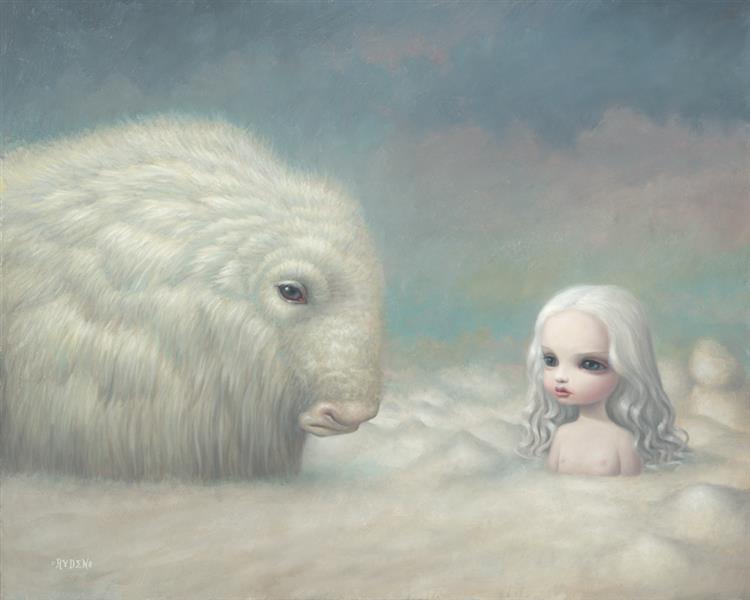
Heaven, 2008 - Mark Ryden
 

     Heaven (2008) 


          Mark Ryden


              _______


by the time of his Piano Sonata in G major, 

D 894, October, 1826, Schubert would’ve 

known he was about to die, he was 29, 

he would die two years later, November, 

1828, you can hear it, his encounter with 

Heaven


this is not merely entertainment, this is

contemplation, a description of what he’s 

seen at the Celestial Gates, you can 

actually hear the stars twinkle in their 

great expanse of infinity from the very 

first movement


later, dance rhythms suggest an embrace, 

an embrace as a symbol of acknowledgment, 

acquiescence, acceptance, welcome, into 

the Beyond, whatever you might want to 

call it


Beethoven confronts God, Schubert describes 

his personal death experience


but that’s not one, but a couple of other stories


meanwhile, listen


R ! chard

a veritable Schubertiade, VIII

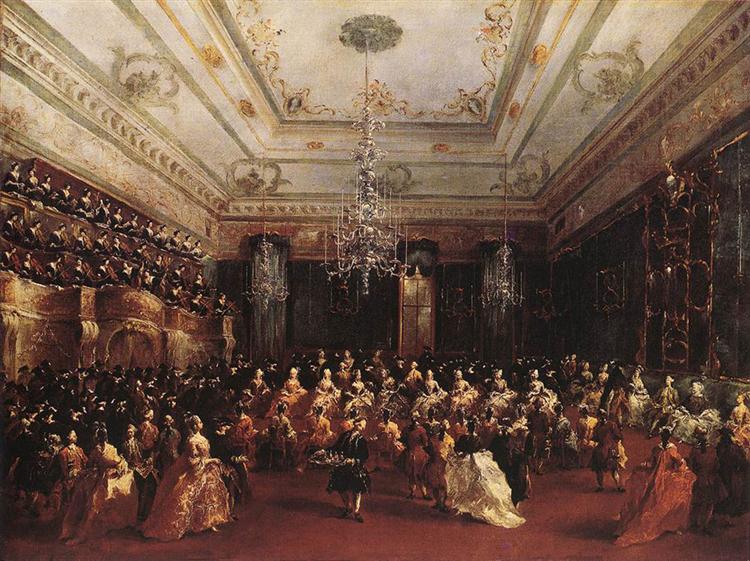
Ladies Concert at the Philharmonic Hall, 1782 - Francesco Guardi

      Ladies Concert at the Philharmonic Hall” (1782) 


                  Francesco Guardi


                         _________


Schubert’s Piano Sonata in B major, D. 575

is an early work, he was twenty, still under 

the influence of Mozart, which is to say, 

tonality, tempo and repetition, but impacted,

decidedly, by Beethoven, who’d just 

transformed Classicism, the art of the 

courts, see above, into Romanticism, the

art of the people, music had to now not

only  entertain, but matter


listen, enjoy


R ! chard

a veritable Schubertiade, VII

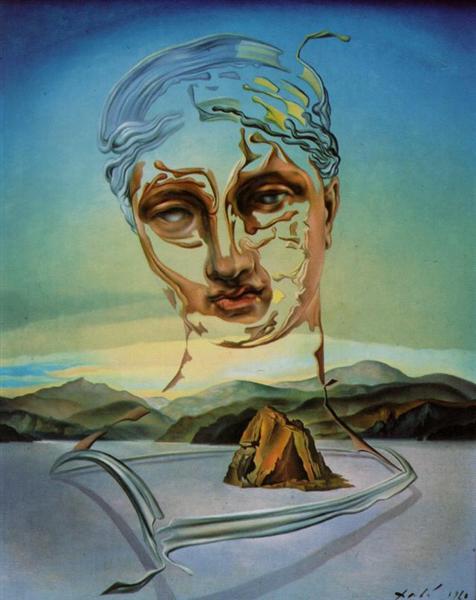
Birth of a Divinity, 1960 - Salvador Dali

  “Birth of a Divinity (1960)  


            Salvador Dali


                  ______


during the third evening of recitals, the 

program, to my surprise, starts with a 

work even earlier than the earliest 

one we’ve heard yet in this 

Schubertiade, his D 568, his Seventh


Schubert’s Piano Sonata No. 4 in 

A minor, D 537, was written when 

he was seventeen, he would’ve 

been, and was, steeped in Mozart, 

music to amuse musical coteries


but at the start of the second movement,

I heard an air I’d heard somewhere

before, it turned out to be the seed of

a magical part in one of his later

transcendental pieces


Schubert was already imbued with his 

divinity, see above, you can hear it, 

listen


R ! chard


a veritable Schubertiade, VI

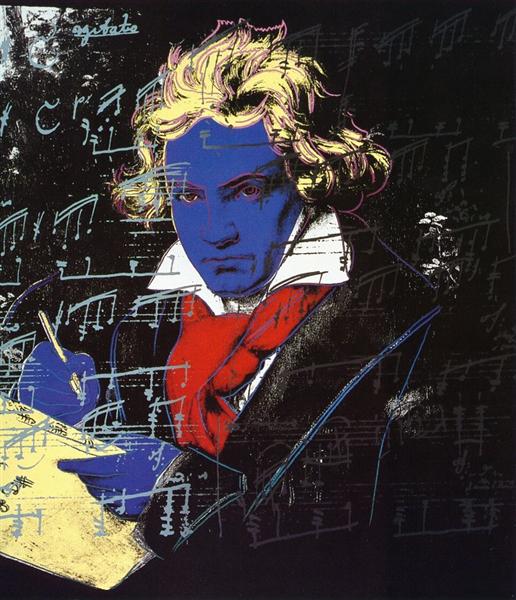
Beethoven, 1987 - Andy Warhol


     “Beethoven (1987) 


           Andy Warhol


               ________


by this time, in his Piano Sonata in A minor, 

D 845, Schubert has accumulated so much 

Beethoven that his Beethoven is beginning 

to shine through in his own compositions, 

Beethoven was a forefather, still present, 

it’s often difficult to tell one, indeed, from 

the other, even here


Beethoven, see above, punched through

Classicism – Mozart, Haydn – its artificiality,

delivering emotion, instinctively, from the

very start, from which he nearly

single-handedly delivered to the world no

less than Romanticism, like delivering the 

recalibration of time and space after 

Einstein essentially, so profound a 

cultural metaphysical reorganization


Schubert remains ever more courteous,

more beholden to the upper crust that

supports him, and that he ever wants to 

court, you can hear it, listen, there is no 

confrontation here, just, dare I say,

entertainment


Schubert was not a revolutionary


R ! chard


a veritable Schubertiade, V

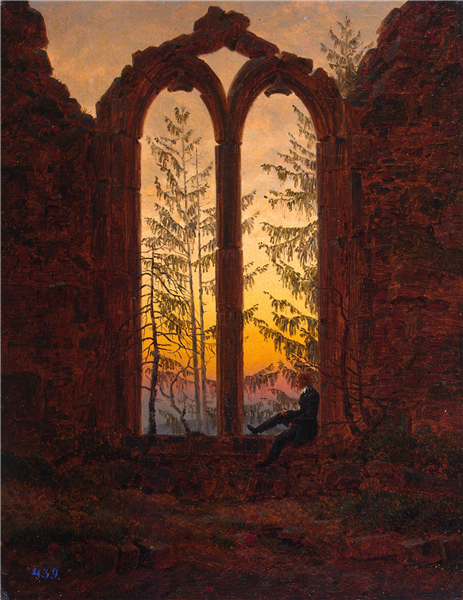
The dreamer, 1820 - 1840 - Caspar David Friedrich

       The Dreamer (1820 – 1840) 


            Caspar David Friedrich


                 ______________


from the start, in his Piano Sonata in C major, D 840,

Schubert is steeped in Mozart, the exhilaration, the 

fantasy, not surprisingly, Mozart is Schubert’s 

motherland, the courts, the salons, the chamber 

music, in Schubert’s day, aristocrats still sponsored, 

to a great degree, the arts


but soon the Romantic impulse takes hold, the

introduction of melancholy into the mix, rather 

than sang froid, artifice, merely, Schubert has 

imbibed, to supplement his manifest technical 

agilities, the temper of the times, Schubert is 

moving his cultural world forward, into 

Romanticism, see above


there are only two movements in his D 840,

there are sketches of its third and fourth

movements, but Schubert had abandoned

them, the sonata, unfinished, was only 

published after he died, profoundly worthy

still, if truncated


what do you think


listen


R ! chard

a veritable Schubertiade, IV

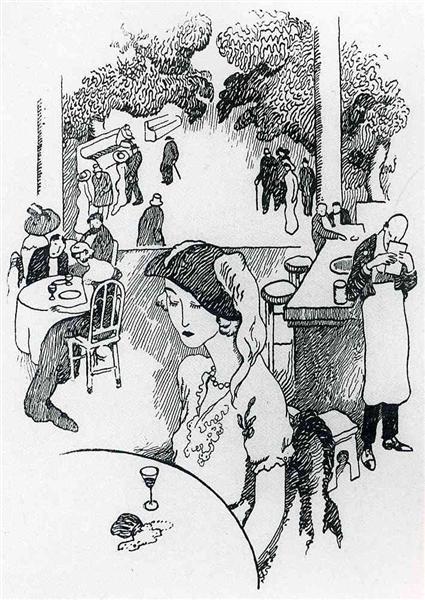
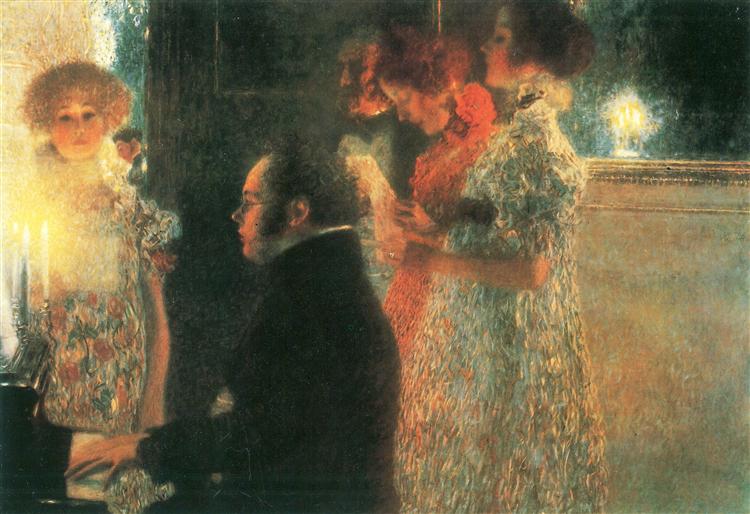
Schubert at the Piano II, 1899 - Gustav Klimt

    Schubert at the Piano II (1899)


                 Gustav Klimt 


                       ______


for the second evening of Schubert sonatas

during my May Schubertiade, it wouldn’t be

surprising to hear again an early work, 1819, 

Schubert would’ve been 22, the series is 

undoubtedly and necessarily somewhat 

chronological


his Piano Sonata in A major, D 664, is 

blatantly anchored in the Classical idiom,

you can hear Mozart all over the place, not 

all pejoratively, Mozart is effervescent, full

of exuberance and creativity, Schubert

diligently follows


but Romanticism equals intimacy, poignancy, 

which Schubert touches upon in his andante, 

the second movement, to a degree not yet 

as markedly as, for instance, Chopin yet,

famous for his sweeping Romanticism, but

still convincing and promising


the third movement, the allegro, is right back 

at Mozart, to delight the aristocracy, his 

essential audience, see above


listen


R ! chard


a veritable Schubertiade, III

Impression, sunrise, 1872 - Claude Monet


     Impression, Sunrise (1872) 


               Claude Monet


                   ________


what struck me most about Schubert’s Piano 

Sonata no. 17 in D major, his D850, was, more

than its emotional impact, its technical

wizardry, from the start Schubert dazzles with 

his prestidigitation, his manual dexterity, the

notes fly


there’s a lot of Beethoven in this composition,

working against the beat, apart from the fourth 

movement, the rondo, Schubert is being 

unequivocally Beethoven


the fourth movement is, incidentally, utter 

Mozart, you can tell from the preponderance

of trills


texture, meanwhile, overcoming melody, 

in, most notably, the third movement, is 

right out of Chopin, his Winter Winds 

for instance, an inspired combination

of both melody and texture, where is

the supremacy of either, listen, you tell 

me, do the Winds conquer the groans, 

the tribulations, of the underlying melody, 

the left hand, the low notes, the chthonic, 

the earth, or does the dexterousness of 

the right hand, the ephemeral, the 

transitory, win the day


texture will overcome melody eventually, 

as the century moves along, Impressionism 

will prioritize perspective over emotion, the 

head over the heart, Debussy, among 

others, Renoir, Monet, Pissaro, will 

dominate, see above,  but that’s another

story


meanwhile Schubert


listen


R ! chard