Richibi’s Weblog
Just another WordPress.com weblog
Tag: Jove / Jupiter / Zeus
November 22, 2020
“Europa’s Rape” (ll) – Ovid
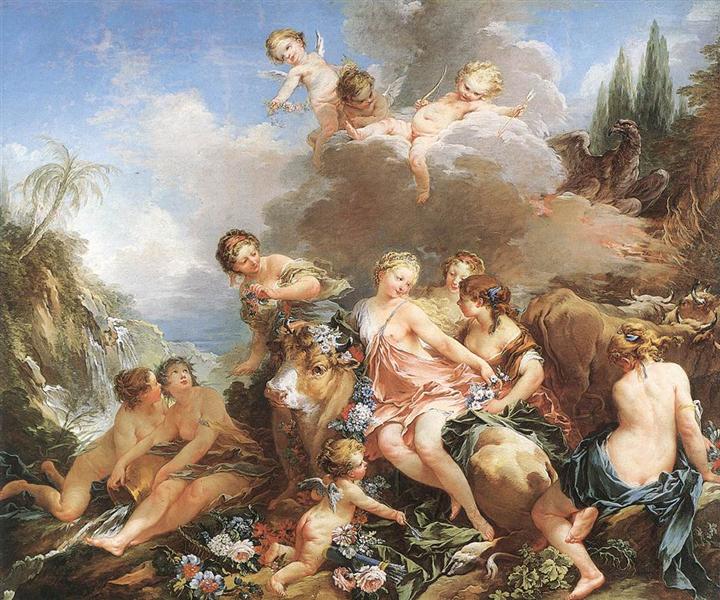
“The Rape of Europa” (c.1732 – 1734)
François Boucher
___________
Agenor’s royal daughter, as she plaid
Among the fields, the milk-white bull survey’d,
Agenor, king of Tyre, in Phoenicia,
an area comprised then of ancient
Lebanon, as well as a good part of
the Eastern, and later, the Southern,
which is to say the African,
Mediterranean coasts, father of,
notably, Europa, his royal, his
indeed mythic, daughter
And view’d his spotless body with delight,
And at a distance kept him in her sight.
Europa is intrigued, delight[ed], by this
milk-white …spotless …bull, but from
a distance, discreetly, furtively
At length she pluck’d the rising flow’rs, and fed
The gentle beast, and fondly stroak’d his head.
pluck’d, dared, mischievously, to
confront
the rising flowers, offering [their] cup
to the sun
He stood well-pleas’d to touch the charming fair,
But hardly could confine his pleasure there.
And now he wantons o’er the neighb’ring strand,
Now rowls his body on the yellow sand;
to wanton, to play, to frolic, often
immodestly, like puppies, goats
strand, shore
rowls, rolls
And, now perceiving all her fears decay’d,
decay’d, dispelled, dissipated,
evaporated
Comes tossing forward to the royal maid;
Gives her his breast to stroke, and downward turns
His grizly brow, and gently stoops his horns.
grizly, grizzly, grayish
In flow’ry wreaths the royal virgin drest
drest, adorned
His bending horns, and kindly clapt his breast.
‘Till now grown wanton and devoid of fear,
Not knowing that she prest the Thunderer,
the Thunderer, Jove / Jupiter / Zeus
She plac’d her self upon his back, and rode
O’er fields and meadows, seated on the God.
however heedlessly, however
immoderately, immodestly,
however innocently
see above
He gently march’d along, and by degrees
Left the dry meadow, and approach’d the seas;
Where now he dips his hoofs and wets his thighs,
Now plunges in, and carries off the prize.
The frighted nymph looks backward on the shoar,
shoar, shore
And hears the tumbling billows round her roar;
But still she holds him fast: one hand is born
born, borne, held
Upon his back; the other grasps a horn:
Her train of ruffling garments flies behind,
Swells in the air, and hovers in the wind.
see here also for a more windswept
picture of Europa, more in keeping
with the last few lines
Through storms and tempests he the virgin bore,
And lands her safe on the Dictean shore;
Dictean, of Dicte, or Dikti, a mountain
range in Eastern Crete, site of the
Diktaion Antron, or Dictaean Cave,
the place where Jove / Jupiter / Zeus
was apparently born, if it wasn’t the
Idaean Cave, which is to say a cave on
Mount Ida, therefore Idaean, also in
Crete, both hollows having claimed
the right to be called the site of the
exalted provenance
Where now, in his divinest form array’d,
In his true shape he captivates the maid;
Jove / Jupiter / Zeus manifest, no
longer bull, but divinity, dripping
still in bovine potency, however
residual
Who gazes on him, and with wond’ring eyes
Beholds the new majestick figure rise,
His glowing features, and celestial light,
And all the God discover’d to her sight.
once, to a man who’d bewitched me,
how could you touch me, I wrote, you
must’ve known you would transfix me,
leave me breathless, which he,
however inadvertently, had, did
I went on, of course, to not populate
continents, nor to become queen of
Crete, but was Europa, in that
instance, before my own exalted
entity
R ! chard
November 15, 2020
“Europa’s Rape” – Ovid
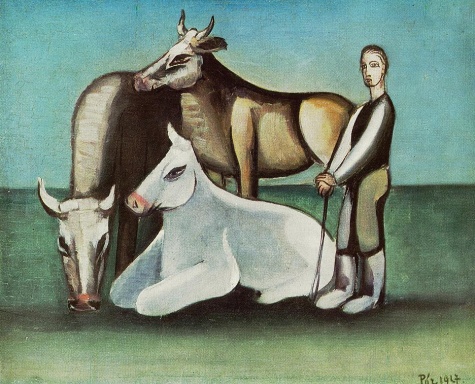
“Bulls” (1948)
Bertalan Por
____
though I’d heard, indeed, of the rape of
Europa, I wasn’t aware, I’d thought, of
the details, was loathe, therefore, to
read on, in the next segment of Ovid’s
Metamorphoses, having been earlier
put off by such incidents in that text
as it turned out, Europa isn’t raped,
but, rather, abducted, more or less
willingly, however innocently, by
Jove / Jupiter / Zeus, and will even,
later, consensually, bear his children
who will then migrate, from their base
in Crete, to populate, to people, the
continent which we’ll come to know
as Europe, after their mum
but that’s a whole other story
meanwhile
When now the God his fury had allay’d,
And taken vengeance of the stubborn maid,
From where the bright Athenian turrets rise
He mounts aloft, and re-ascends the skies.
the God, Hermes / Mercury, if you’ll
remember, had just transformed
Aglauros, the stubborn maid, into a
statue for having been impudent
with him, and mounts aloft now,
re-ascends the skies over Athens,
where the damsel had lived
Jove saw him enter the sublime abodes,
the sublime abodes, Olympus,
home of the gods
And, as he mix’d among the crowd of Gods,
Beckon’d him out, and drew him from the rest,
And in soft whispers thus his will exprest.
Jove / Jupiter / Zeus wants something
from Hermes / Mercury
“My trusty Hermes, by whose ready aid
Thy sire’s commands are through the world convey’d.
sire, Jove / Jupiter / Zeus is the father
of Hermes / Mercury, his sire
Hermes / Mercury, the messenger god,
patron of travellers, heralds, newscasters,
those who convey information
through[out] the world
Resume thy wings, exert their utmost force,
And to the walls of Sidon speed thy course;
Sidon, a city still in Lebanon
There find a herd of heifers wand’ring o’er
The neighb’ring hill, and drive ’em to the shore.”
Thus spoke the God, concealing his intent.
Jove / Jupiter / Zeus, the God, has
an ulterior motive, a conceal[ed] …
intent
The trusty Hermes, on his message went,
And found the herd of heifers wand’ring o’er
A neighb’ring hill, and drove ’em to the shore;
mission accomplished
Where the king’s daughter, with a lovely train
Of fellow-nymphs, was sporting on the plain.
the conceal[ed] …intent is exposed,
Jove / Jupiter / Zeus, in character,
is on the prowl
The dignity of empire laid aside,
(For love but ill agrees with kingly pride)
power, empire, will not abide being
deprived, we’ve seen ample examples
of that in our, even most recent, past
The ruler of the skies, the thund’ring God,
Who shakes the world’s foundations with a nod,
Jove / Jupiter, Zeus, god, remember,
of Thunder
Among a herd of lowing heifers ran,
Frisk’d in a bull, and bellow’d o’er the plain.
Frisk’d, accoutered, dressed up as,
in the guise of, a bull
Large rowles of fat about his shoulders clung,
rowles, rolls
And from his neck the double dewlap hung.
dewlap, a looseflap of skin hanging
from the throat of some animals, or
birds, cattle, for instance, turkeys,
a wattle
His skin was whiter than the snow
see above
that lies
Unsully’d by the breath of southern skies;
a breath of southern skies would
melt away white snow, revealing,
fatefully, ignominiously, patches
of [ ]sully’d earth
Small shining horns on his curl’d forehead stand,
As turn’d and polish’d by the work-man’s hand;
His eye-balls rowl’d, not formidably bright,
rowl’d, rolled
But gaz’d and languish’d with a gentle light.
as in doe eyes
His ev’ry look was peaceful, and exprest
The softness of the lover in the beast.
a wolf, if here a bull, in
sheep’s clothing
stay tuned
R ! chard
August 23, 2020
“The Story of Calisto” – Ovid
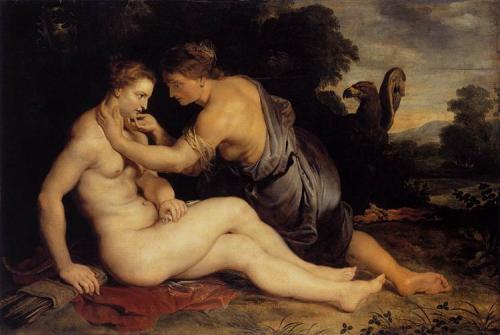
“Jupiter and Callisto“ (1611 – 1613)
Peter Paul Rubens
___________
after having read Homer’s Iliad, the
greatest work of fiction, to my mind,
ever told, resounding through the
centuries and millennia with power,
pathos, and profound humanity, I
found it hard for one reason or
another to complete other
acclaimed epics, Virgil’s Aeneid,
for instance, too brimming with
bombast and bravado, much like
many American war movies,
wherein the Americans win every
conflict, whether or not they’ve
indeed won, all on their own, with
little acknowledgment of the other
international militaries that might’ve
also played essential roles
Ovid’s Metamorphoses, as I read
on, is becoming more and more
offensive because of its recurrent
abuse of women, nymphs, virgins,
so that I can no longer champion
this work, however enthusiastic I
might’ve been at the beginning
I’m not ready to personally give it
up, but intend to relate it in brief
segments, with perhaps, here
and there, noteworthy verses
the myth that follows the
transformation of Cycnus into
a swan, and the restoration of
Earth after its near conflagration
upon the death of Phaeton, has
Jove / Jupiter / Zeus cast[ing]
an eye on ev’ry diff’rent coast in
order to ensure that all is aright,
which it is, and Nature smiles
again
but he spies by chance a nymph,
a follower of Diana, virginal
goddess of the Countryside, and
despite concerns about Juno, his
goddess wife, pursues the maiden
who was easy prey, did whate’er a
virgin cou’d … / With all her might
against his force … / But how can
mortal maids contend with Jove?
following which Diana arrives with
her train of nubile followers, to the
dismay of the young victim, who
could only try to hide her shame,
which her altered demeanour
must’ve somewhat, it is supposed,
uncovered
How in the look does conscious guilt appear!
Slowly she mov’d, and loiter’d in the rear;
Nor lightly tripp’d, nor by the Goddess ran,
As once she us’d, the foremost of the train.
but now the moon had nine times
lost her light, and any doubt about
her condition was erased, so that
Diana, unforgiving, a not uncommon
reaction, I’ve found, among women,
banished her to eventually alone
give birth to a son
meanwhile Juno, now doubly
incensed – This boy, she rails, shall
stand a living mark, to prove / My
husband’s baseness and the strumpet’s
love – turns the wretched mom into a
bear
but when the son had fifteen summers
told, and came inadvertently upon this
beast while in the forest, unaware it was
his mother, and to protect himself, he
aim’d a pointed arrow at her breast,
And would have slain his mother in the beast;
But Jove forbad, and snatch’d ’em through
In whirlwinds up to Heav’n, and fix’d ’em there!
where now we know them as either
the Great Bear and the Little Bear,
Ursa Major and Ursa Minor or,
more familiarly, as the Big Dipper
and the Little Dipper
who could ‘a’ ever thunk it
R ! chard
June 17, 2020
The Transformation of Syrinx into Reeds
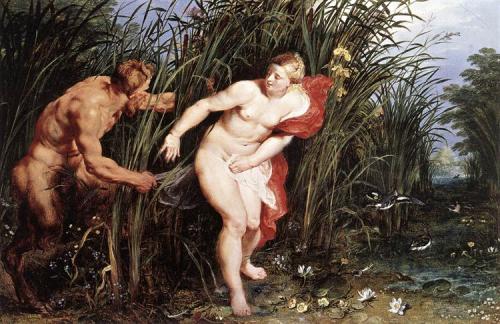
“Pan and Syrinx“ (1617 – 1619)
Peter Paul Rubens
__________
Then Hermes thus:
Hermes, messenger of the gods,
addresses Argus, keeper of Io,
who’s been transformed by Jove,
god of gods, into a heifer, though
she remains daughter, ever, of
Inachus, river god, to tell the
story of his rare, beguiling reeds
A nymph of late there was
Whose heav’nly form her fellows did surpass.
here we go again with nymphs,
beautiful, irresistible, however
ever innocent, prey, due, indeed,
to their very beauty, their very
innocence, to lustful, inordinate
desires, in these instances,
markedly divine
deities, I point out again, make
up their own rules
The pride and joy of fair Arcadia’s plains,
Arcadia, apart from being an
actual area of Greece, is also
the ideal, in our historical
imagination, of an utopia,
much as is the lost island of
Atlantis
Belov’d by deities, ador’d by swains:
Syrinx her name, by Sylvans oft pursu’d,
Sylvans, could only be, though
I’ve been unable to find actual
confirmation of my opinion,
wood spirits, forest entities,
satyrs, goat men, and such
As oft she did the lustful Gods delude:
Syrinx could often, or oft, delude,
or fool, ward off, the lustful Gods
The rural, and the woodland Pow’rs disdain’d;
satyr yourself, Syrinx would’ve
impudently taunted
With Cynthia hunted, and her rites maintain’d:
Like Phoebe clad, even Phoebe’s self she seems,
Cynthia, is Phoebe, both also known
as Diana, goddess of the Hunt, you’ll
remember Phoebe / Diana from her
connection to Daphne, who earlier
here was transformed into a laurel
Syrinx sounds an awful lot, incidentally,
like another version of Daphne
So tall, so streight, such well-proportion’d limbs:
The nicest eye did no distinction know,
But that the goddess bore a golden bow:
the only difference between Syrinx
and Cynthia / Phoebe / Diana was
that Syrinx didn’t have, bear, a
golden bow
Distinguish’d thus, the sight she cheated too.
had she borne a golden bow, Syrinx,
[d]istinguish’d thus, would’ve cheated
the sight, looked identical, to the
beautiful, it is inferred, goddess
Descending from Lycaeus, Pan admires
The matchless nymph, and burns with new desires.
Pan, god of the wild, woodlands
Lycaeus, Latin spelling of Lykaion,
is a mountain in Arcadia
A crown of pine upon his head he wore;
And thus began her pity to implore.
But e’er he thus began, she took her flight
So swift, she was already out of sight.
Nor stay’d to hear the courtship of the God;
But bent her course to Ladon’s gentle flood:
Ladon, a river in Arcadia
flood, rushing, though gentl[y],
water, rhymes in the preceding
verse, you’ll note, with God
There by the river stopt, and tir’d before;
Relief from water nymphs her pray’rs implore.
Syrinx, once by the river stopt, seeks
the help of, assistance, [r]elief from,
the nearby water nymphs, her
consorts
Now while the lustful God, with speedy pace,
Just thought to strain her in a strict embrace,
Pan, like Phoebus / Apollo, or
Jove / Jupiter / Zeus before him,
is, as well, and characteristically,
a lustful God
He fill’d his arms with reeds, new rising on the place.
And while he sighs, his ill success to find,
his ill success, his thwarted,
ineffective, enterprise
The tender canes were shaken by the wind;
And breath’d a mournful air, unheard before;
the reeds that Pan gathered in his arms,
shaken by the wind, create a mournful
air, a melancholy music
That much surprizing Pan, yet pleas’d him more.
though Pan might’ve been much
surpriz[ed] by the sorrowful sounds
he heard, he was more pleas’d by
them than startled
Admiring this new musick, Thou, he said,
Who canst not be the partner of my bed,
At least shall be the confort of my mind:
Thou, Syrinx
And often, often to my lips be joyn’d.
in a kiss of consolation
He form’d the reeds, proportion’d as they are,
Unequal in their length, and wax’d with care,
They still retain the name of his ungrateful fair.
the instrument Pan devised from
the tender canes he fashioned
from the unaccommodating reeds,
what we now name the Pan flute,
was called in Ancient Greece a
syrinx, in honour of the
recalcitrant nymph
listen, coincidentally, to Debussy
tell the story, for solo flute,
however, which is to say, on a
modern instrument, for our having
long ago abandoned at a
professional level the original pipe,
though it remains, apparently, as a
folk instrument in more agrarian,
communities around the world, for
shepherds, one would imagine, to
while away the hours while tending
to their, however wayward, sheep
R ! chard
June 6, 2020
“The Transformation of Io into a Heyfer” (II) – Ovid

“Juno, Jupiter and Io“ (1672)
Gerbrand van den Eeckhout
________________
we left Inachus in my last instalment
looking for his daughter, Io
Her, just returning from her father’s brook,
Her, Io
Jove had beheld, with a desiring look:
the sentence structure, as it’s been
crafted in the verses above, has
been an aspect of Ovid’s poem for
some time, though, it must again
be noted, as translated by John
Dryden, the subject goes where
the object should go, the sentence
is inverted
the sentence should be, Jove had
beheld her, … just returning from
her father’s brook
but the placement of Her at the
top of the sentence, and even
capitalized, is, you must admit,
arresting, and of the highest
poetic order
And, Oh fair daughter of the flood, he said,
the flood, the many rivers that came
to comfort Inachus, their sovereign,
in his distress at having lost Io, his
daughter, their many surging
confluences would’ve created
overflowing torrents, the flood
Worthy alone of Jove’s imperial bed,
Jove thinks Io worthy of no one
else’s mattress but his own
Happy whoever shall those charms possess;
The king of Gods (nor is thy lover less)
Invites thee to yon cooler shades; to shun
The scorching rays of the meridian sun.
whoever might partake of her charms,
Jove tells Io, would be Happy
again an inverted sentence, note
but Jove makes his play, flashes
his pedigree,The king of Gods,
nothing less, and invites her to a
shady grove, out of the noonday,
the meridian, sun
Nor shalt thou tempt the dangers of the grove
Alone, without a guide; thy guide is Jove.
Jove / Jupiter, god of gods
No puny Pow’r, but he whose high command
Is unconfin’d,
Jove / Jupiter is not a nobody, but,
rather, unconfin’d, omnipotent,
he boasts
who rules the seas and land;
And tempers thunder in his awful hand,
Jove / Jupiter, supreme master of
the elements
Oh fly not:
Jove urges Io
for she fled from his embrace
O’er Lerna’s pastures:
Lerna, a region of Ancient Greece
he pursu’d the chace
Along the shades of the Lyrcaean plain;
Lyrcaean, after some investigation,
seems to mean from Lycaeus, the
Latin name for Lykaion, a mountain
in Greece, considered by some to
be the birthplace of Jove / Jupiter /
Zeus
otherwise, but very improbably, the
Lyrcaean plain is a literary invention,
of Ovid, or of his translator, Dryden
At length the God, who never asks in vain,
Involv’d with vapours, imitating night,
Both Air, and Earth;
Inform’d with, having transformed
himself into, vapours, a mist,
imitating night, shrouding [b]oth
Air and Earth in darkness,
becoming himself, therefore,
indistinct, indefinite, nebulous,
within them
and then suppress’d her flight,
And mingling force with love, enjoy’d the full delight.
first of all Phoebus / Apollo‘s pursuit
of Daphne, and now Jove / Jupiter‘s
constraint of Io, are not admirable
aspects of male deities, indeed in
our age of action against the
harassment of women, their
behaviour is disturbing, uncomfortable
for me even to read, I’m too reminded
of dissolute American CEOs, not to
mention presidents, but concluding
that this dilemma has been around
for countless ages among vertebrates,
be they animal, human, or, as in these
instances, divine, therefore written in
our antediluvian, our primeval, genes,
maybe, consequently, ineradicably
Mean-time the jealous Juno, from on high,
Juno, goddess of goddesses, wife
of Jupiter / Jove
Survey’d the fruitful fields of Arcady;
Arcady, or Arcadia, a region still
of Greece
And wonder’d that the mist shou’d over-run
The face of day-light, and obscure the sun.
which is to say, Juno, suspicious,
asks herself, what’s up with that
No nat’ral cause she found, from brooks, or bogs,
Or marshy lowlands, to produce the fogs;
she reckons
Then round the skies she sought for Jupiter,
Her faithless husband; but no Jove was there:
Juno knows her Jove / Jupiter
Suspecting now the worst, Or I, she said,
Am much mistaken, or am much betray’d.
it’s one of two things, Juno figures,
after [s]uspecting … the worst, I am
myself in error, she concludes, I am
myself mistaken , or am, by my
husband, much betray’d
With fury she precipitates her flight:
her flight, her plan of action, both
geographical, and tactical
Dispels the shadows of dissembled night;
dissembled, sham, not actual, Jove /
Jupiter, if you’ll remember, Involv’d
with vapours, was imitating night,
not easily visible
And to the day restores his native light.
note that day is masculine here,
his native light
Th’ Almighty Leacher, careful to prevent
The consequence, foreseeing her descent,
Transforms his mistress in a trice; and now
In Io’s place appears a lovely cow.
Leacher, lecher
in a trice, very quickly, in the bat
of an eyelash
a cow
see above
So sleek her skin, so faultless was her make,
Ev’n Juno did unwilling pleasure take
To see so fair a rival of her love;
though transformed into a cow, Io
remains lovely, even Juno can see
that, however be she jealous
And what she was, and whence, enquir’d of Jove:
where did you get that, Juno asks
of Jove, surely dryly
Of what fair herd, and from what pedigree?
and what, and when, and how, she
further inquires, probably acidly
The God, half caught, was forc’d upon a lye:
And said she sprung from Earth.
Jove, who’d had to tell a lye, a lie,
said that the heifer, the altered Io,
had sprung, spontaneously, he
claimed, from the earth
She took the word,
Juno accepted Jove‘s explanation
And begg’d the beauteous heyfer of her lord.
Juno asks of Jove that she might
keep the heyfer for herself, the
heifer, a virgin cow
What should he do? ’twas equal shame to Jove
Or to relinquish, or betray his love:
Yet to refuse so slight a gift, wou’d be
But more t’ increase his consort’s jealousie:
Jove / Jupiter was in a bind, to
out Io, or to out himself
Thus fear, and love, by turns, his heart assail’d;
And stronger love had sure, at length, prevail’d:
But some faint hope remain’d, his jealous queen
Had not the mistress through the heyfer seen.
if it weren’t for the fact that Juno
maybe, some faint hope, might
not have recognized Io in the
heifer, Jove / Jupiter would’ve,
had sure, eventually, at length,
confessed to his indiscretion, his
stronger love, having prevail’d
The cautious Goddess, of her gift possest,
Yet harbour’d anxious thoughts within her breast;
As she who knew the falshood of her Jove;
though Juno has been granted her
request, she remains sceptical,
knew her husband was prone to
falshood, or falsehood
And justly fear’d some new relapse of love.
justly, the facts would bear her out,
were she cognizant of them
Which to prevent, and to secure her care,
To trusty Argus she commits the fair.
Argus Panoptes, one of the giants
who must’ve remained after their
war
Panoptes, pan optes, Greek for many
eyes, of which only a few, it came to
be believed, of Juno‘s entrusted
guardian, slept at a time
to be continued
R ! chard
May 26, 2020
“The Transformation of Daphne into a Lawrel” (II) – Ovid
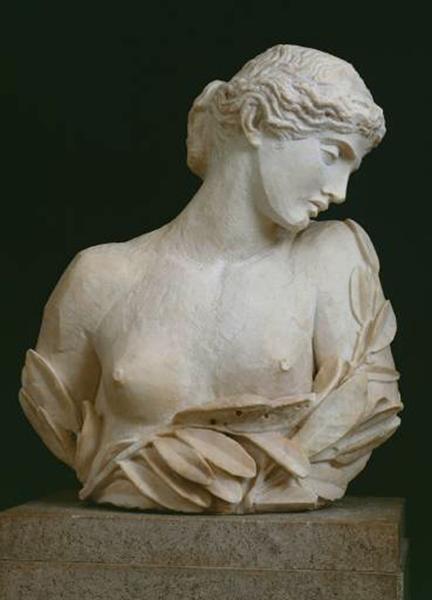
“Daphne” (1879 – 1892)
George Frederick Watts
__________
The God of light, aspiring to her bed,
The God of light, Phoebus, whose
name, incidentally, finds its roots
in the Greek word for shining,
which I won’t inscribe here for its
being not only in another language,
but also of a different alphabet
Phoebus, also known as Apollo,
was not only god of Light, but
too, god of the Sun, as well as of
several other things that brought
clarity, his shrine at Delphi, for
instance, was famed for providing
oracles, intelligibility in the face of
confusion, however cryptic the
actual words of the presiding
sybil commonly were
Hopes what he seeks, with flattering fancies fed;
Phoebus [h]opes, indeed trusts,
that feeding Daphne flattering
fancies will do the trick
And is, by his own oracles, mis-led.
even his oracles, his sybils, his
priestesses, in this circumstance,
fail him
And as in empty fields the stubble burns,
stubble, what’s left of the shaft once
the grain has been removed,
harvested
Or nightly travellers, when day returns,
Their useless torches on dry hedges throw,
That catch the flames, and kindle all the row;
now that day has arrived, the nightly
travellers‘ otherwise useless torches
can serve to kindle, ignite, and burn
off, the rows of slowly smouldering
stubble
So burns the God, consuming in desire,
Phoebus is similarly, [s]o, kindled,
burns with a desire [s]o, as,
consuming
And feeding in his breast a fruitless fire:
the fire, the desire, however, remains
in his breast … fruitless, unabated,
unquenched
Her well-turn’d neck he view’d (her neck was bare)
And on her shoulders her dishevel’d hair;
Daphne‘s hair would’ve been
dishevel’d, undone, during her
flight, by the wind
Oh were it comb’d, said he, with what a grace
Wou’d every waving curl become her face!
Phoebus begins to idealize her
He view’d her eyes, like heav’nly lamps that shone,
He view’d her lips, too sweet to view alone,
Her taper fingers, and her panting breast;
see above
He praises all he sees,
his flattering fancies at work
and for the rest
Believes the beauties yet unseen are best:
Phoebus has no intention of enjoying
merely what Daphne cannot but allow,
her beauties yet unseen, he believes,
are best, are preferable
ahem
Swift as the wind, the damsel fled away,
Nor did for these alluring speeches stay:
alluring speeches, flattering fancies
Stay Nymph, he cry’d, I follow, not a foe.
a nymph, a nature spirit in the form
of a maiden, imagined frolicking by
rivers, or woods
Phoebus calls her by this metonym,
Nymph, probably because he doesn’t
yet know her proper name
a metonym is the word for a part
which signifies the whole, the pen,
for instance, is mightier than the
sword, where the pen stands for
all that is written, and the sword
represents the much larger
concept of war
Nymph, therefore, to metonymize,
to stand in for, any nymph
Stay Nymph, Phoebus cries, I follow,
I don’t lead, I am not coercing you,
you are in charge, I am not a foe,
not an enemy
Thus from the lyon trips the trembling doe;
Thus from the wolf the frighten’d lamb removes,
And, from pursuing faulcons, fearful doves;
prey flee predators [t]hus, Phoebus
explains, which is to say in the
manner that you’re behaving
Thou shunn’st a God, and shunn’st a God, that loves.
but I am not a predator, I am a God,
a God who loves you, who is in love,
he concedes
Ah, lest some thorn shou’d pierce thy tender foot,
Or thou shou’dst fall in flying my pursuit!
To sharp uneven ways thy steps decline;
Abate thy speed,
slow down, he says, Abate thy speed,
you might hurt yourself, you might
pierce thy tender foot, fall, your path
decline[s], is becoming treacherous,
less secure, sharp uneven ways lie
ahead
and I will bate of mine.
bate, opposite of abate, don’t you
love it
Yet think from whom thou dost so rashly fly;
Nor basely born, nor shepherd’s swain am I.
I carry a big stick, Phoebus says, think
about it
Perhaps thou know’st not my superior state;
And from that ignorance proceeds thy hate.
maybe you haven’t recognized me
Me Claros, Delphi, Tenedos obey;
Claros, an ancient Greek sanctuary,
site of another oracle of Phoebus /
Apollo, along with Delphi, the
principal shrine
Tenedos, an island off the coast of
modern Turkey, but under the
dominion then also of the deity
These hands the Patareian scepter sway.
scepter, a staff symbolic of sovereignty
but I’ve found no source at all for the
indecipherable Patareian, forgive me
The King of Gods begot me:
I am the son, Phoebus proclaims, of
Jove / Jupiter / Zeus, depending on
the local vocabulary
what shall be,
Or is, or ever was, in Fate, I see.
Phoebus, like all the gods, sees
everything, past, present, and
future
Mine is th’ invention of the charming lyre;
the lyre, an ancient musical instrument
often associated with Phoebus /Apollo
Sweet notes, and heav’nly numbers, I inspire.
Phoebus / Apollo was also god,
among many other things, of
Music
Sure is my bow, unerring is my dart;
But ah! more deadly his, who pierc’d my heart.
Phoebus has ceded to Cupid, and
acknowledges the superiority of
the stripling‘s, the youth’s, sting
Med’cine is mine; what herbs and simples grow
In fields, and forrests, all their pow’rs I know;
Phoebus / Apollo is also god of
Healing
And am the great physician call’d, below.
that Phoebus / Apollo is god of
Healing is acknowledged below,
which is to say among earthlings
Alas that fields and forrests can afford.
No remedies to heal their love-sick lord!
there is no cure, however, for love,
he moans, the sickness, Alas, No
remedies, among the fields and
forrests for it
To cure the pains of love, no plant avails:
And his own physick, the physician falls.
the physician, Phoebus / Apollo,
falls, which must surely be fails
here, to rhyme with avails, an
unfortunate typo, cannot derive
from the ground, from the wealth
of his own domain, the physick,
the ingredients to make up a
medication
stay tuned
R ! chard
 Richibi's Weblog