Richibi’s Weblog

Just another WordPress.com weblog

Tag: Daphne / naiad

“The Transformation of Io into a Heyfer” (II) – Ovid

Gerbrand_van_den_Eeckhout_-_Juno,_Jupiter_and_Io

   Juno, Jupiter and Io (1672) 


          Gerbrand van den Eeckhout


                      ________________


we left Inachus in my last instalment

looking for his daughter, Io


              Her, just returning from her father’s brook


Her, Io 


              Jove had beheld, with a desiring look: 


the sentence structure, as it’s been

crafted in the verses above, has 

been an aspect of Ovid’s poem for 

some time, though, it must again 

be noted, as translated by John 

Dryden, the subject goes where 

the object should go, the sentence 

is inverted


the sentence should be, Jove had

beheld her, … just returning from 

her father’s brook


but the placement of Her at the 

top of the sentence, and even 

capitalized, is, you must admit,
arresting, and of the highest

poetic order


              And, Oh fair daughter of the flood, he said, 


the flood, the many rivers that came 

to comfort Inachus, their sovereign, 

in his distress at having lost Io, his 

daughter, their many surging 

confluences would’ve created 

overflowing torrents, the flood


              Worthy alone of Jove’s imperial bed, 


Jove thinks Io worthy of no one 

else’s mattress but his own


              Happy whoever shall those charms possess;
              The king of Gods (nor is thy lover less)
              Invites thee to yon cooler shades; to shun
              The scorching rays of the meridian sun. 


whoever might partake of her charms,

Jove tells Io, would be Happy


again an inverted sentence, note


but Jove makes his play, flashes 

his pedigree,The king of Gods, 

nothing less, and invites her to a 

shady grove, out of the noonday, 

the meridian, sun


              Nor shalt thou tempt the dangers of the grove
              Alone, without a guide; thy guide is Jove. 


Jove / Jupiter, god of gods


              No puny Pow’r, but he whose high command
              Is unconfin’d, 


Jove / Jupiter is not a nobody, but, 

rather, unconfin’d, omnipotent,

he boasts


                                    who rules the seas and land;
              And tempers thunder in his awful hand, 


Jove / Jupiter, supreme master of 

the elements


              Oh fly not: 


Jove urges Io


                                for she fled from his embrace
              O’er Lerna’s pastures: 


Lerna, a region of Ancient Greece


                                                he pursu’d the chace
              Along the shades of the Lyrcaean plain; 


Lyrcaean, after some investigation,

seems to mean from Lycaeus, the

Latin name for Lykaion, a mountain

in Greece, considered by some to

be the birthplace of Jove / Jupiter /

Zeus


otherwise, but very improbably, the 

Lyrcaean plain is a literary invention,

of Ovid, or of his translator, Dryden


              At length the God, who never asks in vain,
              Involv’d with vapours, imitating night,
              Both Air, and Earth; 


Inform’d with, having transformed 

himself into, vapours, a mist, 

imitating night, shrouding [b]oth 

Air and Earth in darkness, 

becoming himself, therefore, 

indistinct, indefinite, nebulous, 

within them


                                              and then suppress’d her flight,
              And mingling force with love, enjoy’d the full delight. 


first of all Phoebus / Apollo‘s pursuit 

of Daphne, and now Jove / Jupiter‘s 

constraint of Io, are not admirable

aspects of male deities, indeed in

our age of action against the 

harassment of women, their 

behaviour is disturbing, uncomfortable

for me even to read, I’m too reminded 

of dissolute American CEOs, not to

mention presidents, but concluding 

that this dilemma has been around 

for countless ages among vertebrates,

be they animal, human, or, as in these 

instances, divine, therefore written in 

our antediluvian, our primeval, genes, 

maybe, consequently, ineradicably


              Mean-time the jealous Juno, from on high, 


Juno, goddess of goddesses, wife

of Jupiter / Jove


              Survey’d the fruitful fields of Arcady; 


Arcady, or Arcadia, a region still 

of Greece


              And wonder’d that the mist shou’d over-run
              The face of day-light, and obscure the sun. 


which is to say, Juno, suspicious, 

asks herself, what’s up with that 


              No nat’ral cause she found, from brooks, or bogs,
              Or marshy lowlands, to produce the fogs; 


she reckons


              Then round the skies she sought for Jupiter,
              Her faithless husband; but no Jove was there: 


Juno knows her Jove / Jupiter


              Suspecting now the worst, Or I, she said,
              Am much mistaken, or am much betray’d. 


it’s one of two things, Juno figures, 

after [s]uspecting … the worst, I am 

myself in error, she concludes, I am

myself mistaken , or am, by my 

husband, much betray’d 


              With fury she precipitates her flight: 


her flight, her plan of action, both

geographical, and tactical


              Dispels the shadows of dissembled night; 


dissembled, sham, not actual, Jove / 

Jupiter, if you’ll remember, Involv’d 

with vapours, was imitating night,

not easily visible


              And to the day restores his native light. 


note that day is masculine here, 

his native light


              Th’ Almighty Leacher, careful to prevent
              The consequence, foreseeing her descent,
              Transforms his mistress in a trice; and now
              In Io’s place appears a lovely cow. 


Leacher, lecher


in a trice, very quickly, in the bat

of an eyelash


a cow 


see above


              So sleek her skin, so faultless was her make,
              Ev’n Juno did unwilling pleasure take
              To see so fair a rival of her love; 


though transformed into a cow, Io 

remains lovely, even Juno can see 

that, however be she jealous 


              And what she was, and whence, enquir’d of Jove: 


where did you get that, Juno asks 

of Jove, surely dryly


              Of what fair herd, and from what pedigree? 


and what, and when, and how, she

further inquires, probably acidly 


              The God, half caught, was forc’d upon a lye:
              And said she sprung from Earth. 


Jove, who’d had to tell a lye, a lie, 

said that the heifer, the altered Io

had sprung, spontaneously, he 

claimed, from the earth


                                                     She took the word, 


Juno accepted Jove‘s explanation


              And begg’d the beauteous heyfer of her lord. 


Juno asks of Jove that she might 

keep the heyfer for herself, the 

heifer, a virgin cow


              What should he do? ’twas equal shame to Jove
              Or to relinquish, or betray his love:
              Yet to refuse so slight a gift, wou’d be
              But more t’ increase his consort’s jealousie: 


Jove / Jupiter was in a bind, to

out Io, or to out himself


              Thus fear, and love, by turns, his heart assail’d;
              And stronger love had sure, at length, prevail’d:
              But some faint hope remain’d, his jealous queen
              Had not the mistress through the heyfer seen. 


if it weren’t for the fact that Juno

maybe, some faint hope, might 

not have recognized Io in the 

heifer, Jove / Jupiter would’ve, 

had sure, eventually, at length, 

confessed to his indiscretion, his

stronger love, having prevail’d


              The cautious Goddess, of her gift possest,
              Yet 
harbour’d anxious thoughts within her breast;
              As she who knew the falshood of her Jove;


though Juno has been granted her

request, she remains sceptical, 

knew her husband was prone to

falshood, or falsehood


              And justly fear’d some new relapse of love. 


justly, the facts would bear her out, 

were she cognizant of them


              Which to prevent, and to secure her care,
              To trusty Argus she commits the fair. 


Argus Panoptes, one of the giants 

who must’ve remained after their 

war 


Panoptes, pan optes, Greek for many 

eyes, of which only a few, it came to 

be believed, of Juno‘s entrusted

guardian, slept at a time


to be continued


R ! chard
 

“The Transformation of Daphne into a Lawrel” (II) – Ovid

daphne-1892(1).jpg!Large

           “Daphne” (1879 – 1892) 


            George Frederick Watts


                    __________


                  The God of light, aspiring to her bed, 


The God of light, Phoebus, whose

name, incidentally, finds its roots 

in the Greek word for shining, 

which I won’t inscribe here for its 

being not only in another language,

but also of a different alphabet


Phoebus, also known as Apollo

was not only god of Light, but 

too, god of the Sun, as well as of

several other things that brought

clarity, his shrine at Delphi, for

instance, was famed for providing 

oracles, intelligibility in the face of 

confusion, however cryptic the 

actual words of the presiding 

sybil commonly were 


               Hopes what he seeks, with flattering fancies fed; 


Phoebus [h]opes, indeed trusts, 

that feeding Daphne flattering 

fancies will do the trick


               And is, by his own oracles, mis-led. 


even his oracles, his sybils, his

priestesses, in this circumstance, 

fail him


               And as in empty fields the stubble burns, 


stubble, what’s left of the shaft once 

the grain has been removed, 

harvested 


               Or nightly travellers, when day returns,
               Their useless torches on dry hedges throw,
               That catch the flames, and kindle all the row; 


now that day has arrived, the nightly

travellers‘ otherwise useless torches

can serve to kindle, ignite, and burn

off, the rows of slowly smouldering 

stubble  


               So burns the God, consuming in desire, 


Phoebus is similarly, [s]o, kindled,

burns with a desire [s]o, as, 

consuming


               And feeding in his breast a fruitless fire: 


the fire, the desire, however, remains 

in his breast … fruitless, unabated, 

unquenched


               Her well-turn’d neck he view’d (her neck was bare)
               And on her shoulders her dishevel’d hair; 


Daphne‘s hair would’ve been 

dishevel’d, undone, during her 

flight, by the wind


               Oh were it comb’d, said he, with what a grace
               Wou’d every waving curl become her face! 


Phoebus begins to idealize her


               He view’d her eyes, like heav’nly lamps that shone,
               He view’d her lips, too sweet to view alone,
               Her 
taper fingers, and her panting breast; 


see above


               He praises all he sees, 


his flattering fancies at work 


                                              and for the rest
               Believes the beauties yet unseen are best: 


Phoebus has no intention of enjoying 

merely what Daphne cannot but allow, 

her beauties yet unseen, he believes, 

are best, are preferable


ahem


               Swift as the wind, the damsel fled away,
               Nor did for these alluring speeches stay: 


alluring speeches, flattering fancies


               Stay Nymph, he cry’d, I follow, not a foe. 


a nymph, a nature spirit in the form 

of a maiden, imagined frolicking by 

rivers, or woods


Phoebus calls her by this metonym,

Nymph, probably because he doesn’t 

yet know her proper name


a metonym is the word for a part

which signifies the whole, the pen, 

for instance, is mightier than the 

sword, where the pen stands for

all that is written, and the sword 

represents the much larger 

concept of war


Nymph, therefore, to metonymize,

to stand in for, any nymph


Stay Nymph, Phoebus cries, I follow,

I don’t lead, I am not coercing you, 

you are in charge, I am not a foe, 

not an enemy


               Thus from the lyon trips the trembling doe;
               Thus from the wolf the frighten’d lamb removes,
               And, from pursuing faulcons, fearful doves; 


prey flee predators [t]hus, Phoebus

explains, which is to say in the 

manner that you’re behaving


               Thou shunn’st a God, and shunn’st a God, that loves. 


but I am not a predator, I am a God,

a God who loves you, who is in love,

he concedes


               Ah, lest some thorn shou’d pierce thy tender foot,
               Or thou shou’dst fall in flying my pursuit!
               To sharp uneven ways thy steps decline;
               Abate thy speed,


slow down, he says, Abate thy speed,

you might hurt yourself, you might

pierce thy tender foot, fall, your path 

decline[s], is becoming treacherous, 

less secure, sharp uneven ways lie 

ahead


                                           and I will bate of mine. 


bate, opposite of abate, don’t you 

love it


               Yet think from whom thou dost so rashly fly;
               Nor basely born, nor shepherd’s swain am I. 


I carry a big stick, Phoebus says, think

about it 


               Perhaps thou know’st not my superior state;
               And from that ignorance proceeds thy hate. 


maybe you haven’t recognized me


               Me Claros, Delphi, Tenedos obey; 


Claros, an ancient Greek sanctuary,

site of another oracle of Phoebus /

Apollo, along with Delphi, the 

principal shrine 


Tenedos, an island off the coast of 

modern Turkey, but under the 

dominion then also of the deity


               These hands the Patareian scepter sway. 


scepter, a staff symbolic of sovereignty


but I’ve found no source at all for the

indecipherable Patareian, forgive me


               The King of Gods begot me: 


I am the son, Phoebus proclaims, of 

Jove / Jupiter / Zeus, depending on 

the local vocabulary


                                                    what shall be,
               Or is, or ever was, in Fate, I see. 


Phoebus, like all the gods, sees

everything, past, present, and 

future


               Mine is th’ invention of the charming lyre; 


the lyre, an ancient musical instrument 

often associated with Phoebus /Apollo


               Sweet notes, and heav’nly numbers, I inspire. 


Phoebus / Apollo was also god,

among many other things, of 

Music


               Sure is my bow, unerring is my dart;
               But ah! more deadly his, who pierc’d my heart. 


Phoebus has ceded to Cupid, and

acknowledges the superiority of

the stripling‘s, the youth’s, sting


               Med’cine is mine; what herbs and simples grow
               In fields, and forrests, all their pow’rs I know; 


Phoebus / Apollo is also god of 

Healing


               And am the great physician call’d, below. 


that Phoebus / Apollo is god of 

Healing is acknowledged below,

which is to say among earthlings


               Alas that fields and forrests can afford.
               No remedies to heal their love-sick lord! 


there is no cure, however, for love, 

he moans, the sickness, Alas, No

remedies, among the fields and 

forrests for it


               To cure the pains of love, no plant avails:
               And his own physick, the physician falls. 


the physician, Phoebus / Apollo

falls, which must surely be fails

here, to rhyme with avails, an

unfortunate typo, cannot derive

from the ground, from the wealth

of his own domain, the physick,

the ingredients to make up a

medication


stay tuned


R ! chard


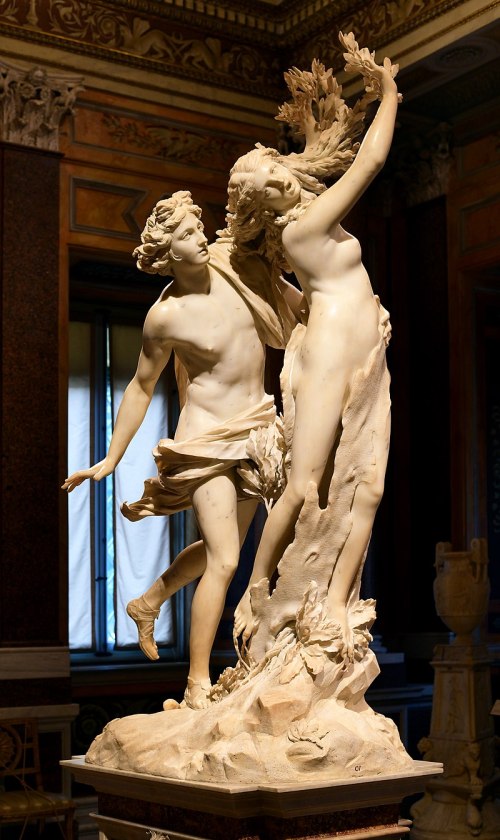
“The Transformation of Daphne into a Lawrel” (I) – Ovid

800px-Apollo_and_Daphne_(Bernini)_(cropped)

     “Apollo and Daphne(1622 – 1625) 


            Gian Lorenzo Bernini


                  ___________


Phoebus has just killed Python, and 

now his thoughts are turned to other 

things 


               The first and fairest of his loves, was she
               Whom not blind fortune, but the dire decree
               Of angry Cupid forc’d him to desire: 


that Phoebus should fall in love, indeed

for the first time, was not the work of 

blind fortune, but the decree, the will, 

rather, of Cupid, son of Mars, god of 

War, and Venus, goddess of Love, 

himself, Cupid, god of Desire, who’d 

been, we’ll see, unacceptably 

disrespected


               Daphne her name, and Peneus was her sire. 


her sire, her father, Peneus


               Swell’d with the pride, that new success attends,
               He sees the stripling, while his bow he bends,
               And thus insults him: 


Phoebus, fresh from his triumphant

bout with Python, thus [s]well’d with … 

pride at his new success, sees Cupid

the stripling, the youth, handling his 

own celebrated bow, and derisively

insults him


                                                    Thou lascivious boy,
               Are arms like these for children to employ? 


arms, weapons


               Know, such atchievements are my proper claim; 


arrows, Phoebus says, are my domain,

my proper claim, my undisputed

territory


               Due to my vigour, and unerring aim:
               Resistless are my shafts, and Python late
               In such a feather’d death, has found his fate. 


the death of Python is proof of my 

unparalleled ability, Phoebus 

proclaims


feather’d death, from the feathers that

are attached to the arrows to direct 

and speed their aim


               Take up the torch (and lay my weapons by), 


my weapons, weapons which should

be mine alone 


               With that the feeble souls of lovers fry. 


Take up the torch, take responsibility,

Phoebus says, lay down your 

weapons, your arrows, the ones that 

fry, he accuses Cupid, that frazzle, 

the feeble, incapacitated, souls of 

lovers


               To whom the son of Venus thus reply’d, 


the son of Venus here is Cupid 


               Phoebus, thy shafts are sure on all beside,
               But mine of Phoebus, mine the fame shall be
               Of all thy conquests, when I conquer thee. 


thy shafts, Cupid says, will always

prevail, surpass others, but my own

arrows will be the ones to best you, 

and yours, at which point the glory 

will be, notoriously, mine, over 

yours, forever


               He said, and soaring, swiftly wing’d his flight: 


Cupid is one of the very few ancient

deities to have wings, incidentally,

there’s also Mercury, the Roman 

Hermesmessenger god, god of

travel, communication


               Nor stopt but on Parnassus’ airy height. 


Parnassus, a mountain in Greece,

site of the Oracle of Delphi, site 

indeed where Python has just 

been killed


               Two diff’rent shafts he from his quiver draws;
               One to repel desire, and one to cause.
               One shaft is pointed with refulgent gold:
               To bribe the love, and make the lover bold:
               One blunt, and tipt with lead, whose base allay 


allay, alloy, combination of metals


               Provokes disdain, and drives desire away.
               The blunted bolt against the nymph he drest:
               But with the sharp transfixt Apollo’s breast.


gotcha


               Th’ enamour’d deity pursues the chace; 


Th’ enamour’d deity, Phoebus, is

now under the spell of Cupid‘s

pointed arrow


               The scornful damsel shuns his loath’d embrace:
               In hunting beasts of prey, her youth employs;
               And Phoebe rivals in her rural joys. 


The scornful damsel, Daphne, in the 

spirit of Phoebe, goddess of the Hunt, 

preferred rural joys, indeed rivalled 

Phoebe‘s own enjoyment of rustic 

sports


to explain the similarity in their names,

it should be noted that Phoebe and 

Phoebus were twins, both children 

of Zeus, god of gods, the equivalent 

of the Roman Jove, also known as 

Jupiter, she, Phoebe, goddess of

the Moon, as well as of the Hunt, he, 

Phoebus, god of the Sun, as well as 

of several other things


it should be noted that the gods and

goddesses of Ancient Greece, firmly 

installed during its period of glory, the

4th and 5th Centuries BCE, travelled 

throughout Europe and Asia, 

migrating, but were adapted to the 

local customs, consequently becoming 

known by different names according to 

the language and culture, you can see 

a parallel in the spread of Latin, for

instance, during the Roman conquests 

of, specifically, Europe, evolving into 

the several derivative languages, 

starting with, historically, Italian itself, 

little by little, achieved through the

effects of time rather than of distance, 

then French, Portuguese, Spanish in

the outlying, eventually impermeated,

areas, see the infiltration of English,

for instance, in the modern world


               With naked neck she goes, and shoulders bare;
               And with a fillet binds her flowing hair. 


fillet, a ribbon


               By many suitors sought, she mocks their pains,
               And still her vow’d virginity maintains.
               Impatient of a yoke, the name of bride
               She shuns, and hates the joys, she never try’d.
               On wilds, and woods, she fixes her desire:
               Nor knows what youth, and kindly love, inspire. 


she’s not the marrying kind


               Her father chides her oft: Thou ow’st, says he, 


Thou ow’st, you owe


               A husband to thy self, a son to me. 


that’s his position


               She, like a crime, abhors the nuptial bed: 


she’d, categorically, rather hunt


               She glows with blushes, and she hangs her head.
               Then casting round his neck her tender arms,
               Sooths him with blandishments, and filial charms: 


filial, can apply to both son or

daughter


blandishments, sweet nothings


               Give me, my Lord, she said, to live, and die,
               A spotless maid, without the marriage tye. 


allow me to live[ ] and die[ ] a spotless 

maid, a virgin, she asks, best, that

line, read without commas 


girls would’ve been at the mercy 

of their fathers’ wishes at the time, 

would’ve needed permission not to 

marry


               ‘Tis but a small request; I beg no more
               Than what Diana’s father gave before. 


Diana is the Roman equivalent 

of Phoebe, a virgin goddess, by

the grace of her father, Zeus, the 

Greek counterpart of the Roman 

Jupiter, or Jove, see above


               The good old sire was soften’d to consent;
               But said her wish wou’d prove her punishment:
               For so much youth, and so much beauty join’d,
               Oppos’d the state, which her desires design’d. 


good luck with that, Zeus prophesies, 

men will find you, so much youth, and 

so much beauty, very hard to resist,

you’ll surely suffer consequences


to be continued


R ! chard