November / Month of the Sonata – 13
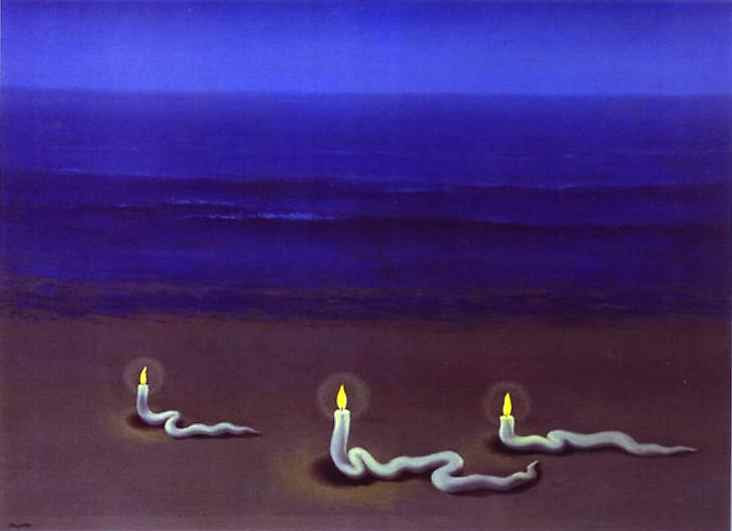.jpg "Meditation, 1936 - Rene Magritte")
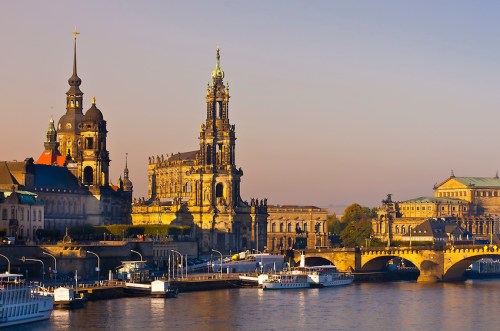
from the centre, the Hofkirche, the Dresden Cathedral, across from the
Augustusbrücke, or Augustus Bridge, extends into the Zwinger, one
of three only palaces in Europe, along with Versailles and Vienna’s
Schönbrunn, distinctly horizontally to the right, not to be confused
with a crook in the Cathedral, an intolerable, were it so, ecclesiastical
gaffe, it ‘s now become one of the most significant art galleries in
Europe, the green rooves, to the right still, are the Semperoper‘s, the
black roof, nestling before it, an unforgettable Italian
restaurant
before it all, majestically, the Elbe
_______
from the very Semperoper in Dresden,
where I’ll ever remember seeing the
worst “Barber of Seville” I’ve ever seen,
first balcony, left of centre, Figaro came
out on a motorcycle, I ask you, it was
downhill after that, my mom, beside
me, was falling even asleep, we left at
intermission, soldiered on to a
restaurant overlooking the Elbe, Italian,
if I remember, but utterly more enjoyable
than the disappointing operatic option,
there might even ‘ve been a moon at our
tableside window, picturesquely
shimmering on the river
but, hey, we both would‘ve stayed,
incontrovertibly, for this performance,
Beethoven’s “Missa Solemnis“, a late,
and towering, entry, 1823, in his opus
– second definition of that word, which
is to say, his entire output, all 135
opuses, first definition there, discrete
compositions – plus all his works
without opus – first definition again –
numbers, WoO
the plural of opus, incidentally, can
also be, both meanings, opera, just
to confuse things, I use either
interchangeably, according to my
narrative rhythm
missae solemnes, plural of missa
solemnis, are a particularly Catholic
form of music, going back to the
very Middle Ages, at which point
religious art was all that really
mattered, anything else was entirely
peripheral, of no consequence
but Catholicism, and its Protestant
offshoots, which is to say, their
common Christianity, remained
culturally entrenched during the
process of their slow disintegration
Nietzsche would, later, take care
of that, but that’s another story
Beethoven, Mozart, Catholics, if,
either, only by name, delivered
missae solemnes, while Bach,
Handel, both Protestant,
delivered oratorios, with some
intermingling
about which, later
Catholic, Protestant expression still
find, even strong, exponents at
present, though the form is,
essentially, outdated, our anthems
are national, now, mostly, if even
somewhat, that, halfheartedly, when
not, paradoxically, searchingly,
hopefully, and maybe even
revolutionarily, again, ideological
imagine “Imagine“ for instance, as
such, just click
R ! chard
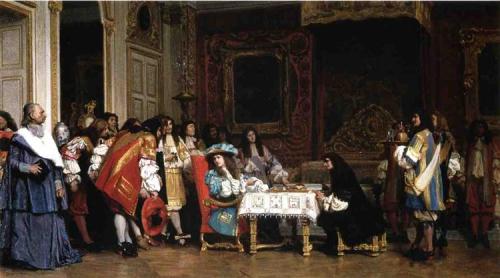
“Louis XIV and Molière“ (1862)
________
the string quartet didn’t come out of nowhere,
as nothing does – I think – but probably, I
suspect, from the earlier period’s suites, the
Baroque’s, Bach’s, for instance
suites are a series of dance pieces, stylized
for the purpose of the musical poet, a popular
appropriation, an even natural one for
composers
the aristocracy, by the middle of the 18th
Century, demanded erudite entertainment,
something that Louis XlV, the Sun King,
had instilled, a little earlier, during his
Radiant Reign – see Racine, Corneille,
Molière, see above, as well, incidentally –
1643 to 1715, up at Versailles, as a
prerequisite for excellence in being a
monarch, a sovereign, sponsorship of
culture, painting, poetry, music
dukes and counts and barons and
princesses got onto the bandwagon
and the arts consequently flourished
witness Haydn and Mozart then, still,
now, giants
here’s Haydn’s first, his Quartet no 1
in B major, (“La chasse”), op. 1 no. 1,
the first significant string quartet in
our Western culture
you’ll note five movements, following
the suite model described above, with
mirrored minuets sandwiched between
opposing mirrored prestos, and an
adagio in the very middle, as though
their crowning moment
an adagio, to my mind, always gives
away a composer’s worth, listen to
this one, it’s melting
and he’s got 67 more to go through, I
marvel, a veritable, and utter,
however improbable, musical
cornucopia
R ! chard
“Sky and Water II“ (1938)
_______
stepping into Shostakovich’s Eighth
Symphony was to me like knocking
at someone’s apartment in the same
building but on the wrong floor,
everything was the same but
different
that had happened to me once before
when I‘d moved from the third floor
of my building, facing the laneway,
overlooking the dumpsters and the
derelicts, I used to say, cause I liked
the alliteration, just above the parking
lot, too few levels up, that spewed
exhaust from cars idling there,
interminably, especially early
mornings in winter
to the twelfth floor, with a view of the
mountains from my living room and
of the ocean from my bedroom, where
I’ve always said I see God/dess every
morning, every day
the floor plan was identical but for
being reversed, the living room on
the left, and the kitchen, in the first,
the bedroom straight ahead of you
as you entered, the living room on
the right, and the kitchen, the
bedroom straight ahead of you as
you entered, in the second
I called it going through the looking
glass, where indeed dumpsters and
derelicts had turned to daily sightings
of God/dess, a truly transcendental
experience
this had happened as well when I
went from atheism, crossed, I said,
the bridge of faith, but that’s
another story
Shostakovich’s Eighth is indeed a
reiteration of previous statements,
patterns are becoming familiar, the
strident opening subsiding into
plaintive laments is recognizable,
links to the Fifth and the Seventh
are evident, so are some of the,
eventually, longueurs, as we say
in French, excessive histrionics,
to my mind
but the third movement here is
nevertheless a stunner, worth
the price of admission, I’ve been
humming that one since in my,
though interrupted, sleep
here‘s a counterpart, however,
a piece I found serendipitously
as I pondered a response to a
cousin who’d asked about
Classical guitar, a piece written
in 1939, the time Shostakovich
was writing his Fourth, though
protectively then retracted, by
a Spanish composer, in another
part of the world, but equally
constricted, by Franco, a
contemporary autocrat, who
demanded art supportive of his
particular political apparatus
Joaquín Rodrigo – but he’s
another story – wrote his
magisterial “Concerto de
Aranjuez“, an utter triumph, a
strictly Classical composition,
three movements, with all the
tempi in the right order,
celebrating a palace, Aranjuez,
historically significant to the
Spanish, like Versailles is to
the French, thereby sidestepping
the local tyrant’s official censure
by skirting that ruler’s autocratic
political proscriptions
but Spain wasn’t massively
obliterating its people either,
as Stalin and Hitler were
theirs then, a crucial
consideration
in either case, these poets are
witnesses to history, and have
survived through their particular
statements, to tell individually,
and idiosyncratically, each his
redoubtable story, each of
which is forcefully telling, and
amazing
listen
R ! chard
 Richibi's Weblog