Richibi’s Weblog

Just another WordPress.com weblog

Tag: the Bible

The Story of Phaeton (VII) – Ovid
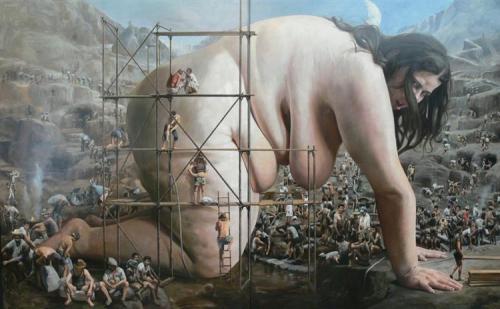
earth.jpg!Large

   Earth (2010) 


            Rolf Ohst


                     ______


mythologies are stories a people will 

tell itself to explain phenomena that 

remain mysterious, by transforming 

conundrums into people, 

anthropomorphizing them, a tale is

told that not only entertains, but 

informs, gives context in order to

shape moral character


most mythologies, if not all, it’s a 

question of definition, which I’ll 

get into later, past and present, 

are pantheistic, which is to say 

they refer to many goddesses 

and gods, rather than to one 

almighty one, therefore they see 

deities in rivers, trees, oceans, 

mountains, the sun, the moon, 

constellations, as well as in the 

more metaphysical entities, 

poetry, beauty, love  


there is therefore a more respectful,

even reverent, attitude to all of these

otherwise neglected realities, for 

being, often, peripheral to more 

immediate, daily, domestic, 

concerns


our prevalent monotheistic 

mythologies, by contrast, purport 

to be historical, however specious, 

which is why the word mythology 

here might not be appropriate, but 

regardless, they all posit one 

omnipotent God, notably 

imponderable, esoteric, and there 

are, correspondingly, only a few 

mentions in their foundational  

texts, the Bible, the Koran, the 

Torah, of nature playing any  

significant part, it is secondary to

to their overriding message


we therefore have allowed ourselves 

to watch the world burning without

having even noticed it come about, 

a function exacerbated, incidentally,

by our living mostly, now, in cities


Phaeton has let his horses stray from 

the cosmically ordained path of the 

Sun, the constellations have already

complained, Earth will follow


we, for our part, have despoiled our 

mother, we are presently watching 

her being ignominiously desecrated


see above


                   The Earth at length, on ev’ry side embrac’d
                   With scalding seas that floated round her waste, 


waste, waist, though waste itself throws 

its own homonymic reverberations of 

disorganized detritus, float[ing] round, 

into the mix, something Shakespeare,

incidentally, was especially good at


                   When now she felt the springs and rivers come,
                   And crowd within the hollow of her womb, 


the waters are receding, evaporating


                   Up-lifted to the Heav’ns her blasted head, 


blasted, overwhelmed


                   And clapt her hand upon her brows, and said
                   (But first, impatient of the sultry heat,
                   Sunk deeper down, and sought a cooler seat): 


a strange, and not especially effective

interjection between the parentheses

here, I think


                   “If you, great king of Gods, my death approve,
                   And I deserve it, let me die by Jove; 


Earth asks of Jove, king of Gods, 

that she might die at his own hands,

if her time has come


                   If I must perish by the force of fire,
                   Let me transfix’d with thunder-bolts expire.
                   See, whilst I speak, my breath the vapours choak
                   (For now her face lay wrapt in clouds of smoak),
                   See my singe’d hair, behold my faded eye,
                   And wither’d face, where heaps of cinders lye! 


we are familiar with forest fires,

hurricanes, droughts in our own day


                   And does the plow for this my body tear? 


after all I have given through 

agriculture, the plow, of nourishment, 

Earth asks, is this how I am to be 

repaid 


                   This the reward for all the fruits I bear,
                   Tortur’d with rakes, and harrass’d all the year?
                   That herbs for cattle daily I renew,
                   And food for Man, and frankincense for you? 


not only does Earth benefit living

creatures, but also the goddesses

and gods, she exclaims


                   But grant me guilty; what has Neptune done? 


Neptune, god of Water, the Sea,

is also Jove‘s brother


                   Why are his waters boiling in the sun?
                   The wavy empire, which by lot was giv’n,
                   Why does it waste, and further shrink from Heav’n? 


wavy empire, made of waves


Jove, Neptune, and Pluto were all

sons of Saturn, Titan, god of Time, 

after the sons overthrew their father 

during the Giants’ War, they divided 

the world by lot, which is to say, who

had the longest straw, Jove got the 

Heavens, Neptune, the Seas, Pluto

the Underworld


waste, resounding from above 


                   If I nor he your pity can provoke,
                   See your own Heav’ns, the Heav’ns begin to smoke!
                   Shou’d once the sparkles catch those bright abodes,
                   Destruction seizes on the Heav’ns and Gods;
                   Atlas becomes unequal to his freight,
                   And almost faints beneath the glowing weight. 


Atlas, a Titan, condemned to hold 

the heavens up for eternity


                   If Heav’n, and Earth, and sea, together burn,
                   All must again into their chaos turn. 


into their chaos turn, see the Creation

of the World


                   Apply some speedy cure, prevent our fate,
                   And succour Nature, ere it be too late.” 


sounds disquietingly familiar


                   She cea’sd, for choak’d with vapours round her spread,
                   Down to the deepest shades she sunk her head. 


surrounded by vapours, round her 

spread, Earth inexorably succumbs
 

gasp


R ! chard


“Metamorphoses” (The Giants’ War, XIV) – Ovid

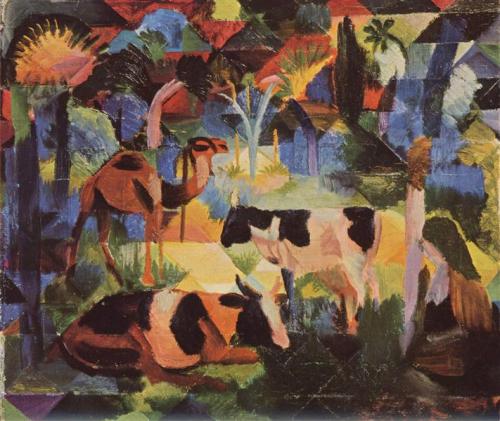
landscape-with-cows-and-a-camel.jpg!Large

    Landscape with Cows and a Camel (1914) 


               August Macke


                   ________


once Deucalion and Pyrrha had found

the way to bring humans back to life, 

it was time to turn to the creation, or

recreation, of other species


              The rest of animals, from teeming Earth
              Produc’d, in various forms receiv’d their birth. 


the rest of animals suggests that 

people were also considered to

be animals, of an however more

elevated, presumably, order


              The native moisture, in its close retreat,
              Digested by the sun’s aetherial heat,
              As in a kindly womb, began to breed: ,
              Then swell’d, and quicken’d by the vital seed. 


by means of the moisture naturally

created by the retreating flood waters, 

the native moisture, the heat of the sun, 

however aetherial, or etherial, which is 

to say of ether, which is to say invisible, 

swell[s], and quicken[s] … the vital seed

the seed which is pregnant with life, or

vital, and nurtures it, swell[s] and 

quicken[s] it, as though within a womb


              And some in less, and some in longer space, 


less, or longer space, of time


              Were ripen’d into form, and took a sev’ral face. 


different kinds of animals, animals with

sev’ral face[s], see, for instance, above

ripen’d, or evolved during longer or 

shorter periods of time, a notion that 

was decisively revisited some nearly 

two thousand years later, incidentally, 

by Charles Darwin 


              Thus when the Nile from Pharian fields is fled, 


Pharian fields, Egypt, from Pharos,

an island off the coast of Alexandria

notable for its lighthouse, itself called 

Pharos, one of the Seven Wonders of 

the Ancient World


              And seeks, with ebbing tides, his ancient bed, 


his ancient bed, the area of earth 

that the Nile had covered during 

the flood, its now exposed river 

banks


the Nile is, note, masculine here, 

his ancient bed


              The fat manure with heav’nly fire is warm’d; 


there’s the heat again


             And crusted creatures, as in wombs, are form’d; 


crusted, it is interesting to note that

apart from the animal feature of the 

womb, all of the terms to describe 

the process of coming to life refer

to plants, see also ripen’d above,

for instance, not to mention the 

vital seed


              These, when they turn the glebe, the peasants find; 


glebe, cultivated land, when the 

peasants plough their fields, they 

find [t]hese, the crusted creatures


              Some rude, and yet unfinish’d in their kind:
              Short of their limbs, a lame imperfect birth:
              One half alive; and one of lifeless earth. 


not all births are successful

              For heat, and moisture, when in bodies join’d,
              The temper that results from either kind
              Conception makes; 
 

life is the product of heat, and moisture

sparking, quicken[ing], matter, bodies, 

a succinct postulation, a metaphysical 

observation, presaging the 17th Century’s 

turn toward the natural sciences, Galileo

Isaac Newton, for instance, coming 

already, and not inaccurately, from the 

age of, at least, Julius Caesar 


it often appals me what was lost of

significant information during the

Middle, the Dark, the Annihilating,

Ages


                                             and fighting ’till they mix,
              Their mingled atoms in each other fix.
              Thus Nature’s hand the genial bed prepares
              With friendly discord, and with fruitful wars. 


generation is a struggle between 

chaos and order, at the most 

fundamental level, according to

Ovid 


              From hence the surface of the ground, with mud
              And slime besmear’d (the faeces of the flood), 


get down


              Receiv’d the rays of Heav’n: and sucking in
              The seeds of heat, 


you can hear the squelch here,

the slim[y] suction


                                             new creatures did begin:
              Some were of sev’ral sorts produc’d before,
              But of new monsters, Earth created more. 


among the new creatures, many 

had existed earlier, been already 

produc’d, but new monsters as 

well sprouted, apparently 

inescapably


              Unwillingly, but yet she brought to light
              Thee, Python too, the wondring world to fright, 


she, the Earth


Python, a mythological serpent, which

guarded Delphi, brought back to light,

or life, the wondring world to fright


              And the new nations, with so dire a sight:
              So monstrous was his bulk, so large a space
              Did his vast body, and long train embrace.
              Whom Phoebus basking on a bank espy’d; 


Phoebus, another name for Apollo

patron deity at Delphi


              E’re now the God his arrows had not try’d
              But on the trembling deer, or mountain goat; 


Phoebus had never needed to try[ ]

his arrow[ ] at anything other than 

game, trembling deer, … mountain 

goat


              At this new quarry he prepares to shoot.
              Though ev’ry shaft took place, he spent the store
              Of his full quiver; and ’twas long before
              Th’ expiring serpent wallow’d in his gore. 


it wasn’t easy


              Then, to preserve the fame of such a deed,
              For Python slain, he Pythian games decred. 


Pythian games, games installed, decreed,  

decred, to honour the slaying of the serpent


              Where noble youths for mastership shou’d strive,
              To quoit, to run, and steeds, and chariots drive. 


to quoit, to throw a ring in a game in

order to encircle at a distance a peg


              The prize was fame: in witness of renown
              An oaken garland did the victor crown. 


nothing other than a crown of oak 

leaves, an oaken garland, was the 

prize at the Pythian Games, but 

enough to assure the fame, the 

glory, of the exalted champion


              The laurel was not yet for triumphs born; 


a crown of laurel leaves, rather than 

of oak, eventually became the symbol 

of triumphs


              But every green alike by Phoebus worn,
              Did, with promiscuous grace, his flowing locks adorn. 


but until the laurel crown prevailed,

an honour associated later, notably, 

with the Ancient Greek Olympics

winners still sported with 

promiscuous grace, the green, the 

colour of Phoebus‘ chosen leaves,

in that god’s honour


later episodes of Metamorphoses

will describe the transformation of

particular people into other 

entities, trees, animals, stars, very

constellations, but for now the 

Creation is complete, the Giants’

War concluded, and the Earth 

replenished, given new life


I suspect that from now on I’ll only

intermittently comment on some 

of the stories in this extraordinary

collection, for this poem is ever as 

long as the very Bible, the only 

other Creation myth, incidentally,  

in the West, a task I expect I’ll 

follow mostly on my own, given

my admittedly idiosyncratic, often

maybe too forbidding, inclinations,

inspirations, interests


but thank you so much for having

listened in, partaken, during this, 

to my mind, fascinating exploration,

this conversation with, I think, 

enlightening, and indeed

ennobling, art


all the very best


R ! chard 


“Metamorphoses” (The Giants’ War, XIII) – Ovid

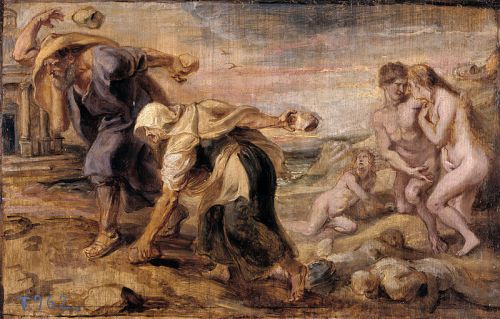
800px-Peter_Paul_Rubens_-_Deucalion_and_Pyrrha,_1636

      Deucalion and Pyrrha (1636) 


             Peter Paul Rubens


                 ___________


                                          for my mom and dad, my own

                                                   Deucalion and Pyrrha


at Cephysus‘ shrine, Deucalion and 

Pyrrha pray to the goddess of

Divine Justice


              O righteous Themis, if the Pow’rs above
              By pray’rs are bent to pity, and to love;
              If humane miseries can move their mind; 


humane, human


              If yet they can forgive, and yet be kind;
              Tell how we may restore, by second birth,
              Mankind, and people desolated Earth. 


the Pow’rs above are the deciding 

factors, can Jove, Neptune, the others, 

Deucalion asks, be moved by human[ ] 

miseries, can they forgive, can they 

restore…Mankind, people, people is

a verb here, the world again, the 

desolated, or desolate, the dismal, 

the forsaken, Earth


              Then thus the gracious Goddess, nodding, said;
              Depart, and with your vestments veil your head:
              And stooping lowly down, with losen’d zones,
              Throw each behind your backs, your mighty mother’s bones. 


losen’d zones, across wide areas


cover, veil, your heads, the goddess 

advises, stoop low, and throw your 

mother’s bones across wide areas, 

she instructs, however scandalously


              Amaz’d the pair, and mute with wonder stand,
              ‘Till Pyrrha first refus’d the dire command. 


Pyrrha is a counterpart for the Christian 

Eve here, contrary, defiant of Heaven, 

however eventually, Pyrrha, blameless, 

but which of the progenitresses came

first, which the chicken, which the egg, 

Eve or Pyrrha, is a question up for 

contemplation


              Forbid it Heav’n, said she, that I shou’d tear
              Those holy reliques from the sepulcher. 


surely, Pyrrha proclaims, Heav’n would 

never allow, Forbid it Heav’n, not to 

mention condone, that I should remove, 

tear, my mother’s bones, [t[hose holy 

reliques, relics, from their sepulcher, 

their grave, this would be profoundly 

unholy 


              They ponder’d the mysterious words again,
              For some new sense; and long they sought in vain:
              At length Deucalion clear’d his cloudy brow,
              And said, the dark Aenigma  


Aenigma, Sphinx, the oracle


                                                                will allow
              A meaning, which, if well I understand,
              From sacrilege will free the God’s command: 


if I can properly understand, decipher,

the meaning of the God’s command, 

Aenigma’s oracular words, however 

cryptic, in such a way, Deucalion 

declares, that our actions be not 

sacrilegious, nor offensive in any 

way to the gods, we may proceed,

he reasons


              This Earth our mighty mother is, the stones
              In her capacious body, are her bones: 


This Earth is our mighty mother, the

stones in her capacious body [ ] are 

her bones, no comma after body


the word order in each clause, note, has 

been reversed, instead of subject, verb,

object, we have object, verb, subject


but then, ever so felicitously, stones 

can rhyme with bones, and equally,

and as liltingly, we’re still in iambic 

pentameter


              These we must cast behind. With hope, and fear,
              The woman did the new solution hear:
              The man diffides in his own augury, 


diffide, distrust, augury, prediction,

Deucalion doubts, in other words,

his own calculations


              And doubts the Gods; yet both resolve to try. 


when my mom is up against a 

dilemma, she calls on my dad,

gone some over thirty years now,

come on, Daddy, let’s go, she 

says, and confronts the issue 

with transcendental, by very 

definition, conviction


see above


              Descending from the mount, they first unbind
              Their vests, and veil’d, they cast the stones behind:
              The stones (a miracle to mortal view,
              But long tradition makes it pass for true) 


what follows will seem miraculous

to mortals, Ovid says, but the story 

has been around for such a while,

which is to say by long tradition, 

that we let it pass for true


              Did first the rigour of their kind expel, 


the stones begin to lose, expel, their 

firmness, the rigour of their kind


              And suppled into softness, as they fell; 


suppled, became supple


              Then swell’d, and swelling, by degrees grew warm;
              And took the rudiments of human form. 


stones are being transformed, 

metamorphosized, into humans 


the Bible, if you’ll remember, would 

have it be clay


              Imperfect shapes: in marble such are seen,
              When the rude chizzel does the man begin; 


chizzel, chisel


              While yet the roughness of the stone remains,
              Without the rising muscles, and the veins. 


as the sculpture is being fashioned, 

certain parts of the human anatomy, 

the muscles, for instance, the veins, 

are not yet revealed, uncovered, 

discovered, extracted, by the 

chizzel, from under the roughness 

of the stone


think of Michelangelo, or Rodin,

sculpting


              The sappy parts, and next resembling juice, 


sappy, from sap, which, emanating 

from stones, would be next to, but 

not as limpid as, juice, or the liquid

required to create humans


              Were turn’d to moisture, for the body’s use:
              Supplying humours, blood, and nourishment; 


the circulatory, and notably viscous, 

system


              The rest, too solid to receive a bent,
              Converts to bones; and what was once a vein,
              Its former name and Nature did retain. 


veins, which hadn’t received enough 

sappy parts to become part of the

circulatory system, retained their 

name of vein, but as understood in

relation to rocks, geological veins

presumably replicated, in this story 

of the Creation, in human bones


              By help of pow’r divine, in little space, 


in little space, in no time at all


              What the man threw, assum’d a manly face;
              And what the wife, renew’d the female race. 


the stones that the man, Deucalion

threw became men, those that 

Pyrrha tossed became women 


              Hence we derive our nature; born to bear
              Laborious life; and harden’d into care.


we’ve inherited, through the labours 

of Deucalion and Pyrrha, our driven

nature, harden’d into, or conditioned, 

condemned, to care 


for better, I infer, or for worse 


R ! chard


“Song of the South”‏ – Walt Disney

it’s been over fifty years since I’ve seen this movie,
never thought I’d see it again but now for the magic
of the Internet, the boundless trove of irreducible
treasures, like those in Ali-Baba’s caves, or the
attics of our ancestors, stowed away, open again
to our poetic or otherwise imaginations, at our
very fingertips
 
I remembered this movie to be wonderful, moving,
but not much else, except for the Zip-A-Dee-Doo-
Dah” theme, which is unforgettable, and a single
plot twist it would be unchivalrous to divulge 
 
it has apparently been controversial, and is
presently banned, it would appear, in cinemas,
but it would be to my mind as racially insensitive
as “Huckleberry Finn”, “Tom Sawyer’, or even
“Gone with the Wind” have been, when they
were patently giving voice rather to a shocking
human cultural, and political, abomination, 
however awkwardly, that is still powerfully,
shamefully, even manifestly, resonant
 
this is not a universal, note, condition, every
season for any culture has its bugbears, its
demons and monsters, and woe to the
unfortunate and inadvertent victim 
 
 
in perhaps his most wonderful movie, and there
were quite a few, Song of the South“, Walt Disney 
lets us know that we’re all in this together, and
that kindness meets kindness in everyone, when
you open your heart 
 
and that the reverse is horrible 
 
 
Walt Disney is of course one of the great cultural
influences of the 20th Century, dismissed among
the titans as merely for kids
 
Walt Disney will be for an entire generation the
place where we learned our moral ABCs, much
more than in the dire Bible
 
as such he’s no less significant an artist, not at
all less significant, than Monet, Picasso, for
instance, Beethoven, Shakespeare, in shaping
our present moral and aesthetic world 
 
 
you’ll need some Kleenex 
 
 
you can also sing along 
 
 
Richard 
 
psst: filmed, I’m sure, right here in beautiful Stanley
         Park behind my place in Vancouver, even the
         animated portions    


“The Trojan Women” – Euripides

the purpose of any art essentially is to either
inform or entertain, preferably both together,
therefore comedy would be associated with
entertaining whereas tragedy with informing
and, as such, this last would be perhaps more
intellectually demanding, so be it 
 
the strength nevertheless of great tragedy is in
its level of delivering immediacy and fascination,
which is to say entertainment, of great comedy
its obverse, insight  
 
The Trojan Women” was written in 415 BC by
Euripides, a tragedian at the very summit still,
2400 years later, count them, of remarkable 
historical achievement 
 
the war with Troy had taken place a full 800
hundred years earlier, Homer had written the
alternate Bible to our Western civilization,
The Iliad“, still with Proust to my mind the
very summit of our Occidental accomplishment,  
resonating across the ages as powerfully as
even the pyramids, extraordinary to read,
from about, again count them, astounding
millennia, nearly unimaginable centuries, 
850 BC  
 
 
Helen had been abducted from Sparta, according
to that side of the story, by Paris, the son of King
Priam of Troy, she had been whisked away not
unwillingly according to that prince of that city,
from where she became known to us as Helen of
Troy, rather than of her original Sparta
 
the Trojan War ensued
 
 
the Trojans were creamed by the Achaeans, the
Greeks, the Spartans, interchangeable terms,
under Menelaus, king of Sparta, and his brother,
Agamemnon, older brother, and king of Mycenae,
the greater incorporating kingdom   
 
the Trojan women remain to pay the price of
war, after so many centuries still their horror is
vivid, nor do we need to look far for equivalent
modern instances, they were all slaughtered or
enslaved, ‘nough, or maybe not ‘nough, said 
 
 
here we get perhaps the best interpretation
we’ll ever see, with a cast we’ll probably not
in a long while again put together – Katharine
Hepburn in perhaps her greatest role – “Once
I was queen in Troy”, she says, and you will
profoundly believe her – Vanessa Redgrave
doesn’t get ever much better as she reaches
chthonically, which is to say from the very
entrails of her earth, her soul, for a cry of
anguish you are not likely to ever forget – 
Geneviève Bujold, a mad Cassandra, and
Irene Papas, the very incarnation of the
most beautiful woman in the world
 
all tear up the screen in their moments,
leaving you breathless and helpless before
their art and evocative power, only Helen,
because of her beauty, insidiously manages
in the story to reasonably comfortably
survive, making mincemeat meanwhile
out of her big bad, he would have it, 
Menelaus
 
Helen had been the gift to Paris, who’d had
to choose among the goddesses, Hera, Athena,
Aphrodite, which of these was the most
beautiful, but only when Aphrodite had bribed
him with the gift of the most beautiful woman
in the world instead of from either other deity
power and glory, had he chosen Helen
 
the other two of course reponded with the
devastation at Troy, Olympians were not prone
to be easy, Christian mercy would find in that
pagan unequivalency propitious ground 
 
  
wonderful rendering of the traditional Greek
chorus – the Greek version of back-up girls,
“doo-wop, doo-wop” or “she loves him, she
loves him” – commenting on the tempestuous
story     
 
one of my favourite ever films   


Richard