Richibi’s Weblog

Just another WordPress.com weblog

Tag: Python

“The Transformation of Daphne into a Lawrel” (I) – Ovid

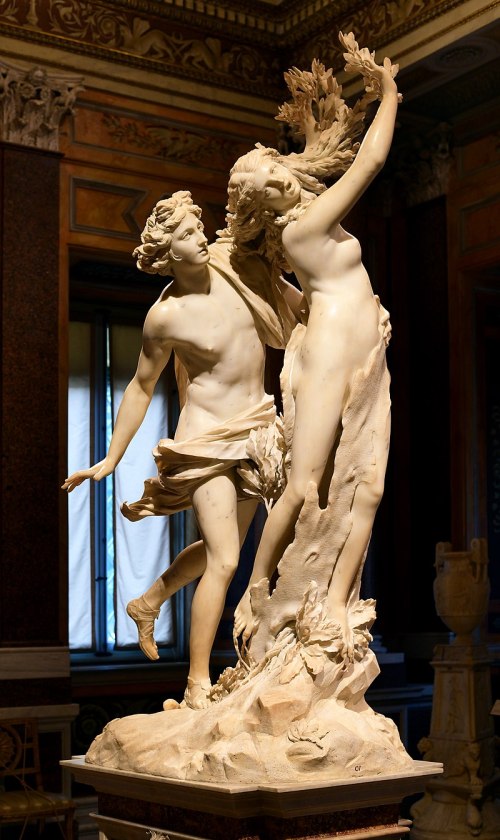
800px-Apollo_and_Daphne_(Bernini)_(cropped)

     “Apollo and Daphne(1622 – 1625) 


            Gian Lorenzo Bernini


                  ___________


Phoebus has just killed Python, and 

now his thoughts are turned to other 

things 


               The first and fairest of his loves, was she
               Whom not blind fortune, but the dire decree
               Of angry Cupid forc’d him to desire: 


that Phoebus should fall in love, indeed

for the first time, was not the work of 

blind fortune, but the decree, the will, 

rather, of Cupid, son of Mars, god of 

War, and Venus, goddess of Love, 

himself, Cupid, god of Desire, who’d 

been, we’ll see, unacceptably 

disrespected


               Daphne her name, and Peneus was her sire. 


her sire, her father, Peneus


               Swell’d with the pride, that new success attends,
               He sees the stripling, while his bow he bends,
               And thus insults him: 


Phoebus, fresh from his triumphant

bout with Python, thus [s]well’d with … 

pride at his new success, sees Cupid

the stripling, the youth, handling his 

own celebrated bow, and derisively

insults him


                                                    Thou lascivious boy,
               Are arms like these for children to employ? 


arms, weapons


               Know, such atchievements are my proper claim; 


arrows, Phoebus says, are my domain,

my proper claim, my undisputed

territory


               Due to my vigour, and unerring aim:
               Resistless are my shafts, and Python late
               In such a feather’d death, has found his fate. 


the death of Python is proof of my 

unparalleled ability, Phoebus 

proclaims


feather’d death, from the feathers that

are attached to the arrows to direct 

and speed their aim


               Take up the torch (and lay my weapons by), 


my weapons, weapons which should

be mine alone 


               With that the feeble souls of lovers fry. 


Take up the torch, take responsibility,

Phoebus says, lay down your 

weapons, your arrows, the ones that 

fry, he accuses Cupid, that frazzle, 

the feeble, incapacitated, souls of 

lovers


               To whom the son of Venus thus reply’d, 


the son of Venus here is Cupid 


               Phoebus, thy shafts are sure on all beside,
               But mine of Phoebus, mine the fame shall be
               Of all thy conquests, when I conquer thee. 


thy shafts, Cupid says, will always

prevail, surpass others, but my own

arrows will be the ones to best you, 

and yours, at which point the glory 

will be, notoriously, mine, over 

yours, forever


               He said, and soaring, swiftly wing’d his flight: 


Cupid is one of the very few ancient

deities to have wings, incidentally,

there’s also Mercury, the Roman 

Hermesmessenger god, god of

travel, communication


               Nor stopt but on Parnassus’ airy height. 


Parnassus, a mountain in Greece,

site of the Oracle of Delphi, site 

indeed where Python has just 

been killed


               Two diff’rent shafts he from his quiver draws;
               One to repel desire, and one to cause.
               One shaft is pointed with refulgent gold:
               To bribe the love, and make the lover bold:
               One blunt, and tipt with lead, whose base allay 


allay, alloy, combination of metals


               Provokes disdain, and drives desire away.
               The blunted bolt against the nymph he drest:
               But with the sharp transfixt Apollo’s breast.


gotcha


               Th’ enamour’d deity pursues the chace; 


Th’ enamour’d deity, Phoebus, is

now under the spell of Cupid‘s

pointed arrow


               The scornful damsel shuns his loath’d embrace:
               In hunting beasts of prey, her youth employs;
               And Phoebe rivals in her rural joys. 


The scornful damsel, Daphne, in the 

spirit of Phoebe, goddess of the Hunt, 

preferred rural joys, indeed rivalled 

Phoebe‘s own enjoyment of rustic 

sports


to explain the similarity in their names,

it should be noted that Phoebe and 

Phoebus were twins, both children 

of Zeus, god of gods, the equivalent 

of the Roman Jove, also known as 

Jupiter, she, Phoebe, goddess of

the Moon, as well as of the Hunt, he, 

Phoebus, god of the Sun, as well as 

of several other things


it should be noted that the gods and

goddesses of Ancient Greece, firmly 

installed during its period of glory, the

4th and 5th Centuries BCE, travelled 

throughout Europe and Asia, 

migrating, but were adapted to the 

local customs, consequently becoming 

known by different names according to 

the language and culture, you can see 

a parallel in the spread of Latin, for

instance, during the Roman conquests 

of, specifically, Europe, evolving into 

the several derivative languages, 

starting with, historically, Italian itself, 

little by little, achieved through the

effects of time rather than of distance, 

then French, Portuguese, Spanish in

the outlying, eventually impermeated,

areas, see the infiltration of English,

for instance, in the modern world


               With naked neck she goes, and shoulders bare;
               And with a fillet binds her flowing hair. 


fillet, a ribbon


               By many suitors sought, she mocks their pains,
               And still her vow’d virginity maintains.
               Impatient of a yoke, the name of bride
               She shuns, and hates the joys, she never try’d.
               On wilds, and woods, she fixes her desire:
               Nor knows what youth, and kindly love, inspire. 


she’s not the marrying kind


               Her father chides her oft: Thou ow’st, says he, 


Thou ow’st, you owe


               A husband to thy self, a son to me. 


that’s his position


               She, like a crime, abhors the nuptial bed: 


she’d, categorically, rather hunt


               She glows with blushes, and she hangs her head.
               Then casting round his neck her tender arms,
               Sooths him with blandishments, and filial charms: 


filial, can apply to both son or

daughter


blandishments, sweet nothings


               Give me, my Lord, she said, to live, and die,
               A spotless maid, without the marriage tye. 


allow me to live[ ] and die[ ] a spotless 

maid, a virgin, she asks, best, that

line, read without commas 


girls would’ve been at the mercy 

of their fathers’ wishes at the time, 

would’ve needed permission not to 

marry


               ‘Tis but a small request; I beg no more
               Than what Diana’s father gave before. 


Diana is the Roman equivalent 

of Phoebe, a virgin goddess, by

the grace of her father, Zeus, the 

Greek counterpart of the Roman 

Jupiter, or Jove, see above


               The good old sire was soften’d to consent;
               But said her wish wou’d prove her punishment:
               For so much youth, and so much beauty join’d,
               Oppos’d the state, which her desires design’d. 


good luck with that, Zeus prophesies, 

men will find you, so much youth, and 

so much beauty, very hard to resist,

you’ll surely suffer consequences


to be continued


R ! chard


“Metamorphoses” (The Giants’ War, XIV) – Ovid

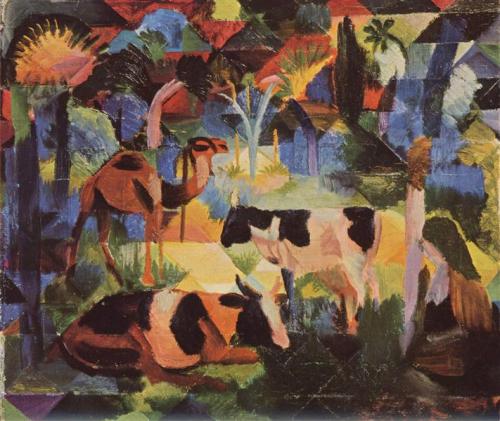
landscape-with-cows-and-a-camel.jpg!Large

    Landscape with Cows and a Camel (1914) 


               August Macke


                   ________


once Deucalion and Pyrrha had found

the way to bring humans back to life, 

it was time to turn to the creation, or

recreation, of other species


              The rest of animals, from teeming Earth
              Produc’d, in various forms receiv’d their birth. 


the rest of animals suggests that 

people were also considered to

be animals, of an however more

elevated, presumably, order


              The native moisture, in its close retreat,
              Digested by the sun’s aetherial heat,
              As in a kindly womb, began to breed: ,
              Then swell’d, and quicken’d by the vital seed. 


by means of the moisture naturally

created by the retreating flood waters, 

the native moisture, the heat of the sun, 

however aetherial, or etherial, which is 

to say of ether, which is to say invisible, 

swell[s], and quicken[s] … the vital seed

the seed which is pregnant with life, or

vital, and nurtures it, swell[s] and 

quicken[s] it, as though within a womb


              And some in less, and some in longer space, 


less, or longer space, of time


              Were ripen’d into form, and took a sev’ral face. 


different kinds of animals, animals with

sev’ral face[s], see, for instance, above

ripen’d, or evolved during longer or 

shorter periods of time, a notion that 

was decisively revisited some nearly 

two thousand years later, incidentally, 

by Charles Darwin 


              Thus when the Nile from Pharian fields is fled, 


Pharian fields, Egypt, from Pharos,

an island off the coast of Alexandria

notable for its lighthouse, itself called 

Pharos, one of the Seven Wonders of 

the Ancient World


              And seeks, with ebbing tides, his ancient bed, 


his ancient bed, the area of earth 

that the Nile had covered during 

the flood, its now exposed river 

banks


the Nile is, note, masculine here, 

his ancient bed


              The fat manure with heav’nly fire is warm’d; 


there’s the heat again


             And crusted creatures, as in wombs, are form’d; 


crusted, it is interesting to note that

apart from the animal feature of the 

womb, all of the terms to describe 

the process of coming to life refer

to plants, see also ripen’d above,

for instance, not to mention the 

vital seed


              These, when they turn the glebe, the peasants find; 


glebe, cultivated land, when the 

peasants plough their fields, they 

find [t]hese, the crusted creatures


              Some rude, and yet unfinish’d in their kind:
              Short of their limbs, a lame imperfect birth:
              One half alive; and one of lifeless earth. 


not all births are successful

              For heat, and moisture, when in bodies join’d,
              The temper that results from either kind
              Conception makes; 
 

life is the product of heat, and moisture

sparking, quicken[ing], matter, bodies, 

a succinct postulation, a metaphysical 

observation, presaging the 17th Century’s 

turn toward the natural sciences, Galileo

Isaac Newton, for instance, coming 

already, and not inaccurately, from the 

age of, at least, Julius Caesar 


it often appals me what was lost of

significant information during the

Middle, the Dark, the Annihilating,

Ages


                                             and fighting ’till they mix,
              Their mingled atoms in each other fix.
              Thus Nature’s hand the genial bed prepares
              With friendly discord, and with fruitful wars. 


generation is a struggle between 

chaos and order, at the most 

fundamental level, according to

Ovid 


              From hence the surface of the ground, with mud
              And slime besmear’d (the faeces of the flood), 


get down


              Receiv’d the rays of Heav’n: and sucking in
              The seeds of heat, 


you can hear the squelch here,

the slim[y] suction


                                             new creatures did begin:
              Some were of sev’ral sorts produc’d before,
              But of new monsters, Earth created more. 


among the new creatures, many 

had existed earlier, been already 

produc’d, but new monsters as 

well sprouted, apparently 

inescapably


              Unwillingly, but yet she brought to light
              Thee, Python too, the wondring world to fright, 


she, the Earth


Python, a mythological serpent, which

guarded Delphi, brought back to light,

or life, the wondring world to fright


              And the new nations, with so dire a sight:
              So monstrous was his bulk, so large a space
              Did his vast body, and long train embrace.
              Whom Phoebus basking on a bank espy’d; 


Phoebus, another name for Apollo

patron deity at Delphi


              E’re now the God his arrows had not try’d
              But on the trembling deer, or mountain goat; 


Phoebus had never needed to try[ ]

his arrow[ ] at anything other than 

game, trembling deer, … mountain 

goat


              At this new quarry he prepares to shoot.
              Though ev’ry shaft took place, he spent the store
              Of his full quiver; and ’twas long before
              Th’ expiring serpent wallow’d in his gore. 


it wasn’t easy


              Then, to preserve the fame of such a deed,
              For Python slain, he Pythian games decred. 


Pythian games, games installed, decreed,  

decred, to honour the slaying of the serpent


              Where noble youths for mastership shou’d strive,
              To quoit, to run, and steeds, and chariots drive. 


to quoit, to throw a ring in a game in

order to encircle at a distance a peg


              The prize was fame: in witness of renown
              An oaken garland did the victor crown. 


nothing other than a crown of oak 

leaves, an oaken garland, was the 

prize at the Pythian Games, but 

enough to assure the fame, the 

glory, of the exalted champion


              The laurel was not yet for triumphs born; 


a crown of laurel leaves, rather than 

of oak, eventually became the symbol 

of triumphs


              But every green alike by Phoebus worn,
              Did, with promiscuous grace, his flowing locks adorn. 


but until the laurel crown prevailed,

an honour associated later, notably, 

with the Ancient Greek Olympics

winners still sported with 

promiscuous grace, the green, the 

colour of Phoebus‘ chosen leaves,

in that god’s honour


later episodes of Metamorphoses

will describe the transformation of

particular people into other 

entities, trees, animals, stars, very

constellations, but for now the 

Creation is complete, the Giants’

War concluded, and the Earth 

replenished, given new life


I suspect that from now on I’ll only

intermittently comment on some 

of the stories in this extraordinary

collection, for this poem is ever as 

long as the very Bible, the only 

other Creation myth, incidentally,  

in the West, a task I expect I’ll 

follow mostly on my own, given

my admittedly idiosyncratic, often

maybe too forbidding, inclinations,

inspirations, interests


but thank you so much for having

listened in, partaken, during this, 

to my mind, fascinating exploration,

this conversation with, I think, 

enlightening, and indeed

ennobling, art


all the very best


R ! chard