Richibi’s Weblog

Just another WordPress.com weblog

Tag: Inachus / river god

“The Afternoon of a Faun” – Debussy / Nijinsky / Nureyev

397px-Faun_merse

      Faun and Nymph (1867)


              Pál Szinyei Merse               


                      ________


to take a break, for a moment, from the

travails of Io, a heifer still, though her

father, Inachus, is aware of the situation,

and Hermes, messenger of the gods, is 

out, on the orders of Jove/ Jupiter / Zeus

to save her, and, at the same time, 

inspired by the music Hermes tells Argus

her many-eyed keeper, Pan, god of the

wilds, has been playing, with reeds he’s 

been left with of Syrinx, the nymph he  

would’ve loved had she not been 

transformed into rushes, as imagined by 

Debussy in his evocative Syrinx for solo 

flute, as highlighted in my last instalment

I could not not remember Debussy‘s 

other similarly mythological, and intimately

related, work, his Prelude to the Afternoon 

of a Faun, as modified itself by Vaslav

Nijinsky, legendary dancer and 

choreographer, into an event that verily 

shook the early 20th Century 


retitled, L’après-midi d’un faune, The

Afternoon of a Faun in English, the 

performance captures everything one

would gather from Ovid’s myths of its 

primitive, primal, sensibilities


the faun, needless to say, is representative 

of Pan, god of the wild, woodlands, a satyr, 

part instinct, part man, see above 


watch Rudolf Nureyev, then, his equally 

celebrated successor, take on the role

Nijinsky made famous, without any 

alterations made to the original 1912 

production, however improbably, 

though entirely successfully, we’re in 

Paris, May 29, though transposed,

faithfully and superbly, to New York,

Broadway, 1979 


proceed, however, at your own discretion, 

The Afternoon of a Faun is steaming, it’s 

about what happens when a young buck’s 

fancies, implacable and irrepressible, turn 

to love, not for the scrupulous, where does 

love begin, it asks, and lust retire, or is it 

the other way around, where does yin, in 

other words, meet, become, yang


these are questions that more and more 

begin to come up, you’ll find, in Greek 

and Roman, and most other ancient, 

for that matter, mythologies, something 

that isn’t at all touched upon in the 

Abrahamic traditions, Christanity, Islam, 

Judaism, monotheistic, though they’re 

at least as old, where nature, the place 

of animals, vegetation, land, water, our

intimate interconnection with them, 

don’t much, for better or for worse, 

come up


I miss the wonder of the more 

pantheistic, the pagan, perspective 


enjoy


R ! chard


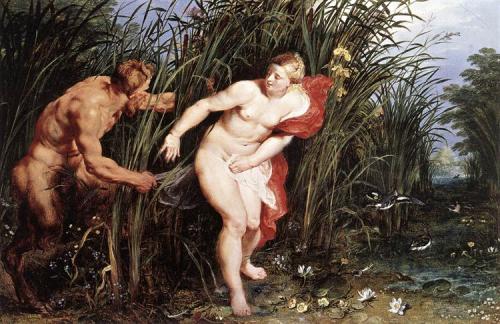
The Transformation of Syrinx into Reeds

pan-and-syrinx-1619.jpg!Large

   Pan and Syrinx (1617 – 1619) 


           Peter Paul Rubens


                 __________


               Then Hermes thus: 


Hermes, messenger of the gods,

addresses Argus, keeper of Io

who’s been transformed by Jove

god of gods, into a heifer, though 

she remains daughter, ever, of 

Inachus, river god, to tell the

story of his rare, beguiling reeds


                                             A nymph of late there was
               Whose heav’nly form her fellows did surpass. 


here we go again with nymphs, 

beautiful, irresistible, however 

ever innocent, prey, due, indeed,

to their very beauty, their very

innocence, to lustful, inordinate 

desires, in these instances, 

markedly divine 


deities, I point out again, make 

up their own rules


               The pride and joy of fair Arcadia’s plains, 


Arcadia, apart from being an 

actual area of Greece, is also 

the ideal, in our historical 

imagination, of an utopia

much as is the lost island of

Atlantis 


               Belov’d by deities, ador’d by swains:
               Syrinx her name, by Sylvans oft pursu’d, 


Sylvans, could only be, though

I’ve been unable to find actual 

confirmation of my opinion, 

wood spirits, forest entities, 

satyrs, goat men, and such


               As oft she did the lustful Gods delude: 


Syrinx could often, or oft, delude, 

or fool, ward off, the lustful Gods


               The rural, and the woodland Pow’rs disdain’d; 


satyr yourself, Syrinx would’ve 

impudently taunted


               With Cynthia hunted, and her rites maintain’d:
               Like Phoebe clad, even Phoebe’s self she seems, 


Cynthia, is Phoebe, both also known

as Dianagoddess of the Hunt, you’ll

remember Phoebe / Diana from her

connection to Daphne, who earlier

here was transformed into a laurel 


Syrinx sounds an awful lot, incidentally,

like another version of Daphne


               So tall, so streight, such well-proportion’d limbs:
               The nicest eye did no distinction know,
               But that the goddess bore a golden bow: 


the only difference between Syrinx

and Cynthia / Phoebe / Diana was 

that Syrinx didn’t have, bear, 

golden bow


               Distinguish’d thus, the sight she cheated too. 


had she borne a golden bow, Syrinx

[d]istinguish’d thus, would’ve cheated 

the sight, looked identical, to the 

beautiful, it is inferred, goddess 


               Descending from Lycaeus, Pan admires
               The matchless nymph, and burns with new desires. 


Pan, god of the wild, woodlands


Lycaeus, Latin spelling of Lykaion,

is a mountain in Arcadia


               A crown of pine upon his head he wore;
               And thus began her pity to implore.
               But e’er he thus began, she took her flight
               So swift, she was already out of sight.
               Nor stay’d to hear the courtship of the God;
               But bent her course to Ladon’s gentle flood: 


Ladon, a river in Arcadia 


flood, rushing, though gentl[y], 

water, rhymes in the preceding 

verse, you’ll note, with God


               There by the river stopt, and tir’d before;
               Relief from water nymphs her pray’rs implore. 


Syrinx, once by the river stopt, seeks 

the help of, assistance, [r]elief from, 

the nearby water nymphs, her 

consorts  


               Now while the lustful God, with speedy pace,
               Just thought to strain her in a strict embrace, 


Pan, like Phoebus / Apollo, or 

Jove / Jupiter / Zeus before him,

is, as well, and characteristically,

a lustful God


               He fill’d his arms with reeds, new rising on the place.
               And while he sighs, his ill success to find, 


his ill success, his thwarted, 

ineffective, enterprise 


               The tender canes were shaken by the wind;
               And breath’d a mournful air, unheard before; 


the reeds that Pan gathered in his arms, 

shaken by the wind, create a mournful 

air, a melancholy music


               That much surprizing Pan, yet pleas’d him more. 


though Pan might’ve been much

surpriz[ed] by the sorrowful sounds 

he heard, he was more pleas’d by 

them than startled


               Admiring this new musick, Thou, he said,
               Who canst not be the partner of my bed,
               At least shall be the confort of my mind: 


Thou, Syrinx


               And often, often to my lips be joyn’d. 


in a kiss of consolation 


               He form’d the reeds, proportion’d as they are,
               Unequal in their length, and wax’d with care,
               They still retain the name of his ungrateful fair. 


the instrument Pan devised from

the tender canes he fashioned

from the unaccommodating reeds, 

what we now name the Pan flute

was called in Ancient Greece a 

syrinx, in honour of the 

recalcitrant nymph 


listen, coincidentally, to Debussy 

tell the storyfor solo flute,

however, which is to say, on a

modern instrumentfor our having 

long ago abandoned at a 

professional level the original pipe, 

though it remains, apparently, as a

folk instrument in more agrarian,

communities around the world, for 

shepherds, one would imagine, to

while away the hours while tending

to their, however wayward, sheep 


R ! chard


“The Transformation of Io into a Heyfer” (II) – Ovid

Gerbrand_van_den_Eeckhout_-_Juno,_Jupiter_and_Io

   Juno, Jupiter and Io (1672) 


          Gerbrand van den Eeckhout


                      ________________


we left Inachus in my last instalment

looking for his daughter, Io


              Her, just returning from her father’s brook


Her, Io 


              Jove had beheld, with a desiring look: 


the sentence structure, as it’s been

crafted in the verses above, has 

been an aspect of Ovid’s poem for 

some time, though, it must again 

be noted, as translated by John 

Dryden, the subject goes where 

the object should go, the sentence 

is inverted


the sentence should be, Jove had

beheld her, … just returning from 

her father’s brook


but the placement of Her at the 

top of the sentence, and even 

capitalized, is, you must admit,
arresting, and of the highest

poetic order


              And, Oh fair daughter of the flood, he said, 


the flood, the many rivers that came 

to comfort Inachus, their sovereign, 

in his distress at having lost Io, his 

daughter, their many surging 

confluences would’ve created 

overflowing torrents, the flood


              Worthy alone of Jove’s imperial bed, 


Jove thinks Io worthy of no one 

else’s mattress but his own


              Happy whoever shall those charms possess;
              The king of Gods (nor is thy lover less)
              Invites thee to yon cooler shades; to shun
              The scorching rays of the meridian sun. 


whoever might partake of her charms,

Jove tells Io, would be Happy


again an inverted sentence, note


but Jove makes his play, flashes 

his pedigree,The king of Gods, 

nothing less, and invites her to a 

shady grove, out of the noonday, 

the meridian, sun


              Nor shalt thou tempt the dangers of the grove
              Alone, without a guide; thy guide is Jove. 


Jove / Jupiter, god of gods


              No puny Pow’r, but he whose high command
              Is unconfin’d, 


Jove / Jupiter is not a nobody, but, 

rather, unconfin’d, omnipotent,

he boasts


                                    who rules the seas and land;
              And tempers thunder in his awful hand, 


Jove / Jupiter, supreme master of 

the elements


              Oh fly not: 


Jove urges Io


                                for she fled from his embrace
              O’er Lerna’s pastures: 


Lerna, a region of Ancient Greece


                                                he pursu’d the chace
              Along the shades of the Lyrcaean plain; 


Lyrcaean, after some investigation,

seems to mean from Lycaeus, the

Latin name for Lykaion, a mountain

in Greece, considered by some to

be the birthplace of Jove / Jupiter /

Zeus


otherwise, but very improbably, the 

Lyrcaean plain is a literary invention,

of Ovid, or of his translator, Dryden


              At length the God, who never asks in vain,
              Involv’d with vapours, imitating night,
              Both Air, and Earth; 


Inform’d with, having transformed 

himself into, vapours, a mist, 

imitating night, shrouding [b]oth 

Air and Earth in darkness, 

becoming himself, therefore, 

indistinct, indefinite, nebulous, 

within them


                                              and then suppress’d her flight,
              And mingling force with love, enjoy’d the full delight. 


first of all Phoebus / Apollo‘s pursuit 

of Daphne, and now Jove / Jupiter‘s 

constraint of Io, are not admirable

aspects of male deities, indeed in

our age of action against the 

harassment of women, their 

behaviour is disturbing, uncomfortable

for me even to read, I’m too reminded 

of dissolute American CEOs, not to

mention presidents, but concluding 

that this dilemma has been around 

for countless ages among vertebrates,

be they animal, human, or, as in these 

instances, divine, therefore written in 

our antediluvian, our primeval, genes, 

maybe, consequently, ineradicably


              Mean-time the jealous Juno, from on high, 


Juno, goddess of goddesses, wife

of Jupiter / Jove


              Survey’d the fruitful fields of Arcady; 


Arcady, or Arcadia, a region still 

of Greece


              And wonder’d that the mist shou’d over-run
              The face of day-light, and obscure the sun. 


which is to say, Juno, suspicious, 

asks herself, what’s up with that 


              No nat’ral cause she found, from brooks, or bogs,
              Or marshy lowlands, to produce the fogs; 


she reckons


              Then round the skies she sought for Jupiter,
              Her faithless husband; but no Jove was there: 


Juno knows her Jove / Jupiter


              Suspecting now the worst, Or I, she said,
              Am much mistaken, or am much betray’d. 


it’s one of two things, Juno figures, 

after [s]uspecting … the worst, I am 

myself in error, she concludes, I am

myself mistaken , or am, by my 

husband, much betray’d 


              With fury she precipitates her flight: 


her flight, her plan of action, both

geographical, and tactical


              Dispels the shadows of dissembled night; 


dissembled, sham, not actual, Jove / 

Jupiter, if you’ll remember, Involv’d 

with vapours, was imitating night,

not easily visible


              And to the day restores his native light. 


note that day is masculine here, 

his native light


              Th’ Almighty Leacher, careful to prevent
              The consequence, foreseeing her descent,
              Transforms his mistress in a trice; and now
              In Io’s place appears a lovely cow. 


Leacher, lecher


in a trice, very quickly, in the bat

of an eyelash


a cow 


see above


              So sleek her skin, so faultless was her make,
              Ev’n Juno did unwilling pleasure take
              To see so fair a rival of her love; 


though transformed into a cow, Io 

remains lovely, even Juno can see 

that, however be she jealous 


              And what she was, and whence, enquir’d of Jove: 


where did you get that, Juno asks 

of Jove, surely dryly


              Of what fair herd, and from what pedigree? 


and what, and when, and how, she

further inquires, probably acidly 


              The God, half caught, was forc’d upon a lye:
              And said she sprung from Earth. 


Jove, who’d had to tell a lye, a lie, 

said that the heifer, the altered Io

had sprung, spontaneously, he 

claimed, from the earth


                                                     She took the word, 


Juno accepted Jove‘s explanation


              And begg’d the beauteous heyfer of her lord. 


Juno asks of Jove that she might 

keep the heyfer for herself, the 

heifer, a virgin cow


              What should he do? ’twas equal shame to Jove
              Or to relinquish, or betray his love:
              Yet to refuse so slight a gift, wou’d be
              But more t’ increase his consort’s jealousie: 


Jove / Jupiter was in a bind, to

out Io, or to out himself


              Thus fear, and love, by turns, his heart assail’d;
              And stronger love had sure, at length, prevail’d:
              But some faint hope remain’d, his jealous queen
              Had not the mistress through the heyfer seen. 


if it weren’t for the fact that Juno

maybe, some faint hope, might 

not have recognized Io in the 

heifer, Jove / Jupiter would’ve, 

had sure, eventually, at length, 

confessed to his indiscretion, his

stronger love, having prevail’d


              The cautious Goddess, of her gift possest,
              Yet 
harbour’d anxious thoughts within her breast;
              As she who knew the falshood of her Jove;


though Juno has been granted her

request, she remains sceptical, 

knew her husband was prone to

falshood, or falsehood


              And justly fear’d some new relapse of love. 


justly, the facts would bear her out, 

were she cognizant of them


              Which to prevent, and to secure her care,
              To trusty Argus she commits the fair. 


Argus Panoptes, one of the giants 

who must’ve remained after their 

war 


Panoptes, pan optes, Greek for many 

eyes, of which only a few, it came to 

be believed, of Juno‘s entrusted

guardian, slept at a time


to be continued


R ! chard


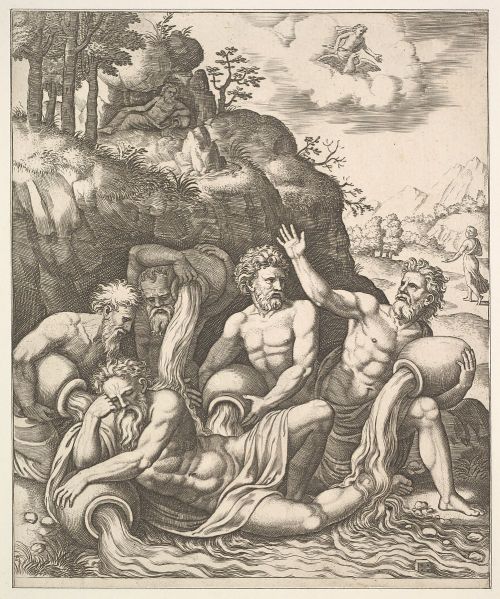
“The Transformation of Io into a Heyfer” – Ovid

main-image

  “River gods consoling Peneus for the Loss of his Daughter, Daphne (1530–60) 


           Master of the Die


                __________


the transformation of Daphne into 

a lawrel, though a story on its own,

has repercussions, which flow into

the introduction of Ovid‘s following 

instalment, The Transformation of

Io into a Heyfer“, however 

essentially unrelated 


                  An ancient forest in Thessalia grows; 


Thessalia, or Thessaly, a region of

Ancient Greece 


                  Which Tempe’s pleasing valley does inclose: 


Tempe, a valley, or vale, in Greece,

the Vale of Tempe, with a rich

mythological history


                  Through this the rapid Peneus take his course; 


Peneus, river god, Daphne‘s father


you’ll note that Peneus is given 

a plural conjugation here, take 

instead of takes in the singular,

unless this is a typo, otherwise

we have a metonym at work, a 

part signifying the whole, the 

whole in this instance meaning

the collection of rivers of which

Peneus was the god


                  From Pindus rolling with impetuous force; 


Pindus, a mountain range in 

northern Greece named after 

its highest peak


                  Mists from the river’s mighty fall arise: 


the river, one of Peneus‘ mighty 

torrents, cascading down the 

mountain, the Pindus, creating, 

along the way, [m]ists


                  And deadly damps inclose the cloudy skies:
                  Perpetual fogs are hanging o’er the wood;
                  And sounds of waters deaf the neighbourhood. 


deaf, used as a verb here, means 

to deafen, to prevent sounds from 

being heard


                  Deep, in a rocky cave, he makes abode 


he, Peneus, the river god


                  (A mansion proper for a mourning God). 


mourning God, Peneus, who’s just

lost Daphnehis daughter


                  Here he gives audience; issuing out decrees
                  To rivers, his dependant deities.
                  On this occasion hither they resort;
                  To pay their homage, and to make their court. 


to make their court, [t]o pay  homage, 

to attend to, their sovereign, Peneus 


                  All doubtful, whether to congratulate
                  His daughter’s honour, or lament her fate. 


His daughter’s honour, Daphne has 

been deemed the symbolic mistress 

of champions, to compensate for her

irreversible, and lament[able], 

transformation


                  Sperchaeus, crown’d with poplar, first appears;
                  Then old Apidanus came crown’d with years:
                  Enipeus turbulent, Amphrysos tame;
                  And Aeas last with lagging waters came. 


Sperchaeus, or SpercheiosApidanus

Enipeus, Amphrysos, or Amphrysus

and Aeas, are all river gods, if not all 

actual rivers


                  Then, of his kindred brooks, a num’rous throng
                  Condole his loss; and bring their urns along. 


kindred brooks, smaller tributaries, 

of Peneus


                  Not one was wanting of the wat’ry train,
                  That fill’d his flood, or mingled with the main: 


all the waterways, the wat’ry flows, 

train, were in attendance


                  But Inachus, who in his cave, alone, 


Inachus, a personification of the 

Greek river, Inachos


                  Wept not another’s losses, but his own,
                  For his dear Io, whether stray’d, or dead, 


Io, nymph, a nature spirit, daughter 

of Inachus


                  To him uncertain, doubtful tears he shed.
                  He sought her through the world; but sought in vain;
                  
And no where finding, rather fear’d her slain. 


a tragedy in the making


to be continued


R ! chard