Richibi’s Weblog

Just another WordPress.com weblog

Tag: Argus Panoptes

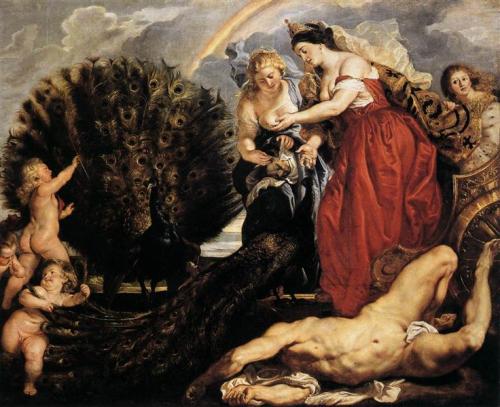
“The Eyes of Argus transform’d into a Peacock’s Train” – Ovid

juno-and-argus.jpg!Large

    Juno and Argus (c.1611) 


           Peter Paul Rubens


                         ______


                  While Hermes pip’d, and sung, and told his tale,
                  The keeper’s winking eyes began to fail, 


The keeper, Argus, of Io, nymph

become heifer


                  And drowsie slumber on the lids to creep; 
                  ‘Till all the watchman was at length asleep. 


all the watchman, all of Argus‘ eyes, 

were closed, asleep, at length, after 

a time 


                  Then soon the God his voice, and song supprest; 


the God, Hermes, messenger of the

gods, on a mission from Jove / 

Jupiter / Zeus to save Io, nymph 

become heifer


his voice, and song supprest, Hermes 

stopped talking, stopped playing his

song, his music


                  And with his pow’rful rod confirm’d his rest: 


his powerful rod, the caduceus, with

which Hermes could both waken those

asleep as well lull the wakeful to

slumber


                  Without delay his crooked faulchion drew, 


faulchion, now spelled falchion, 

is a short sword with only one 

sharp edge, a sort of sickle


since falchions go back only to the 

13th Century, Dryden‘s translation 

from the Latin has to be an 

anachronism


just saying


                  And at one fatal stroke the keeper slew.
                  Down from the rock fell the dissever’d head,
                  Opening its eyes in death; and falling, bled;
                  And mark’d the passage with a crimson trail:
                  Thus Argus lies in pieces, cold, and pale;
                  And all his hundred eyes, with all their light,
                  Are clos’d at once, in one perpetual night.
                  These Juno takes, that they no more may fail,
                  And spreads them in her peacock’s gaudy tail. 


see above


Juno, wife of Jove / Jupiter / Zeus,
queen, therefore, of the gods and 

goddesses


                  Impatient to revenge her injur’d bed, 


Juno had been offended by the fact 

that Jove / Jupiter / Zeus had

transgressed 


                  She wreaks her anger on her rival’s head; 


her rival, Io


                  With Furies frights her from her native home; 


Furies, also known as Erinyes

goddesses of vengeance, the 

oldest of all the deities, they live 

in Erebus, the Underworld, look 

frightful, snakes in their hair, bat’s 

wings, and haunt, unsettle, the 

disrespectful, the insolent, those 

who betray, are not true to, their 

word 


frights, frightens


                  And drives her gadding, round the world to roam: 


her, Io, nymph become heifer


to gad, to wander


                  Nor ceas’d her madness, and her flight, before
                  She touch’d the limits of the Pharian shore. 


Pharian, relating to Pharos, island off 

the coast of Alexandria, notable for 

its lighthouse, itself called Pharos

one of the Seven Wonders of the 

Ancient World


                  At length, arriving on the banks of Nile,
                  Wearied with length of ways, and worn with toil,
                  She laid her down; 


She laid her down, she laid herself 

down, stopped, stayed in place


                                                 and leaning on her knees,
                  Invok’d the cause of all her miseries: 


the cause of all her miseries, Jove /

Jupiter / Zeus, who’d abandoned 

her, Io, to the wrath of Juno, his 

wife, when she’d discovered him 

to be unfaithful 


                  And cast her languishing regards above,
                  For help from Heav’n, and her ungrateful Jove.
                  She sigh’d, she wept, she low’d; ’twas all she cou’d;
                  And with unkindness seem’d to tax the God. 


to tax, to accuse, to make 

responsible for


                  Last, with an humble pray’r, she beg’d repose,
                  Or death at least, to finish all her woes. 


repose, relief, Io, nymph become 

heifer, has completely had it


                  Jove heard her vows, and with a flatt’ring look,
                  In her behalf to jealous Juno spoke, 


a flatt’ring look, a seductive approach,

toward Juno, his reproachful wife


                  He cast his arms about her neck, and said,
                  Dame, rest secure; no more thy nuptial bed
                  This nymph shall violate; 


Dame, or Madam


                                                       by Styx I swear, 


Styx, one of the five rivers that 

separate Earth from the 

Underworld, also one of the 

earliest goddesses, after whom

the river itself was named, who 

had, significantly, sided with Jove /

Jupiter / Zeus during the Giants’ 

War, for which, upon having won, 

Jove / Jupiter / Zeus ordained that 

all oaths be sworn upon her, Styx

much as we, in our own day, swear 

upon Bibles


this all precedes, note, Bibles


                  And every oath that binds the Thunderer. 


the Thunderer, Jove / Jupiter, Zeus,

god, indeed, of Thunder


                  The Goddess was appeas’d;  


The Goddess, Juno


                                                       and at the word
                  Was Io to her former shape restor’d.
                  The rugged hair began to fall away;
                  The sweetness of her eyes did only stay,
                  Tho’ not so large; her crooked horns decrease;
                  The wideness of her jaws and nostrils cease:
                  Her hoofs to hands return, in little space: 


little space, the blink of an eye


                  The five long taper fingers take their place,
                  And nothing of the heyfer now is seen,
                  Beside the native whiteness of the skin.
                  Erected on her feet she walks again:
                  And two the duty of the four sustain. 


rather than walk on four feet, Io

now stands erect, [e]rected, on 

two


                  She tries her tongue; her silence softly breaks,
                  And fears her former lowings when she speaks: 


she can hardly believe she’s  

become, not just a nymph,

but indeed 


                  A Goddess now, through all th’ Aegyptian State:
                  And serv’d by priests, who in white linnen wait. 


Io has become the Egyptian 

goddess Isis


but that’s an entirely other story 


stay tuned


R ! chard


“The Afternoon of a Faun” – Debussy / Nijinsky / Nureyev

397px-Faun_merse

      Faun and Nymph (1867)


              Pál Szinyei Merse               


                      ________


to take a break, for a moment, from the

travails of Io, a heifer still, though her

father, Inachus, is aware of the situation,

and Hermes, messenger of the gods, is 

out, on the orders of Jove/ Jupiter / Zeus

to save her, and, at the same time, 

inspired by the music Hermes tells Argus

her many-eyed keeper, Pan, god of the

wilds, has been playing, with reeds he’s 

been left with of Syrinx, the nymph he  

would’ve loved had she not been 

transformed into rushes, as imagined by 

Debussy in his evocative Syrinx for solo 

flute, as highlighted in my last instalment

I could not not remember Debussy‘s 

other similarly mythological, and intimately

related, work, his Prelude to the Afternoon 

of a Faun, as modified itself by Vaslav

Nijinsky, legendary dancer and 

choreographer, into an event that verily 

shook the early 20th Century 


retitled, L’après-midi d’un faune, The

Afternoon of a Faun in English, the 

performance captures everything one

would gather from Ovid’s myths of its 

primitive, primal, sensibilities


the faun, needless to say, is representative 

of Pan, god of the wild, woodlands, a satyr, 

part instinct, part man, see above 


watch Rudolf Nureyev, then, his equally 

celebrated successor, take on the role

Nijinsky made famous, without any 

alterations made to the original 1912 

production, however improbably, 

though entirely successfully, we’re in 

Paris, May 29, though transposed,

faithfully and superbly, to New York,

Broadway, 1979 


proceed, however, at your own discretion, 

The Afternoon of a Faun is steaming, it’s 

about what happens when a young buck’s 

fancies, implacable and irrepressible, turn 

to love, not for the scrupulous, where does 

love begin, it asks, and lust retire, or is it 

the other way around, where does yin, in 

other words, meet, become, yang


these are questions that more and more 

begin to come up, you’ll find, in Greek 

and Roman, and most other ancient, 

for that matter, mythologies, something 

that isn’t at all touched upon in the 

Abrahamic traditions, Christanity, Islam, 

Judaism, monotheistic, though they’re 

at least as old, where nature, the place 

of animals, vegetation, land, water, our

intimate interconnection with them, 

don’t much, for better or for worse, 

come up


I miss the wonder of the more 

pantheistic, the pagan, perspective 


enjoy


R ! chard


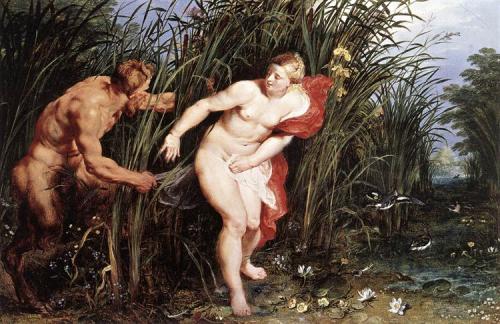
The Transformation of Syrinx into Reeds

pan-and-syrinx-1619.jpg!Large

   Pan and Syrinx (1617 – 1619) 


           Peter Paul Rubens


                 __________


               Then Hermes thus: 


Hermes, messenger of the gods,

addresses Argus, keeper of Io

who’s been transformed by Jove

god of gods, into a heifer, though 

she remains daughter, ever, of 

Inachus, river god, to tell the

story of his rare, beguiling reeds


                                             A nymph of late there was
               Whose heav’nly form her fellows did surpass. 


here we go again with nymphs, 

beautiful, irresistible, however 

ever innocent, prey, due, indeed,

to their very beauty, their very

innocence, to lustful, inordinate 

desires, in these instances, 

markedly divine 


deities, I point out again, make 

up their own rules


               The pride and joy of fair Arcadia’s plains, 


Arcadia, apart from being an 

actual area of Greece, is also 

the ideal, in our historical 

imagination, of an utopia

much as is the lost island of

Atlantis 


               Belov’d by deities, ador’d by swains:
               Syrinx her name, by Sylvans oft pursu’d, 


Sylvans, could only be, though

I’ve been unable to find actual 

confirmation of my opinion, 

wood spirits, forest entities, 

satyrs, goat men, and such


               As oft she did the lustful Gods delude: 


Syrinx could often, or oft, delude, 

or fool, ward off, the lustful Gods


               The rural, and the woodland Pow’rs disdain’d; 


satyr yourself, Syrinx would’ve 

impudently taunted


               With Cynthia hunted, and her rites maintain’d:
               Like Phoebe clad, even Phoebe’s self she seems, 


Cynthia, is Phoebe, both also known

as Dianagoddess of the Hunt, you’ll

remember Phoebe / Diana from her

connection to Daphne, who earlier

here was transformed into a laurel 


Syrinx sounds an awful lot, incidentally,

like another version of Daphne


               So tall, so streight, such well-proportion’d limbs:
               The nicest eye did no distinction know,
               But that the goddess bore a golden bow: 


the only difference between Syrinx

and Cynthia / Phoebe / Diana was 

that Syrinx didn’t have, bear, 

golden bow


               Distinguish’d thus, the sight she cheated too. 


had she borne a golden bow, Syrinx

[d]istinguish’d thus, would’ve cheated 

the sight, looked identical, to the 

beautiful, it is inferred, goddess 


               Descending from Lycaeus, Pan admires
               The matchless nymph, and burns with new desires. 


Pan, god of the wild, woodlands


Lycaeus, Latin spelling of Lykaion,

is a mountain in Arcadia


               A crown of pine upon his head he wore;
               And thus began her pity to implore.
               But e’er he thus began, she took her flight
               So swift, she was already out of sight.
               Nor stay’d to hear the courtship of the God;
               But bent her course to Ladon’s gentle flood: 


Ladon, a river in Arcadia 


flood, rushing, though gentl[y], 

water, rhymes in the preceding 

verse, you’ll note, with God


               There by the river stopt, and tir’d before;
               Relief from water nymphs her pray’rs implore. 


Syrinx, once by the river stopt, seeks 

the help of, assistance, [r]elief from, 

the nearby water nymphs, her 

consorts  


               Now while the lustful God, with speedy pace,
               Just thought to strain her in a strict embrace, 


Pan, like Phoebus / Apollo, or 

Jove / Jupiter / Zeus before him,

is, as well, and characteristically,

a lustful God


               He fill’d his arms with reeds, new rising on the place.
               And while he sighs, his ill success to find, 


his ill success, his thwarted, 

ineffective, enterprise 


               The tender canes were shaken by the wind;
               And breath’d a mournful air, unheard before; 


the reeds that Pan gathered in his arms, 

shaken by the wind, create a mournful 

air, a melancholy music


               That much surprizing Pan, yet pleas’d him more. 


though Pan might’ve been much

surpriz[ed] by the sorrowful sounds 

he heard, he was more pleas’d by 

them than startled


               Admiring this new musick, Thou, he said,
               Who canst not be the partner of my bed,
               At least shall be the confort of my mind: 


Thou, Syrinx


               And often, often to my lips be joyn’d. 


in a kiss of consolation 


               He form’d the reeds, proportion’d as they are,
               Unequal in their length, and wax’d with care,
               They still retain the name of his ungrateful fair. 


the instrument Pan devised from

the tender canes he fashioned

from the unaccommodating reeds, 

what we now name the Pan flute

was called in Ancient Greece a 

syrinx, in honour of the 

recalcitrant nymph 


listen, coincidentally, to Debussy 

tell the storyfor solo flute,

however, which is to say, on a

modern instrumentfor our having 

long ago abandoned at a 

professional level the original pipe, 

though it remains, apparently, as a

folk instrument in more agrarian,

communities around the world, for 

shepherds, one would imagine, to

while away the hours while tending

to their, however wayward, sheep 


R ! chard


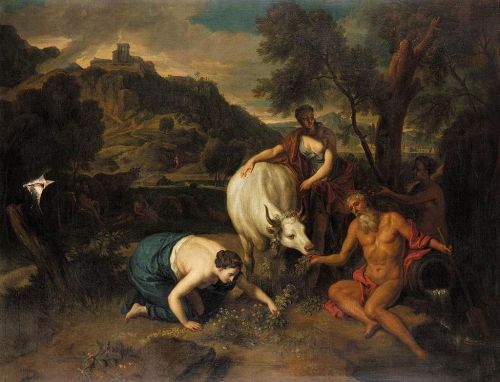
“The Transformation of Io into a Heyfer” (III) – Ovid

1024px-Victor-Janssens_Io-recognized-by-her-father

     Io Recognised by Her Father 


          Victor Honoré Janssens


              ______________


               The head of Argus (as with stars the skies)
               Was compass’d round, and wore an hundred eyes. 


not only did [t]he head of Argus have

an hundred eyes, but they circled,

compass’d, round his head, as with

stars the skies, as with stars the

geocentric firmament 


note the passive form of the verb to 

compass in the two lines above 

standing in for the inverted sentences

I earlier made mention of as literary 

devices Ovid, or Dryden, uses 

throughout the poem


the standard sentence, the active

sentence,  should read, an hundred

eyes compass’d [t]he head of Argus


compass’d, encircled


               But two by turns their lids in slumber steep;
               The rest on duty still their station keep;
               Nor cou’d the total constellation sleep. 


never could all the eyes, the total

constellation, sleep, or in slumber 

steep, since only two of them would 

turn[ ] their lids, close, at a time, 

while the others continued diligently

to keep watch


steep, incidentally, is a verb here, 

as in to put the kettle on, not an 

adjective, as in dauntingly

pitched, threateningly angled 


               Thus, ever present, to his eyes, and mind,
               His charge was still before him, tho’ behind. 


even when she was standing behind

him, Argus could still see Io, [h]is

charge, with the eyes he had in the

back of his head


               In fields he suffer’d her to feed by Day,
               But when the setting sun to night gave way,
               The captive cow he summon’d with a call;
               And drove her back, and ty’d her to the stall.
               On leaves of trees, and bitter herbs she fed,
               Heav’n was her canopy, bare earth her bed:
               So hardly lodg’d, and to digest her food,
               She drank from troubled streams, defil’d with mud. 


hardly lodg’d, given difficult living 

conditions


               Her woeful story fain she wou’d have told,
               With hands upheld, but had no hands to hold. 


fain, gladly


               Her head to her ungentle keeper bow’d,
               She strove to speak, she spoke not, but she low’d: 


to low is to make the sound that 

cows do, to moo


               Affrighted with the noise, she look’d around,
               And seem’d t’ inquire the author of the sound. 


the sound that she herself was making 

not only [a]ffrighted her, frightened her, 

but had her wondering where could 

it possibly be coming from 


               Once on the banks where often she had play’d
               (Her father’s banks), she came, 


Her father, Inachus, god of rivers


                                                    and there survey’d
               Her alter’d visage, and her branching head;
               And starting, from her self she wou’d have fled. 


much as the sound of her altered

voice had [a]ffrighted Io, now her 

reflection in the water chastened 

her as well, enough to make her

start, be startled, and want to run 

away from her self


               Her fellow nymphs, familiar to her eyes,
               Beheld, but knew her not in this disguise.
               Ev’n Inachus himself was ignorant;
               And in his daughter, did his daughter want. 


no one recognized Io, not even 

her father, who, in his daughter, 

the one who stood before him, 

the altered Io, could not make 

her out 


did his daughter want, as in to 

be found wanting, in the cow, 

to not even be suggested in

the, however conspicuous, 

heifer, not at all part of the 

picture 


Io is there but, simultaneously, 

disconcertingly, not there


               She follow’d where her fellows went, as she
               Were still a partner of the company: 


it should be remembered that 

Io was a beautiful heifer, even 

Juno had been impressed, so

that her fellows, her companions,

only other maidens, I’ll point out, 

fellows taking on its sexually 

indiscriminate meaning here, 

not at all restricted to males, 

would have easily let her follow


note the symmetry, incidentally, 

between follow’d and fellows, 

the nearly hidden alliteration, 

a delightful literary effect, 

though if you blinked you’d 

miss it


               They stroak her neck; the gentle heyfer stands,
               And her neck offers to their stroaking hands.
               Her father gave her grass; the grass she took;
               And lick’d his palms, and cast a piteous look;
               And in the language of her eyes, she spoke. 


her lowing would’ve had no effect,

would’ve let no one in on the fact

that beneath the animal exterior 

there might be an Io


               She wou’d have told her name, and ask’d relief,
               But wanting words, in tears she tells her grief.
               Which,


and here we get the punchline,

the plot twist, which turns this

story into, relatively speaking,

a total enchantment, as though 

Ovid were giving us, prefiguring

in fact, Walt Disney, our own 

20th Century mythologist


                            with her foot she makes him understand;
               And prints the name of Io in the sand. 


see above


R ! chard


“The Transformation of Io into a Heyfer” (II) – Ovid

Gerbrand_van_den_Eeckhout_-_Juno,_Jupiter_and_Io

   Juno, Jupiter and Io (1672) 


          Gerbrand van den Eeckhout


                      ________________


we left Inachus in my last instalment

looking for his daughter, Io


              Her, just returning from her father’s brook


Her, Io 


              Jove had beheld, with a desiring look: 


the sentence structure, as it’s been

crafted in the verses above, has 

been an aspect of Ovid’s poem for 

some time, though, it must again 

be noted, as translated by John 

Dryden, the subject goes where 

the object should go, the sentence 

is inverted


the sentence should be, Jove had

beheld her, … just returning from 

her father’s brook


but the placement of Her at the 

top of the sentence, and even 

capitalized, is, you must admit,
arresting, and of the highest

poetic order


              And, Oh fair daughter of the flood, he said, 


the flood, the many rivers that came 

to comfort Inachus, their sovereign, 

in his distress at having lost Io, his 

daughter, their many surging 

confluences would’ve created 

overflowing torrents, the flood


              Worthy alone of Jove’s imperial bed, 


Jove thinks Io worthy of no one 

else’s mattress but his own


              Happy whoever shall those charms possess;
              The king of Gods (nor is thy lover less)
              Invites thee to yon cooler shades; to shun
              The scorching rays of the meridian sun. 


whoever might partake of her charms,

Jove tells Io, would be Happy


again an inverted sentence, note


but Jove makes his play, flashes 

his pedigree,The king of Gods, 

nothing less, and invites her to a 

shady grove, out of the noonday, 

the meridian, sun


              Nor shalt thou tempt the dangers of the grove
              Alone, without a guide; thy guide is Jove. 


Jove / Jupiter, god of gods


              No puny Pow’r, but he whose high command
              Is unconfin’d, 


Jove / Jupiter is not a nobody, but, 

rather, unconfin’d, omnipotent,

he boasts


                                    who rules the seas and land;
              And tempers thunder in his awful hand, 


Jove / Jupiter, supreme master of 

the elements


              Oh fly not: 


Jove urges Io


                                for she fled from his embrace
              O’er Lerna’s pastures: 


Lerna, a region of Ancient Greece


                                                he pursu’d the chace
              Along the shades of the Lyrcaean plain; 


Lyrcaean, after some investigation,

seems to mean from Lycaeus, the

Latin name for Lykaion, a mountain

in Greece, considered by some to

be the birthplace of Jove / Jupiter /

Zeus


otherwise, but very improbably, the 

Lyrcaean plain is a literary invention,

of Ovid, or of his translator, Dryden


              At length the God, who never asks in vain,
              Involv’d with vapours, imitating night,
              Both Air, and Earth; 


Inform’d with, having transformed 

himself into, vapours, a mist, 

imitating night, shrouding [b]oth 

Air and Earth in darkness, 

becoming himself, therefore, 

indistinct, indefinite, nebulous, 

within them


                                              and then suppress’d her flight,
              And mingling force with love, enjoy’d the full delight. 


first of all Phoebus / Apollo‘s pursuit 

of Daphne, and now Jove / Jupiter‘s 

constraint of Io, are not admirable

aspects of male deities, indeed in

our age of action against the 

harassment of women, their 

behaviour is disturbing, uncomfortable

for me even to read, I’m too reminded 

of dissolute American CEOs, not to

mention presidents, but concluding 

that this dilemma has been around 

for countless ages among vertebrates,

be they animal, human, or, as in these 

instances, divine, therefore written in 

our antediluvian, our primeval, genes, 

maybe, consequently, ineradicably


              Mean-time the jealous Juno, from on high, 


Juno, goddess of goddesses, wife

of Jupiter / Jove


              Survey’d the fruitful fields of Arcady; 


Arcady, or Arcadia, a region still 

of Greece


              And wonder’d that the mist shou’d over-run
              The face of day-light, and obscure the sun. 


which is to say, Juno, suspicious, 

asks herself, what’s up with that 


              No nat’ral cause she found, from brooks, or bogs,
              Or marshy lowlands, to produce the fogs; 


she reckons


              Then round the skies she sought for Jupiter,
              Her faithless husband; but no Jove was there: 


Juno knows her Jove / Jupiter


              Suspecting now the worst, Or I, she said,
              Am much mistaken, or am much betray’d. 


it’s one of two things, Juno figures, 

after [s]uspecting … the worst, I am 

myself in error, she concludes, I am

myself mistaken , or am, by my 

husband, much betray’d 


              With fury she precipitates her flight: 


her flight, her plan of action, both

geographical, and tactical


              Dispels the shadows of dissembled night; 


dissembled, sham, not actual, Jove / 

Jupiter, if you’ll remember, Involv’d 

with vapours, was imitating night,

not easily visible


              And to the day restores his native light. 


note that day is masculine here, 

his native light


              Th’ Almighty Leacher, careful to prevent
              The consequence, foreseeing her descent,
              Transforms his mistress in a trice; and now
              In Io’s place appears a lovely cow. 


Leacher, lecher


in a trice, very quickly, in the bat

of an eyelash


a cow 


see above


              So sleek her skin, so faultless was her make,
              Ev’n Juno did unwilling pleasure take
              To see so fair a rival of her love; 


though transformed into a cow, Io 

remains lovely, even Juno can see 

that, however be she jealous 


              And what she was, and whence, enquir’d of Jove: 


where did you get that, Juno asks 

of Jove, surely dryly


              Of what fair herd, and from what pedigree? 


and what, and when, and how, she

further inquires, probably acidly 


              The God, half caught, was forc’d upon a lye:
              And said she sprung from Earth. 


Jove, who’d had to tell a lye, a lie, 

said that the heifer, the altered Io

had sprung, spontaneously, he 

claimed, from the earth


                                                     She took the word, 


Juno accepted Jove‘s explanation


              And begg’d the beauteous heyfer of her lord. 


Juno asks of Jove that she might 

keep the heyfer for herself, the 

heifer, a virgin cow


              What should he do? ’twas equal shame to Jove
              Or to relinquish, or betray his love:
              Yet to refuse so slight a gift, wou’d be
              But more t’ increase his consort’s jealousie: 


Jove / Jupiter was in a bind, to

out Io, or to out himself


              Thus fear, and love, by turns, his heart assail’d;
              And stronger love had sure, at length, prevail’d:
              But some faint hope remain’d, his jealous queen
              Had not the mistress through the heyfer seen. 


if it weren’t for the fact that Juno

maybe, some faint hope, might 

not have recognized Io in the 

heifer, Jove / Jupiter would’ve, 

had sure, eventually, at length, 

confessed to his indiscretion, his

stronger love, having prevail’d


              The cautious Goddess, of her gift possest,
              Yet 
harbour’d anxious thoughts within her breast;
              As she who knew the falshood of her Jove;


though Juno has been granted her

request, she remains sceptical, 

knew her husband was prone to

falshood, or falsehood


              And justly fear’d some new relapse of love. 


justly, the facts would bear her out, 

were she cognizant of them


              Which to prevent, and to secure her care,
              To trusty Argus she commits the fair. 


Argus Panoptes, one of the giants 

who must’ve remained after their 

war 


Panoptes, pan optes, Greek for many 

eyes, of which only a few, it came to 

be believed, of Juno‘s entrusted

guardian, slept at a time


to be continued


R ! chard


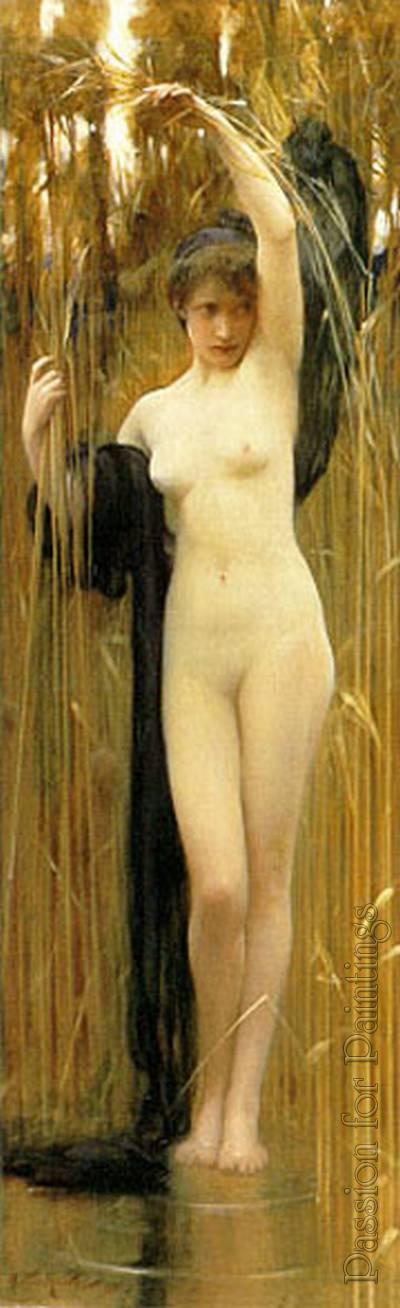
“Syrinx” – Claude Debussy‏

big

         Syrinx (1892)
 
          Arthur Hacker
 
            __________
 
 
though Debussy would’ve called his
Syrinx “Flûte de Pan”, “Pan Flute”,
alas, the name had already been 
taken, he therefore came up with the 
much more inspired Syrinx
 
Syrinx, with the help of other nymphs, 
who’d come at her cry for help as she 
fled the god Pan, a pursuer, had been 
turned into a bush of reeds, its canes 
producing a song so sweet as to 
confound and disarm him, impelling
him to create of them that sublime 
instrument  
 
Hermes had been telling Argus, Argus 
Panoptes, the giant with the hundred 
eyes, the story about the pipes he  
was playing, an implement received 
from Jove, apparently, god of all the 
gods, who wanted him to kill Argus, 
for confining Io, who’d been turned 
into a heifer by Juno, Jove’s wife, 
who’d caught him chasing her, Io’s 
plaintive lows had been getting to 
Juno as Io fretted unfettered through 
the fields too close to Olympus 
 
when Hermes’ music finally closed the
giant’s last two eyes, he beheaded him,
but Juno, in merciful recognition of his
service, however ultimately ineffectual, 
set them into the variegated tail of the 
peacock
 
are you kidding me, I always think when
I read Ovid’s “Metamorphoses”, and am
ever nevertheless entirely enchanted
 
a flute solo had not been composed in
over 150 years when Debussy composed
his Syrinx“, 1913, after C.P.E. Bach’s not  
at all unimpressive Sonata in A Minor 
of 1747, it duly set off a new life for the 
long overlooked flute, a reed which 
Mozart famously didn’t like
 
note the tonal, rhythmic, and repetition 
shifts from the rigid Classical model, 
where these are much more strict, 
Impressionism was not only breaking 
down pictures, the pictorial arts, but its
sound world as well, it was an utterly
new era, new sensibility, new zeitgeist, 
and you can feel it, though you might
not be quite able to immediately 
verbalize it, the arts were again, as
they ever ‘ve been, the canary in the 
gold mine
 
 
Richard
 
psst:
 
   The Transformation of Syrinx into Reeds 
 
Then Hermes thus: A nymph of late there was 
Whose heav’nly form her fellows did surpass. 
The pride and joy of fair Arcadia’s plains, 
Belov’d by deities, ador’d by swains: 
Syrinx her name, by Sylvans oft pursu’d, 
As oft she did the lustful Gods delude: 
The rural, and the woodland Pow’rs disdain’d; 
With Cynthia hunted, and her rites maintain’d: 
Like Phoebe clad, even Phoebe’s self she seems, 
So tall, so streight, such well-proportion’d limbs: 
The nicest eye did no distinction know, 
But that the goddess bore a golden bow: 
Distinguish’d thus, the sight she cheated too. 
Descending from Lycaeus, Pan admires 
The matchless nymph, and burns with new desires. 
A crown of pine upon his head he wore; 
And thus began her pity to implore. 
 
Now while the lustful God, with speedy pace, 
Just thought to strain her in a strict embrace, 
He fill’d his arms with reeds, new rising on the place. 
And while he sighs, his ill success to find, 
The tender canes were shaken by the wind; 
And breath’d a mournful air, unheard before; 
That much surprizing Pan, yet pleas’d him more. 
Admiring this new musick, Thou, he said, 
Who canst not be the partner of my bed, 
At least shall be the confort of my mind: 
And often, often to my lips be joyn’d. 
He form’d the reeds, proportion’d as they are, 
Unequal in their length, and wax’d with care, 
They still retain the name of his ungrateful fair.
 
                                                  Ovid