Richibi’s Weblog

Just another WordPress.com weblog

Category: poetry

“Metamorphoses” (The Giants’ War, XIII) – Ovid

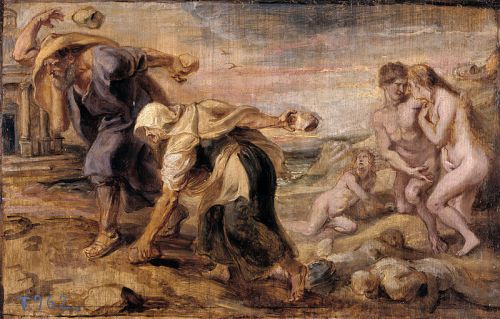
800px-Peter_Paul_Rubens_-_Deucalion_and_Pyrrha,_1636

      Deucalion and Pyrrha (1636) 


             Peter Paul Rubens


                 ___________


                                          for my mom and dad, my own

                                                   Deucalion and Pyrrha


at Cephysus‘ shrine, Deucalion and 

Pyrrha pray to the goddess of

Divine Justice


              O righteous Themis, if the Pow’rs above
              By pray’rs are bent to pity, and to love;
              If humane miseries can move their mind; 


humane, human


              If yet they can forgive, and yet be kind;
              Tell how we may restore, by second birth,
              Mankind, and people desolated Earth. 


the Pow’rs above are the deciding 

factors, can Jove, Neptune, the others, 

Deucalion asks, be moved by human[ ] 

miseries, can they forgive, can they 

restore…Mankind, people, people is

a verb here, the world again, the 

desolated, or desolate, the dismal, 

the forsaken, Earth


              Then thus the gracious Goddess, nodding, said;
              Depart, and with your vestments veil your head:
              And stooping lowly down, with losen’d zones,
              Throw each behind your backs, your mighty mother’s bones. 


losen’d zones, across wide areas


cover, veil, your heads, the goddess 

advises, stoop low, and throw your 

mother’s bones across wide areas, 

she instructs, however scandalously


              Amaz’d the pair, and mute with wonder stand,
              ‘Till Pyrrha first refus’d the dire command. 


Pyrrha is a counterpart for the Christian 

Eve here, contrary, defiant of Heaven, 

however eventually, Pyrrha, blameless, 

but which of the progenitresses came

first, which the chicken, which the egg, 

Eve or Pyrrha, is a question up for 

contemplation


              Forbid it Heav’n, said she, that I shou’d tear
              Those holy reliques from the sepulcher. 


surely, Pyrrha proclaims, Heav’n would 

never allow, Forbid it Heav’n, not to 

mention condone, that I should remove, 

tear, my mother’s bones, [t[hose holy 

reliques, relics, from their sepulcher, 

their grave, this would be profoundly 

unholy 


              They ponder’d the mysterious words again,
              For some new sense; and long they sought in vain:
              At length Deucalion clear’d his cloudy brow,
              And said, the dark Aenigma  


Aenigma, Sphinx, the oracle


                                                                will allow
              A meaning, which, if well I understand,
              From sacrilege will free the God’s command: 


if I can properly understand, decipher,

the meaning of the God’s command, 

Aenigma’s oracular words, however 

cryptic, in such a way, Deucalion 

declares, that our actions be not 

sacrilegious, nor offensive in any 

way to the gods, we may proceed,

he reasons


              This Earth our mighty mother is, the stones
              In her capacious body, are her bones: 


This Earth is our mighty mother, the

stones in her capacious body [ ] are 

her bones, no comma after body


the word order in each clause, note, has 

been reversed, instead of subject, verb,

object, we have object, verb, subject


but then, ever so felicitously, stones 

can rhyme with bones, and equally,

and as liltingly, we’re still in iambic 

pentameter


              These we must cast behind. With hope, and fear,
              The woman did the new solution hear:
              The man diffides in his own augury, 


diffide, distrust, augury, prediction,

Deucalion doubts, in other words,

his own calculations


              And doubts the Gods; yet both resolve to try. 


when my mom is up against a 

dilemma, she calls on my dad,

gone some over thirty years now,

come on, Daddy, let’s go, she 

says, and confronts the issue 

with transcendental, by very 

definition, conviction


see above


              Descending from the mount, they first unbind
              Their vests, and veil’d, they cast the stones behind:
              The stones (a miracle to mortal view,
              But long tradition makes it pass for true) 


what follows will seem miraculous

to mortals, Ovid says, but the story 

has been around for such a while,

which is to say by long tradition, 

that we let it pass for true


              Did first the rigour of their kind expel, 


the stones begin to lose, expel, their 

firmness, the rigour of their kind


              And suppled into softness, as they fell; 


suppled, became supple


              Then swell’d, and swelling, by degrees grew warm;
              And took the rudiments of human form. 


stones are being transformed, 

metamorphosized, into humans 


the Bible, if you’ll remember, would 

have it be clay


              Imperfect shapes: in marble such are seen,
              When the rude chizzel does the man begin; 


chizzel, chisel


              While yet the roughness of the stone remains,
              Without the rising muscles, and the veins. 


as the sculpture is being fashioned, 

certain parts of the human anatomy, 

the muscles, for instance, the veins, 

are not yet revealed, uncovered, 

discovered, extracted, by the 

chizzel, from under the roughness 

of the stone


think of Michelangelo, or Rodin,

sculpting


              The sappy parts, and next resembling juice, 


sappy, from sap, which, emanating 

from stones, would be next to, but 

not as limpid as, juice, or the liquid

required to create humans


              Were turn’d to moisture, for the body’s use:
              Supplying humours, blood, and nourishment; 


the circulatory, and notably viscous, 

system


              The rest, too solid to receive a bent,
              Converts to bones; and what was once a vein,
              Its former name and Nature did retain. 


veins, which hadn’t received enough 

sappy parts to become part of the

circulatory system, retained their 

name of vein, but as understood in

relation to rocks, geological veins

presumably replicated, in this story 

of the Creation, in human bones


              By help of pow’r divine, in little space, 


in little space, in no time at all


              What the man threw, assum’d a manly face;
              And what the wife, renew’d the female race. 


the stones that the man, Deucalion

threw became men, those that 

Pyrrha tossed became women 


              Hence we derive our nature; born to bear
              Laborious life; and harden’d into care.


we’ve inherited, through the labours 

of Deucalion and Pyrrha, our driven

nature, harden’d into, or conditioned, 

condemned, to care 


for better, I infer, or for worse 


R ! chard


“Metamorphoses” (The Giants’ War, XII) – Ovid

after-the-storm-1872.jpg!Large

      “After the Storm (1872)


            Gustave Courbet


                __________


                  A thin circumference of land appears;
                  And Earth, but not at once, her visage rears,
                  And peeps upon the seas from upper grounds; 


as the land begins to peep[ ] through 

the water, a circumference of land 

appears, a circle of Earth within the 

earlier universal water


to rear, to raise upright, boldly, the better,

here, for Earth‘s visage, Earth‘s face, to 

peep[ ] upon the seas from newly gained 

upper grounds


                  The streams, but just contain’d within their bounds,
                  By slow degrees into their channels crawl; 


streams, just recently redefining their  

boundaries, or bounds[b]y slow 

degrees settle, become waterways, 

channels, rivers, rivulets, rills


I love crawl here, incidentally, the slow, 

insidious, infiltration of a territory, silent 

and immutable, as [t]he streams, at the 

dispassionate pace of nature, find their 

individual course


                  And Earth increases, as the waters fall. 


the waters fall, the waters recede


                  In longer time the tops of trees appear, 


[i]n longer time, after a while


                  Which mud on their dishonour’d branches bear. 


for which the only solution here, would

be, I thought, however ironically, a

shower, rain


but I digress

                 
                  At length the world was all restor’d to view;

                  But desolate, and of a sickly hue:  

see, for instance, above


                  Nature beheld her self, and stood aghast,
                  A dismal desart, and a silent waste. 


desart, is desert, even my spellcheck 

insisted


meanwhile, back on Mount Parnassus

our two survivors, look around


                  Which when Deucalion, with a piteous look
                  Beheld, he wept, and thus to Pyrrha spoke: 


let me point out that what follows, 

which is to say when Deucalion 

… thus to Pyrrha spoke, we have 

an extended monologue, rather 

than a narration, the poet, Ovid

has given a voice to Deucalion

his character, his creation


I was reminded of Shakespeare‘s 

monologues, especially since the 

metre is iambic pentameter,

Shakespeare‘s signature poetic

rhythm 


it should be noted that this translation

of Metamorphoses is from 1717, a

century and a very year after 

Shakespeare‘s demise, in 1616, time 

for poets to have imbibed his already 

profound influence


nor could they not have been marked

by the spirit of their own time, and the 

many transformative epochs since 

Metamorphoses had been written, in 

the year 1, that would’ve affected the 

translation 


the original Latin text, for instance,

was in dactylic hexameter, not 

iambic pentameter


                  Oh wife, oh sister, oh of all thy kind
                  The best, and only creature left behind,
                  By kindred, love, and now by dangers joyn’d;
                  Of multitudes, who breath’d the common air,
                  We two remain; a species in a pair:
                  The rest the seas have swallow’d; nor have we
                  Ev’n of this wretched life a certainty.
                  The clouds are still above; and, while I speak,
                  A second deluge o’er our heads may break.
                  Shou’d I be snatcht from hence, and thou remain,
                  Without relief, or partner of thy pain,
                  How cou’dst thou such a wretched life sustain?
                  Shou’d I be left, and thou be lost, the sea
                  That bury’d her I lov’d, shou’d bury me.
                  Oh cou’d our father his old arts inspire,
                  And make me heir of his informing fire,
                  That so I might abolisht Man retrieve,
                  And perisht people in new souls might live.
                  But Heav’n is pleas’d, nor ought we to complain,
                  That we, th’ examples of mankind, remain. 


cou’d our father, JoveDeucalion asks,

breathe into me his inspiration, his old 

arts, his informing fire, so that I could 

reconstitute Man, retrieve him, and 

supply the perisht people with new, and

presumably more honourable, souls


                  He said; the careful couple joyn their tears: 


He said, or this he spoke, and the

couple joyn their tears


                  And then invoke the Gods, with pious prayers.
                  Thus, in devotion having eas’d their grief,
                  From sacred oracles they seek relief;
                  And to Cephysus’ brook their way pursue: 


Cephysus, or Cephissus, was a river god,

associated with the river Cephissus, which 

runs through Central Greece


                  The stream was troubled, but the ford they knew; 


the ford, the way across the stream


                  With living waters, in the fountain bred, 


living waters would gush from a 

spring, around which a fountain 

would’ve been built


                  They sprinkle first their garments, and their head,
                  Then took the way, which to the temple led.
                  The roofs were all defil’d with moss, and mire,
                  The desart altars void of solemn fire.
                  Before the gradual, prostrate they ador’d;
                  The pavement kiss’d; and thus the saint implor’d.


the gradual is a hymn sung within

the context of a full religious service


desart here is again desert, but in

this instance signifying deserted


the saint, an anachronism here, 

for saints were not at all even a

concept at the time of Ovid

would’ve been Themis, goddess,

at Delphi, on Mount Parnassus

of Divine Justice


R ! chard


“Metamorphoses” (The Giants’ War, XI) – Ovid

david-1624(4).jpg!Large

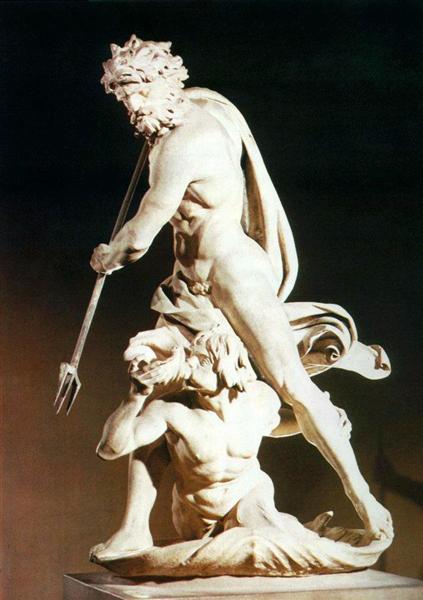
    “Neptune and Triton (1620 – 1622) 


          Gian Lorenzo Bernini


                ____________


              When Jupiter, surveying Earth from high,
              Beheld it in a lake of water lie,
              That where so many millions lately liv’d,
              But two, the best of either sex, surviv’d;
              He loos’d the northern wind; 


the new world begins


                                                       fierce Boreas flies
              To puff away the clouds, and purge the skies:
              Serenely, while he blows, the vapours driv’n,
              Discover Heav’n to Earth, and Earth to Heav’n. 


Boreas, ruler of the northern wind, as in 

aurora borealis, at the instigation of the

officiating Jupiter, disperses the clouds, 

drives away the vapours, allowing Heav’n 

to see Earth, and Earth  to see Heav’n, 

nothing between the earth and the 

clear blue sky


              The billows fall, while Neptune lays his mace
              On the rough sea, and smooths its furrow’d face. 


while billows fall, gusts of boreal wind, 

Neptune, god of the Sea, as well and 

simultaneously in the service of Jupiter

smooths the surface of the water by 

laying his mace, a club with spikes, 

upon it, to still the unruly waves


              Already Triton, at his call, appears
              Above the waves; 


Triton, son of Neptune, also a sea deity


                                           a Tyrian robe he wears; 


Tyrian, of Tyre, a city in what is now

Lebanon, but was then Phoenicia, it 

was famous at the time for its cloth 

of a particular colour, Tyrian purple


Tyre is one of the oldest continuously

inhabited cities in the world


              And in his hand a crooked trumpet bears. 


Triton is characteristically depicted 

with a conch shella crooked trumpet 


see above


              The soveraign bids him peaceful sounds inspire,
              And give the waves the signal to retire. 


[t]he soveraign, or sovereign, is none

other than Neptune, his father 


              His writhen shell he takes; whose narrow vent
              Grows by degrees into a large extent, 


writhen, twisted, contorted, as is typical 

of a conch shell, which grows from 

where one blows into it, by degrees,  

towards the much larger opening from 

which the sound emanates


              Then gives it breath; the blast with doubling sound,
              Runs the wide circuit of the world around: 


Triton blows into the conch, gives it 

breath, the blast [ ] doubling [the]

sound, resounding, reverberating, 

the world around, the world over


              The sun first heard it, in his early east,
              And met the rattling ecchos in the west.
              The waters, listning to the trumpet’s roar,
              Obey the summons, and forsake the shore.


the waters begin to recede


R ! chard


“Metamorphoses” (The Giants’ War, X) – Ovid

deucalion-and-pyrrha-praying-before-the-statue-of-the-goddess-themis.jpg!Large

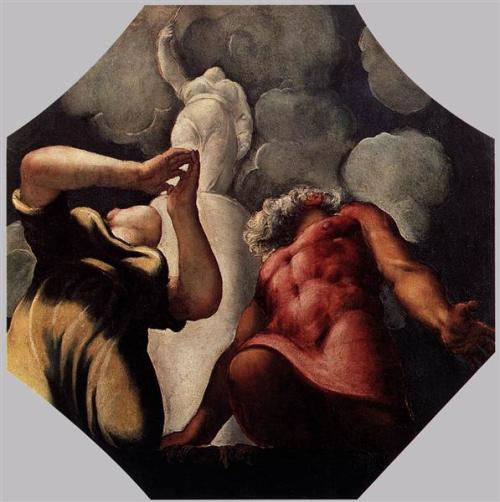
  “Deucalion and Pyrrha Praying before the Statue of the Goddess Themis (c.1542) 


          Tintoretto


             _____


              A mountain of stupendous height there stands
              Betwixt th’ Athenian and Boeotian lands, 


Boetia was, and still is, a region of 

Central Greece, its largest city is,

and was, Thebes, a major rival in

ancient times of Athens


              The bound of fruitful fields, while fields they were, 


bound, boundary, the fruitful fields

within a certain limited area, between 

Athens, here, and Boetia


              But then a field of waters did appear: 


              Parnassus is its name; whose forky rise
              Mounts thro’ the clouds, and mates the lofty skies. 


Parnassus is a mountain in Central 

Greece, however forky, however 

forked, craggy, uneven, sacred 

especially to Apollo, god of too 

many things to list here, and the 

site, at Delphi, on its south-western 

slope, of his Oracle, famous for 

being consulted on a variety of 

matters, from personal to affairs 

of state, its high priestess was 

believed to incarnate the very 

voice of Apollo


Parnassus was also the home, 

incidentally, of the Muses, goddesses 

in their own right, of the several arts, 

who ministered to Apollo


              High on the summit of this dubious cliff,
              Deucalion wafting, moor’d his little skiff. 


Deucalion is the Abrahamic Noah‘s

counterpart, sole survivor, with his 

wife Pyrrha, of the flood 


the cliff is dubious because the

mountain is still deep in water,

its summit precarious yet 


              He with his wife were only left behind
              Of perish’d Man; they two were human kind. 


they two alone were left of humankind,

of perish’d Man


              The mountain nymphs, and Themis they adore, 


Themis, goddess of Divine Justice


              And from her oracles relief implore. 


Deucalion and Pyrrha pray to Themis

at Delphi, its first high priestess, hungry

for, and heedful of, her oracles, counsel


see above


              The most upright of mortal men was he;
              The most sincere, and holy woman, she. 


a chance at a new world


R ! chard

“Metamorphoses” (The Giants’ War, IX) – Ovid

the-nereids-1886.jpg!Large

     “The Nereids (1886) 


            Joaquín Sorolla


                     _______


once the water begins to everywhere

oferflow, humans are left to somehow

find shelter, or perish


               One climbs a cliff; one in his boat is born: 


born here should be our 21st Century

borne, as in carried away, past participle 

of the verb to bear, to transport, a 

combination, incidentally, of verb forms, 

and divergent spellings, we’ve seen

here before


               And ploughs above, where late he sow’d his corn. 


ploughs, in the line above, deftly plays 

with a double meaning, to plough as in 

to struggle through, and to plough as 

in to work a field, the struggle is through 

water this time, however, not through

grassland


               Others o’er chimney-tops and turrets row,
               And drop their anchors on the meads below: 


meads, meadows


               Or downward driv’n, they bruise the tender vine,
               Or tost aloft, are knock’d against a pine. 


tossed, or tost, upon the waves, people 

are thrown about indiscriminately, some

against things that they break, bruise,

the tender vine, for instance, others 

against things that break them, the 

pine[s], all order, in the chaos, having 

been subverted


               And where of late the kids had cropt the grass, 


kids, baby goats


              The monsters of the deep now take their place. 


monsters of the deep, creepy things 

that lurk beneath the waves, now 

graze where earlier there’d been 

pasture, baby goats


               Insulting Nereids on the cities ride, 


Nereids, sea nymphs, daughters of Nereus

and Doris, god and goddess themselves, 

of water, fifty of them, one brother, Nerites

all often accompanying Poseidonsupreme 

ruler of the Sea, Neptune‘s Greek 

counterpart


the Nereids were especially known, in later, 

less turbulent times, to come to the aid of 

sailors 


               And wond’ring dolphins o’er the palace glide. 


wond’ring, would be wandering, as 

in to roam aimlessly, but one can 

hear rustling, in the background of

that unconventional spelling, the 

idea of dolphins wide-eyed, 

marvelling, filled with wonder, at 

this new, palatial, environment 


               On leaves, and masts of mighty oaks they brouze; 


brouze, browse, or the more familiar, 

graze, said of animals who eat grass, 

whereas those who browse, or brouze, 

eat leaves, shrubbery, greens which 

grow higher up


               And their broad fins entangle in the boughs. 


the fins of dolphins become entangled 

in the branches, boughs, of trees


               The frighted wolf now swims amongst the sheep; 


wolf and sheep, cast asunder, much 

like, above, man at the mercy of the 

pine, or the tender vine, all equals 

in their overriding fight for survival 


               The yellow lion wanders in the deep: 


the deep, the water


               His rapid force no longer helps the boar: 


earlier inherent skills have been

rendered irrelevant


               The stag swims faster, than he ran before.
               The fowls, long beating on their wings in vain,
               Despair of land, and drop into the main. 


the main, the ocean


               Now hills, and vales no more distinction know; 


the water has flattened all horizons


               And levell’d Nature lies oppress’d below. 


Nature, distinct from water here, 

now lies below the water’s surface


               The most of mortals perish in the flood:
               The small remainder dies for want of food. 


if Ovid remains to tell the tale, one

must suppose that this story must,

however relatively, have a happy 

ending


stay tuned


R ! chard


“Metamorphoses” (The Giants’ War, VIII) – Ovid

scene-of-the-deluge.jpg!Large

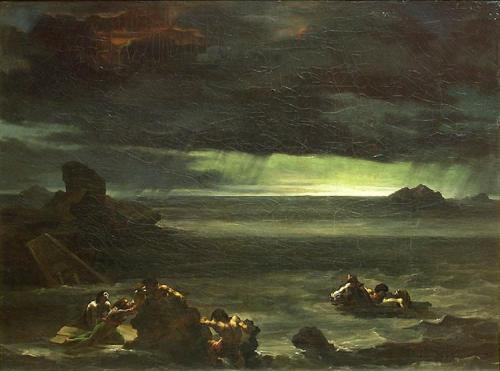
    Scene of the Deluge (1820) 


            Théodore Géricault


                    _______


following upon the threat of water,

rather than fire, to destroy the world

under the command of Jove, dutifully 

abetted by Neptune, his Olympian

brother, sea god himself, with his 

fleet of observant minions, the 

rivers, streams, waterways, the 

annihilating flood takes place


Ovid recounts


            The floods, by Nature enemies to land,
            And proudly swelling with their new command,
            Remove the living stones, that stopt their way, 


the living stones, you’ve got me there, 

these could only be stones as initial 

matter somehow contributing to the 

advent of an inherent life source, later 

activated, induced into vivifying action


we are dust, in other words, we return 

to dust, inert dust, however 

incomprehensibly


            And gushing from their source, augment the sea. 


the flowing rivers augment, enlarge, 

the growing sea, covering the land


          Then, with his mace, their monarch struck the ground; 


a mace is a club with metal spikes


          With inward trembling Earth receiv’d the wound; 


a comma after trembling here would 

make this line easier to read, “With

inward trembling, Earth receiv’d the 

wound”, but not everyone is as 

punctilious about grammar as I am


          And rising streams a ready passage found. 


streams easily found their way 

amidst the bracken, the shrubbery, 

the rushes, to overwhelm the 

otherwise quiescent pastures


          Th’ expanded waters gather on the plain: 


Manitoba, often, lately, in spring


          They float the fields, and over-top the grain;
          Then rushing onwards, with a sweepy sway,
          Bear flocks, and folds, and lab’ring hinds away. 


Bear here is a verb, not a noun, meaning 

that animals, flocks, and folds, and lab’ring

hinds, are carried away, borne away,

borne asunder 


          Nor safe their dwellings were, for, sap’d by floods, 


sap’d, sapped, deprived, weakened,

rendered unsuitable


          Their houses fell upon their houshold Gods. 


household Gods, icons, Lares or Penates

personally held by the Ancients, like we 

now keep pictures, tokens, of our own

particular, however often secular, 

rather than religious, idols


            The solid piles, too strongly built to fall,
            High o’er their heads, behold a watry wall: 


though tall, and apparently indestructible,

the solid piles are nevertheless submerged, 

the very recent South Asian tsunami, for

instance, or the Japanese one that 

provoked the nuclear incident that put an

end there to that earlier profoundly 

nationally integrated industry, if you’ll 

remember 


            Now seas and Earth were in confusion lost;
            A world of waters, and without a coast. 


water, water, everywhere, but the last 

thing you want to do is drink


next, how humans survive


stay tuned


R ! chard


“Metamorphoses” (The Giants’ War, VII) – Ovid

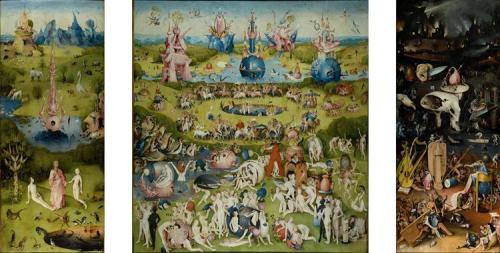
the-garden-of-earthly-delights-1515-7.jpg!Large

    The Garden of Earthly Delights (1510 – 1515) 


             Hieronymus Bosch


                  __________


              Nor from his patrimonial Heaven alone
              Is Jove content to pour his vengeance down; 


let me say something about Heaven 

here, a concept that is quite different 

from the earlier Ancient Greek and 

Roman understanding of the term, 

was it, for that matter, even a term

then, of the Ancients, that would’ve 

meant nothing other to them than 

the blue sky above, not at all an 

area reached by extraterrestrial 

transcendence


the abode of the gods and goddesses 

at the time of Ovid was Mount Olympus

and had been for centuries, much closer 

to the earth than the more ethereal home 

we imagine of the gods today, every one

of them, however professedly uniquely  

supreme, otherworldly


all gods, note, no goddesses, what’s up  

with that, I’ve long wondered


the Underworld was for the Ancients 

the dwelling place of the departed, 

somewhere deep beneath the earth, 

or at the very ends of all the seas, 

never totally beyond the very 

cosmos, as our prevailing faiths 

now uniformly preach 


the image of Heaven, Hell, and 

Purgatory for that matter, that last

a completely Catholic invention – to 

account for the salvation, however 

partial, of innocent souls deprived 

of Heaven for not having been 

christened, though not able yet, at 

so early an age, to have sinned – 

was pretty well codified by Dante

in the 14th Century in his 

masterpiece, The Divine Comedy,​ 

a daunting, but profoundly

illuminating read, which has 

shaped our impression of these 

several possible afterlives ever 

since


see above


this particular translation, however 

magisterial, but crafted after over a

thousand years of Catholic cultural 

domination, cannot avoid the impact 

of the Catholic understanding of 

Heaven


neither, now, can we, for that matter, 

intimately imbued as we are with

the binding faiths of our relatively

more recent forebears


be therefore perspicacious


              Aid from his brother of the seas he craves,
              To help him with auxiliary waves. 


later, we’ll learn that Jove’s brother 

of the seas is Neptune, god of all

aqueous things


            The watry tyrant calls his brooks and floods,
            Who rowl from mossie caves (their moist abodes); 


rowl, or roil, upset 


mossie, mossy


            And with perpetual urns his palace fill:
            To whom in brief, he thus imparts his will.


Neptune is stockpiling water, with

the help of his conforming waterways


            Small exhortation needs


no time, in other words, no need, 

to do much coaxing, much 

exhortation


                                          your pow’rs employ: 


use, put into action, or employ, 

your pow’rs


            And this bad world, so Jove requires, destroy. 


Jove, god of gods, is here commanding, 

authorizing, orchestrating    


            Let loose the reins to all your watry store:
            Bear down the damms, and open ev’ry door.


             The floods

 will inexorably follow


stay tuned


R ! chard


“Take care of your link with life” – Buffy Sainte-Marie

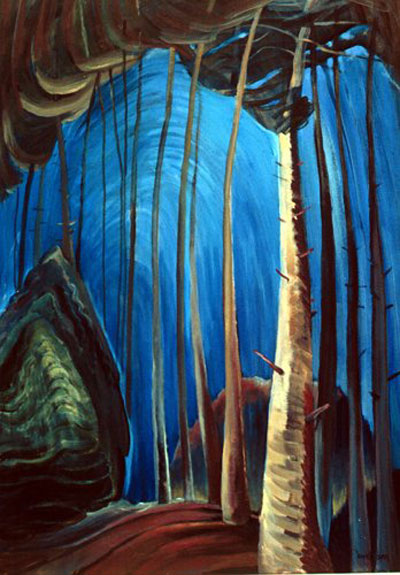
blue-sky-1932

   Blue Sky (1932) 


         Emily Carr


             _____


while on the topic of alternate 

mythologieslook what I found, 

a poem of Buffy Sainte-Marie

on our present collective 

crisis


the faith is that of our indigenous

brothers and sisters, who’ve

managed to keep their ancient

stories alive despite years of 

intense political and official 

opposition


their lore was never ever less effective

than Roman lore was to the Romans,

Sainte-Marie‘s Mother Nature no less

noble and inspirational than Juno,

queen of Rome’s Heaven, nor, for 

that matter, than to Catholics their 

Virgin Mary


listen


Take care of your link with life


         Hold your head up
         Lift the top of your mind
         Put your eyes on the Earth
         Lift your heart to your own home planet
         What do you see?
         What is your attitude
         Are you here to improve or damn it
         Look right now and you will see
         We’re only here by the skin of our teeth as it is

         So take heart and take care of your link with life 
         It ain’t money that makes the world go round
         That’s only temporary confusion
         It ain’t governments that make the people strong
         It’s the opposite illusion
         Look right now and you will see
        They’re only here by the skin of their teeth as it is
        So take heart and take care of your link with Life


         Life is beautiful
         If you’ve got the sense to take care of your source of protection
         Mother Nature
         She’s the daughter of God and the source of all protection
         Look right now
         And you will see she’s only here by the skin of her teeth as it is
         So take heart and take care of your link with life


         And carry it on
         We’re saying
         And carry it on
         And keep playing
         And carry it on
         And keep praying
         And carry it on


                                   Buffy Sainte-Marie   


R ! chard


“Metamorphoses” (The Giants’ War, V) – Ovid

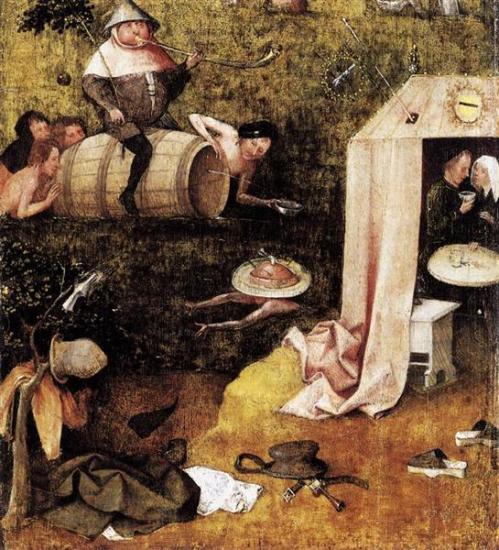
allegory-of-gluttony-and-lust-1500.jpg!Large

     Allegory of Gluttony and Lust (1490 – 1500) 


             Hieronymus Bosch


                _____________


             This was a single ruin, but not one
             Deserves so just a punishment alone


the punishment of Lycaon, Jove says,

was not an isolated incident, more 

miscreants need to be held 

accountable for deeds equally as 

blameworthy, equally as horrid


             Mankind’s a monster, and th’ ungodly times
             Confed’rate into guilt, are sworn to crimes. 


Jove doesn’t think much of the human 

race, nor of th’ ungodly times, for that

matter, that promise more crimes, are

sworn, he believes, consigned to them


confed’rate is an adjective here, 

meaning participating, in agreement,

party to the events


             All are alike involv’d in ill, and all
             Must by the same relentless fury fall. 


Jove here, much like the Christian God,

intends to subject the entire human race, 

not just Lycaon, to punishment for its 

pervasive monstrosities, its innate

aberrations


             Thus ended he; the greater Gods assent;
             By clamours urging his severe intent;
             The less fill up the cry for punishment. 


all Gods are in agreement, the greater, 

and [t]he less, by very clamours urging

Jove’s blanket, and severe, censure,

once he has ended, completed, his 

proclamation  


             Yet still with pity they remember Man;
             And mourn as much as heav’nly spirits can. 


there remains among the Gods, 

however, the memory of early Man, 

which is to say the people of the

Golden Age, but the trials and 

tribulations of earthlings generally 

would not be of much consequence  

to the deities, it is suggested, who 

as immortals, and as a function of 

their infinite longevity, wouldn’t be 

very likely, anyway, to mourn, 

would find it an unfamiliar concept


             They ask, when those were lost of humane birth,
             What he wou’d do with all this waste of Earth: 


if, the Gods ask, all humans were

obliterated from the Earth, what 

would he, Jove, do with what 

remained, bereft as it would be 

of human stewardship


             If his dispeopl’d world he would resign
             To beasts, a mute, and more ignoble line;
             Neglected altars must no longer smoke,
             If none were left to worship, and invoke. 


if Jove were to grant the dispeopl’d 

world, a world without humans, to 

beasts alone, the mute, and more

ignoble species, who would tend 

the altars, who would worship


             To whom the Father of the Gods reply’d,
             Lay that unnecessary fear aside:
             Mine be the care, new people to provide. 


leave it to me, Jove, Father of the

Gods, tells them, I will provide 

a new and improved model


             I will from wondrous principles ordain
             A race unlike the first, and try my skill again. 


from new and wondrous principles,

Jove promises, I will create from the 

scratch, as my German teacher used

to say, a better humanity


let’s see how that turns out


R ! chard 


“Metamorphoses” (The Giants’ War, III) – Ovid

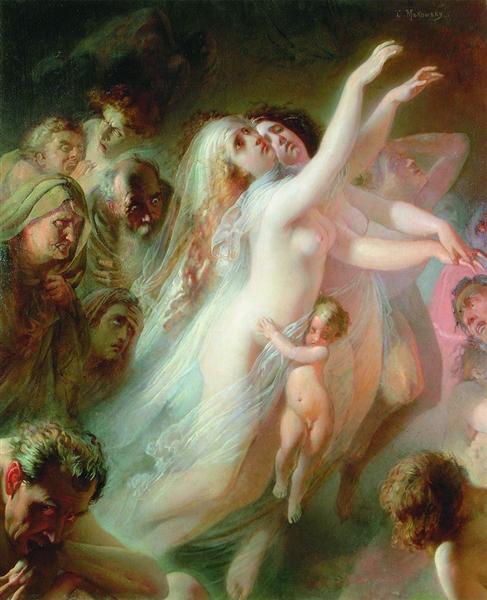
charon-carries-dead-souls-across-the-river-styx.jpg!Large

    “Charon Carries Dead Souls across the River Styx(1861)


           Konstantin Makovsky


                 ____________


Jove, god of Thunder, speaks


            I was not more concern’d in that debate
            Of empire, when our universal state
            Was put to hazard, and the giant race
            Our captive skies were ready to imbrace: 


I was not especially disturbed, Jove says,

when the state of our universe was 

challenged, or debate[d], when the giants 

tried to usurp our territory, were ready to 

imbrace, or embrace, take on, our  

vulnerable, [o]ur captive, skies


            For tho’ the foe was fierce, the seeds of all
            Rebellion, sprung from one original; 


because the enemy, then, the adversary, 

came from the one original source, its 

however manifold predations, its 

however myriad desecrations, would’ve

been identifiable to Jove, not foreign, not

unmanageable, he would’ve recognized

the black sheep of the Olympian family,

the giants  


            Now, wheresoever ambient waters glide,
            All are corrupt, and all must be destroy’d. 


ambient, nearby, related, infected, corrupt,

all has been corrupted


            Let me this holy protestation make,
            By Hell, and Hell’s inviolable lake, 


here’s another anachronism, for Hell wouldn’t’ve 

been even a concept in the era of Ovid, where

the Underworld, and Hades, entirely different

afterworlds, would’ve prevailed, areas of 

persistent gloom and shade, see Homer here,

for instance, or Virgil


the Underworld of the ancient world was 

surrounded by five rivers, Hell’s inviolable 

lake, the most famous of which was the 

river Styx


in the Divine Comedy, Dante updates this 

watery boundary for his own 14th Century

readers, and makes it the passageway to

the fifth circle of Hell, where Charon 

remains, after even over a thousand 

years, the very same ferryman


see above


nor was there either any of our present

conception of Heaven, Heaven would’ve 

been Olympus then, the exclusive domain 

of the Gods, either Greek or Roman 


            I try’d whatever in the godhead lay: 


Jove says, I tried everything a god 

could use


            But gangren’d members must be lopt away,
            Before the nobler parts are tainted to decay. 


you’ve got to lop[ ] away, cut off, the bad 

parts before they infect the more vital 

components of the body

 
            There dwells below, a race of demi-gods,
            Of nymphs in waters, and of fawns in woods:
            Who, tho’ not worthy yet, in Heav’n to live,
            Let ’em, at least, enjoy that Earth we give. 


not all beings are corrupt, but nymphs 

and fawns, innocents, Jove pleads, 

should be given consideration on 

Earth, if they be not yet worthy of the 

majesty of Heav’n, and granted earthly 

areas of enjoyment in the confines of 

their forsaken place 


            Can these be thought securely lodg’d below,
            When I my self, who no superior know,
            I, who have Heav’n and Earth at my command,
            Have been attempted by Lycaon’s hand? 


if Lycaon could attack me, Jove, god 

of Thunder, asks, how can these 

innocents, nymphs, fawns, ever be 

safe


             At this a murmur through the synod went,
             And with one voice they vote his punishment. 


the punishment of Lycaon, which we’ll 

soon encounter


             Thus, when conspiring traytors dar’d to doom
             The fall of Caesar, and in him of Rome,
             The nations trembled with a pious fear;
             All anxious for their earthly Thunderer: 


Thus, or in a similar manner, did the nations

of the earth tremble when Caesar, their 

earthly Thunderer, was assassinated 


nations, incidentally, is another anachronism,

nations didn’t appear on earth until the 

18th Century, with the French Revolution


             Nor was their care, o Caesar, less esteem’d
             By thee, than that of Heav’n for Jove was deem’d: 


Ovid addresses Caesar here, his contemporary,

and compares that emperor’s esteem for nations, 

his reliance on their allegiance, to the esteem 

Heav’n has for Jove


             Who with his hand, and voice, did first restrain
             Their murmurs, then resum’d his speech again. 


Jove calls for silence in the assembly

before speaking again


             The Gods to silence were compos’d, and sate
             With reverence, due to his superior state. 


The Gods … sate, or sat, then took heed,

bowing to Jove’s superior position


the tale of the punishment of Lycaon

will follow  


R ! chard