Just another WordPress.com weblog
Category: literature to ponder
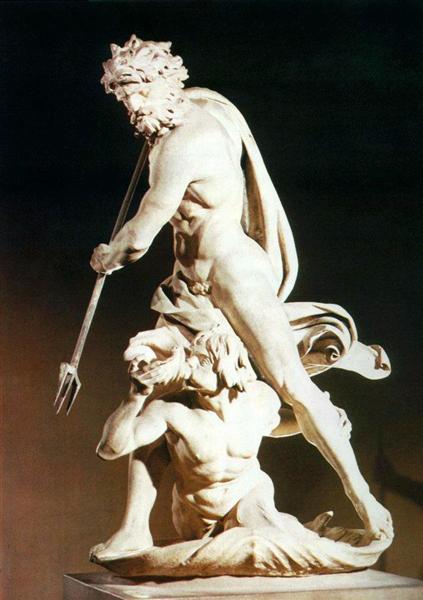
____________ When Jupiter, surveying Earth from high, Beheld it in a lake of water lie, That where so many millions lately liv’d, But two, the best of either sex, surviv’d; He loos’d the northern wind; the new world begins fierce Boreas flies To puff away the clouds, and purge the skies: Serenely, while he blows, the vapours driv’n, Discover Heav’n to Earth, and Earth to Heav’n. Boreas , ruler of the northern wind, as in aurora borea lis, at the instigation of the officiating Jupiter , disperses the clouds, drives away the vapours, allowing Heav’n to see Earth , and Earth to see Heav’n, nothing between the earth and the clear blue sky The billows fall, while Neptune lays his mace On the rough sea, and smooths its furrow’d face. while billows fall , gusts of boreal wind, Neptune , god of the Sea, as well and simultaneously in the service of Jupiter , smooths the surface of the water by laying his mace, a club with spikes, upon it, to still the unruly waves Already Triton, at his call, appears Above the waves; Triton , son of Neptune , also a sea deity a Tyrian robe he wears; Tyrian, of Tyre , a city in what is now was famous at the time for its cloth Tyre is one of the oldest continuously inhabited cities in the world And in his hand a crooked trumpet bears. Triton is characteristically depicted with a conch shell , a crooked trumpet The soveraign bids him peaceful sounds inspire, And give the waves the signal to retire. [t]he soveraign, or sovereign, is none other than Neptune , his father His writhen shell he takes; whose narrow vent Grows by degrees into a large extent, writhen, twisted, contorted, as is typical of a conch shell , which grows from where one blows into it , by degrees, towards the much larger opening from which the sound emanates Then gives it breath; the blast with doubling sound, Runs the wide circuit of the world around: Triton blows into the conch, gives it breath , the blast [ ] doubling [the] sound, resounding, reverberating, t he world a round, the world over The sun first heard it, in his early east, And met the rattling ecchos in the west. The waters, listning to the trumpet’s roar, Obey the summons, and forsake the shore. the waters begin to recede R ! chard
_____
A mountain of stupendous height there stands Betwixt th’ Athenian and Boeotian lands, Boetia was, and still is, a region of Central Greece, its largest city is, and was, Thebes , a major rival in ancient times of Athens The bound of fruitful fields, while fields they were, bound, boundary, the fruitful fields within a certain limited area, between But then a field of waters did appear: Parnassus is its name; whose forky rise Mounts thro’ the clouds, and mates the lofty skies. Parnassus is a mountain in Central Greece, however forky, however forked, craggy, uneven, sacred especially to Apollo , god of too many things to list here, and the site, at Delphi , on its south-western slope, of his Oracle , famous for being consulted on a variety of matters, from personal to affairs of state, its high priestess was believed to incarnate the very Parnassus was also the home, incidentally, of the Muses , goddesses in their own right, of the several arts, who ministered to Apollo High on the summit of this dubious cliff, Deucalion wafting, moor’d his little skiff. counterpart, sole survivor, with his wife Pyrrha , of the flood the cliff is dubious because the mountain is still deep in water, its summit precarious yet He with his wife were only left behind Of perish’d Man; they two were human kind. they two alone were left of humankind, of perish’d Man The mountain nymphs, and Themis they adore, Themis , goddess of Divine Justice And from her oracles relief implore. at Delphi , its first high priestess, hungryfor, and heedful of, her oracles, counsel The most upright of mortal men was he; The most sincere, and holy woman, she. a chance at a new world R ! chard
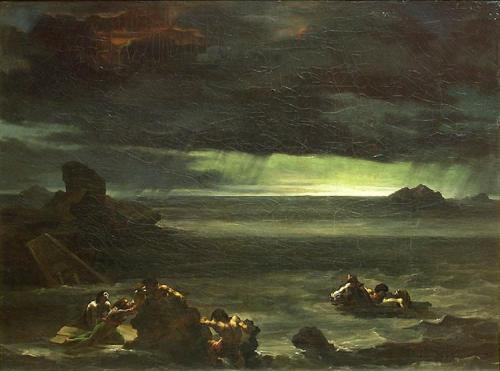
_______ once the water begins to everywhere oferflow, humans are left to somehow find shelter, or perish One climbs a cliff; one in his boat is born: born here should be our 21st Century borne , as in carried away, past participle of the verb to bear, to transport, a combination , incidentally, of verb forms, and divergent spellings, we’ve seen And ploughs above, where late he sow’d his corn. ploughs, in the line above, deftly plays with a double meaning, to plough as in to struggle through, and to plough as in to work a field, the struggle is through water this time , however, not through grassland Others o’er chimney-tops and turrets row, And drop their anchors on the meads below: meads, meadows Or downward driv’n, they bruise the tender vine, Or tost aloft, are knock’d against a pine. tossed, or tost, upon the waves, people are thrown about indiscriminately, some against things that they break, bruise, the tender vine , for instance, others against things that break them, the pine[s], all order, in the chaos, having been subverted And where of late the kids had cropt the grass, kids, baby goats The monsters of the deep now take their place. monsters of the deep, creepy things that lurk beneath the waves, now graze where earlier there’d been pasture, baby goats Insulting Nereids on the cities ride,
Nereids , sea nymphs , daughters of Nereus and Doris , god and goddess themselves, of water, fifty of them, one brother, Nerites , all often accompanying Poseidon , supreme ruler of the Sea, Neptune ‘s Greek counterpart the Nereids were especially known, in later, less turbulent times, to come to the aid of sailors And wond’ring dolphins o’er the palace glide. wond’ring, would be wandering, as in to roam aimlessly, but one can hear rustling, in the background of that unconventional spelling, the idea of dolphins wide-eyed, marvelling, filled with wonder, at this new, palatial, environment On leaves, and masts of mighty oaks they brouze; brouze, browse, or the more familiar, graze, said of animals who eat grass, whereas those who browse , or brouze, eat leaves, shrubbery, greens which grow higher up And their broad fins entangle in the boughs. the fins of dolphins become entangled in the branches, boughs, of trees The frighted wolf now swims amongst the sheep; wolf and sheep, cast asunder, much like , above, man at the mercy of the pine, or the tender vine, all equals in their overriding fight for survival The yellow lion wanders in the deep: the deep, the water His rapid force no longer helps the boar: earlier inherent skills have been rendered irrelevant The stag swims faster, than he ran before. The fowls, long beating on their wings in vain, Despair of land, and drop into the main. the main, the ocean Now hills, and vales no more distinction know; the water has flattened all horizons And levell’d Nature lies oppress’d below. Nature, distinct from water here, now lies below the water’s surface The most of mortals perish in the flood: The small remainder dies for want of food. if Ovid remains to tell the tale , one must suppose that this story must, however relatively, have a happy ending stay tuned R ! chard
_______ under the command of Jove , dutifully abetted by Neptune , his Olympian brother, sea god himself, with his fleet of observant minions, the rivers, streams, waterways, the annihilating flood takes place Ovid recounts The floods, by Nature enemies to land, And proudly swelling with their new command, Remove the living stones, that stopt their way, the living stones, you’ve got me there, these could only be stones as initial matter somehow contributing to the advent of an inherent life source, later activated, induced into vivifying action we are dust, in other words, we return to dust, inert dust, however incomprehensibly And gushing from their source, augment the sea. the flowing rivers augment , enlarge, the growing sea, covering the land Then, with his mace, their monarch struck the ground; a mace is a club with metal spikes With inward trembling Earth receiv’d the wound; a comma after trembling here would make this line easier to read, “With inward trembling, Earth receiv’d the wound” , but not everyone is as punctilious about grammar as I am And rising streams a ready passage found. streams easily found their way amidst the bracken, the shrubbery, the rushes, to overwhelm the otherwise quiescent pastures Th’ expanded waters gather on the plain: Manitoba, often, lately, in spring They float the fields, and over-top the grain; Then rushing onwards, with a sweepy sway, Bear flocks, and folds, and lab’ring hinds away. Bear here is a verb, not a noun, meaning that animals, fl ocks, and folds, and lab’ring hinds, are carried away, borne away, borne asunder Nor safe their dwellings were, for, sap’d by floods, sap’d, sapped, deprived, weakened,rendered unsuitable Their houses fell upon their houshold Gods. household Gods, icons, Lares or Penates , personally held by the Ancients, like we now keep pictures, tokens, of our own particular, however often secular, rather than religious, idols The solid piles, too strongly built to fall, High o’er their heads, behold a watry wall: though tall, and apparently indestructible, the solid piles are nevertheless submerged, the very recent South Asian tsunami, for instance, or the Japanese one that provoked the nuclear incident that put an end there to that earlier profoundly nationally integrated industry, if you’ll remember Now seas and Earth were in confusion lost; A world of waters, and without a coast. water, water, everywhere, but the last thing you want to do is drink next, how humans survive stay tuned R ! chard
__________ Nor from his patrimonial Heaven alone Is Jove content to pour his vengeance down; let me say something about Heaven here, a concept that is quite different from the earlier Ancient Greek and Roman understanding of the term, was it, for that matter, even a term then, of the Ancients, that would’ve meant nothing other to them than the blue sky above, not at all an area reached by extraterrestrial transcendence the abode of the gods and goddesses and had been for centuries, much closer to the earth than the more ethereal home we imagine of the gods today, every one of them, however professedly uniquely supreme, otherworldly all gods, note, no goddesses, what’s up with that, I’ve long wondered the dwelling place of the departed, somewhere deep beneath the earth, or at the very ends of all the seas, never totally beyond the very cosmos, as our prevailing faiths now uniformly preach the image of Heaven, Hell, and Purgatory for that matter, that last a completely Catholic invention – to account for the salvation, however partial, of innocent souls deprived of Heaven for not having been christened, though not able yet, at so early an age, to have sinned – was pretty well codified by Dante in the 14th Century in his a daunting, but profoundly illuminating read, which has shaped our impression of these several possible afterlives ever since magisterial, but crafted after over a thousand years of Catholic cultural domination, cannot avoid the impact of the Catholic understanding of Heaven neither, now, can we, for that matter, intimately imbued as we are with the binding faiths of our relatively more recent forebears be therefore perspicacious Aid from his brother of the seas he craves, To help him with auxiliary waves. later, we’ll learn that Jove’s brother of the seas is Neptune , god of allaqueous things The watry tyrant calls his brooks and floods, Who rowl from mossie caves (their moist abodes); rowl, or roil, upset mossie, mossy And with perpetual urns his palace fill: To whom in brief, he thus imparts his will. Neptune is stockpiling water, with the help of his conforming waterways Small exhortation needs ; no time, in other words, no need, to do much coaxing, much exhortation your pow’rs employ: use, put into action, or employ, your pow’rs And this bad world, so Jove requires, destroy. Jove, god of gods, is here commanding, authorizing, orchestrating Let loose the reins to all your watry store: Bear down the damms, and open ev’ry door. The floods
will inexorably follow stay tuned R ! chard
_______ Already had he toss’d the flaming brand; And roll’d the thunder in his spacious hand; Preparing to discharge on seas and land: in order to begin to fulfil his decree of ridding the world of humans, Jove had toss’d [a] flaming brand, a piece of wood that’s been set on fire, and roll’d [ ] thunder , set it to rumble, in his spacious, or large, hand, ready to cast it upon the seas and land But stopt, for fear, thus violently driv’n, The sparks should catch his axle-tree of Heav’n. an axletree is a beam that connects two wheels of a carriage in order to make them turn simultaneously the suggestion here is that Heaven is intimately connected to the earth, both interwoven parts of a functioning, and interdependent, mechanism Remembring in the fates, a time when fire Shou’d to the battlements of Heaven aspire, And all his blazing worlds above shou’d burn; And all th’ inferior globe to cinders turn. Jove remembers that the fates had decreed a time when fire would reach the very battlements of Heaven, and shou’d burn it, as well as the earth below, turning everything there to cinders, ashes a counterpart to this event exists in Norse mythology, incidentally, which music, in the last segment, of the Gods , of his four-part opera, The Ring of the Nibelung , wherein Valhalla , the great hall of the Gods, goes up in flames, bringing an end to the dominion of that hallowed, not to mention earlier incontestable, pantheon do not, despite its lack of subtitles, do not not be astonished, Richard 19th Century, let him take you to I cried His dire artill’ry thus dismist, he bent His thoughts to some securer punishment: Concludes to pour a watry deluge down; And what he durst not burn, resolves to drown. having decided against fire, his dire artill’ry, as an effective way of carrying out his destructive mission, Jove opts for water instead, a wat’ry deluge need I even bring up here, Valhalla , an obvious mythological equivalent, but which of the two was the chicken, one wonders, which was the egg, both trails leading deep into inscrutable, and indecipherable, antiquity The northern breath, that freezes floods, he binds; With all the race of cloud-dispelling winds: The south he loos’d, who night and horror brings; to set in motion his scheme, Jove enlists, or binds, the winds, [t]he northern breath, and [t]he south wind, both of which apply their own destructive methods And foggs are shaken from his flaggy wings. flaggy, in layers, feathers upon feathers, Jove is represented here, however unusually, with wings From his divided beard two streams he pours, His head, and rheumy eyes distill in show’rs, With rain his robe, and heavy mantle flow: And lazy mists are lowring on his brow; the water that will lay waste the earth flows from Jove’s very physical attributes, his divided beard, his rheumy eyes, his brow, et cetera Still as he swept along, with his clench’d fist He squeez’d the clouds, not only does Jove exude a flow of water through divine, though intrinsically viable coroporeal avenues, but he also actively promotes it, squeez[ing] the very clouds but th’ imprison’d clouds resist: however The skies, from pole to pole, with peals resound; And show’rs inlarg’d, come pouring on the ground. February, for instance, in Vancouver Then, clad in colours of a various dye, Junonian Iris breeds a new supply To feed the clouds: Iris was a messenger of the gods, though of Juno , Jove’s wife , in particular Iris , herself a goddess, of the rainbow, was usually depicted arrayed, appropriately, in vibrant colours impetuous rain descends; The bearded corn beneath the burden bends: Defrauded clowns deplore their perish’d grain; And the long labours of the year are vain. clowns, people who’ve been made to look foolish, having been deprived, [d]efrauded, of the fruit of their labour R ! chard
_____________ This was a single ruin, but not one Deserves so just a punishment alone . the punishment of Lycaon, Jove says, was not an isolated incident, more miscreants need to be held accountable for deeds equally as blameworthy, equally as horrid Mankind’s a monster, and th’ ungodly times Confed’rate into guilt, are sworn to crimes. Jove doesn’t think much of the human race, nor of th’ ungodly times, for thatmatter, that promise more crimes, are sworn, he believes, consigned to them confed’rate is an adjective here, meaning participating, in agreement, party to the events All are alike involv’d in ill, and all Must by the same relentless fury fall. Jove here, much like the Christian God, intends to subject the entire human race, not just Lycaon, to punishment for its pervasive monstrosities, its innate aberrations Thus ended he; the greater Gods assent; By clamours urging his severe intent; The less fill up the cry for punishment. all Gods are in agreement, the greater, and [t]he less, by very clamours urging Jove’s blanket, and severe, censure, once he has ended , completed, his proclamation Yet still with pity they remember Man; And mourn as much as heav’nly spirits can. there remains among the Gods, however, the memory of early Man, which is to say the people of the tribulations of earthlings generally would not be of much consequence to the deities, it is suggested, who as immortals, and as a function of their infinite longevity, wouldn’t be very likely, anyway, to mourn, would find it an unfamiliar concept They ask, when those were lost of humane birth, What he wou’d do with all this waste of Earth: if, the Gods ask, all humans were obliterated from the Earth, what would he, Jove, do with what remained, bereft as it would be of human stewardship If his dispeopl’d world he would resign To beasts, a mute, and more ignoble line; Neglected altars must no longer smoke, If none were left to worship, and invoke. if Jove were to grant the dispeopl’d world, a world without humans, to beasts alone, the mute, and more ignoble species, who would tend the altars, who would worship To whom the Father of the Gods reply’d, Lay that unnecessary fear aside: Mine be the care, new people to provide. leave it to me, Jove, Father of the Gods, tells them, I will provide a new and improved model I will from wondrous principles ordain A race unlike the first, and try my skill again. from new and wondrous principles, Jove promises, I will create from the scratch, as my German teacher used to say, a better humanity let’s see how that turns out R ! chard
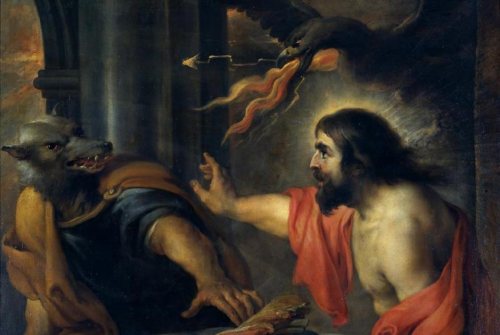
_______ having already warned his court of Lycaon’s excesses, Jove instructs his deities to Cancel your pious cares; already he Has paid his debt to justice, and to me. job accomplished Yet what his crimes, and what my judgments were, Remains for me thus briefly to declare. let me tell you briefly, however, how I came about it , Jove confides The clamours of this vile degenerate age, The cries of orphans, and th’ oppressor’s rage, Had reach’d the stars: he tells them I will descend, said I, In hope to prove this loud complaint a lye. in order to prove that these clamours stood for nothing, this loud complaint a lye, or lie, he would, Jove explains, descend to Earth in order to investigate Disguis’d in humane shape, I travell’d round The world, and more than what I heard, I found. from his travels around the world, his proofs, Jove claims, were mostly personally obtained, rather than having been merely hearsay humane here, note, is an archaic spelling of human O’er Maenalus I took my steepy way, a mountain in Ancient Greece, sacred, incidentally, to the god Pan , god of rusticity, undomesticated nature By caverns infamous for beasts of prey: beasts of prey , note, would not have been unexpected in Pan ‘s territory Then cross’d Cyllene, and the piny shade More infamous, by curst Lycaon made: mountain in Ancient Greece, this one sacred to the god Hermes , god of messages, communication, travellers, speedy deliveries what Lycaon did to make the piny shade afraid I haven’t been able to ferret out Dark night had cover’d Heaven, and Earth, before I enter’d his unhospitable door. nighttime permeates Jove’s arrival in this new, and unfamiliar, unhospitable, environment Just at my entrance, I display’d the sign That somewhat was approaching of divine. as he entered this unfamiliar place, Jove says, he display’d the sign of his divinity, but one only approaching of divine, he specifies, a subtle sign, something merely suggestive The prostrate people pray; the tyrant grins; [t]he prostrate people get it, prostrate, face down in reverence or submission, Lycaon, the tyrant, however, doesn’t And, adding prophanation to his sins, prophanation, profanation I’ll try, said he, and if a God appear, To prove his deity shall cost him dear. Lycaon challenges the god, any god, to, should he appear, prove his divinity, goddesses, surely also, would’ve been similarly confronted, otherwise any impostor would grievously suffer ‘Twas late; the graceless wretch my death prepares, When I shou’d soundly sleep, opprest with cares: while Jove sleeps, giving respite to his cares, Lycaon plots his murder This dire experiment he chose, to prove If I were mortal, or undoubted Jove: [t]his, or what is to follow, Jove points out, is the method Lycaon had already decided he would try out to determine Jove’s undoubted, or indubitable, divinity But first he had resolv’d to taste my pow’r; the test Not long before, but in a luckless hour, Some legates, sent from the Molossian state, Were on a peaceful errand come to treat: legates, ambassadors the Molossians , a tribe of Ancient Greece come to peacefully confer with Lycaon Of these he murders one, he boils the flesh; And lays the mangled morsels in a dish: Some part he roasts; then serves it up, so drest, And bids me welcome to this humane feast. humane here again is an olden form of human, as in they were feasting on human flesh Mov’d with disdain, the table I o’er-turn’d; And with avenging flames, the palace burn’d. The tyrant in a fright, for shelter gains The neighb’ring fields, and scours along the plains. Lycaon has realized that this guest is indeed a god Howling he fled, and fain he wou’d have spoke; But humane voice his brutal tongue forsook. fain, or most willingly again here humane means human, Lycaon could no longer speak in a human voice About his lips the gather’d foam he churns, And, breathing slaughters, still with rage he burns, though his voice and lips begin to be affected, Lycaon continues through this channel to fume, rage, breath[e] slaughters But on the bleating flock his fury turns. but his anger, his fury, is now directed towards flocks of bleating sheep His mantle, now his hide, with rugged hairs Cleaves to his back; a famish’d face he bears; His arms descend, his shoulders sink away To multiply his legs for chase of prey. the metamorphosis of Lycaon has begun, he wears a hide instead of a mantle, an overgarment, his back becomes hairy, his arms become legs as his shoulders sink away , a transformation appropriate to hunt prey He grows a wolf, his hoariness remains, hoariness , the condition of being old and grey, a remnant of his earlier human self And the same rage in other members reigns. His eyes still sparkle in a narr’wer space: His jaws retain the grin, and violence of his face Lycaon’s members, or limbs, rage, or exhibit fury his eyes become narrower Lycaon has turned into a wolf R ! chard
____________ Jove, god of Thunder, speaks I was not more concern’d in that debate Of empire, when our universal state Was put to hazard, and the giant race Our captive skies were ready to imbrace: I was not especially disturbed, Jove says, when the state of our universe was challenged, or debate[d] , when the giants tried to usurp our territory, were ready to imbrace, or embrace, take on, our vulnerable, [o]ur captive, skies For tho’ the foe was fierce, the seeds of all Rebellion, sprung from one original; because the enemy, then, the adversary, came from the one original source, its however manifold predations, its however myriad desecrations, w ould’ve been identifiable to Jove, not foreign, not unmanageable, he would’ve recognized the black sheep of the Olympian family, the giants Now, wheresoever ambient waters glide, All are corrupt, and all must be destroy’d. ambient, nearby, related, infected, corrupt, all has been corrupted Let me this holy protestation make, By Hell, and Hell’s inviolable lake, here’s another anachronism, for Hell wouldn’t’ve been even a concept in the era of Ovid, where the Underworld, and Hades, entirely different afterworlds, would’ve prevailed, areas of persistent gloom and shade, see Homer here, for instance, or Virgil the Underworld of the ancient world was surrounded by five rivers, Hell’s inviolable lake, the most famous of which was the watery boundary for his own 14th Century readers, and makes it the passageway to remains, after even over a thousand years, the very same ferryman nor was there either any of our present conception of Heaven, Heaven would’ve been Olympus then, the exclusive domain of the Gods, either Greek or Roman I try’d whatever in the godhead lay: Jove says, I tried everything a god could use But gangren’d members must be lopt away, Before the nobler parts are tainted to decay. you’ve got to lop[ ] away, cut off, the bad parts before they infect the more vital components of the body There dwells below, a race of demi-gods, Of nymphs in waters, and of fawns in woods: Who, tho’ not worthy yet, in Heav’n to live, Let ’em, at least, enjoy that Earth we give. not all beings are corrupt, but nymphs and fawns, innocents, Jove pleads, should be given consideration on Earth, if they be not yet worthy of the majesty of Heav’n, and granted earthly areas of enjoyment in the confines of their forsaken place Can these be thought securely lodg’d below, When I my self, who no superior know, I, who have Heav’n and Earth at my command, Have been attempted by Lycaon’s hand? if Lycaon could attack me, Jove, god of Thunder, asks, how can these innocents, nymphs, fawns, ever be safe At this a murmur through the synod went, And with one voice they vote his punishment. soon encounter Thus, when conspiring traytors dar’d to doom The fall of Caesar, and in him of Rome, The nations trembled with a pious fear; All anxious for their earthly Thunderer: Thus, or in a similar manner, did the nations of the earth tremble when Caesar , their earthly Thunderer, was assassinated nations, incidentally, is another anachronism, nations didn’t appear on earth until the 18th Century, with the French Revolution Nor was their care, o Caesar, less esteem’d By thee, than that of Heav’n for Jove was deem’d: Ovid addresses Caesar here, his contemporary, and compares that emperor’s esteem for nations, his reliance on their allegiance, to the esteem Heav’n has for Jove Who with his hand, and voice, did first restrain Their murmurs, then resum’d his speech again. Jove calls for silence in the assembly before speaking again The Gods to silence were compos’d, and sate With reverence, due to his superior state. The Gods … sate, or sat, then took heed,bowing to Jove’s superior position the tale of the punishment of Lycaon will follow R ! chard
_________ longer with his pity strove; / But kindled to a wrath” which was worthy of him Then call’d a general council of the Gods; Who summon’d, issue from their blest abodes, And fill th’ assembly with a shining train. Jove calls the gods together to discuss the abhorrent conditions on Earth, who, upon being summon’d, leave their blest, or blessed, homes, and fill Jove’s assembly hall with their glittering train, their advancing pageantry A way there is, in Heav’n’s expanded plain, Which, when the skies are clear, is seen below, And mortals, by the name of Milky, know. when the skies are clear in Heaven’s expanded plain, its wide expanse, mortals can see the Milky Way The ground-work is of stars; through which the road Lyes open to the Thunderer’s abode: this Milky Way is paved with stars, which lead to Jove’s, the Thunderer’s, domain The Gods of greater nations dwell around, And, on the right and left, the palace bound; the dwellings of the gods who represent the greater nations of the era, of Rome, for instance, or Greece, surround, encircle, the Thunderer’s abode, his palace The commons where they can: the nobler sort With winding-doors wide open, front the court. the more common gods, those of lesser nations, live where they can, while the winding-doors of the nobler gods, doors which can be activated mechanically , on hinges, though perhaps here divinely, stand wide open for this colloquy , this exalted conference, before the celestial court This place, as far as Earth with Heav’n may vie, I dare to call the Louvre of the skie. if one were to compare [t]his place this court, to anything on Earth, have it vie with, one would liken it, Ovid there’s evidently an anachronism here since the Louvre didn’t exist at the time of Ovid, so that the translators have replaced the “Palatia” of Ovid’s original Latin, which refers to the Seven Hills , where imperial palaces were built at the time of Augustus , 63 B.C. to 14 A.D., which is to say during Ovid’s time, 43 B.C. to 17 /18 A.D., by this relatively more recent palatial residence, the Louvre, in order to make the text more contemporary, like settings and attire are used in Renaissance art to kindle the viewer’s sense of connection see , for instance, above , where Veronese depicts the scene of Jesus in Galilee, and transforms water there into wine to accommodate a shortage, midst Roman, note, rather than Galilean, trappings, splendour When all were plac’d, in seats distinctly known, And he, their father, had assum’d the throne, seats distinctly known means the traditionally assigned places, with Jove, “their father”, at the head of the convocation Upon his iv’ry sceptre first he leant, Then shook his head, that shook the firmament: leant, or leaned, [t]hen shook his head in revulsion Air, Earth, and seas, obey’d th’ almighty nod; And, with a gen’ral fear, confess’d the God. the elements, “ Air, Earth, and seas “, acknowledge, or confess’d , the God, with quivering anxiety At length, with indignation, thus he broke His awful silence, and the Pow’rs bespoke. Jove, after a silence, bespeaks, or addresses, the assembled Pow’rs, the other divinities R ! chard



 Richibi's Weblog