Richibi’s Weblog

Just another WordPress.com weblog

Category: Johann Sebastian Bach

Easter Oratorio – J.S.Bach
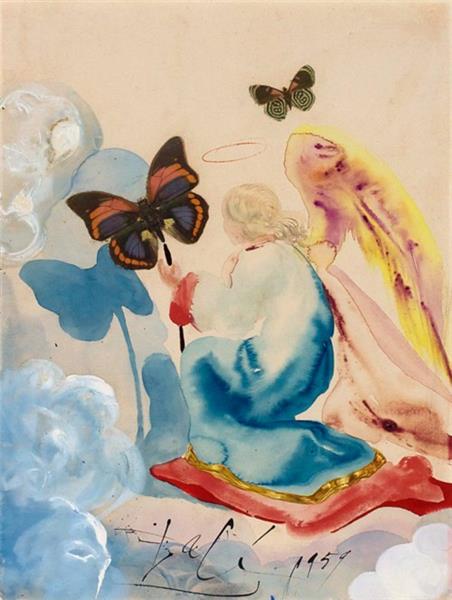
easter-angel-1959.jpg!Large

   “Easter Angel (1959) 

          Salvador Dali

               _______

                                  for Elizabeth, 
                                      who needs an oratorio right now,
                                           and who takes great comfort, 
                                                 she tells me, in this music


if The Seven Last Words of Our Saviour 
on the Cross is not a divertimento, it 
nevertheless didn’t come out of nowhere,
and a clue to its inspiration lies in the 
eventual transposition of the orchestra 
only piece to, a few years later, the piece 
with voice, its oratorio

Haydn had heard his original composition
rendered in a nearby provincial town, where
they’d added lyrics, however saccharine, to
the score, and he thought it entirely effective 
and appropriate, had new less sanctimonious 
lyrics composedand gave us what we now 
hear

oratorios go back quite a while, not 
surprisingly, they are quintessentially 
religious music, meant to inspire, a 
familiar convocational ploy, Bach and 
Handel made them especially immortal
in the early 18th Century

listen to Bach’s Easter Oratorio to see,
to hear rather, the connection to Haydn,
though you might not even notice much
significant difference, they’ve as many 
movements more or less, nine for Haydn,
Bach’s has eleven, but all the forces are 
the same, and in the same order

that Bach’s oratorio would be more 
joyous is not surprising, the occasion for 
the Easter Oratorio is one of celebration,
where The Words is more lugubrious, it 
describes a portentous demise, dance 
rhythms therefore are not in the former 
inappropriate

its dances, however, are rather gavottes
and sarabandes instead of the later 
minuets, a not not instructive alteration 
when you think that minuets not much
later than Haydn had become waltzes,
more about that later

in the Easter Oratorio“, the story is told
by the singers, whereas in The Seven 
Last Words“, the music is doing the 
telling, secured by the fact that the piece
was originally written without singers

The Words is more dramatic, more
use of contrasting volumes and tempi,
the piano hadn’t been invented at the 
time of Bach, long notes couldn’t be 
accommodated on the harpsichord,
which determined the pace of the plot,
the piano allowed with its soft pedal 
a moderation in volume, and with its 
hold pedal a moderation of a note’s 
resonance, which allowed for more 
expansive expression, which led 
eventually, nearly inescapably, to 
the Romantic Period, after passing, 
of course, through, Mozart and
Haydn

but listen to what Bach can do 
without these later interventions,
proof that a poet can inspire with 
merely matchstick, the second 
aria itself – My soul, the spice that 
embalms you shall no longer be 
myrrh – for soprano and baroque 
flute, spare as it is instrumentally, 
is manifestly entirely worth the 
priceless price of admission 


R ! chard
Divertimento no 17, K334 – Mozart

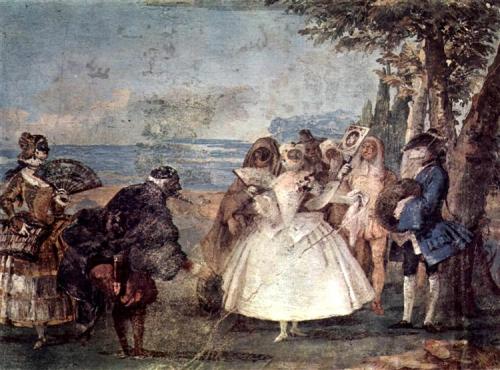
minuet-with-pantaloon-and-colombine-from-the-room-of-carnival-scenes-in-the-foresteria-1757.jpg!Large.jpg

Minuet with Pantaloon and Colombine, from the Room of Carnival Scenes
                                                                                                       in the Foresteria (1757)

     Giovanni Domenico Tiepolo

             ________________

already I can hear you asking, why is
The Seven Last Words“, with its nine
already movements, not a divertimento,
you’ll cry 

a divertimento is an entertainment, it 
doesn’t have the gravitas of Haydn’s 
composition, a sacred work, a 
divertimento is meant to delight

The Seven Last Words“, therefore,
by definition is not a divertimento,
it’s a completely different idea of a
piece with several movements, it 
has profoundly ulterior intentions,
following, rather, in the tradition of
Bach’s oratorios, though it had 
originally been conceived without 
words, the prelate in this work 
would be doing the talking

the piece gives itself a theme, a 
focus, a project, creating something 
like chapters in a book 

or think of the Stations of the Cross 
a metaphorically more apt, perhaps, 
unifying principle, instead of just a 
series of disparate airs, like singles 
were on albums until Pink Floyd 
similarly revolutionized music with 
a topic during my generation, The
Wall, with a little preparatory help
albeit, from the Beatles, earlier,
our friends

here’s Mozart, nevertheless, in order 
to compare, his Divertimento no 17,  
K334giving the aristocracy what 
they still, in 1780, wanted, something 
courtly

you’ll notice there are not just one 
but two minuets in the program, both 
with recapitulations, sure sign that 
we’re still in the Classical Era, though 
the minuet will die off as quickly as 
the divertimento will in the following 
decades, relics, both, of an earlier era

and indeed this is Mozart’s last for 
small orchestra, divertimenti would be 
composed from here on as merely 
tributes to an earlier period and its 
musical formulas

masses and oratorios would go the same 
way, incidentally, with some resurgence 
in the following centuries from a couple 
of Catholic organists who left profound 
influences individually on later centuries

but more about them later

meanwhile, here’s Mozart, feel the 
gentility, his genuflexion to propriety 
rather than to faith


R ! chard

String quartets, Op.20 – Joseph Haydn

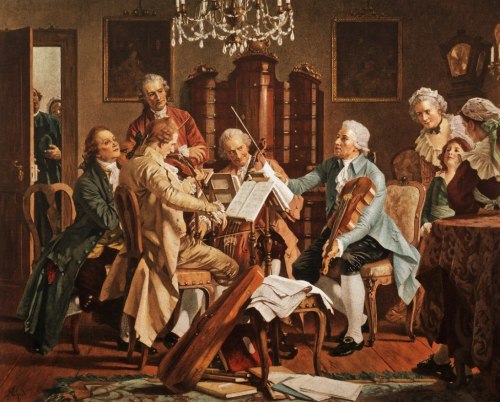
HaydnPlaying

  Joseph Haydn playing string quartets 

          Anonymous 

                (Staatsmuseum, Vienna)

             _______

upon first hearing the first movement only 
even of the opus 20, no 5 of Haydn, I was 
immediately struck by the more determined, 
insistent, peremptory strokes of the strings,
something not especially appropriate in an 
aristocratic setting, where the music should
be polite, reserved, nearly unobtrusive, a 
music composed for performance here 
rather than as an after dinner mint

the second and third movements return to 
a more conventional, which is to say courtly,
tone, but the end of the fourth movement is
also, and more virulently, vociferous

what’s up 

you might view this as the very beginning 
of the Classical Period, the stately 
institutions of not only the aristocratic 
social experiment, but also of the very 
world order were being debated, personal
opinion was beginning to supersede 
convention, the very core of the upcoming
Romantic Era, which saw the rights of the 
individual installed rather than the voice
of an imperial, or an indeed spiritual,
authority

Haydn was expressing his musical, and
dare I say Delphic, anima, his inspired 
spirit, setting the stage for what was to 
come, however historically blindly, the
French Revolution was coming up


I have a beef with the third movement, 
the adagio, however lovely – it’s right 
out of Bach, without anywhere any 
apparent attribution, I object to that 

is this a tribute, or an appropriation,
or does it matter, you tell me, I think
it’s, again however lovely, and ever
so influential, not only not right, but 
neither as lovely as the sublime 
BWV1031, a complete and utter
serenity, a sin of the sons against 
the fathers, or is it, rather, our 
indifferent patrimony, like putting 
moustache on the Mona Lisa 


the opus 20, no 2, is, for reasons I
won’t get into, a later work, it is 
throughout vociferous, peremptory,
insistent, adamant, assertive, 
vehement, uncompromising, it’s 
nearly even Beethoven, it’s, in
other words, a scorcher, like 
Beethoven, it takes no prisoners 

check it out, it’s only 1772 and the 
earlier model of civilizational order 
isn’t any longer holding, opus 20,
no 2 is an augury, an omen of what
is to come, which is, of course, the 
very task of the poet 


R ! chard

Quartet 1 in B major (“La chasse”), op. 1 no. 1 – Haydn

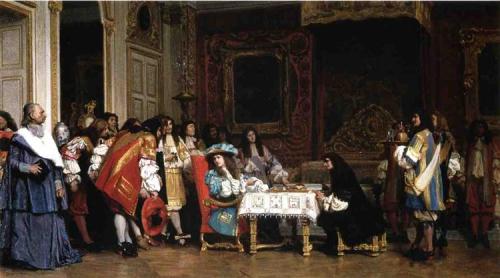
louis-xiv-and-moliere.jpg!Large

        “Louis XIV and Molière (1862) 

              Jean-Léon Gérôme

                     ________

the string quartet didn’t come out of nowhere,
as nothing does – I think – but probably, I 
suspect, from the earlier period’s suites, the
Baroque’s, Bach’sfor instance

suites are a series of dance pieces, stylized 
for the purpose of the musical poet, a popular 
appropriation, an even natural one for 
composers

the aristocracy, by the middle of the 18th
Century, demanded erudite entertainment,
something that Louis XlV, the Sun King,  
had instilled, a little earlier, during his 
Radiant Reign – see Racine, Corneille
Molière, see above, as well, incidentally –
1643 to 1715, up at Versaillesas 
prerequisite for excellence in being a
monarch, a sovereign, sponsorship of 
culture, painting, poetry, music

dukes and counts and barons and 
princesses got onto the bandwagon 
and the arts consequently flourished

witness Haydn and Mozart then, still, 
now, giants 

here’s Haydn’s first, his Quartet no 1
in B major, (“La chasse”), op. 1 no. 1,
the first significant string quartet in 
our Western culture

you’ll note five movements, following 
the suite model described above, with 
mirrored minuets sandwiched between 
opposing mirrored prestos, and an 
adagio in the very middle, as though  
their crowning moment 

an adagio, to my mind, always gives 
away a composer’s worth, listen to 
this one, it’s melting

and he’s got 67 more to go through, I    
marvel, a veritable, and utter,
however improbable, musical
cornucopia 


R ! chard

on string quartets – Opus 76, no 1 – Joseph Haydn

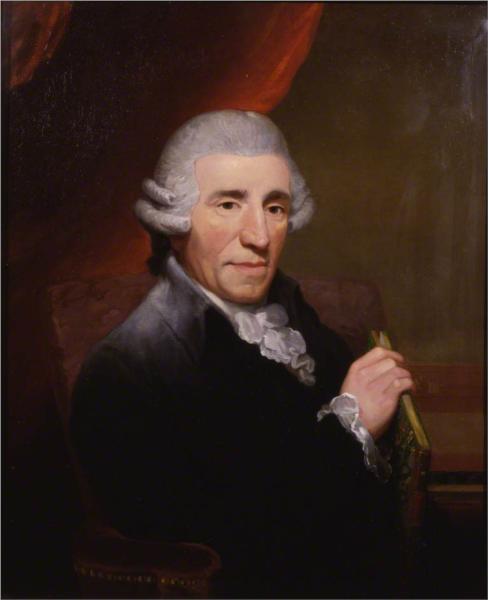
joseph-haydn-1791.jpg!Large.jpg

                                   “Joseph Haydn (1791) 

                                          Thomas Hardy

                                                 ______

to not consider other musical forms of
Shostakovich would be unfair, his
symphonies are mostly propaganda,
however often, though somewhat 
culturally specific, riveting

my favourite works of his, works I 
consider iconic, are mostly chamber 
pieces, piano solos, string quartets

a string quartet, after a symphony, is
like sitting down to dinner with four,
at the very least, acquaintances, 
rather than being a guest at a party,  
the conversation is more intimate,
every person plays hir part, everyone
is heeded, if even only with courtesy,
a social, a Classical, an aristocratic,
prerequisite 

movements can be compared to 
courses, distinct and identifiable for
their particular culinary, musical, 
propriety

later variations on this reflect the 
variations in social mores, where 
restaurants, the modern way of
socializing, allow for disparate 
choices, often superimposed, 
throughout the meal for any,
every, occasion

dim sum, tapas, celebrate this, not
unhappily 


but string quartets can be tricky, I 
thought I’d start from the beginning,
with some Haydn, their recognized 
Father, you’ll understand when you
hear this, his Opus 76, no 1, an 
outstanding string quartet to live 
up to

Haydn set the standard for string 
quartets when the norms of Western 
music were being established, Bach
had given us the alphabet, the
well-tempered clavier, Mozart, the 
grammar, the structure of music,
tempo, tonality, repetition, Beethoven 
gave us the literature, the poetry, the 
philosophical, the transcendent

Haydn is somewhere between these 
last two, but decidedly, still, the king  
of the string quartet, though Beethoven  
does a good job of trying to best him,  
and so does Shostakovich, you’ll have 
to pick

but first, let’s start with Haydn, that’ll
be already, you’ll see, or hear, enough

later, I’ll get into it


R ! chard

Symphony no 13 in B-flat minor, opus 113, “Babi Yar” – Dmitri Shostakovich

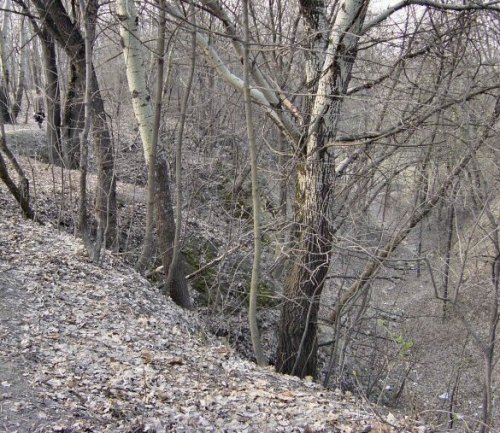
Babi_Jar_ravijn

             the ravine at Baby Yar 

                     ___________

Shostakovich’s Symphony no 13
“Babi Yar”, to me is not a symphony, 
it’s a cantata, a text with accompanying 
orchestra, which is what we have here

does it matter, perhaps not that much, 
but it’s like going to a restaurant where 
you’re looking to enjoy what they’ve 
posted on their website but when you 
get there they tell you they’re out, you 
can only have what they’re serving 

unless it’s sensational, you’re put out 

Shostakovich’s Symphony no 13
“Babi Yar”, is not sensational, not only 
too mired in local history, no matter
how horrid, how very horrid, but too, 
musically, not inspired 

note that with voice to concentrate the
composition, the orchestra becomes
just backdrop, no more of 
Shostakovich’s signature obbligatos, 
that gave distinction and significance 
to individual orchestral players’ lone,
often poignant, complaints

the choice of a bass to anchor the 
enterprise is especially, I think,
unfortunate, like putting all your eggs 
in one basket, that basket lugubrious
and forbidding – I thought of Taras 
Bulba, or Alberich, the gnome in
Wagner’s “Ring”, singing – the jokes in 
the second movement, “Humour”,  
go flat, people wouldn’t laugh, but 
tremble rather before the domineering 
patriarch, oligarch, the composition
needs the grace, the lightness, the 
breath, of a female figure, voice


Bach is famous for cantatas, but what
came up for me was Carl Orff‘s 
incomparable Carmina Burana“,
written in, coincidentally, 1937, from 
medieval texts the composer had 
found, in Latin, describing, in lurid 
lyrics, the spirit of cloistered monks
during the Medieval Era 

you’ll enjoy the translation of the 
Latin into English here, something I 
hadn’t experienced before, giving 
a whole new meaning to the word
“monastery”


R ! chard

Dmitri Shostakovich – Symphony no. 2 in B major, opus 14 – “to October”

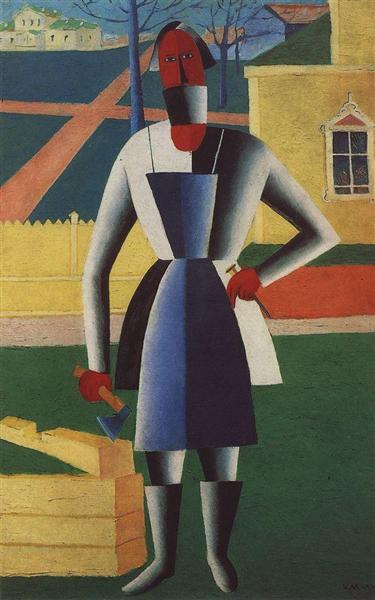
carpenter-1929.jpg!Large

    “Carpenter (1929) – note the industrialization 
                                       of the subject, however 
                                       Cubist, for better or for 
                                       worse

      Kazimir Malevich

             _________

Shostakovich’s Symphony no. 2 doesn’t 
sound like a symphony – one movement
only, a chorus – but was never meant to, 
it had been conceived as a piece in 
commemoration of the October 
Revolution, a significant event in the 
Communist cosmology, and
commissioned by that very polity, 
hence the name, to October

but later, the symphonic poem was 
included chronologically, thus no 2,  
in the Shostakovichian oeuvre – if 
you’ll excuse that pedantry, “oeuvre” 
being too sweet a word for me not to 
resist its austere territoriality – the 
Symphony no 2 in B major being 
first performed in 1927 

it starts a shade above inaudibly, which 
I often find irritating – unless, of course, 
it’s Wagner, or Richard Strauss, who 
knew what they were doing – suggesting 
something significant is rumbling, 
brewing on the musical horizon, after 
which we enter in a lively fashion upon 
a dance, full of folkloric flavour

but the harmonies are atonal, discordant, 
a society, however traditional, is in disorder, 
tonality, one of the stalwarts of Classicism, 
along with tempo and repetition, has been 
upended, distorted, the commune, the 
community, can, no longer unburdened, 
with only discordant harmonies, dance, 
though you can feel them trying

Ravel does something similar in his 
La valse“, where, with a distortion  
of tempo, the world is spinning  

with only a change in volume, intensity,
in Shostakovichthe music becomes 
martial, autocratic, peremptory, nearly 
even frightening

I found at this point that the subtlety of 
the move from the conviviality of dance  
to the aggression delivered by a more 
forceful music, marches and so forth,
lay in a mere alteration of the musical 
pulse, from seduction to, indeed, rape, 
in a simple change of rhythm – thus is it 
written in our very sensibilities 

a violin obbligato then intervenes, 
strangely, but welcome, in a piece of
brash, by this point, agitprop, but 
soon becomes as vociferous as 
earlier the crowd who wanted to, 
however awkwardly, dance

the obbligato, incidentally, instead of
an out and out solo part, as also with 
the piano in Shostakovich’s First 
Symphony, suggests the work of a
a community, a Soviet ideal, rather 
than that of an individual asserting 
hir particular predominance, if you  
listen between the lines

a particularly impressive chorus 
eventually delivers a tribute, a  
hagiographic poem, to Lenin, which 
Shostakovich abjured, but delivered 
nevertheless for the money, and for 
the influence, reportedly, however 
ignominiously, for he was young, 
not fully formed, innocent yet  

it resembles, of course, a cantata, a
religious chant – see Bach, one of the 
evident muses of Shostakovich – but 
which addresses here a political 
system, a cute trick of contemporary 
secular regimes, the several –isms 
within our post-religious ideological
societies 

watch for it

note the spoken, or rather, prosaically 
proclaimed last verses of the oration,
hortatory, don’t you think, or what

R ! chard

psst: incidentally, few composers are as 
          political, though few have been 
          under such ideological pressure,
          as Shostakovich

on art, its purpose

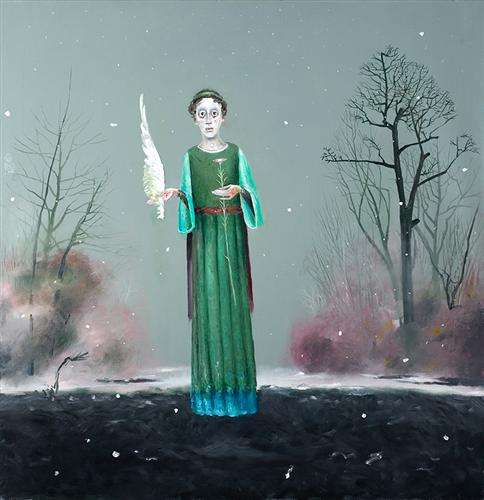
poet-with-flower-2008-jpgblog

                                Poet With Flower (2008)

                                          Stefan Caltia

                                                 _____

wherefore art, I’ve long and often wondered,
with only a wink to Juliet’s Romeo, for my
question dug deeper, why, indeed, itself art

we build our souls on the stories we’ve 
heard, the impressions we’ve received
from voices that spoke directly to our 
senses, painters with paint, musicians
with music, writers with words, poets 
with poems

it started with fairy tales, which told of
right and wrong, good and bad, courage,
kindness, responsibility, and dire 
consequences for discord

Biblical stories also took up a lot of my own
childhood, Jesus, Adam and Eve, Moses
and the Ten Commandments, this last 
reinforced by Cecil B. DeMille’s epic

but soon enough it was Oliver TwistLittle
Nell, and by an inescapable authorial leap, 
since these were all by an irresistible 
Charles Dickens for a guy my age, Sydney
Carton, who valiantly stands in for his
friend, Charles Darnay, at the guillotine, a 
quantum, even existential, leap from 
Peter Pan and Mary Poppins 

though I had the good fortune to learn to 
read and write music as a boy, play music, 
learn about Bach, Brahms and Beethoven, 
it didn’t take anyone else much more than
their enthusiasm to see what the Beatles
were similarly doing, the Rolling Stones, 
the Supremes, they were not only singing, 
but making history, shaping it, and us, we 
followed the questions they rose, their 
responses, the effects upon ourselves
for nothing is considered until it’s 
mentioned, spoken, made clear, and they
were those prophets

the same goes for art, we see as we see
cause Monet, Picasso, Warhol showed 
us how to see, what to look at

and of course poets, Shakespeare, 
RostandDanteGoethe, to inform, each,
their individual language, and culture

I have been Philip CareyScarlett O’Hara, 
Blanche DuboisGary Cooper in High
Noon“, both Martha and George in 
Who’s Afraid of Virginia Woolf“, lately 
I’ve been even Hank Williams

as Babette would say, a French doll who 
gets abducted in Raggedy Ann and Andy:
A Musical Misadventure“, an animated 
movie from the Seventies, – oo aahrr yoo 

Richard

psst: all of them have been me too,
      incidentally

“Easter Oratorio”, BWV 249 – Johann Sebastian Bach‏

ascension-of-jesus.jpg!Blog

 
                                    El Greco
 
                                      ______
 
 
                        for Martha and Chris, who still go to Easter 
                        Mass, and whom Martha calls therefore  
                        relics 
 
                        and for Staf and Annemie, who live in 
                        presently beleaguered Belgium, and 
                        who must, at this time of distress, 
                        need our prayers
 
 
having long ago lost track of the Christian
calendar, I only this week found out 
Sunday ‘d be Easter, therefore Friday
Good Friday, not that this would much 
change my daily routine, but it set me 
perusing pertinent art, I knew I could 
count on Bach for an oratorio, and sure 
enough I found it
 
an oratorio, as I earlier explained, is an
opera without sets or costumes, usually
associated with religious services, but 
Bach had one for every Sunday and 
every Christian feast day
 
after an instrumental introduction, 
reminiscent of Handel, I thought, 
Bach’s “Easter Oratorio” slips into a
lovely adagio, notable for its exquisite
oboe obligato, where the innocence 
and purity of that wind defines the 
movement
 
the ceremonial pomp of the earlier 
section then returns to include 
chorus expressing triumph, the 
realization that the Lamb of God 
has returned
 
but soon enough, Mary, the soprano 
of a quartet of singers, each of the 
four singing according to their own – 
alto, Mary Magdalene, tenor, Simon 
Peter, bass, John the Evangelist  
voices, and accompanied by an 
utterly transcendental transverse 
flute, sings 
 
      “My soul, the spice that embalms 
       you shall no longer be myrrh. Only
       a crown of laurels can soothe your 
       anxious longing.”  
 
and knocks your socks off 
 
 
this week at market, stuffing my 
organic red pepper and a bag of 
handcrafted chips, barbecued,
designer, into my bagat their 
express counter, collecting my 
coins, my receipt, my change 
purse, my wallet, and last but not 
least, of course, my self, I sensed 
something of mine drop, looked 
dutifully aroundcould find 
nothing, wondered, and made to 
go
 
excuse me, sir, I heard behind me, 
you dropped something
 
a little boy, an urchin, blond hair, 
blue eyes, right out of Charles 
Dickens, I thought, eight maybe,
nine, held out a quarter, apparently 
mine
 
why thank you, I replied, enchanted
 
and you know what, I asked, I’m 
going to give this back to you, and 
put the quarter back into his hand
 
the last time I did something like 
that, I saw an angel, I remembered
but that’s another story
 
thank you, he said back, gleaming
with the maturity of his interaction, 
though I’m not sure he wasn’t 
himself in fact also a very angel
 
 
later I thought I should’ve sent him 
for a crème brûlée, a piece of carrot 
cake, a pastry, or something, and 
berated myself for the paucity of 
my recompense
 
 
but there is a link to Easter in my 
tale, the idea of hope, revival, 
regeneration, in the possibility of
goodness reentering the world, a
task inherited by the children, and 
whom we must not lead astray
 
apart from its more traditional 
associations, for perhaps the less 
observant, people of other creeds 
and faiths, if Easter means anything 
still, or has ever, it is about just that, 
hope, revival, regeneration, nor must 
we ourselves betray those ideals   
 
happy Easter 
 
 
Richard

“Christmas Oratorio” – Johann Sebastian Bach‏

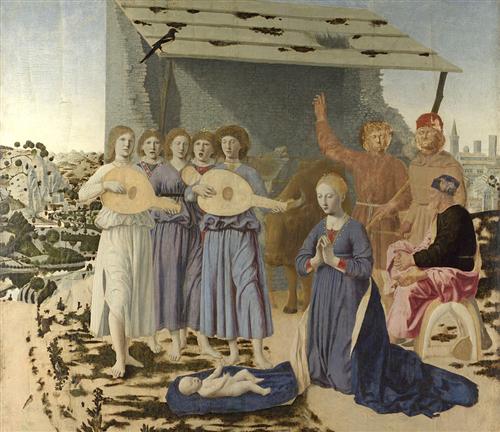
"Nativity" - Piero della Francesca

Nativity (1470 – 1475)

Piero della Francesca

__________

on the first day of Christmas, which
is to say December 25, 1734, the first
cantata of Bach’s Christmas Oratorio“,
“The Birth”, was presented at the
Nikolaikirche, or the Church of St
Nicholas
, in Leipzig

it was followed by five other cantatas,
each corresponding to its own
elaboration of the holy event

the Annunciation to the Shepherds, December 26, 1734
the Adoration of the Shepherds, December 27, 1734
the Circumcision – if you can believe it – and Naming of Jesus, January 1, 1735
the Journey of the Magi, January 2, 1735
and the Adoration of the Magi, January 6, 1735

the cantatas are usually played in
groups of three, or in their entirety,
to more easily accommodate too
either long, or short, performances
– the cantatas last only about 25
minutes – though Leipzig, and other
neighbouring communities might
still adhere to their more reverent
original position

an oratorio, of course, is an opera
without sets or costumes, usually
associated with religious services,
and, quite specifically, mostly, with
Bach’s, of whose manifestly prolific
output an astonishing 209 still
survive

a cantata is a work for voice and
instrumentation in several
movements, or contrasting musical
episodes, in Bach’s liturgical ones,
four voices, usually, cover the
ranges, soprano, alto, tenor and
bass, they tell the story, while the
choir stand in for the angels

this performance, conducted by the
eminent Nikolaus Harnoncourt, is
from the Nikolaikirche in Leipzig
itself, the Oratorio‘s very cradle,
its stunning altarpiece, flanked by
two mighty Christmas trees, is
glorious

incidentally the soprano and the
alto voices are taken over here by
cherubs, in the obvious guise of
prepubescents, you can tell by
their missing wings

their more stentorian counterparts,
tenor and bass, are aptly authoritative,
arresting, you’ll feel utterly blessed

here’s the text in English

Richard

psst: merry, incidentally, Christmas