Richibi’s Weblog

Just another WordPress.com weblog

Category: Apollo

“The Transformation of Daphne into a Lawrel” (III) – Ovid
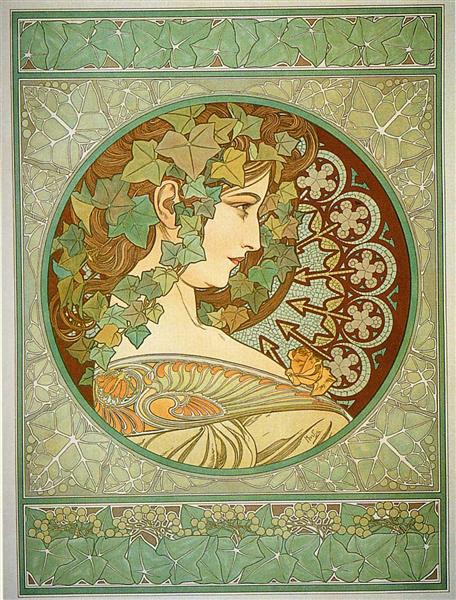
laurel-1901.jpg!Large

       Laurel”  (1901) 


             Alphonse Mucha


                         _______


however ardently might’ve Phoebus 

been pleading his case before 

Daphne, his, however recalcitrant,  

intended, flashing his divine pedigree, 

vowing to put all that aside to serve 

only her


               She heard not half; so furiously she flies;
               And on her ear th’ imperfect accent dies, 


th’ imperfect accent might be the 

unnatural tone of a divinity Daphne 

might be hearing, the unusual timbre 

of a deity’s voice, I can’t imagine Ovid 

would be suggesting that Daphne and 

Phoebus spoke different Greek dialects


perhaps th’ imperfect accent is the

unsettling manner of his entreaties,

his indecorous urgency


poets can be confounding


               Fear gave her wings; and as she fled, the wind
               Increasing, spread her flowing hair behind;
               And left her legs and thighs expos’d to view:
               Which made the God more eager to
pursue. 


the pagan gods were notoriously 

mischievous, spirited, impulsive,

quite human, never sublime and

irreproachable as is the Abrahamic 

Supreme Deity


the pagan gods lived in the fields

and streams, the hills and vales,

the seas and mountains, that 

surrounded Greek and Roman 

communities, Olympus was their 

steepest height, never the 

supernatural elevations, beyond 

even our visible heaven, that our 

present pervasive monotheism 

proclaims


               The God was young, and was too hotly bent
               To lose his time in empty compliment:
               But led by love, and fir’d with such a sight,
               Impetuously pursu’d his near delight. 


often, the gods of antiquity were

perverse, not at all blameless,

not innocent, not irreproachable, 

like the one and only god that, 

today, in its several interpretations, 

even murderously conflicting, rules,

oversees, mostly, our present, at 

least Western, faith communities


               As when th’ impatient greyhound slipt from far,

               Bounds o’er the glebe to course the fearful hare,


glebe, fields


               She in her speed does all her safety lay; 
               And he with double speed pursues the prey; 
               O’er-runs her at the sitting turn, and licks 
               His chaps in vain, and blows upon the flix: 


flix, fur, the greyhound’s pelt 


perhaps greyhounds do this, blow

upon their flix, you’ll have to ask 

Ovid, or maybe Dryden, his 

translator


               She scapes, and for the neighb’ring covert strives, 


 a covert, a bush in which to hide


               And gaining shelter, doubts if yet she lives: 


doubts if yet she lives, she can’t 

believe she made it 


               If little things with great we may compare,
               Such was the God, and such the flying fair, 


the flying fair, Daphne, the God,

Phoebus


               She urg’d by fear, her feet did swiftly move,
               But he more swiftly, who was urg’d by love. 


love, as Ovid, or is it, once again,  

Drydenwho defines it, urg’d, 

compelled by hormones, not at all 

our romantic conception of it


               He gathers ground upon her in the chace:
               Now breathes upon her hair, with nearer pace;
               And just is fast’ning on the wish’d embrace. 


Red Riding Hood and the Big

Bad Wolf


               The nymph grew pale, and in a mortal fright,
               Spent with the labour of so long a flight; 


Spent, defeated


               And now despairing, cast a mournful look
               Upon the streams of her paternal brook; 


her father, Peneus, was a river god, 

if you’ll remember, paternal brook, 

the rill, the rivulet, of her father


               Oh help, she cry’d, in this extreamest need!
               If water Gods are deities indeed: 


if there is a god, be with me, she 

cry’d, you, yourself, I’m sure, have 

been there, though Daphne‘s faith 

was grounded in help, in this case, 

from her father, god of, appropriately

in this instance, streams


               Gape Earth, and this unhappy wretch intomb; 


I’d rather die, Daphne pleads, I’d

rather the earth swallowed me up, 

I’d rather be intomb[ed]


               Or change my form, whence all my sorrows come. 


transform me, rid me of what makes 

me appealing, Daphne pleads


               Scarce had she finish’d, when her feet she found
               Benumb’d with cold, and fasten’d to the ground:
               A filmy rind about her body grows; 


a condition I’ve found not unlike the 

ravages I call, ironically, bark, crusty 

imperfections that afflict my own 

ageing body


               Her hair to leaves, her arms extend to boughs:
               The nymph is all into a lawrel gone; 


Daphne is turning into a tree,

a lawrel 


               The smoothness of her skin remains alone. 


of Daphne, only her smoothness 

remains


               Yet Phoebus loves her still, and casting round
               Her bole, his arms, some little warmth he found. 


bole, the stem of a tree


               The tree still panted in th’ unfinish’d part: 


where Daphne had not yet become

a tree, she still panted, pulsed


               Not wholly vegetive, and heav’d her heart. 


heav’d her heart, passionately

reacted


               He fixt his lips upon the trembling rind; 


rind, bark


               It swerv’d aside, and his embrace declin’d. 


kisses not at all sweeter than wine,

said the lawrel 


               To whom the God, Because thou canst not be
               My mistress, I espouse thee for my tree: 


Phoebus begins to speak directly 

here, Because thou canst not be, /

My mistress, he says, I espouse 

thee for my tree: 


espouse, marry


               Be thou the prize of honour, and renown; 


you will be, he continues, the 

prize that will represent heroes


               The deathless poet, and the poem, crown. 


honour, first of all, worthy, deathless, 

poets, Phoebus commands, let the 

laurel wreath crown deserving 

wordsmiths


Ovid had reason to champion poets,

he’d been exiled from Rome by the

Emperor, Augustus, his catering to

the Roman ruler becomes 

intermittently evident throughout 

this masterpiece


               Thou shalt the Roman festivals adorn,
               And, after poets, be by victors worn. 


victors, Olympic champions, notably


               Thou shalt returning Caesar’s triumph grace; 


Ovid curries imperial favour here with 

Augustus, by simply immortalizing in

poetry the name of Caesar, the new

Emperor’s great-uncle, and adoptive

father, making his own personal 

nemesis shine, for what it might be 

worth, by association


               When pomps shall in a long procession pass. 


the parades will be long ones


               Wreath’d on the posts before his palace wait; 


the laurel leaves will garland the 

posts, stations, before, in front of, 

the imperial palace


               And be the sacred guardian of the gate.
               Secure from thunder, and unharm’d by Jove, 


even Jove / Jupiter, god of gods,

will stand by, honour, the symbol 

of the laurel


               Unfading as th’ immortal Pow’rs above: 


Unfading, into very eternity


it’s interesting to note that the 

laurel has not lost its significance

despite the intervening centuries, 

epochs, we find reference to it even 

in the honorific title of laureate, as 

in Nobel laureate, or even in the

accolade of baccalaureate, the

bachelor’s degree, the prestigious

academic accomplishment 


Unfading indeed


               And as the locks of Phoebus are unshorn, 


Phoebus always sports perfect 

hair


               So shall perpetual green thy boughs adorn.


it would seem that, according to 

this, laurel leaves, perpetual 

green, don’t ever lose their 

colour, but I can’t attest to this,

being a poet rather than an

arborist, a gardener, though

bay leaves, laurel, even dry,

don’t turn brown, I’ve since

noticed


               The grateful tree was pleas’d with what he said;
               And shook the shady honours of her head. 


and they all lived happily ever 

after


or didn’t


myths are the enduring fairy tales 

that adults continue to believe in, 

according to their culture, about 

men and women rather than 

boys and girls, they help us, like

fairy tales, make up our moral 

order


R ! chard


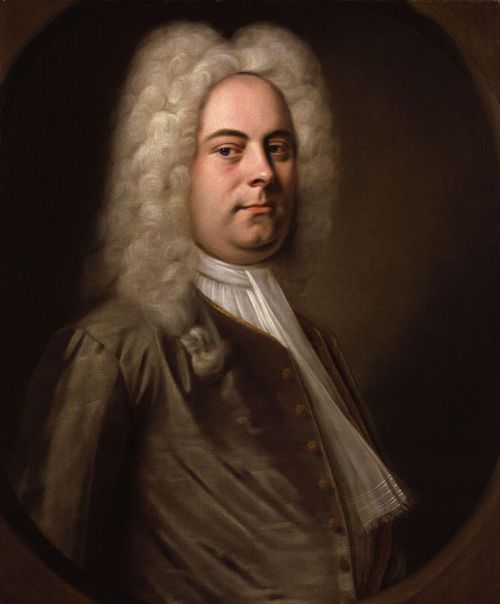
“Apollo e Dafne” – George Frideric Handel

800px-George_Frideric_Handel_by_Balthasar_Denner

     “George Frideric Handel(1726 – 1728) 


              Balthasar Denner


                   __________


supposing that there would probably 

be a musical interpretation of the 

myth of Apollo and Daphne, I wasn’t 

surprised to discover that Handel 

had written one, in 1709 – 10, cantatas

on mythic subjects was the type of 

thing he did, don’t forget the 

Renaissance, the renewed, and 

probing fascination, starting more 

or less in the 14th Century, with 

Classical Greece and Rome, affecting 

everything, even as late, 1685 to 1759,

as the 18th Century for this composer


I must admit that I’m not particularly

partial to Handel, his rhythms are

way too elementary for my taste, 

plus he never achieves the depth 

of emotion Bach, his contemporary, 

does, 1685 – 1750, so that I’ve put 

him aside pretty well completely 


but here’s an Apollo e Dafne that

I found compelling from beginning 

to end


Apollo e Dafne is not an opera, but

a cantata, which means a piece 

for voice and orchestra, but with 

several movements, like tunes in

a Broadway show


this production, however, has 

incorporated a scenario with 

singers in costume acting 

out a plot


it has no subtitles though, but 

you can read the translation 

here, should you need to


Handel’s libretto, note, is a 

reworking of Ovid’s texttherefore 

not an exact reproduction of the 

version I’ve been highlighting, 

Dryden’s translation of 1717, 

written a few years, you’ll want to 

consider, after Handel’s own 

composition, but the essential 

story is there, she eventually 

turns into a tree, no surprise, 

you knew that already from Ovid’s

very title, The Transformation of

Daphne into a Lawrelas 

inscribed, however archaically 

now, by Dryden 


I’ll just point out that Cupid’s in 

red, doesn’t sing, just delivers 

atmospheric context, and you 

might find some later scenes 

quite, even shockingly, I did, 

explicit, be advised


otherwise, enjoy, be delighted


R ! chard


“The Transformation of Daphne into a Lawrel” (II) – Ovid

daphne-1892(1).jpg!Large

           “Daphne” (1879 – 1892) 


            George Frederick Watts


                    __________


                  The God of light, aspiring to her bed, 


The God of light, Phoebus, whose

name, incidentally, finds its roots 

in the Greek word for shining, 

which I won’t inscribe here for its 

being not only in another language,

but also of a different alphabet


Phoebus, also known as Apollo

was not only god of Light, but 

too, god of the Sun, as well as of

several other things that brought

clarity, his shrine at Delphi, for

instance, was famed for providing 

oracles, intelligibility in the face of 

confusion, however cryptic the 

actual words of the presiding 

sybil commonly were 


               Hopes what he seeks, with flattering fancies fed; 


Phoebus [h]opes, indeed trusts, 

that feeding Daphne flattering 

fancies will do the trick


               And is, by his own oracles, mis-led. 


even his oracles, his sybils, his

priestesses, in this circumstance, 

fail him


               And as in empty fields the stubble burns, 


stubble, what’s left of the shaft once 

the grain has been removed, 

harvested 


               Or nightly travellers, when day returns,
               Their useless torches on dry hedges throw,
               That catch the flames, and kindle all the row; 


now that day has arrived, the nightly

travellers‘ otherwise useless torches

can serve to kindle, ignite, and burn

off, the rows of slowly smouldering 

stubble  


               So burns the God, consuming in desire, 


Phoebus is similarly, [s]o, kindled,

burns with a desire [s]o, as, 

consuming


               And feeding in his breast a fruitless fire: 


the fire, the desire, however, remains 

in his breast … fruitless, unabated, 

unquenched


               Her well-turn’d neck he view’d (her neck was bare)
               And on her shoulders her dishevel’d hair; 


Daphne‘s hair would’ve been 

dishevel’d, undone, during her 

flight, by the wind


               Oh were it comb’d, said he, with what a grace
               Wou’d every waving curl become her face! 


Phoebus begins to idealize her


               He view’d her eyes, like heav’nly lamps that shone,
               He view’d her lips, too sweet to view alone,
               Her 
taper fingers, and her panting breast; 


see above


               He praises all he sees, 


his flattering fancies at work 


                                              and for the rest
               Believes the beauties yet unseen are best: 


Phoebus has no intention of enjoying 

merely what Daphne cannot but allow, 

her beauties yet unseen, he believes, 

are best, are preferable


ahem


               Swift as the wind, the damsel fled away,
               Nor did for these alluring speeches stay: 


alluring speeches, flattering fancies


               Stay Nymph, he cry’d, I follow, not a foe. 


a nymph, a nature spirit in the form 

of a maiden, imagined frolicking by 

rivers, or woods


Phoebus calls her by this metonym,

Nymph, probably because he doesn’t 

yet know her proper name


a metonym is the word for a part

which signifies the whole, the pen, 

for instance, is mightier than the 

sword, where the pen stands for

all that is written, and the sword 

represents the much larger 

concept of war


Nymph, therefore, to metonymize,

to stand in for, any nymph


Stay Nymph, Phoebus cries, I follow,

I don’t lead, I am not coercing you, 

you are in charge, I am not a foe, 

not an enemy


               Thus from the lyon trips the trembling doe;
               Thus from the wolf the frighten’d lamb removes,
               And, from pursuing faulcons, fearful doves; 


prey flee predators [t]hus, Phoebus

explains, which is to say in the 

manner that you’re behaving


               Thou shunn’st a God, and shunn’st a God, that loves. 


but I am not a predator, I am a God,

a God who loves you, who is in love,

he concedes


               Ah, lest some thorn shou’d pierce thy tender foot,
               Or thou shou’dst fall in flying my pursuit!
               To sharp uneven ways thy steps decline;
               Abate thy speed,


slow down, he says, Abate thy speed,

you might hurt yourself, you might

pierce thy tender foot, fall, your path 

decline[s], is becoming treacherous, 

less secure, sharp uneven ways lie 

ahead


                                           and I will bate of mine. 


bate, opposite of abate, don’t you 

love it


               Yet think from whom thou dost so rashly fly;
               Nor basely born, nor shepherd’s swain am I. 


I carry a big stick, Phoebus says, think

about it 


               Perhaps thou know’st not my superior state;
               And from that ignorance proceeds thy hate. 


maybe you haven’t recognized me


               Me Claros, Delphi, Tenedos obey; 


Claros, an ancient Greek sanctuary,

site of another oracle of Phoebus /

Apollo, along with Delphi, the 

principal shrine 


Tenedos, an island off the coast of 

modern Turkey, but under the 

dominion then also of the deity


               These hands the Patareian scepter sway. 


scepter, a staff symbolic of sovereignty


but I’ve found no source at all for the

indecipherable Patareian, forgive me


               The King of Gods begot me: 


I am the son, Phoebus proclaims, of 

Jove / Jupiter / Zeus, depending on 

the local vocabulary


                                                    what shall be,
               Or is, or ever was, in Fate, I see. 


Phoebus, like all the gods, sees

everything, past, present, and 

future


               Mine is th’ invention of the charming lyre; 


the lyre, an ancient musical instrument 

often associated with Phoebus /Apollo


               Sweet notes, and heav’nly numbers, I inspire. 


Phoebus / Apollo was also god,

among many other things, of 

Music


               Sure is my bow, unerring is my dart;
               But ah! more deadly his, who pierc’d my heart. 


Phoebus has ceded to Cupid, and

acknowledges the superiority of

the stripling‘s, the youth’s, sting


               Med’cine is mine; what herbs and simples grow
               In fields, and forrests, all their pow’rs I know; 


Phoebus / Apollo is also god of 

Healing


               And am the great physician call’d, below. 


that Phoebus / Apollo is god of 

Healing is acknowledged below,

which is to say among earthlings


               Alas that fields and forrests can afford.
               No remedies to heal their love-sick lord! 


there is no cure, however, for love, 

he moans, the sickness, Alas, No

remedies, among the fields and 

forrests for it


               To cure the pains of love, no plant avails:
               And his own physick, the physician falls. 


the physician, Phoebus / Apollo

falls, which must surely be fails

here, to rhyme with avails, an

unfortunate typo, cannot derive

from the ground, from the wealth

of his own domain, the physick,

the ingredients to make up a

medication


stay tuned


R ! chard


“The Transformation of Daphne into a Lawrel” (I) – Ovid

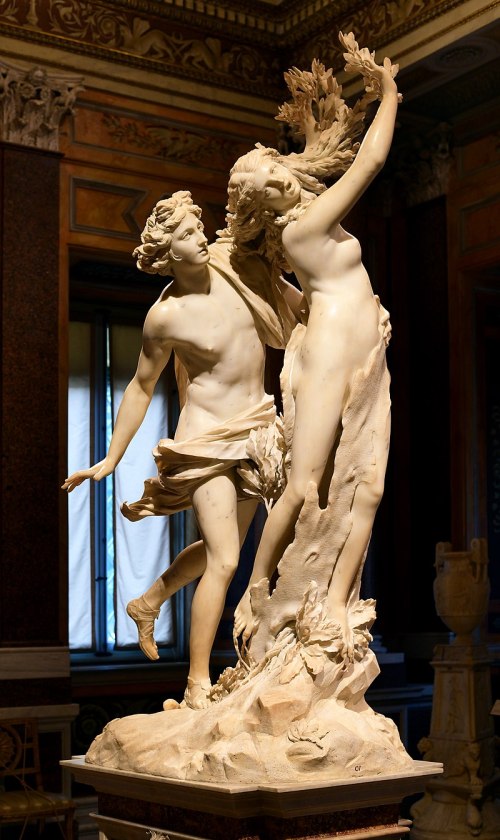
800px-Apollo_and_Daphne_(Bernini)_(cropped)

     “Apollo and Daphne(1622 – 1625) 


            Gian Lorenzo Bernini


                  ___________


Phoebus has just killed Python, and 

now his thoughts are turned to other 

things 


               The first and fairest of his loves, was she
               Whom not blind fortune, but the dire decree
               Of angry Cupid forc’d him to desire: 


that Phoebus should fall in love, indeed

for the first time, was not the work of 

blind fortune, but the decree, the will, 

rather, of Cupid, son of Mars, god of 

War, and Venus, goddess of Love, 

himself, Cupid, god of Desire, who’d 

been, we’ll see, unacceptably 

disrespected


               Daphne her name, and Peneus was her sire. 


her sire, her father, Peneus


               Swell’d with the pride, that new success attends,
               He sees the stripling, while his bow he bends,
               And thus insults him: 


Phoebus, fresh from his triumphant

bout with Python, thus [s]well’d with … 

pride at his new success, sees Cupid

the stripling, the youth, handling his 

own celebrated bow, and derisively

insults him


                                                    Thou lascivious boy,
               Are arms like these for children to employ? 


arms, weapons


               Know, such atchievements are my proper claim; 


arrows, Phoebus says, are my domain,

my proper claim, my undisputed

territory


               Due to my vigour, and unerring aim:
               Resistless are my shafts, and Python late
               In such a feather’d death, has found his fate. 


the death of Python is proof of my 

unparalleled ability, Phoebus 

proclaims


feather’d death, from the feathers that

are attached to the arrows to direct 

and speed their aim


               Take up the torch (and lay my weapons by), 


my weapons, weapons which should

be mine alone 


               With that the feeble souls of lovers fry. 


Take up the torch, take responsibility,

Phoebus says, lay down your 

weapons, your arrows, the ones that 

fry, he accuses Cupid, that frazzle, 

the feeble, incapacitated, souls of 

lovers


               To whom the son of Venus thus reply’d, 


the son of Venus here is Cupid 


               Phoebus, thy shafts are sure on all beside,
               But mine of Phoebus, mine the fame shall be
               Of all thy conquests, when I conquer thee. 


thy shafts, Cupid says, will always

prevail, surpass others, but my own

arrows will be the ones to best you, 

and yours, at which point the glory 

will be, notoriously, mine, over 

yours, forever


               He said, and soaring, swiftly wing’d his flight: 


Cupid is one of the very few ancient

deities to have wings, incidentally,

there’s also Mercury, the Roman 

Hermesmessenger god, god of

travel, communication


               Nor stopt but on Parnassus’ airy height. 


Parnassus, a mountain in Greece,

site of the Oracle of Delphi, site 

indeed where Python has just 

been killed


               Two diff’rent shafts he from his quiver draws;
               One to repel desire, and one to cause.
               One shaft is pointed with refulgent gold:
               To bribe the love, and make the lover bold:
               One blunt, and tipt with lead, whose base allay 


allay, alloy, combination of metals


               Provokes disdain, and drives desire away.
               The blunted bolt against the nymph he drest:
               But with the sharp transfixt Apollo’s breast.


gotcha


               Th’ enamour’d deity pursues the chace; 


Th’ enamour’d deity, Phoebus, is

now under the spell of Cupid‘s

pointed arrow


               The scornful damsel shuns his loath’d embrace:
               In hunting beasts of prey, her youth employs;
               And Phoebe rivals in her rural joys. 


The scornful damsel, Daphne, in the 

spirit of Phoebe, goddess of the Hunt, 

preferred rural joys, indeed rivalled 

Phoebe‘s own enjoyment of rustic 

sports


to explain the similarity in their names,

it should be noted that Phoebe and 

Phoebus were twins, both children 

of Zeus, god of gods, the equivalent 

of the Roman Jove, also known as 

Jupiter, she, Phoebe, goddess of

the Moon, as well as of the Hunt, he, 

Phoebus, god of the Sun, as well as 

of several other things


it should be noted that the gods and

goddesses of Ancient Greece, firmly 

installed during its period of glory, the

4th and 5th Centuries BCE, travelled 

throughout Europe and Asia, 

migrating, but were adapted to the 

local customs, consequently becoming 

known by different names according to 

the language and culture, you can see 

a parallel in the spread of Latin, for

instance, during the Roman conquests 

of, specifically, Europe, evolving into 

the several derivative languages, 

starting with, historically, Italian itself, 

little by little, achieved through the

effects of time rather than of distance, 

then French, Portuguese, Spanish in

the outlying, eventually impermeated,

areas, see the infiltration of English,

for instance, in the modern world


               With naked neck she goes, and shoulders bare;
               And with a fillet binds her flowing hair. 


fillet, a ribbon


               By many suitors sought, she mocks their pains,
               And still her vow’d virginity maintains.
               Impatient of a yoke, the name of bride
               She shuns, and hates the joys, she never try’d.
               On wilds, and woods, she fixes her desire:
               Nor knows what youth, and kindly love, inspire. 


she’s not the marrying kind


               Her father chides her oft: Thou ow’st, says he, 


Thou ow’st, you owe


               A husband to thy self, a son to me. 


that’s his position


               She, like a crime, abhors the nuptial bed: 


she’d, categorically, rather hunt


               She glows with blushes, and she hangs her head.
               Then casting round his neck her tender arms,
               Sooths him with blandishments, and filial charms: 


filial, can apply to both son or

daughter


blandishments, sweet nothings


               Give me, my Lord, she said, to live, and die,
               A spotless maid, without the marriage tye. 


allow me to live[ ] and die[ ] a spotless 

maid, a virgin, she asks, best, that

line, read without commas 


girls would’ve been at the mercy 

of their fathers’ wishes at the time, 

would’ve needed permission not to 

marry


               ‘Tis but a small request; I beg no more
               Than what Diana’s father gave before. 


Diana is the Roman equivalent 

of Phoebe, a virgin goddess, by

the grace of her father, Zeus, the 

Greek counterpart of the Roman 

Jupiter, or Jove, see above


               The good old sire was soften’d to consent;
               But said her wish wou’d prove her punishment:
               For so much youth, and so much beauty join’d,
               Oppos’d the state, which her desires design’d. 


good luck with that, Zeus prophesies, 

men will find you, so much youth, and 

so much beauty, very hard to resist,

you’ll surely suffer consequences


to be continued


R ! chard


“Metamorphoses” (The Giants’ War, X) – Ovid

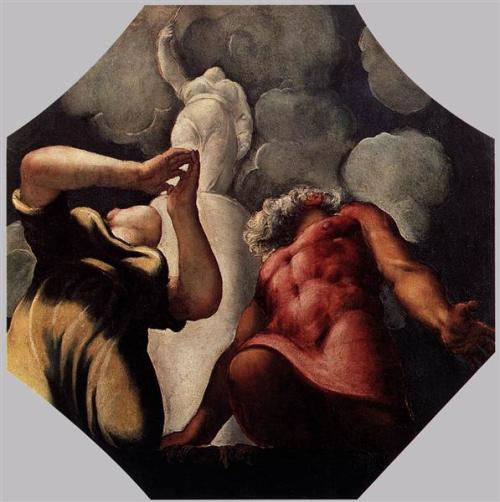
deucalion-and-pyrrha-praying-before-the-statue-of-the-goddess-themis.jpg!Large

  “Deucalion and Pyrrha Praying before the Statue of the Goddess Themis (c.1542) 


          Tintoretto


             _____


              A mountain of stupendous height there stands
              Betwixt th’ Athenian and Boeotian lands, 


Boetia was, and still is, a region of 

Central Greece, its largest city is,

and was, Thebes, a major rival in

ancient times of Athens


              The bound of fruitful fields, while fields they were, 


bound, boundary, the fruitful fields

within a certain limited area, between 

Athens, here, and Boetia


              But then a field of waters did appear: 


              Parnassus is its name; whose forky rise
              Mounts thro’ the clouds, and mates the lofty skies. 


Parnassus is a mountain in Central 

Greece, however forky, however 

forked, craggy, uneven, sacred 

especially to Apollo, god of too 

many things to list here, and the 

site, at Delphi, on its south-western 

slope, of his Oracle, famous for 

being consulted on a variety of 

matters, from personal to affairs 

of state, its high priestess was 

believed to incarnate the very 

voice of Apollo


Parnassus was also the home, 

incidentally, of the Muses, goddesses 

in their own right, of the several arts, 

who ministered to Apollo


              High on the summit of this dubious cliff,
              Deucalion wafting, moor’d his little skiff. 


Deucalion is the Abrahamic Noah‘s

counterpart, sole survivor, with his 

wife Pyrrha, of the flood 


the cliff is dubious because the

mountain is still deep in water,

its summit precarious yet 


              He with his wife were only left behind
              Of perish’d Man; they two were human kind. 


they two alone were left of humankind,

of perish’d Man


              The mountain nymphs, and Themis they adore, 


Themis, goddess of Divine Justice


              And from her oracles relief implore. 


Deucalion and Pyrrha pray to Themis

at Delphi, its first high priestess, hungry

for, and heedful of, her oracles, counsel


see above


              The most upright of mortal men was he;
              The most sincere, and holy woman, she. 


a chance at a new world


R ! chard

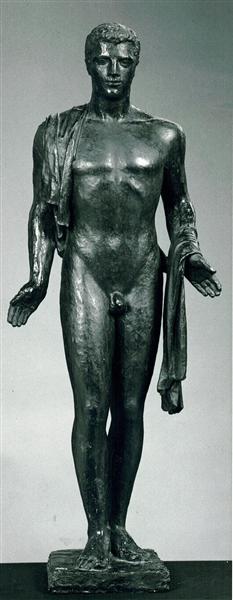
“The Man I Love” – the Gershwins

apollon-1937.jpg!Large.jpg

             Apollon(1937) 

             Charles Despiau

                    _______

flipping through old ruminations 
lately, that I’d left in my out box for 
whatever reason, I came across this 
number that I’d discovered on the 
Internet in order to soothe a trying 
emotional upset, when my heart is 
broken, I learn the words to torch 
songs, and wallow in their misery 
until the poignancy of the poetry 
seduces me and I revel in their 
caress, in their, indeed, excess

Apollo, my own personal deity, and 
I had split after 17 years, and though 
that story is completely different 
from the one in this torrid love song 
the anguish remains utterly the same, 
whether it’s around the man one 
loves, loved, or would love 

watch this wonderful rendition of 
The Man I Love in a version you’ll 
probably never forget, for both its 
originality and its great humanity


R ! chard

what’s up in Düsseldorf / Beethoven

tn_705x705_3

          the “Altstadt“, Düsseldorf, Germany

                  ______

from Düsseldorf, a city I’ve called 
Düsseldon’t, Düsseldreary, 
Düsselneverbother, comes a 
performance there to change, utterly,  
my mind about it, though I’d always 
known that every European city has
its extraordinary wonders, count ’em

watch this, for instance, one of those

Beethoven didn’t write string quartets
until he was ready, following in the 
footsteps of Haydn wouldn’t’ve been
easy, but Beethoven wasn’t wasting 
his time in the meanwhile, or, 
alternately, his while in the meantime
– while you consider that, listen

in his Opus 5, no 1, the first to leave  
me with much of an impression, as 
began to explore Beethoven 
chronologically, the first four 
opuses – a word I deplore, but its
equivalent plural, opera, seems 
to me so pretentious – seemed, 
indeed again, to me long, tedious 
and academic, a student delivering 
exercises  

then the Opus 5, no 1 hit, and blew 
me right out of the water, he verily, 
Beethoven, thrust the metre right  
out of the ballpark, propelled the  
music – who ‘ld ‘a’ ever thunk it –  
right off the page 

marvel, I urge


there was also a restaurant in 
Düsselwhatever I really loved,
it served an improbable 
assortment of schnitzels, the 
Altstadt 

we embraced, the staff and I, 
when I had to eventually, and 
finally, leave, to go back home, 
to Canada, I’ll always remember, 
never ever forget, their grace


R ! chard

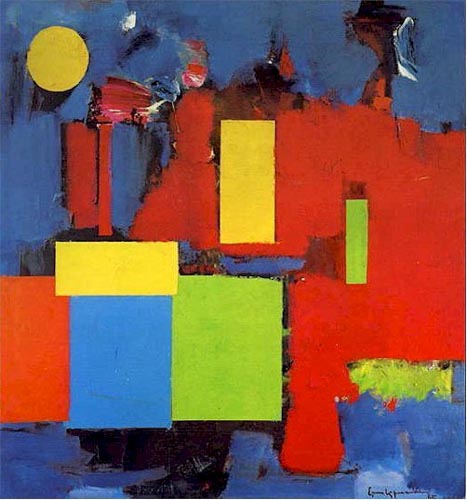
on “Song to the Moon” – Antonin Dvořák

rising-moon-1964

   “Rising Moon (1964)

          Hans Hofmann

              __________

the moon was out last night, grand
upon the starlit evening, either 
waxing or waning, I’m not sure, but
not full, a gibbous moon, above the 
buildings that scrape, in my big city 
neighbourhood, in the very Cubist 
manner, the night sky, see above

I’d been listening to Renée Fleming
singing Dvořák‘s Song to the Moon
in my head since I’d seen her do it, 
on television, in a summer evening 
concert at Schönbrunn, Vienna, some
few days ago, sheit, had been utterly, 
sublimely, enchanting, I’m a Cancer, a
moon child, I speak to the moon

to the moon, I said, moon in the dark
heavens, who steal into every home
and hearth at night, find my beloved
and tell him what is in my heart, rapt 
as I was in the spell of my special
planet, my personal orb, and the 
enveloping Dvořákian magic, though 
there’s been no beloved lately, just 
trailings of the latest one who broke, 
of course, my heart, which gives more 
pathos, however, incidentally, to my 
singing, I’ve giddily gathered

at home, I found Renée Fleming doing 
the piece on the Internet, entirely as 
splendidly, earlier, at London’s Royal
Albert Hall, September, 2010

listen

R ! chard

“The Man I Love” – George and Ira Gershwin

apollon-1937-jpglarge

             Apollon” (1937) 

             Charles Despiau

                    _______

when my heart is broken, I learn the 
words to torch songs, and wallow in 
my misery until the poignancy of the
poetry seduces me and I revel in its 
caress

for a while now I’ve been yodelling 
along with Hank Williams, who, 
incidentally, sings in my key, though 
the accurate reach of his far-flung 
notes can be tricky

but today, I inadvertently slipped into 
this Sophie Tucker classic enough to 
change my tune

watch this wonderful rendition of 
The Man I Love in a version you’ll 
never forget for both its originality
and its great humanity

Richard

Polonaise in F# minor, opus 44 – Frédéric Chopin

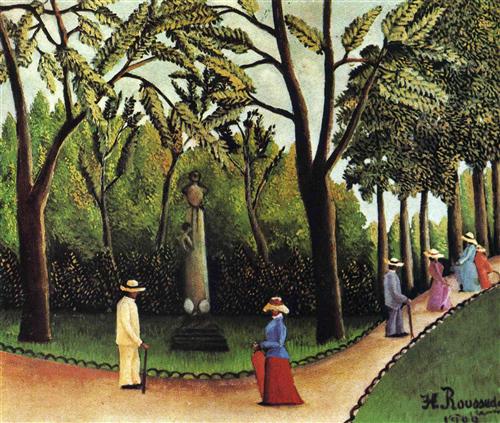
"The Monument to Chopin in the Luxembourg Gardens" - Henri Rousseau

The Monument to Chopin in the Luxembourg Gardens (1909)

Henri Rousseau

__________

a short while ago, my sister touted,
virtually of course, an up-and-coming
pianist, from around the corner,
relatively, from where she lives

Charles Richard-Hamelin was born in
Lanaudière, Quebec, whereas she’s
been living in Montreal forever, apart
from a stint in Timmins, Ontario, where
we were both born, at least a generation
before Shania Twain put it on the map

I left in a hurry, she followed
somewhat less urgently, a condition
of an intermediary marriage, which
engendered a miracle, my single,
but extraordinary, nephew, though
not much else

at his website, Charles Richard-Hamelin
delivers a few examples of his talent, I
listened to a couple of his Chopins, was
especially impressed by their structure,
the way Chopin imbues strict Classical
conditions with melting, Romantic,
sentiment, the very ideal, in my
estimation, of poetry

you’ll note in the Polonaise he plays
the adherence to tonality, never a
melodic line out of place, a strict
tempo, not ever indulgent, or maudlin,
despite evident emotional appeals,
and the recurrence of the original
theme after an however intoxicating
digression, giving subsistence to an
otherwise flight of aimless airs, out
of any context

music gives coherence, order, to an
otherwise inchoate, inscrutable world,
Classical music represents the original
rhythm of the heartbeat – time, regularity,
logic, the possibility of understanding,
the foundation of our present Western
culture, for better, of course, or for
worse, if not, indeed, of our very
species – defrayed of language’s inherent
ambiguities, its malleability, elasticity,
the indeed outright potential for
duplicity it accords the spoken, or
written, word

music is not just entertainment, it is
a philosophy, Apollo’s most transparent
muse

listen

Richard