Just another WordPress.com weblog
Tag: Zeus / Jupiter / Jove / gods of gods
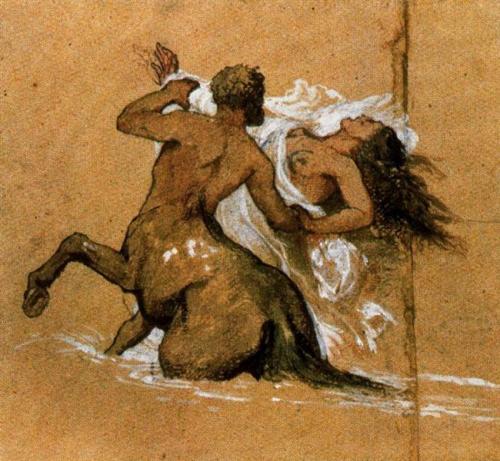
________ Old Chiron took the babe with secret joy, Proud of the charge of the celestial boy. His daughter too, whom on the sandy shore The nymph Charicle to the centaur bore, With hair dishevel’d on her shoulders, came To see the child, Ocyrrhoe was her name; nymph Charicle , c[o]me …[t] o see the child With hair dishevel’d on her shoulders, there’s a suggestion here, regarding Charicle , of madness, or possession the child, the babe, the celestial boy, the infant, ript, by its very father, Apollo , from his unfaithful lover,its, or his, care She knew her father’s arts, and could rehearse The depths of prophecy in sounding verse. it appears that Ocyrrhoe , daughter of a poetess , was possessed, on her father’s side, of poetry, could reveal, decipher, or rehearse / The depths of prophecy, in sounding verse , was able, as wordmongers sometimes do, to tell truth, deliver, in rhyme, incisive evaluations Once, as the sacred infant she survey’d, the sacred infant, the child born of The God was kindled in the raving maid, The God, the child, the sacred infant, by virtue of being half, if only half, divine, having been fathered by the kindled, inspired the raving maid, Ocyrrhoe , beset byneurotic, irrational, though prophetic, it is proposed, powers And thus she utter’d her prophetick tale: “Hail, great physician of the world, all-hail; great physician of the world, become a healer of legend Hail, mighty infant, who in years to come Shalt heal the nations, and defraud the tomb; defraud the tomb, recall from thehereafter, resuscitate, revive, return to life Swift be thy growth! thy triumphs unconfin’d! Make kingdoms thicker, and increase mankind. thicker, more populated Thy daring art shall animate the dead, Thy daring art, medicine, the mighty infant will eventually be recognizedas a celebrated man of healing And draw the thunder on thy guilty head: guilty head, when Hades , king of the brother, that the mighty infant was stealing his subjects, the departed, Zeus shot the great physician down,acknowledging the healer’s guilt, of his defraud[ing] the tomb, condemningthe culprit with a punishing, an annihilating, thunderbolt Then shalt thou dye, but from the dark abode Rise up victorious, and be twice a God. Apollo , aggrieved, had had his son,the child, the sacred infant, reinstated,after tortuous ministrations, as animmortal god, an entirely, however, other story And thou, my sire, not destin’d by thy birth To turn to dust, and mix with common earth, How wilt thou toss, and rave, and long to dye, And quit thy claim to immortality; When thou shalt feel, enrag’d with inward pains, The Hydra’s venom rankling in thy veins? the child, the sire, not destin’d by [its] birth / T o turn to dust, which is to say, to be nolonger mortal but immortal, how will it, not wanting particularly to survive, quit [its] claim to immortality, deal with theimpossibility of dying, [w]hen [it] shal[l] f eel, enrag’d with inward pains, agonies, that compel it to seek personal annihilation Hydra , a snakelike monster with manyheads, whose venom and very breath were poisonous, stationed at one of The Gods, in pity, shall contract thy date, And give thee over to the pow’r of Fate.” contract thy date, make mortal,subject once again to Fate R ! chard
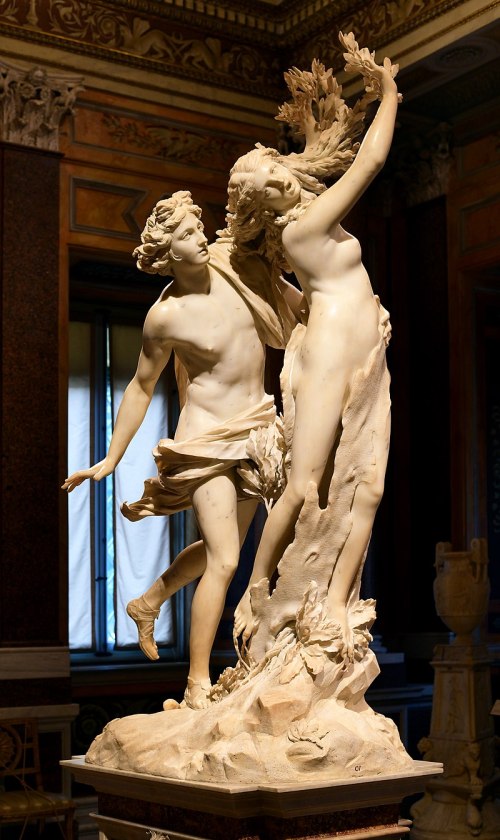
___________ now his thoughts are turned to other things The first and fairest of his loves, was she Whom not blind fortune, but the dire decree Of angry Cupid forc’d him to desire: that Phoebus should fall in love, indeed for the first time, was not the work of blind fortune, but the decree, the will, rather, of Cupid , son of Mars , god of War, and Venus , goddess of Love, himself, Cupid , god of Desire, who’d been, we’ll see, unacceptably disrespected Daphne her name, and Peneus was her sire. her sire, her father, Peneus Swell’d with the pride, that new success attends, He sees the stripling, while his bow he bends, And thus insults him: Phoebus , fresh from his triumphantbout with Python , thus [s]well’d with … pride at his new success, sees Cupid , the stripling, the youth, handling his own celebrated bow, and derisively insults him Thou lascivious boy, Are arms like these for children to employ? arms, weapons Know, such atchievements are my proper claim; arrows, Phoebus says, are my domain, my proper claim, my undisputedterritory Due to my vigour, and unerring aim: Resistless are my shafts, and Python late In such a feather’d death, has found his fate. the death of Python is proof of my unparalleled ability, Phoebus proclaims feather’d death, from the feathers thatare attached to the arrows to direct and speed their aim Take up the torch (and lay my weapons by), my weapons, weapons which shouldbe mine alone With that the feeble souls of lovers fry. Take up the torch, take responsibility,Phoebus says, lay down your weapons, your arrows, the ones that fry, he accuses Cupid , that frazzle, the feeble, incapacitated, souls of l overs To whom the son of Venus thus reply’d, Phoebus, thy shafts are sure on all beside, But mine of Phoebus, mine the fame shall be Of all thy conquests, when I conquer thee. thy shafts, Cupid says, will alwaysprevail, surpass others, but my own arrows will be the ones to best you, and yours, at which point the glory will be, notoriously, mine, over yours, forever He said, and soaring, swiftly wing’d his flight: Cupid is one of the very few ancientdeities to have wings, incidentally, there’s also Mercury , the Roman Hermes , messenger god, god of travel, communication Nor stopt but on Parnassus’ airy height. Parnassus , a mountain in Greece,indeed where Python has just been killed Two diff’rent shafts he from his quiver draws; One to repel desire, and one to cause. One shaft is pointed with refulgent gold: To bribe the love, and make the lover bold: One blunt, and tipt with lead, whose base allay allay, alloy, combination of metals Provokes disdain, and drives desire away. The blunted bolt against the nymph he drest: But with the sharp transfixt Apollo’s breast. gotcha Th’ enamour’d deity pursues the chace; Th’ enamour’d deity, Phoebus , isnow under the spell of Cupid ‘s pointed arrow The scornful damsel shuns his loath’d embrace: In hunting beasts of prey, her youth employs; And Phoebe rivals in her rural joys. The scornful damsel, Daphne , in the spirit of Phoebe , goddess of the Hunt, preferred rural joys, indeed rivalled Phoebe ‘s own enjoyment of rustic sports to explain the similarity in their names, it should be noted that Phoebe and Phoebus were twins, both children of Zeus , god of gods, the equivalent of the Roman Jove , also known as the Moon, as well as of the Hunt, he, Phoebus , god of the Sun, as well as of several other things it should be noted that the gods and goddesses of Ancient Greece, firmly installed during its period of glory, the 4th and 5th Centuries BCE, travelled throughout Europe and Asia, migrating, but were adapted to the local customs, consequently becoming known by different names according to the language and culture, you can see a parallel in the spread of Latin, for instance, during the Roman conquests of, specifically, Europe, evolving into the several derivative languages, starting with, historically, Italian itself, little by little, achieved through the effects of time rather than of distance, then French, Portuguese, Spanish in the outlying, eventually impermeated, areas, see the infiltration of English, for instance, in the modern world With naked neck she goes, and shoulders bare; And with a fillet binds her flowing hair. fillet, a ribbon By many suitors sought, she mocks their pains, And still her vow’d virginity maintains. Impatient of a yoke, the name of bride She shuns, and hates the joys, she never try’d. On wilds, and woods, she fixes her desire: Nor knows what youth, and kindly love, inspire. she’s not the marrying kind Her father chides her oft: Thou ow’st, says he, Thou ow’st, you owe A husband to thy self, a son to me. that’s his position She, like a crime, abhors the nuptial bed: she’d, categorically, rather hunt She glows with blushes, and she hangs her head. Then casting round his neck her tender arms, Sooths him with blandishments, and filial charms: filial, can apply to both son ordaughter blandishments, sweet nothings Give me, my Lord, she said, to live, and die, A spotless maid, without the marriage tye. allow me to live[ ] and die[ ] a spotless maid , a virgin, she asks, best, thatline, read without commas girls would’ve been at the mercy of their fathers’ wishes at the time, would’ve needed permission not to marry ‘Tis but a small request; I beg no more Than what Diana’s father gave before. Diana is the Roman equivalent of Phoebe , a virgin goddess, by the grace of her father, Zeus , the Greek counterpart of the Roman The good old sire was soften’d to consent; But said her wish wou’d prove her punishment: For so much youth, and so much beauty join’d, Oppos’d the state, which her desires design’d. good luck with that, Zeus prophesies, men will find you, so much youth, and so much beauty, very hard to resist,you’ll surely suffer consequences to be continued R ! chard
 Richibi's Weblog