Richibi’s Weblog

Just another WordPress.com weblog

Tag: William Shakespeare

“The Story of Narcissus” (ll) – Ovid
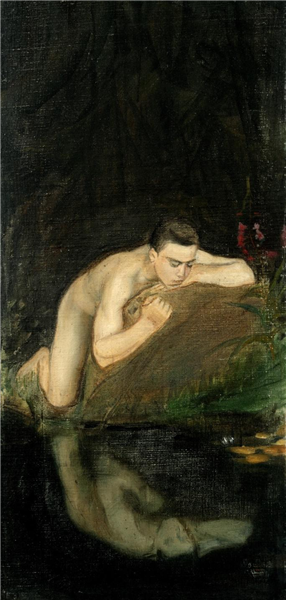
Narcissus, 1896 - 1897 - Magnus Enckell


            “Narcissus” (1896 – 1897)


                     Magnus Enckell


                            __________


           Still o’er the fountain’s wat’ry gleam he stood,

           Mindless of sleep, and negligent of food;

           Still view’d his face, and languish’d as he view’d.


Narcissus has been smitten by this

reflection of himself in the fountain’s

wat’ry gleam, can’t sleep, won’t eat


note, incidentally, the two meanings

of Still here, the first, without moving,

the second, not having stopped, not

discontinued


           At length he rais’d his head, and thus began

           To vent his griefs, and tell the woods his pain.

          “You trees,” says he, “and thou surrounding grove,

           Who oft have been the kindly scenes of love,

           Tell me, if e’er within your shades did lye

           A youth so tortur’d, so perplex’d as I?

           I, who before me see the charming fair,


the charming fair, his reflection

in the fountain’s wat’ry gleam


           Whilst there he stands, and yet he stands not there:

           In such a maze of love my thoughts are lost:


Narcissus reflects, bewildered

by the ephemerality of his

vision


           And yet no bulwark’d town, nor distant coast

           Preserves the beauteous youth from being seen,

           No mountains rise, nor oceans flow between.


there is no material object, he reasons,

to obstruct a clear view of the beauteous

youth before him, no intervening

obstacles between him and his vision


bulwark’d, defended with fortifications,

as in Medieval towns


the beauteous youth, his own reflection


           A shallow water hinders my embrace;


A shallow water, only a sheen is

required to cast a reflection, a

film merely, the water need not

be at all that deep


           And yet the lovely mimick wears a face


the lovely mimickthe image in

the water


           That kindly smiles, and when I bend to join

           My lips to his, he fondly bends to mine.


what of homosexuality here, an

unobjectionable predilection at

the time, apparently, there isn’t

a whiff of iniquity in this attraction,

according to the text, no hint of

guilt or embarrassment


           Hear, gentle youth, and pity my complaint,


a direct exhortation here, note,

no longer, in this instance, a

literary narration, a tale being

told


           Come from thy well, thou fair inhabitant.

           My charms an easy conquest have obtain’d

           O’er other hearts, by thee alone disdain’d.


you, Narcissus says, alone, replication,

disdain[ ], repulse, my advances, my

elsewhere, otherwise, easy conquest[s]


           But why should I despair? I’m sure he burns

           With equal flames, and languishes by turns.

           When-e’er I stoop, he offers at a kiss,


offers, responds with


           And when my arms I stretch, he stretches his.

           His eye with pleasure on my face he keeps,

           He smiles my smiles, and when I weep he weeps.

           When e’er I speak, his moving lips appear

           To utter something, which I cannot hear.


all his senses are alive, but for

his hearing, which registers only

silence, when all of the other

aspects of the experience are

precise and vivid as though

real, utterly, however

incompatibly, convincing


           “Ah wretched me! I now begin too late

           To find out all the long-perplex’d deceit;

           It is my self I love, my self I see;

           The gay delusion is a part of me.

           I kindle up the fires by which I burn,

           And my own beauties from the well return.

           Whom should I court? how utter my complaint?


court, sue to, argue, put to the

test a dilemma, a complaint, as

though before an arbiter


           Enjoyment but produces my restraint,

           And too much plenty makes me die for want.

           How gladly would I from my self remove!

           And at a distance set the thing I love.

           My breast is warm’d with such unusual fire,

           I wish him absent whom I most desire.

           And now I faint with grief; my fate draws nigh;

           In all the pride of blooming youth I die.


the contradictions inherent in passion

are evidenced, in this case those of

love


           Death will the sorrows of my heart relieve.

           Oh might the visionary youth survive,


visionary, relating to vision, observed,

caught sight of, viewed, in the water


relieve, render solace to, there is no

solution to this anguished misery

but dying


           I should with joy my latest breath resign!

           But oh! I see his fate involv’d in mine.”


you might have noted, or not, that

the tale has become psychological

in the instance of Narcissus, where

earlier an action transpired and

events were recounted in

chronological order, in this myth,

the subject explores his inner

world while sitting quietly

throughout by the still water,

nothing moves, but the

palpitations of his heart, and its

distempers


there’s a shift here in not only

the mythological template, more

personal, individual stuff, but also 

in the very evolution of literature,

which takes on a more interior

tone rather than fatalistic,

episodic, given entirely to

unfathomed circumstance


this will lead to To be, or not to be

eventually, the anthem that took

over the subsequent centuries

since, Shakespeare‘s homage to

introspection, setting the stage

for the ensuing ages of

individualism, human rights


but that’s another story

stay tuned


R ! chard

Ovid / Shakespeare

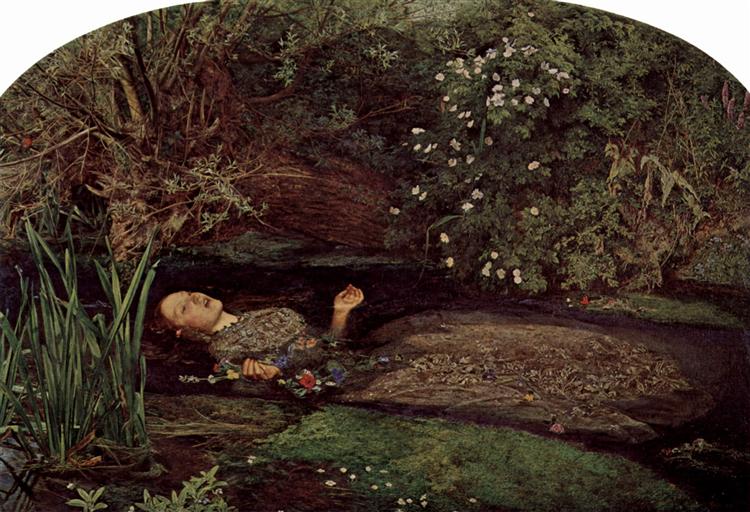
Ophelia, 1851 - 1852 - John Everett Millais

               Ophelia(1851 – 1852)


                   John Everett Millais


                              _________


for a while now, I’ve been feeling the

spirit of Ovid in many of the works of

William Shakespeare, a recent, in

some depth, project of mine, the

nearly pagan perspective in many

of his works, a lust for life, for

instance, that is not at all that of his

contemporary Protestantism, not

to mention an obvious Catholic, and

therefore potentially treacherous, at

the time, prominent bent of his


but that’s another story


many of his plays set scenes in places

right out of Roman mythology, with a

morality to match,and even character

names, Hippolyta, Hero, Polonius,

Titania, Oberon, Greek and Latin

patronyms redolent of Classical

Antiquity


here’s Ovid, for instance, from The

Story of Narcissus


           There stands a fountain in a darksom wood,

           Nor stain’d with falling leaves nor rising mud;

           Untroubled by the breath of winds it rests,

           Unsully’d by the touch of men or beasts;

           High bow’rs of shady trees above it grow,

           And rising grass and chearful greens below.


here’s Shakespeare, from his Hamlet,

Gertrude, Queen of Denmark, gives

the news of Ophelia’s death, in a

particularly Ovidian, I think, manner


           There is a willow grows aslant a brook,
           That shows his hoar leaves in the glassy stream;
           There with fantastic garlands did she come
           Of crow-flowers, nettles, daisies, and long purples
           That liberal shepherds give a grosser name,
           But our cold maids do dead men’s fingers call them:
           There, on the pendent boughs her coronet weeds
           Clambering to hang, an envious sliver broke;
           When down her weedy trophies and herself
           Fell in the weeping brook. Her clothes spread wide;
           And, mermaid-like, awhile they bore her up:
           Which time she chanted snatches of old tunes;
           As one incapable of her own distress,
           Or like a creature native and indued
           Unto that element: but long it could not be
           Till that her garments, heavy with their drink,
           Pull’d the poor wretch from her melodious lay
           To muddy death.


see above


there is the influence of Dryden to

consider, it must be noted, Ovid‘s

translator into Englishbut the

similarity in the spirit of the text is

so great, the characteristic voice

so evident, regardless of elapsed

time, the intervening fifteen hundred

years, 8 CE for Ovid, to somewhere

around 1600 CE for Shakespeare,

for the congruence to be coincidental,

Shakespeare had to have been reading 

his Ovid, imbibing it, what, do you think


then again, as Shakespeare would

have said, There are more things in

heaven and earth, Horatio, / Than

are dreamt of in your philosophy


R ! chard

on art, its purpose

poet-with-flower-2008-jpgblog

                                Poet With Flower (2008)

                                          Stefan Caltia

                                                 _____

wherefore art, I’ve long and often wondered,
with only a wink to Juliet’s Romeo, for my
question dug deeper, why, indeed, itself art

we build our souls on the stories we’ve 
heard, the impressions we’ve received
from voices that spoke directly to our 
senses, painters with paint, musicians
with music, writers with words, poets 
with poems

it started with fairy tales, which told of
right and wrong, good and bad, courage,
kindness, responsibility, and dire 
consequences for discord

Biblical stories also took up a lot of my own
childhood, Jesus, Adam and Eve, Moses
and the Ten Commandments, this last 
reinforced by Cecil B. DeMille’s epic

but soon enough it was Oliver TwistLittle
Nell, and by an inescapable authorial leap, 
since these were all by an irresistible 
Charles Dickens for a guy my age, Sydney
Carton, who valiantly stands in for his
friend, Charles Darnay, at the guillotine, a 
quantum, even existential, leap from 
Peter Pan and Mary Poppins 

though I had the good fortune to learn to 
read and write music as a boy, play music, 
learn about Bach, Brahms and Beethoven, 
it didn’t take anyone else much more than
their enthusiasm to see what the Beatles
were similarly doing, the Rolling Stones, 
the Supremes, they were not only singing, 
but making history, shaping it, and us, we 
followed the questions they rose, their 
responses, the effects upon ourselves
for nothing is considered until it’s 
mentioned, spoken, made clear, and they
were those prophets

the same goes for art, we see as we see
cause Monet, Picasso, Warhol showed 
us how to see, what to look at

and of course poets, Shakespeare, 
RostandDanteGoethe, to inform, each,
their individual language, and culture

I have been Philip CareyScarlett O’Hara, 
Blanche DuboisGary Cooper in High
Noon“, both Martha and George in 
Who’s Afraid of Virginia Woolf“, lately 
I’ve been even Hank Williams

as Babette would say, a French doll who 
gets abducted in Raggedy Ann and Andy:
A Musical Misadventure“, an animated 
movie from the Seventies, – oo aahrr yoo 

Richard

psst: all of them have been me too,
      incidentally
” Shakespeare and Politics”- Professor Paul Cantor

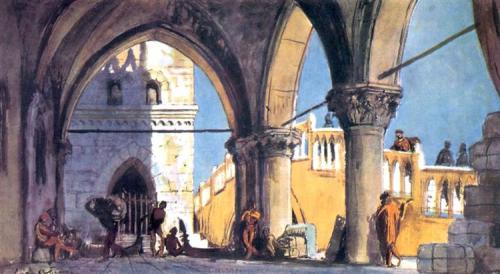
on-the-waterfront-set-design-for-shakespeare-s-drama-the-merchant-of-venice(1).jpg!Large.jpg

 On The Waterfront. Set Design For Shakespeare’s Drama

   “The Merchant Of Venice” (1920)


      Alexandre Benois


                 ________


though this recommendation might seem 

erudite, esoteric, indeed eccentric, if not

even improbable, I vaunt this invaluable 

series to the stars, Professor Paul Cantor

of the University of Virginia, speaking from 

Harvard, however, here, shines such 

glorious light on the already extraordinary 

Shakespeare so as to make him the equal 

of very  Beethoven, poets of nearly 

supernatural ability 


Professor Paul Cantor views Shakespeare 

through Shakespeare’s understanding of  

politics, comparing his political settings – 

commercial Venice, imperial Rome, 

medieval and Renaissance England, 

Denmark under a Christian king – to not 

only shed light on those individual 

political systems alive at a time when 

democracy was being born, but as well 

on Shakespeare’s own unexpectedly 

probing philosophical insights in the 

matter of governance, right up there 

with John Locke and Machiavelli


who’d ‘o thunk it 


the professor is engaging throughout, his  

information entirely absorbing, you’ll come 

out a new wo/man


the lectures are not short at an hour, twenty
minutes, I break to powder my nose, get a
a glass of wine, even answer the phone to,
of course, preferred only parties, but have 
been returning addictively daily 

 it’s a heady indeed addiction


Richard   

up my idiosyncrasies – a bio

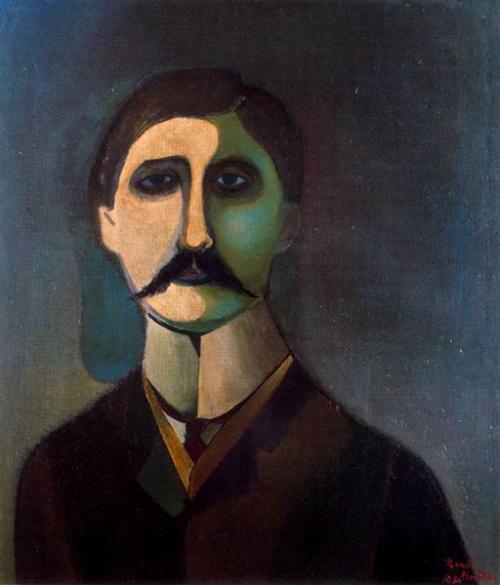
marcel-proust.jpg!Large

      “Marcel Proust” 
 
       Richard Lindner
 
          ___________
 
 
for a bio with which I’ve been asked 
to provide an online poetry magazine 
I’ve been encouraged to apply to, I’m 
submitting the following text
 
I thought you might enjoy it
 
 
Richard
 
           ______________
 
 
my name is Richard Bisson, from
which you’ll intuit my French 
Canadian background, though I 
write mostly in English, with no 
trouble however in French, my 
mother tongue is le français  
 
I am thus imbued, undoubtedly,
with that sensibility, my peers 
have been HugoFlaubert, and
most of all Marcel Proust, whom 
I imbibed for 33 years, in French,
page by page, reading each out 
loud as though it were my own, I 
cannot but be replicating now his 
rhythms, his aesthetic, his view 
of the world
 
it didn’t take me as long to read 
Homer, in the thunderous Robert  
Fitzgerald translation, – a mighty
roar resounding still from the 
ninth century before the Christian 
Era – from him I learned to speak 
from the heart, it’s not one’s style  
one has to master, but one’s 
humanity
 
Robert Browning gave me the 
dramatic monologue as a poetic
device, a gift he’d received from
 
Shakespeare himself, of course,
the unbridled freedom of his own 
literary imagination
 
Carl Sandburg‘s Chicago taught 
me to talk about every wo/man, 
about things even my own folks 
were doing
 
Collapsed showed me that even 
apparently inconsequential acts
can be poetry, poetry in the 
apparently humdrum 
 
Mary Oliver is a strong present 
influence
 
the cadence is entirely Beethoven,
with some help, I must admit, from 
the atonalists, SchoenbergBerg,
and Weberncommas are my bar 
lines
 
 
I call what I do prosetry, a word so 
new my computer won’t even let 
me write it, I’m a prosetrist, this 
word either
 
I want to link everyday experience 
with poetry, make poetry in the eye 
of the beholder, where truth and 
beauty lie
 
if people can see what I see, they 
can see that way themselves, it’s 
something one learns, and it’s all 
in the way one entrenches words 
and ideas
 
I eliminated the word “if” from my 
vocabulary once, for being then
too speculative, it changed my life, 
I’ve replaced it since with the word 
“miracle”, that has also changed 
my life
 
I am 67 years old
 
I live in Vancouver, Canada
 
I consider myself to be, at this 
point in my life, bibliosexual, I
sleep with my books, and we’re
all still getting along just fine 
 
may you be so blessed
 
 
Richard
 
psst: also Anaïs Nin, for the 
          intimacy of her diaries
 
          o, and Woody Allen, for
          giving up before his  
          nihilism and just 
          laughing

Sonnet 128 – William Shakespeare‏

Sonnet 128

How oft when thou, my music, music play’st,
Upon that blessed wood whose motion sounds
With thy sweet fingers when thou gently sway’st
The wiry concord that mine ear confounds,
Do I envy those jacks that nimble leap,
To kiss the tender inward of thy hand,
Whilst my poor lips which should that harvest reap,
At the wood’s boldness by thee blushing stand!
To be so tickled, they would change their state
And situation with those dancing chips,
O’er whom thy fingers walk with gentle gait,
Making dead wood more bless’d than living lips.
Since saucy jacks so happy are in this,
Give them thy fingers, me thy lips to kiss.


                                William Shakespeare


it would not be incorrect to suppose that the
“wood” of which Shakespeare speaks here
is his own and not that of the instrument,
you’ll probably even enjoy the poem more
that way, which is to say for its saucy, not
to mention, unexpected and, ahem, 
protracted allegory 
 
you might also note the equally raffish
use of the word “jacks”
 
 
enjoy  
 
Richard  


happy hallowe’en

                                                                                                                                                        just in time a brew to invigorate the season,
courtesy of Shakespeare 
 
 
Richard
 
                _________________   


               (from “Macbeth”, act IV, scene 1)


Round about the cauldron go;
In the poison’d entrails throw.
Toad, that under cold stone
Days and nights hast thirty one
Swelter’d venom sleeping got,
Boil thou first i’ the charmed pot. 

           Double, double toil and trouble; 
           Fire burn and cauldron bubble.  
                                                                                                                                               Fillet of a fenny snake,
In the cauldron boil and bake;
Eye of newt, and toe of frog,
Wool of bat, and tongue of dog,
Adder’s fork, and blind-worm’s sting,
Lizard’s leg, and howlet’s wing,
For a charm of powerful trouble,
Like a hell-broth boil and bubble.

           Double, double toil and trouble; 
           Fire burn and cauldron bubble.

Scale of dragon, tooth of wolf,
Witches’ mummy, maw and gulf
Of the ravin’d salt-sea shark,
Root of hemlock digg’d i’ the dark,
Liver of blaspheming Jew,
Gall of goat, and slips of yew
Sliver’d in the moon’s eclipse,
Nose of Turk, and Tartar’s lips,
Finger of birth-strangled babe
Ditch-deliver’d by a drab,
Make the gruel thick and slab:
Add thereto a tiger’s chaudron,
For the ingredients of our cauldron.

            Double, double toil and trouble;
            Fire burn and cauldron bubble


                                  William Shakespeare


“King Lear” – William Shakespeare


forget about any other version, this is the only King Lear” 

 
Richard


XIV. If thou must love me, let it be for nought – Elizabeth Barrett Browning‏

from Sonnets from the Portuguese

XIV. If thou must love me, let it be for nought

If thou must love me, let it be for nought
Except for love’s sake only. Do not say
“I love her for her smile – her look – her way
Of speaking gently, – for a trick of thought
That falls in well with mine, and certes brought
A sense of pleasant ease on such a day” –
For these things in themselves, Beloved, may
Be changed, or change for thee, – and love, so wrought,
May be unwrought so. Neither love me for
Thine own dear pity’s wiping my cheeks dry, –
A creature might forget to weep, who bore
Thy comfort long, and lose thy love thereby!
But love me for love’s sake, that evermore
Thou may’st love on, through love’s eternity.

Elizabeth Barrett Browning

_____________________

with this poem Elizabeth has written her way, I think,
along with “love’s”, into her own immortality, not only
has she acknowledged her lover’s love, taken a practical
stance about it – straightforward, no circumlocutions –
but touches also upon a truth of love, one of its
inextricable conditions, love is, she affirms, as an
article of very faith, forever

compare Shakespeare on the subject, an interesting
juxtaposition I picked up from another astute observer
on the Internet

Sonnet CXVl

Let me not to the marriage of true minds
Admit impediments. Love is not love
Which alters when it alteration finds,
Or bends with the remover to remove:
O no! it is an ever-fixed mark
That looks on tempests and is never shaken;
It is the star to every wandering bark,
Whose worth’s unknown, although his height be taken.
Love’s not Time’s fool, though rosy lips and cheeks
Within his bending sickle’s compass come:
Love alters not with his brief hours and weeks,
But bears it out even to the edge of doom.
If this be error and upon me proved,
I never writ, nor no man ever loved.

William Shakespeare

the implicit debt to Shakespeare in Barrett Browning
is worth noting, they sound very much alike, unlike
alone, it would at first appear, in gender

Richard

“Trouble” – Matthew Dickman‏

                                                                                                                                                                              after the great hiatus of the Middle Ages Descartes declared I think, therefore I am, and set the modern world in motion, the Age of Reason, the Era of Human Rights 
 
but even Shakespeare some seventy years earlier had given voice already to the consequent existential dilemma, by way of Hamlet in his “To be, or not to be“, the moral dilemma of the individual before existence – “the slings and arrows of outrageous fortune” – and the abyss of eternity, a question up to that point forbidden on dire pain of heresy  
  

                                                                                                                                                                         Emily Dickinson touches on the subject famously, others also of equal authority, but here is something I thought true, touching, beautiful, and ultimately inspiring for anyone who’s delved that deep  
 
                                                                                                                                                                   Richard 
  
  
                       ______________________
  
 
Trouble   
 

                                                                                                                                                                        Marilyn Monroe took all her sleeping pills
to bed when she was thirty-six, and Marlon Brando’s daughter
hung in the Tahitian bedroom
of her mother’s house,
while Stanley Adams shot himself in the head. Sometimes
you can look at the clouds or the trees
and they look nothing like clouds or trees or the sky or the ground.
The performance artist Kathy Change
set herself on fire while Bing Crosby’s sons shot themselves
out of the music industry forever.
I sometimes wonder about the inner lives of polar bears. The French
philosopher Gilles Deleuze jumped
from an apartment window into the world
and then out of it. Peg Entwistle, an actress with no lead
roles, leaped off the “H” in the HOLLYWOOD sign
when everything looked black and white
and David O. Selznick was king, circa 1932. Ernest Hemingway
put a shotgun to his head in Ketchum, Idaho
while his granddaughter, a model and actress, climbed the family tree
and overdosed on phenobarbital. My brother opened
thirteen fentanyl patches and stuck them on his body
until it wasn’t his body anymore. I like
the way geese sound above the river. I like
the little soaps you find in hotel bathrooms because they’re beautiful.
Sarah Kane hanged herself, Harold Pinter
brought her roses when she was still alive,
and Louis Lingg, the German anarchist, lit a cap of dynamite
in his own mouth
though it took six hours for him
to die, 1887. Ludwig II of Bavaria drowned
and so did Hart Crane, John Berryman, and Virginia Woolf. If you are
travelling, you should always bring a book to read, especially
on a train. Andrew Martinez, the nude activist, died
in prison, naked, a bag
around his head, while in 1815 the Polish aristocrat and writer
Jan Potocki shot himself with a silver bullet.
Sara Teasdale swallowed a bottle of blues
after drawing a hot bath,
in which dozens of Roman senators opened their veins beneath the water.
Larry Walters became famous
for flying in a Sears patio chair and forty-five helium-filled
weather balloons. He reached an altitude of 16,000 feet
and then he landed. He was a man who flew.
He shot himself in the heart. In the morning I get out of bed, I brush
my teeth, I wash my face, I get dressed in the clothes I like best.
I want to be good to myself.


Matthew Dickman


                        ____________________________________