Richibi’s Weblog

Just another WordPress.com weblog

Tag: “The Wall” – Pink Floyd

Divertimento no 17, K334 – Mozart
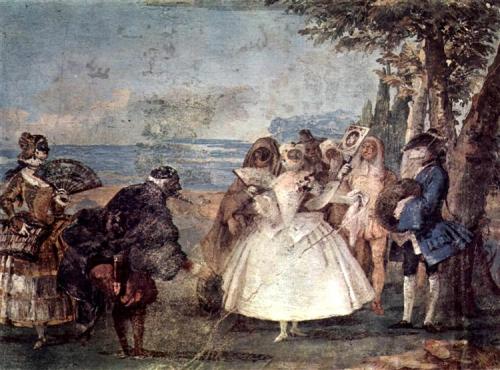
minuet-with-pantaloon-and-colombine-from-the-room-of-carnival-scenes-in-the-foresteria-1757.jpg!Large.jpg

Minuet with Pantaloon and Colombine, from the Room of Carnival Scenes
                                                                                                       in the Foresteria (1757)

     Giovanni Domenico Tiepolo

             ________________

already I can hear you asking, why is
The Seven Last Words“, with its nine
already movements, not a divertimento,
you’ll cry 

a divertimento is an entertainment, it 
doesn’t have the gravitas of Haydn’s 
composition, a sacred work, a 
divertimento is meant to delight

The Seven Last Words“, therefore,
by definition is not a divertimento,
it’s a completely different idea of a
piece with several movements, it 
has profoundly ulterior intentions,
following, rather, in the tradition of
Bach’s oratorios, though it had 
originally been conceived without 
words, the prelate in this work 
would be doing the talking

the piece gives itself a theme, a 
focus, a project, creating something 
like chapters in a book 

or think of the Stations of the Cross 
a metaphorically more apt, perhaps, 
unifying principle, instead of just a 
series of disparate airs, like singles 
were on albums until Pink Floyd 
similarly revolutionized music with 
a topic during my generation, The
Wall, with a little preparatory help
albeit, from the Beatles, earlier,
our friends

here’s Mozart, nevertheless, in order 
to compare, his Divertimento no 17,  
K334giving the aristocracy what 
they still, in 1780, wanted, something 
courtly

you’ll notice there are not just one 
but two minuets in the program, both 
with recapitulations, sure sign that 
we’re still in the Classical Era, though 
the minuet will die off as quickly as 
the divertimento will in the following 
decades, relics, both, of an earlier era

and indeed this is Mozart’s last for 
small orchestra, divertimenti would be 
composed from here on as merely 
tributes to an earlier period and its 
musical formulas

masses and oratorios would go the same 
way, incidentally, with some resurgence 
in the following centuries from a couple 
of Catholic organists who left profound 
influences individually on later centuries

but more about them later

meanwhile, here’s Mozart, feel the 
gentility, his genuflexion to propriety 
rather than to faith


R ! chard

the “wall”

study-for-a-sunday-on-la-grande-jatte-1885(1).jpg!Large

    “A Sunday on La Grande Jatte (1884)

           Georges Seurat

                 ________

should you know Vancouver, you’ll
recognize, nearly immediately, the 
Seawall on this video, before even 
a minute has elapsed you spot the 
Westin Bayshore coming at you, 
nearly perilously, before the speeding 
bullet that takes you on the journey 
turns the crucial corner on the paved 
path that wends its way afterwards
around the peninsula

on foot, this takes about three hours,
but here, inspired by the music of Pink 
Floyd, on a deft reinterpretation of the 
title and music from The Wall“, their 
oracular masterpiece, an inspired 
cyclist brings this local trajectory to 
psychedelic life, if you can stand the 
unsettling disjunction between his 
dizzying speed and the grandeur 
of the transcendent, immutable,  
coastlines

you’ll need, I suggest, seatbelt,
but the ride is wild

the journey ends abruptly, both 
geographically and musically, 
just down the street from my place, 
across the road from recently 
favourite restaurant, with a view, 
just as transcendent, however not
at all disappointingly mutable, of 
the Pacific sunset, whenever we, 
family and friends, eat there

R ! chard

the wall

colors-for-a-large-wall-1951.jpg

   “Colors For A Large Wall (1951)

       Ellsworth Kelly

          __________

talking about walls, isn’t it only a few
years ago we were tearing one down

here is Roger Waters and several
other outstanding guest artists, in 
very Berlin, July 21, 1990, celebrating 
its demise

a little earlier, C***mas, 1989, only
moments after East Germans had 
been allowed to visit West Germany,
essentially giving way to the 
dissolution of the barrier, Leonard
Bernstein conducted Beethoven’s
Ninth Symphony, changing the 
word “joy” from the title of Schiller’s 
poem, appropriated by Beethoven 
for his great fourth choral movement, 
to “freedom”, giving new meaning, 
and new life, and new inspiration,  
to Beethoven’s always resounding 
nevertheless masterpiece

how soon we’ve forgotten

Richard

psst: let’s paint the wall