Richibi’s Weblog

Just another WordPress.com weblog

Tag: the Underworld

“The Story of Narcissus” (lll) – Ovid

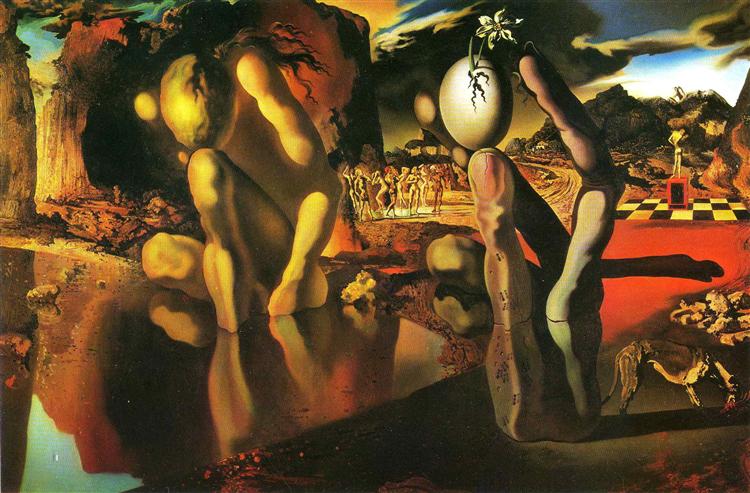
The Metamorphosis of Narcissus, 1937 - Salvador Dali


         The Metamorphosis of Narcissus” (1937)


                   Salvador Dali


                            _____


              This said, the weeping youth again return’d

              To the clear fountain, 


This said, you’ll remember that Narcissus

had pondered suicide, but was afraid that

such an act would also have an impact on

his reflection


                                          where again he burn’d;


burn’d, from the unusual fire that kindled
his breast


                His tears defac’d the surface of the well,

                With circle after circle, as they fell:


disfiguring reverberations in the water

from the tears


               And now the lovely face but half appears,
               O’er-run with wrinkles, and deform’d with tears.
               “Ah whither,” cries Narcissus, “dost thou fly?
               Let me still feed the flame by which I die;


the flame by which I die, the fire which

burns in his chest


              Let me still see, tho’ I’m no further blest.”


Narcissus will not willingly forego the

sight of his reflection though it will

manifestly not at all still his desire,

nor quell his fate


              Then rends his garment off, and beats his breast:
              His naked bosom redden’d with the blow,
              In such a blush as purple clusters show,
              Ere yet the sun’s autumnal heats refine
              Their sprightly juice, and mellow it to wine.


bruises the colour of wine blush in

purple clusters on his chest where

Narcissus has struck himself

repeatedly


              The glowing beauties of his breast he spies,
              And with a new redoubled passion dies.


The glowing beauties, the throbbing

discolorations left by the redoubled

blows


              As wax dissolves, as ice begins to run,
              And trickle into drops before the sun;
              So melts the youth, and languishes away,
              His beauty withers, and his limbs decay;
              And none of those attractive charms remain,
              To which the slighted Echo su’d in vain.


slighted, rebuffed


Echo, the nymph who’d pursued him,

in vain, if you’ll remember


su’d, sued, implored


              She saw him in his present misery,
              Whom, spight of all her wrongs, she griev’d to see.


spight, in spite


              She answer’d sadly to the lover’s moan,
              Sigh’d back his sighs, and groan’d to ev’ry groan:
              “Ah youth! belov’d in vain,” Narcissus cries;


to his reflection


              “Ah youth! belov’d in vain,” the nymph replies.


Echo can only echo


              “Farewel,” says he; the parting sound scarce fell
              From his faint lips, but she reply’d, “farewel.”


Narcissus, interestingly, is reproduced

not only visually in the water by his

own reflection, but audibly as well by

Echo‘s reverberating sounds


see above

              Then on th’ wholsome earth he gasping lyes,
              ‘Till death shuts up those self-admiring eyes.
              To the cold shades his flitting ghost retires,
              And in the Stygian waves it self admires.


Stygian, of the river Styx, which forms

the boundary between Earth and the

Underworld

              For him the Naiads and the Dryads mourn,


Naiads, water nymphs


Dryadstree nymphs


              Whom the sad Echo answers in her turn;


Echo also mourns


              And now the sister-nymphs prepare his urn:
              When, looking for his corps, they only found
              A rising stalk, with yellow blossoms crown’d.


corps, corpse, dead body


rising stalk, with yellow blossoms

crown’d, the narcissus, the flower


R ! chard

“The Birth of Bacchus” (ll)– Ovid

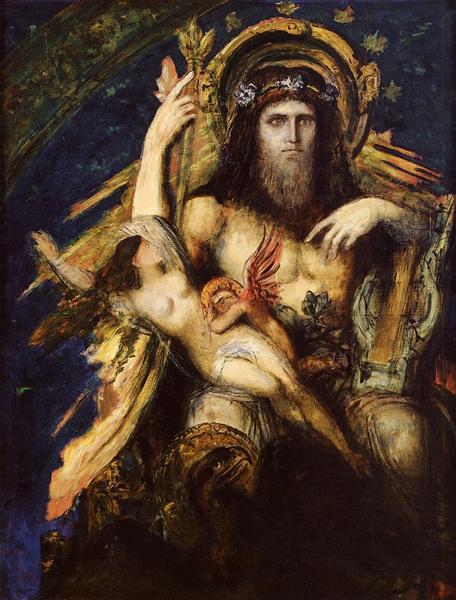
Jupiter and Semele, 1889 - 1895 - Gustave Moreau

         Jupiter and Semele” (1889 – 1895)


                 Gustave Moreau


                       _________


            Old Beroe’s decrepit shape she wears,

            Her wrinkled visage, and her hoary hairs;


Old Beroe, faithful servant of Semele


she, Juno / Hera, goddess


hoary hairs, love it


            Whilst in her trembling gait she totters on,

            And learns to tattle in the nurse’s tone.


Juno / Hera transforms herself into

Old Beroe, tattl[ing], talking idly, in

the nurse’s tone, impersonating her

in order to seek revenge, if you’ll

remember, on Semele, for bearing

her husband’s progeny


            The Goddess, thus disguis’d in age, beguil’d

            With pleasing stories her false foster-child.


foster-child, child who is fostered,

nurtured, by someone other than a

parent, Semele, by Old Beroe,

purportedly, in this instance


false, Juno / Hera is not Old Beroe,

but the nurse’s duplicitous, false,

in both senses of the word here,

double


beguil’d, enchanted, amused


            Much did she talk of love, and when she came

            To mention to the nymph her lover’s name,

            Fetching a sigh, and holding down her head,

            “‘Tis well,” says she, “if all be true that’s said.


Juliet’s nurse from Romeo and Juliet,

I thought, meets Sleeping Beauty’s

wicked stepmother, for a more

contemporary coupling


            But trust me, child, I’m much inclin’d to fear

            Some counterfeit in this your Jupiter:


Some counterfeit, yourJupiter is not

your [actual] Jupiter, Juno / Hera

suggests


            Many an honest well-designing maid

            Has been by these pretended Gods betray’d,


well-designing, without guile, with

no ulterior motive


pretended Gods, men who unjustifiably

beat their chest, tell tall tales, unequal

to their proclaimed accomplishments


            But if he be indeed the thund’ring Jove,

            Bid him, when next he courts the rites of love,

            Descend triumphant from th’ etherial sky,

            In all the pomp of his divinity,

            Encompass’d round by those celestial charms,

            With which he fills th’ immortal Juno’s arms.”


Juno / Hera, as Old Beroe, tells Semele

to ask her lover, when next he courts

the rites of love, to prove he is indeed

Jove / Jupiter / Zeus, to dress

appropriately


Encompass’d round, accoutred,

enveloped, in


the pomp, incidentally, the splendour

of his divinity, take on a couple of

extra poetic lines, verses, indicative

of that very splendour


note also that Semele seems to have

no qualms about Jove / Jupiter / Zeus‘s

marital status, about bearing the child

of another woman’s man, indeed that

of a very, in this instance, goddess,

the redoubtable Juno / Hera


            Th’ unwary nymph, ensnar’d with what she said, 


ensnar’d, ensnarled, caught up in


            Desir’d of Jove, when next he sought her bed,

            To grant a certain gift which she would chuse;


Desir’d of, asked of, requested of


chuse, choose


            “Fear not,” reply’d the God, “that I’ll refuse

            Whate’er you ask: may Styx confirm my voice,

            Chuse what you will, and you shall have your choice.”


Styx, goddess of the river Styx, which

forms the boundary between Earth and

the Underworld, had sided with Jove /

Jupiter / Zeus during the War of the

Titans and been granted by him that

oaths should henceforth all be sworn

upon her, and be punctiliously observed


Phoebus / Apollo had similarly granted

his own son Phaeton his wish upon very

Styx, if you’ll remember, with the direst,

for both, of consequences


            “Then,” says the nymph, “when next you seek my arms,

            May you descend in those celestial charms,

            And fill with transport Heav’n’s immortal dame.”


show me, Semele asks of her suitor,

what she gets, what Juno / Hera gets,

when next you seek my arms


go, girl, I thought, if you’re going

to be irreverent


            The God surpriz’d would fain have stopp’d her voice,

            But he had sworn, and she had made her choice.


on very Styx, he’d sworn, ever so

perilously


stay tuned


R ! chard

“The Story of of Cadmus” (lll) – Ovid

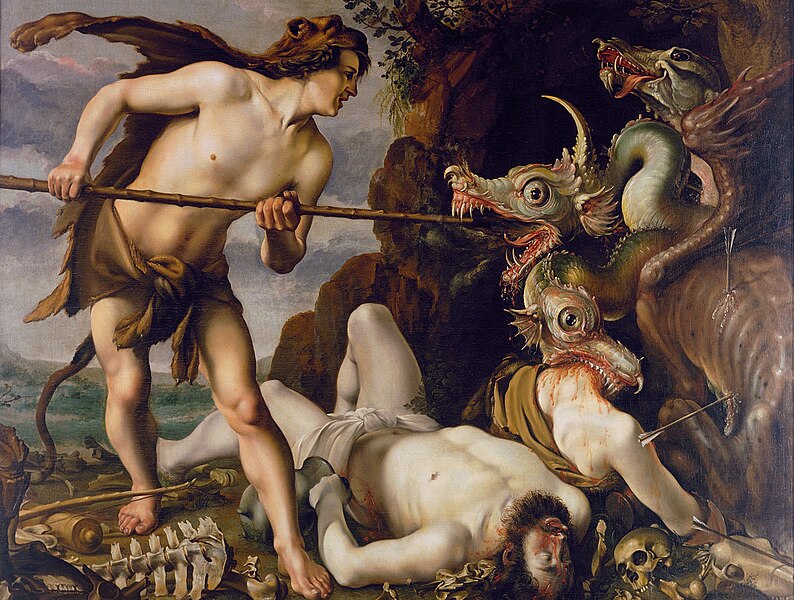
File:Hendrick Goltzius Cadmus Statens Museum for Kunst 1183.jpg

             Cadmus Slays the Dragon


                       Hendrick Goltzius


                                __________


             And now the scorching sun was mounted high,

             In all its lustre, to the noon-day sky;

             When, anxious for his friends, and fill’d with cares,

             To search the woods th’ impatient chief prepares.


th’ impatient chief, Cadmus, prince of

Tyre, had sen[t] his servants to a

neighb’ring grove / For living streams,

if you’ll remembersacrifice to Jove,

to thank that god for these new

dominionstheir new home


             A lion’s hide around his loins he wore,

             The well poiz’d javelin to the field he bore,

             Inur’d to blood; the far-destroying dart;

             And, the best weapon, an undaunted heart.


Cadmus here is a precursor of the

mythologically later Heracles, or

Herakles, or Hercules in Latin, a

hero, which is to say descended

from the gods, in that latter’s case,

son of Jove / Zeus / Jupiter, the

very deity who’d just abducted

Europa, Cadmus‘ sister, mother

of all Europeans, divine or human


             Soon as the youth approach’d the fatal place,

             He saw his servants breathless on the grass;


breathless, not breathing,

deceased


             The scaly foe amid their corps he view’d,

             Basking at ease, and feasting in their blood.


The scaly foe, the dragon


corps, corpses


             “Such friends,” he cries, “deserv’d a longer date;


a longer date, a longer life, a more

extended period of existence


             But Cadmus will revenge or share their fate.”


either [t]he scaly foe will die, the

dragon, or Cadmus himself, in the

attempt to avenge his friends, his

servants breathless on the grass,

he promises


              Then heav’d a stone, and rising to the throw, 

              He sent it in a whirlwind at the foe:


in a whirlwind, taking advantage

of a meteorological condition, as

one would a kite


             A tow’r, assaulted by so rude a stroke,

             With all its lofty battlements had shook;


a tower would’ve swayed at so

powerful a strike, I remember

an earthquake once rocking my

own high rise apartment building

for an unnerving moment before

settling, returning the ground, 

my ground, to its, otherwise

imperturbable, placidity


             But nothing here th’ unwieldy rock avails,

             Rebounding harmless from the plaited scales,

             That, firmly join’d, preserv’d him from a wound,

             With native armour crusted all around.


native, integral, a constituent

part of


             With more success, the dart unerring flew,


the dart, the javelin


             Which at his back the raging warriour threw;


the raging warriour, Cadmus


             Amid the plaited scales it took its course,

             And in the spinal marrow spent its force.

             The monster hiss’d aloud, and rag’d in vain,

             And writh’d his body to and fro with pain;

             He bit the dart, and wrench’d the wood away;

             The point still buried in the marrow lay.

             And now his rage, increasing with his pain,

             Reddens his eyes, and beats in ev’ry vein;

             Churn’d in his teeth the foamy venom rose,

             Whilst from his mouth a blast of vapours flows,

             Such as th’ infernal Stygian waters cast.


Stygian, of the River Styx, which

forms the boundary between the

Earth and the Underworld, named

after the Goddess Styx, daughter

of Tethys and Oceanus, god, and

river also, which encircled the

entire world


             The plants around him wither in the blast.

             Now in a maze of rings he lies enrowl’d,


enrowl’d, encircled, surrounded


             Now all unravel’d, and without a fold;


without a fold, without a hitch, without

an intervening obstacle


             Now, like a torrent, with a mighty force

             Bears down the forest in his boist’rous course.


Bears down the forest, advances,

like a torrent, against the wall of

trees


             Cadmus gave back, and on the lion’s spoil

             Sustain’d the shock, then forc’d him to recoil;


gave back, drew back, backed

away, forc’d … to recoil


the lion’s spoil, the dragon’s

venom and its gore


             The pointed jav’lin warded off his rage:


the dragon readies for the onslaught,

overcoming his, otherwise consuming

rage, at the sight of [t]he pointed jav’lin


             Mad with his pains, and furious to engage,

             The serpent champs the steel, and bites the spear,

             Till blood and venom all the point besmear.

             But still the hurt he yet receiv’d was slight;

             For, whilst the champion with redoubled might

             Strikes home the jav’lin, his retiring foe

             Shrinks from the wound, and disappoints the blow.


the jav’lin is still no match for the,

however wounded, dragon


             The dauntless heroe still pursues his stroke,

             And presses forward, ’till a knotty oak

             Retards his foe, and stops him in the rear;


retards, stops, inhibits


             Full in his throat he plung’d the fatal spear,

             That in th’ extended neck a passage found,

             And pierc’d the solid timber through the wound.


the fatal spear has pierc’d not

only th’ extended neck, but also

the knotty oak behind it, which

had prevented the dragon from

moving onward toward his

escape


             Fix’d to the reeling trunk, with many a stroke

             Of his huge tail he lash’d the sturdy oak;

             ‘Till spent with toil, and lab’ring hard for breath,

             He now lay twisting in the pangs of death.


ding dong, the dragon is, if not

dead, dying


stay tuned


R ! chard

“Ocyrrhoe transform’d into a Mare” (II) – Ovid

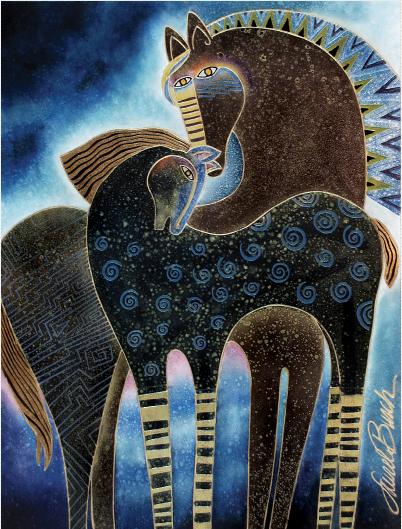
indigo-sky-mares

      Indigo Sky Mares


             Laurel Burch


                     ______


         Thus entring into destiny, the maid

         The secrets of offended Jove betray’d:


the maid, Ocyrrhoe, daughter of Chiron

and [t]he nymph Charicle


Ocyrrhoe had offended Jove, but

especially Hades, Jove’s brother,

ruler of the Underworld, when she

had prophesied that Apollo‘s child

with Coronis would be an acclaimed

healer, thus defraud[ing] the tomb,

thereby saving people from the 

clutches of Hades, the especially 

aggrieved god


         More had she still to say; but now appears

         Oppress’d with sobs and sighs, and drown’d in tears.


Occhyroe would have had more

to prophesy, but was impeded by

involuntary physical spasms


         “My voice,” says she, “is gone, my language fails;

         Through ev’ry limb my kindred shape prevails:


kindred shape, the bodily

characteristics of her father,

her kin, the centaur Chiron 


         Why did the God this fatal gift impart,

         And with prophetick raptures swell my heart!


prophetick raptures, Occhyroe, who

knew her father’s arts, and could

rehearse The depths of prophecy,

had inherited through her father,

Chiron, who had himself received

it from Apollo, his own father, the 

gift of divination, for better, for 

either, we’ll learn, or for worse


         What new desires are these? I long to pace

         O’er flow’ry meadows, and to feed on grass;

         I hasten to a brute, a maid no more;


what’s happening, What new desires

are these?, Occhyroe cries, or nearly

neighs, rather, at this point, I’m

becoming a brute, she groans, an

animal, a maid, no more, she objects


         But why, alas! am I transform’d all o’er?

         My sire does half a human shape retain,

         And in his upper parts preserve the man.”


why, Occhyroe asks, since my

father, Chiron, is partially a man,

am I transform’d all o’er?, why

is there nothing left of me that

is human


         Her tongue no more distinct complaints affords,


distinct, clear, easy to decipher


affords, allows, permits


         But in shrill accents and mis-shapen words

         Pours forth such hideous wailings, as declare

         The human form confounded in the mare:


Occhyroe has become a horse,

the proof is in her braying


         ‘Till by degrees accomplish’d in the beast,

         She neigh’d outright, and all the steed exprest.


all the steed exprest, was

everywhere the very picture 

of a horse


         Her stooping body on her hands is born,


born, borne, carried


         Her hands are turn’d to hoofs, and shod in horn,

         Her yellow tresses ruffle in a mane,

         And in a flowing tail she frisks her train,

         The mare was finish’d in her voice and look,

         And a new name from the new figure took.


Occhyroe can no longer be called

Occhyroe, she is no longer she,

but a new figure, needing to be

identified as something else


R ! chard

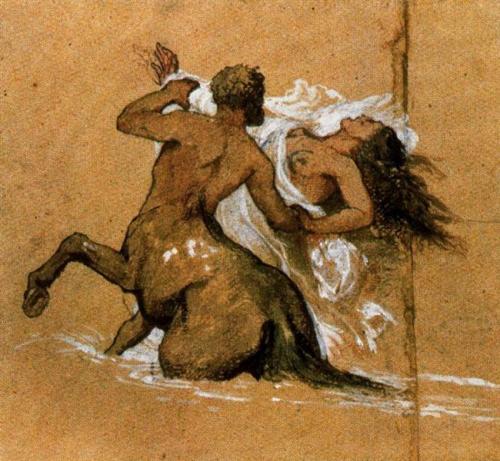
“Ocyrrhoe transform’d into a Mare” – Ovid

centaur-and-nymph.jpg!Large


       Centaur and Nymph


              Arnold Böcklin


                           ________


                  Old Chiron took the babe with secret joy,                 

                  Proud of the charge of the celestial boy.

                  His daughter too, whom on the sandy shore

                  The nymph Charicle to the centaur bore,

                  With hair dishevel’d on her shoulders, came

                  To see the child, Ocyrrhoe was her name;


Ocyrrhoe, daughter of Chiron and [t]he

nymph Chariclec[o]me …[t]see

the child


With hair dishevel’d on her shoulders,

there’s a suggestion here, regarding

Charicle, of madness, or possession


the child, the babethe celestial boy,

the infant, ript, by its very father,

Apollo, from his unfaithful lover,

Coronis’, womb, and [given] … to

the centaur Chiron”s charge, into

its, or his, care


                  She knew her father’s arts, and could rehearse

                  The depths of prophecy in sounding verse.


it appears that Ocyrrhoe, daughter of

Chiron and the nymph Charicle, was

a poetess, was possessed, on her

father’s side, of poetry, could reveal,  

decipher, or rehearse / The depths

of prophecy, in sounding verse, was

able, as wordmongers sometimes do,

to tell truth, deliver, in rhyme, incisive

evaluations


              Once, as the sacred infant she survey’d,


the sacred infant, the child born of

Apollo and Coronis 


              The God was kindled in the raving maid,


The God, the child, the sacred infant,

by virtue of being half, if only half,

divine, having been fathered by the

god, Apollo


kindled, inspired


the raving maid, Ocyrrhoe, beset by

neurotic, irrational, though prophetic,

it is proposed, powers


                   And thus she utter’d her prophetick tale:

                  “Hail, great physician of the world, all-hail;


great physician of the world, the fated

child of Apollo and Coronis would

become a healer of legend


                  Hail, mighty infant, who in years to come

                  Shalt heal the nations, and defraud the tomb;


defraud the tomb, recall from the

hereafter, resuscitate, revive,

return to life


                  Swift be thy growth! thy triumphs unconfin’d!

                  Make kingdoms thicker, and increase mankind.


thicker, more populated


                  Thy daring art shall animate the dead,


Thy daring art, medicine, the mighty

infant will eventually be recognized

as a celebrated man of healing 


                  And draw the thunder on thy guilty head:


guilty head, when Hades, king of the

Underworld, complained to Zeus, his

brother, that the mighty infant was

stealing his subjects, the departed,

Zeus shot the great physician down,

acknowledging the healer’s guilt, of

his defraud[ing] the tomb, condemning

the culprit with a punishing, an

annihilating, thunderbolt


                  Then shalt thou dye, but from the dark abode

                  Rise up victorious, and be twice a God.


Apollo, aggrieved, had had his son,

the child, the sacred infant, reinstated,

after tortuous ministrations, as an

immortal god, an entirely, however,

other story


                  And thou, my sire, not destin’d by thy birth

                  To turn to dust, and mix with common earth,

                  How wilt thou toss, and rave, and long to dye,

                  And quit thy claim to immortality;

                  When thou shalt feel, enrag’d with inward pains,

                  The Hydra’s venom rankling in thy veins?


the child, the sire, not destin’d by [its] birth

/ To turn to dust, which is to say, to be no

longer mortal but immortal, how will it, not

wanting particularly to survive, quit [its]

claim to immortality, deal with the

impossibility of dying, [w]hen [it] shal[l]

feel, enrag’d with inward pains, agonies,

that compel it to seek personal annihilation


Hydra, a snakelike monster with many

heads, whose venom and very breath

were poisonous, stationed at one of

the entrances to the Underworld


                  The Gods, in pity, shall contract thy date,

                  And give thee over to the pow’r of Fate.”


contract thy date, make mortal,

subject once again to Fate


R ! chard

The Story of Phaeton (III) – Ovid

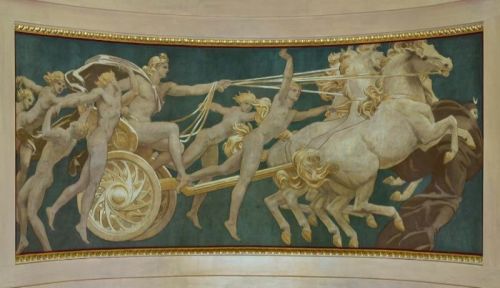
Apollo_in_His_Chariot_with_the_Hours

   Apollo in His Chariot with the Hours (1922–25) 


               John Singer Sargent


                     __________


                 The God repented of the oath he took, 


the God, Helios / Phoebus / Apollo,

father of Phaeton, with Clymene,

Phaeton’s mother


the oath, to grant Phaeton his wish

in order to prove his paternity


                 For anguish thrice his radiant head he shook;
                 “My son,” says he, “some other proof require,
                 Rash was my promise, rash is thy desire.
                 I’d fain deny this wish, which thou hast made,
                 Or, what I can’t deny, wou’d fain disswade. 


fain, willingly, gladly


what I can’t deny, his oath


disswade, dissuade


                Too vast and hazardous the task appears,
                 Nor suited to thy strength, nor to thy years.
                 Thy lot is mortal, but thy wishes fly
                 Beyond the province of mortality:


Beyond the province of mortality,

into immortality, for which Phaeton

is not equipped, being human, his

lot is mortal


                There is not one of all the Gods that dares
                 (However skill’d in other great affairs)
                 To mount the burning axle-tree, but I; 


the axle-tree, the bar that joins the 

wheels of the chariot, is burning 

because it transports the sun


                Not Jove himself, the ruler of the sky,
                 That hurles the three-fork’d thunder from above,
                 Dares try his strength: yet who so strong as Jove? 


not even Jove / Jupiter / Zeus, god of 

gods, and of Thunder, will attempt to  

mount the burning axle-tree, despite 

his immense strength, superior to

anyone’s


                The steeds climb up the first ascent with pain,
                 And when the middle firmament they gain, 


the middle firmament, noon, the

middle of the day, where the sun

reaches its zenith


                If downward from the Heav’ns my head I bow,
                 And see the Earth and Ocean hang below, 


hang, suspended in the heavens


                Ev’n I am seiz’d with horror and affright,
                 And my own heart misgives me at the sight. 


Helios / Phoebus / Apollo admits 

to fear of vertigo


                A mighty downfal steeps the ev’ning stage,
                 And steddy reins must curb the horses’ rage.
                 Tethys herself has fear’d to see me driv’n
                 Down headlong from the precipice of Heav’n. 


Tethys, a Titaness, of the race of 

Giants, who were defeated during 

the Giants’ War


what I’ve learned in the meantime 

is that the Giants, the Titans, had 

actually ruled the cosmos before 

being defeated by the Olympians

something Ovid had misrepresented

in his retelling, where he suggests 

that they were upstarts, rather, 

mortal, however gigantic, who were 

trying from the Earth, Hills pil’d on

hills, on mountains mountains … /

To make their mad approaches to

the skie, in order to unseat the 

gods of Olympus


the Titans, as it turns out, were 

immortals, who ruled the cosmos 

before being ousted by the

Olympians, Jove / Jupiter / Zeus

and his cohorts, and relegated, 

most of them, to the Underworld

though Tethys herself seems to 

have made it out, and been 

reconciled with, at least, the 

Sun god


should I point out that to try to set 

out in one, however comprehensive,

manuscript, a mythology that had 

endured for going on a thousand 

years was likely to reflect some 

inconsistencies, some inaccuracies,

not to mention the dictates of not 

only cultural, but also political 

considerations, we’ll have to 

forgive Ovid, or not, it appears,

his  transgressions 


                Besides, consider what impetuous force
                 Turns stars and planets in a diff’rent course. 


Helios / Phoebus / Apollo continues

to speak, warning his son Phaeton

of the strong, impetuous, and 

unpredictable, currents that [t]urn,

jostle, stars and planets


                I steer against their motions; 


that’s what I have to deal with,

Helios / Phoebus / Apollo

cautions, these motions,

these irascible, interplanetary,

interstellar, streams 


                                                              nor am I
                 Born back by all the current of the sky. 


neither am I born back, which is 

to say borne back, carried back, 

guided back, by any regular,

orderly, current of the sky, by any 

rhythm, of the days, for instance, 

or of the, however intransigent,

hours, that could, potentially,

redirect his path 


                But how cou’d you resist the orbs that roul
                 In adverse whirls, and stem the rapid pole? 


roul, roll, swirl


adverse whirls, of the winds, like 

ocean currents, that stem, are 

created by, are the source of, as 

in the stem of plants, the rapid 

pole, or pull, to rhyme with roul,

a bit, I think, of a poetic stretch


                But you perhaps may hope for pleasing woods,
                 And stately dooms, and cities fill’d with Gods;
                 While through a thousand snares your progress lies,
                 Where forms of starry monsters stock the skies: 


dooms, eventualities, a wonderful 

conjunction here of stately, or 

exalted, expectations, with the 

more dire threat of a thousand

snares, or starry monsters, that

the word doom would usually

suggest


                For, shou’d you hit the doubtful way aright, 


even if you stay on the right track,

even if you hit the … way aright


                The bull with stooping horns stands opposite; 


you’ll have to confront [t]he bull, 

Taurus


                Next him the bright Haemonian bow is strung, 


Haemonian, of Thessaly, a region 

still of Greece  


the Haemonian bow, representative

of Sagittarius


                And next, the lion’s grinning visage hung: 


the lion, Leo


                 The scorpion’s claws, here clasp a wide extent; 


The scorpion, Scorpio


                And here the crab’s in lesser clasps are bent. 


the crab, Cancer


an array of astrological configurations 

obstruct the sky


                Nor wou’d you find it easie to compose
                 The mettled steeds, when from their nostrils flows
                 The scorching fire, that in their entrails glows. 


mettled, spirited 


                Ev’n I their head-strong fury scarce restrain,
                 When they grow warm and restif to the rein. 


Ev’n I, Helios / Phoebus / Apollo, can 

barely, scarce, hold them back, restrain

them, when they grow … restif, restive,

unable to keep still 


                Let not my son a fatal gift require, 


don’t require of me a fatal gift, 

Phaeton’s father pleads, a gift 

that will destroy you 


                But, O! in time, recall your rash desire;
                 You ask a gift that may your parent tell, 


a gift that may your parent tell,

that is meant to determine, to 

prove, your descent


                Let these my fears your parentage reveal;
                 And learn a father from a father’s care:
                 Look on my face; or if my heart lay bare,
                 Cou’d you but look, you’d read the father there. 


were you to just look at my face, 

see my concern, you should be 

able to make out that I’m your 

father, Helios / Phoebus / Apollo

says


                Chuse out a gift from seas, or Earth, or skies, 


[c]huse, choose


                For open to your wish all Nature lies,
                 Only decline this one unequal task,
                 For ’tis a mischief, not a gift, you ask. 


unequal task, a challenge that 

is too great for Phaeton


                You ask a real mischief, Phaeton:
                 Nay hang not thus about my neck, my son: 


don’t hang about my neck, Helios

/ Phoebus / Apollo tells his son, 

you don’t need to try to cajole me


                I grant your wish, and Styx has heard my voice, 


Helios / Phoebus / Apollo has 

sworn an oath on Styx, the 

goddess, the river, an 

unshakable promise, which 

he intends to deliver


                Chuse what you will, but make a wiser choice.” 


now it’s up to you, Phaeton, for 

better or for worse, to decide


R ! chard


“Metamorphoses” (The Giants’ War, VII) – Ovid

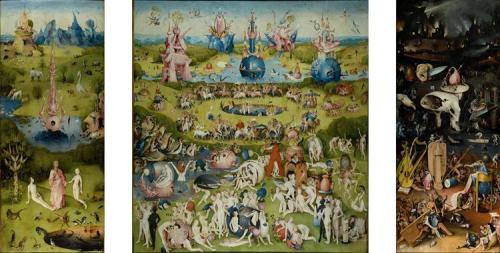
the-garden-of-earthly-delights-1515-7.jpg!Large

    The Garden of Earthly Delights (1510 – 1515) 


             Hieronymus Bosch


                  __________


              Nor from his patrimonial Heaven alone
              Is Jove content to pour his vengeance down; 


let me say something about Heaven 

here, a concept that is quite different 

from the earlier Ancient Greek and 

Roman understanding of the term, 

was it, for that matter, even a term

then, of the Ancients, that would’ve 

meant nothing other to them than 

the blue sky above, not at all an 

area reached by extraterrestrial 

transcendence


the abode of the gods and goddesses 

at the time of Ovid was Mount Olympus

and had been for centuries, much closer 

to the earth than the more ethereal home 

we imagine of the gods today, every one

of them, however professedly uniquely  

supreme, otherworldly


all gods, note, no goddesses, what’s up  

with that, I’ve long wondered


the Underworld was for the Ancients 

the dwelling place of the departed, 

somewhere deep beneath the earth, 

or at the very ends of all the seas, 

never totally beyond the very 

cosmos, as our prevailing faiths 

now uniformly preach 


the image of Heaven, Hell, and 

Purgatory for that matter, that last

a completely Catholic invention – to 

account for the salvation, however 

partial, of innocent souls deprived 

of Heaven for not having been 

christened, though not able yet, at 

so early an age, to have sinned – 

was pretty well codified by Dante

in the 14th Century in his 

masterpiece, The Divine Comedy,​ 

a daunting, but profoundly

illuminating read, which has 

shaped our impression of these 

several possible afterlives ever 

since


see above


this particular translation, however 

magisterial, but crafted after over a

thousand years of Catholic cultural 

domination, cannot avoid the impact 

of the Catholic understanding of 

Heaven


neither, now, can we, for that matter, 

intimately imbued as we are with

the binding faiths of our relatively

more recent forebears


be therefore perspicacious


              Aid from his brother of the seas he craves,
              To help him with auxiliary waves. 


later, we’ll learn that Jove’s brother 

of the seas is Neptune, god of all

aqueous things


            The watry tyrant calls his brooks and floods,
            Who rowl from mossie caves (their moist abodes); 


rowl, or roil, upset 


mossie, mossy


            And with perpetual urns his palace fill:
            To whom in brief, he thus imparts his will.


Neptune is stockpiling water, with

the help of his conforming waterways


            Small exhortation needs


no time, in other words, no need, 

to do much coaxing, much 

exhortation


                                          your pow’rs employ: 


use, put into action, or employ, 

your pow’rs


            And this bad world, so Jove requires, destroy. 


Jove, god of gods, is here commanding, 

authorizing, orchestrating    


            Let loose the reins to all your watry store:
            Bear down the damms, and open ev’ry door.


             The floods

 will inexorably follow


stay tuned


R ! chard


“Orfeo ed Euridice” – Christoph Willibald Gluck

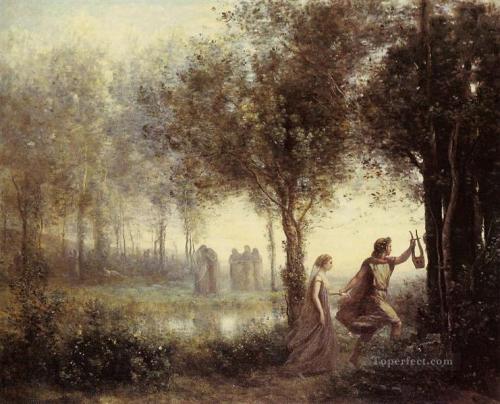
6-orpheus-leading-eurydice-from-the-underworld-plein-air-romanticism-jean-baptiste-camille-corot.jpg!Large

   Orpheus Leading Eurydice from the Underworld (1861) 


           Camille Corot


              _________


the question of the afterlife comes up

in several places in art history, from

very Homer to the present, my very

favourite is Gluck‘s opera Orfeo ed 

Euridice“, 1762


Orpheus, because of the sweetness 

of his music, his ability on the lyre, 

is granted, by the rulers of the 

Underworld, the return, among the 

mortals, of his recently deceased 

beloved, Eurydice 


the condition is that he not turn back

to look at her as he leads her back 

to the world of the living, our 

sensate world


it’s a journey I’ve taken often for its

utter enchantment and inspiration,

you’ll find it irresistible


watch, listen 


you won’t want to not go back,

I didn’t


R ! chard


XXVll. My own Belovèd, who hast lifted me – Elizabeth Barrett Browning‏

from Sonnets from the Portuguese

XXVll. My own Belovèd, who hast lifted me

My own Belovèd, who hast lifted me
From this drear flat of earth where I was thrown,
And, in betwixt the languid ringlets, blown
A life-breath, till the forehead hopefully
Shines out again, as all the angels see,
Before thy saving kiss! My own, my own,
Who camest to me when the world was gone,
And I who looked for only God, found thee!
I find thee; I am safe, and strong, and glad.
As one who stands in dewless asphodel
Looks backward on the tedious time he had
In the upper life,–so I, with bosom-swell,
Make witness, here, between the good and bad,
That Love, as strong as Death, retrieves as well.

Elizabeth Barrett Browning

_______________________

the Asphodel Meadows were a mythological
nether field where souls wandered aimless
after death, bereft of their earthly memories,
washed away by the river Lethe they’d had
to cross to enter the Underworld, can you
dig it

very few have returned from There, notably
Eurydice, who, profoundly grieved by
Orpheus, her swain, is granted leave to
come back by the god of the Underworld,
Hades, as a grace for Orpheus’ uncanny,
uneartlhy, musical ability, though with one
dire condition, that he, Orpheus, Lot-like,
not look back, but that’s an entire other story

love however is what has resurrected her here,
according to Elizabeth Barrett Browning,
afforded her another, transformed, life, she
states

for transcendental apparently love, not only
ineluctable death, according to her earlier
staunch expectations, had proved able to
stir her from her earlier in-, or “asphodel”,
as she calls it, existence

as love does

Richard