Richibi’s Weblog

Just another WordPress.com weblog

Tag: “The Transformation of Io into a Heyfer” – Ovid

“The Transformation of Io into a Heyfer” (V) – Ovid
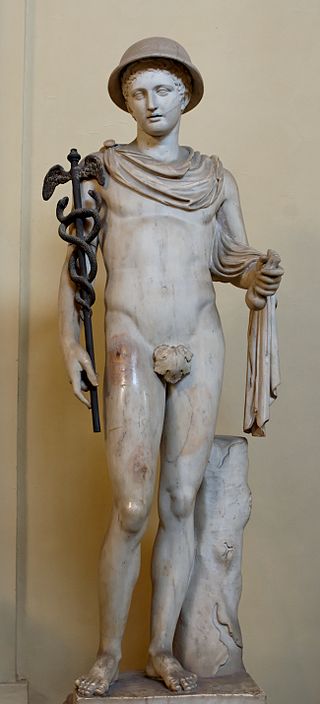
320px-Statue_Hermes_Chiaramonti

     Statue of Hermes (Vatican Museums)

                     ___________________

though Io might still have been “not

out of the woods”, when last we saw 

her, there remained nevertheless 

her original suitor, Jove, god of gods


                 Now Jove no longer cou’d her suff’rings bear;
                 But call’d in haste his airy messenger,
                 The son of Maia, with severe decree
                 To kill the keeper, and to set her free.  
 

The son of Maia, Hermes, messenger

of the gods


Maia, one of the Pleiadesplaymates

of Artemisgoddess of the Hunt,

daughters, also, of Atlasfamously 

condemned, he, to hold up the

heavens for eternity


                 With all his harness soon the God was sped, 
 

Hermes, no sooner equipped,

[w]ith all his harness, livery,

attire, was sped, got under

way


                 His flying hat was fastned on his head,
                 Wings on his heels were hung, and in his hand
                 He holds the vertue of the snaky wand. 
 

vertue, virtue, but having retained, 

still in 1717, its root, vertu, French 

for virtue, benefit 


Hermes is usually shown wearing

[h]is flying hat, [w]ings on his heels,

a snaky wand, identifying accessories


snaky wand, his caduceus


see above


                 The liquid air his moving pinions wound, 


pinions, the feathers of a bird’s wing


wound, to injure, but also to wrap 

around, according to its two 

differing pronunciations


                 And, in the moment, shoot him on the ground.


to rhyme with wound, note


Hermes has landed, but apparently

uncomfortably


                 Before he came in sight, the crafty God
                 His wings dismiss’d, but still retain’d his rod: 


dismiss’d, put aside, made invisible,

[h]is wings


                 That sleep-procuring wand wise Hermes took,
                 But made it seem to sight a sherpherd’s hook. 


though Hermes kept his rod, he made

it look, seem to sight, like a shepherd’s 

staff, hook


                 With this, he did a herd of goats controul;  


controul, control


                 Which by the way he met, and slily stole. 


by the way, as he walked along


slily stole, deities make up their

own rules


                 Clad like a country swain, he pip’d, and sung;
                 And playing, drove his jolly troop along. 


swain, young man


                 With pleasure, Argus the musician heeds; 


Argus heeds the musician, again

an inverted sentence, in order to 

rhyme with


                 But wonders much at those new vocal reeds. 


vocal reeds suggests Pan pipes

here, a wind instrument consisting 

of several tubes of increasing length 

placed side by side, where the piper 

creates the melody by moving his 

lips, her lips, from embouchure to 

embouchure, the openings through 

which to blow


               And whosoe’er thou art, my friend, said he,
               Up hither drive thy goats, and play by me: 


Argus asks Hermes to stay, drive thy 

goats away, [u]p hither, he directs, 

and play thy instrument, keep him 

company


                 This hill has browz for them, and shade for thee. 


browz, browse, matter, twigs, shoots,

upon which goats might graze


                 The God, who was with ease induc’d to climb,  


to climb, [u]p hither, in order to drive

the goats 

                Began discourse to pass away the time;
                 And still betwixt, his tuneful pipe he plies;   


betwixt, meanwhile


plies, continues


                 And watch’d his hour, to close the keeper’s eyes.


his hour, his opportune moment  


the keeper, Argus, over Io


                 With much ado, he partly kept awake; 


the calming effect of the Pan pipes

was making it hard, much ado, for

Argus to stay awake 


                 Not suff’ring all his eyes repose to take: 


never allowing, suff’ring, all his eyes 

to close, repose to take, at the same

time


                 And ask’d the stranger, who did reeds invent,
                 And whence began so rare an instrument? 


how do you do that, Argus asks,

which leads to an interpolated story,

wherein Hermes, before we learn

much more about Io, answers the 

questions 


stay tuned


R ! chard


“The Transformation of Io into a Heyfer” (IV) – Ovid

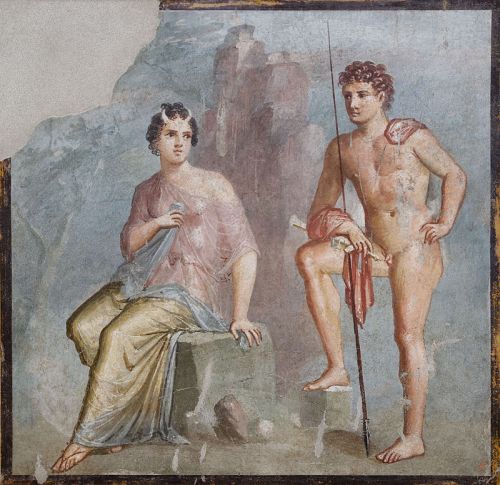
800px-Io_Argos_MAN_Napoli_Inv9556

   Io Wearing Bovine Horns Watched over by Argos on Hera’s Orders

                                                                                               (1st century AD)


           ______________


before moving forward with the trials 

of Io in Ovid’s poem, let me interject 

a few extracurricular opinions


a great work of art, be it poetry, prose,

a painting, a piece of music, is indicated 

by what you can read between the lines


this very Ovid is such an example, 

interrupted, as it is, by my

commentaries


but a better example, a more personal 

one, I would think, would be that of 

listening to music, and finding oneself 

wandering, often often, in all kinds of 

apparently unrelated areas of 

introspection, before being drawn 

back into the piece, the present, often 

unexpectedly, when it recaptures, with 

artful ingenuity, an arresting mixture of 

substance and style according to the

poet’s artistry, one’s errant attention, 

helping one find one’s way back home  


to rekindle again and again your 

attention, therein lies the art


the journey, the reverie, has been the

point of the music, where it is that the 

enchantment, and I use that word 

advisedly here, has taken you, that 

jaunt has been your part of the  

communication, which has turned it

into, indeed, a conversation


all art tries to do that


here are a few of my own reveries 

around Ovid’s poem, that it must be 

read as a cooperation in this instance  

between Ovid and John Dryden, who 

translated it, along with the help, here 

and there throughout the work, of a 

few other noteworthies, who must be 

acknowledged


it would be impossible to translate

alliteration, onomatopeia, other 

literary devices from one language 

to another, these exist only, and

specifically, in the individual 

vernacular, like fingerprints, the 

personal and particular impression 

of teeth, in people, for example 


of a more technical nature is the 

fact that though Dryden‘s verse

is in iambic pentameter

Shakespeare‘s shtick, a notably

conversational metre, Ovid‘s 

dactylic hexameter is of a heroic 

cadence, orotund and imperious,

like ceremonial music is 

unmistakably different from more 

lilting popular ditties


the point is that this translation of 

Metamorphoses must be read, in

my opinion, as a collaboration 

between Ovid for his substance, 

which is to say, the essential 

story, and John Dryden for his 

style


for better or for worse


otherwise we must learn Latin


an interesting element of the style,

meanwhile, I’ve uncovered, upon 

reading this text, is that the 

apostrophe that is often removed 

from verbs we see today with the 

e typically installed before the d, 

in the first line below, cry’d, for 

instance, reply’d in the next,

would’ve been that the poet was 

indicating, in his 1717, by the 

insistent elision, that the letter 

not be pronounced, where 

custom had earlier had it that it 

often was


for a more vivid impression, compare 

bless’d with blessed, both pronunciations 

still in use today, where the second 

spelling, the one with the e, is a 

throwback to a time when most of these 

participles would’ve been voiced in that

manner


1717, we learn, however incidentally, 

was a year when the English language 

was evolving, their is not was turning 

into their isn’t  


but back now to Ovid


                 Ah wretched me! her mournful father cry’d;
                 She, with a sigh, to wretched me reply’d:


how, between two profoundly 

different oratories, Inachus, Io‘s 

father, wonders, to translate 


see my exegesis above


                 About her milk-white neck, his arms he threw;
                 And wept, and then these tender words ensue. 


Inachus speaks


                 And art thou she, whom I have sought around
                 The world, and have at length so sadly found?
                 So found, is worse than lost: with mutual words
                 Thou answer’st not, no voice thy tongue affords: 


mutual words,a shared language


                 But sighs are deeply drawn from out thy breast;
                 And speech deny’d, by lowing is express’d. 


lowing, the sound a cow makes


                 Unknowing, I prepar’d thy bridal bed;
                 With empty hopes of happy issue fed. 


happy issue, children


                 But now the husband of a herd must be
                 Thy mate, and bell’wing sons thy progeny. 


bell’wing, bellowing 


Inachus fears Io will be mothering

calves


                 Oh, were I mortal, death might bring relief:
                 But now my God-head but extends my grief:
                 Prolongs my woes, of which no end I see,
                 And makes me curse my immortality! 


note that even the gods in this 

mythology suffer


                 More had he said, but fearful of her stay,
                 The starry guardian drove his charge away, 


The starry guardian, Argus


see above


                 To some fresh pasture; on a hilly height
                 He sate himself, and kept her still in sight. 


to sate, to refresh, satisfy


Io is still not out of the woods


R ! chard


“The Transformation of Io into a Heyfer” (III) – Ovid

1024px-Victor-Janssens_Io-recognized-by-her-father

     Io Recognised by Her Father 


          Victor Honoré Janssens


              ______________


               The head of Argus (as with stars the skies)
               Was compass’d round, and wore an hundred eyes. 


not only did [t]he head of Argus have

an hundred eyes, but they circled,

compass’d, round his head, as with

stars the skies, as with stars the

geocentric firmament 


note the passive form of the verb to 

compass in the two lines above 

standing in for the inverted sentences

I earlier made mention of as literary 

devices Ovid, or Dryden, uses 

throughout the poem


the standard sentence, the active

sentence,  should read, an hundred

eyes compass’d [t]he head of Argus


compass’d, encircled


               But two by turns their lids in slumber steep;
               The rest on duty still their station keep;
               Nor cou’d the total constellation sleep. 


never could all the eyes, the total

constellation, sleep, or in slumber 

steep, since only two of them would 

turn[ ] their lids, close, at a time, 

while the others continued diligently

to keep watch


steep, incidentally, is a verb here, 

as in to put the kettle on, not an 

adjective, as in dauntingly

pitched, threateningly angled 


               Thus, ever present, to his eyes, and mind,
               His charge was still before him, tho’ behind. 


even when she was standing behind

him, Argus could still see Io, [h]is

charge, with the eyes he had in the

back of his head


               In fields he suffer’d her to feed by Day,
               But when the setting sun to night gave way,
               The captive cow he summon’d with a call;
               And drove her back, and ty’d her to the stall.
               On leaves of trees, and bitter herbs she fed,
               Heav’n was her canopy, bare earth her bed:
               So hardly lodg’d, and to digest her food,
               She drank from troubled streams, defil’d with mud. 


hardly lodg’d, given difficult living 

conditions


               Her woeful story fain she wou’d have told,
               With hands upheld, but had no hands to hold. 


fain, gladly


               Her head to her ungentle keeper bow’d,
               She strove to speak, she spoke not, but she low’d: 


to low is to make the sound that 

cows do, to moo


               Affrighted with the noise, she look’d around,
               And seem’d t’ inquire the author of the sound. 


the sound that she herself was making 

not only [a]ffrighted her, frightened her, 

but had her wondering where could 

it possibly be coming from 


               Once on the banks where often she had play’d
               (Her father’s banks), she came, 


Her father, Inachus, god of rivers


                                                    and there survey’d
               Her alter’d visage, and her branching head;
               And starting, from her self she wou’d have fled. 


much as the sound of her altered

voice had [a]ffrighted Io, now her 

reflection in the water chastened 

her as well, enough to make her

start, be startled, and want to run 

away from her self


               Her fellow nymphs, familiar to her eyes,
               Beheld, but knew her not in this disguise.
               Ev’n Inachus himself was ignorant;
               And in his daughter, did his daughter want. 


no one recognized Io, not even 

her father, who, in his daughter, 

the one who stood before him, 

the altered Io, could not make 

her out 


did his daughter want, as in to 

be found wanting, in the cow, 

to not even be suggested in

the, however conspicuous, 

heifer, not at all part of the 

picture 


Io is there but, simultaneously, 

disconcertingly, not there


               She follow’d where her fellows went, as she
               Were still a partner of the company: 


it should be remembered that 

Io was a beautiful heifer, even 

Juno had been impressed, so

that her fellows, her companions,

only other maidens, I’ll point out, 

fellows taking on its sexually 

indiscriminate meaning here, 

not at all restricted to males, 

would have easily let her follow


note the symmetry, incidentally, 

between follow’d and fellows, 

the nearly hidden alliteration, 

a delightful literary effect, 

though if you blinked you’d 

miss it


               They stroak her neck; the gentle heyfer stands,
               And her neck offers to their stroaking hands.
               Her father gave her grass; the grass she took;
               And lick’d his palms, and cast a piteous look;
               And in the language of her eyes, she spoke. 


her lowing would’ve had no effect,

would’ve let no one in on the fact

that beneath the animal exterior 

there might be an Io


               She wou’d have told her name, and ask’d relief,
               But wanting words, in tears she tells her grief.
               Which,


and here we get the punchline,

the plot twist, which turns this

story into, relatively speaking,

a total enchantment, as though 

Ovid were giving us, prefiguring

in fact, Walt Disney, our own 

20th Century mythologist


                            with her foot she makes him understand;
               And prints the name of Io in the sand. 


see above


R ! chard


“The Transformation of Io into a Heyfer” (II) – Ovid

Gerbrand_van_den_Eeckhout_-_Juno,_Jupiter_and_Io

   Juno, Jupiter and Io (1672) 


          Gerbrand van den Eeckhout


                      ________________


we left Inachus in my last instalment

looking for his daughter, Io


              Her, just returning from her father’s brook


Her, Io 


              Jove had beheld, with a desiring look: 


the sentence structure, as it’s been

crafted in the verses above, has 

been an aspect of Ovid’s poem for 

some time, though, it must again 

be noted, as translated by John 

Dryden, the subject goes where 

the object should go, the sentence 

is inverted


the sentence should be, Jove had

beheld her, … just returning from 

her father’s brook


but the placement of Her at the 

top of the sentence, and even 

capitalized, is, you must admit,
arresting, and of the highest

poetic order


              And, Oh fair daughter of the flood, he said, 


the flood, the many rivers that came 

to comfort Inachus, their sovereign, 

in his distress at having lost Io, his 

daughter, their many surging 

confluences would’ve created 

overflowing torrents, the flood


              Worthy alone of Jove’s imperial bed, 


Jove thinks Io worthy of no one 

else’s mattress but his own


              Happy whoever shall those charms possess;
              The king of Gods (nor is thy lover less)
              Invites thee to yon cooler shades; to shun
              The scorching rays of the meridian sun. 


whoever might partake of her charms,

Jove tells Io, would be Happy


again an inverted sentence, note


but Jove makes his play, flashes 

his pedigree,The king of Gods, 

nothing less, and invites her to a 

shady grove, out of the noonday, 

the meridian, sun


              Nor shalt thou tempt the dangers of the grove
              Alone, without a guide; thy guide is Jove. 


Jove / Jupiter, god of gods


              No puny Pow’r, but he whose high command
              Is unconfin’d, 


Jove / Jupiter is not a nobody, but, 

rather, unconfin’d, omnipotent,

he boasts


                                    who rules the seas and land;
              And tempers thunder in his awful hand, 


Jove / Jupiter, supreme master of 

the elements


              Oh fly not: 


Jove urges Io


                                for she fled from his embrace
              O’er Lerna’s pastures: 


Lerna, a region of Ancient Greece


                                                he pursu’d the chace
              Along the shades of the Lyrcaean plain; 


Lyrcaean, after some investigation,

seems to mean from Lycaeus, the

Latin name for Lykaion, a mountain

in Greece, considered by some to

be the birthplace of Jove / Jupiter /

Zeus


otherwise, but very improbably, the 

Lyrcaean plain is a literary invention,

of Ovid, or of his translator, Dryden


              At length the God, who never asks in vain,
              Involv’d with vapours, imitating night,
              Both Air, and Earth; 


Inform’d with, having transformed 

himself into, vapours, a mist, 

imitating night, shrouding [b]oth 

Air and Earth in darkness, 

becoming himself, therefore, 

indistinct, indefinite, nebulous, 

within them


                                              and then suppress’d her flight,
              And mingling force with love, enjoy’d the full delight. 


first of all Phoebus / Apollo‘s pursuit 

of Daphne, and now Jove / Jupiter‘s 

constraint of Io, are not admirable

aspects of male deities, indeed in

our age of action against the 

harassment of women, their 

behaviour is disturbing, uncomfortable

for me even to read, I’m too reminded 

of dissolute American CEOs, not to

mention presidents, but concluding 

that this dilemma has been around 

for countless ages among vertebrates,

be they animal, human, or, as in these 

instances, divine, therefore written in 

our antediluvian, our primeval, genes, 

maybe, consequently, ineradicably


              Mean-time the jealous Juno, from on high, 


Juno, goddess of goddesses, wife

of Jupiter / Jove


              Survey’d the fruitful fields of Arcady; 


Arcady, or Arcadia, a region still 

of Greece


              And wonder’d that the mist shou’d over-run
              The face of day-light, and obscure the sun. 


which is to say, Juno, suspicious, 

asks herself, what’s up with that 


              No nat’ral cause she found, from brooks, or bogs,
              Or marshy lowlands, to produce the fogs; 


she reckons


              Then round the skies she sought for Jupiter,
              Her faithless husband; but no Jove was there: 


Juno knows her Jove / Jupiter


              Suspecting now the worst, Or I, she said,
              Am much mistaken, or am much betray’d. 


it’s one of two things, Juno figures, 

after [s]uspecting … the worst, I am 

myself in error, she concludes, I am

myself mistaken , or am, by my 

husband, much betray’d 


              With fury she precipitates her flight: 


her flight, her plan of action, both

geographical, and tactical


              Dispels the shadows of dissembled night; 


dissembled, sham, not actual, Jove / 

Jupiter, if you’ll remember, Involv’d 

with vapours, was imitating night,

not easily visible


              And to the day restores his native light. 


note that day is masculine here, 

his native light


              Th’ Almighty Leacher, careful to prevent
              The consequence, foreseeing her descent,
              Transforms his mistress in a trice; and now
              In Io’s place appears a lovely cow. 


Leacher, lecher


in a trice, very quickly, in the bat

of an eyelash


a cow 


see above


              So sleek her skin, so faultless was her make,
              Ev’n Juno did unwilling pleasure take
              To see so fair a rival of her love; 


though transformed into a cow, Io 

remains lovely, even Juno can see 

that, however be she jealous 


              And what she was, and whence, enquir’d of Jove: 


where did you get that, Juno asks 

of Jove, surely dryly


              Of what fair herd, and from what pedigree? 


and what, and when, and how, she

further inquires, probably acidly 


              The God, half caught, was forc’d upon a lye:
              And said she sprung from Earth. 


Jove, who’d had to tell a lye, a lie, 

said that the heifer, the altered Io

had sprung, spontaneously, he 

claimed, from the earth


                                                     She took the word, 


Juno accepted Jove‘s explanation


              And begg’d the beauteous heyfer of her lord. 


Juno asks of Jove that she might 

keep the heyfer for herself, the 

heifer, a virgin cow


              What should he do? ’twas equal shame to Jove
              Or to relinquish, or betray his love:
              Yet to refuse so slight a gift, wou’d be
              But more t’ increase his consort’s jealousie: 


Jove / Jupiter was in a bind, to

out Io, or to out himself


              Thus fear, and love, by turns, his heart assail’d;
              And stronger love had sure, at length, prevail’d:
              But some faint hope remain’d, his jealous queen
              Had not the mistress through the heyfer seen. 


if it weren’t for the fact that Juno

maybe, some faint hope, might 

not have recognized Io in the 

heifer, Jove / Jupiter would’ve, 

had sure, eventually, at length, 

confessed to his indiscretion, his

stronger love, having prevail’d


              The cautious Goddess, of her gift possest,
              Yet 
harbour’d anxious thoughts within her breast;
              As she who knew the falshood of her Jove;


though Juno has been granted her

request, she remains sceptical, 

knew her husband was prone to

falshood, or falsehood


              And justly fear’d some new relapse of love. 


justly, the facts would bear her out, 

were she cognizant of them


              Which to prevent, and to secure her care,
              To trusty Argus she commits the fair. 


Argus Panoptes, one of the giants 

who must’ve remained after their 

war 


Panoptes, pan optes, Greek for many 

eyes, of which only a few, it came to 

be believed, of Juno‘s entrusted

guardian, slept at a time


to be continued


R ! chard


“The Transformation of Io into a Heyfer” – Ovid

main-image

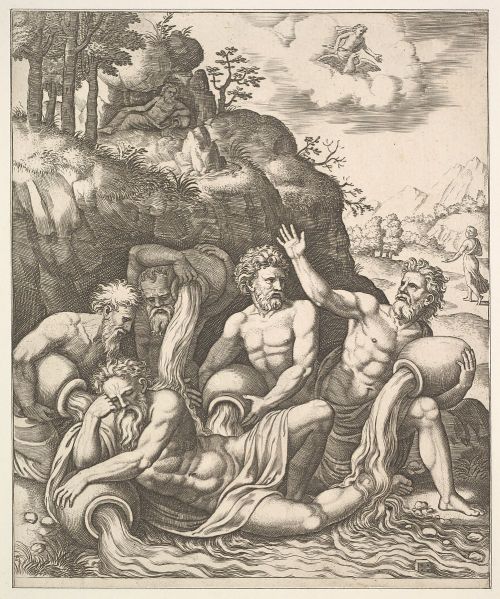
  “River gods consoling Peneus for the Loss of his Daughter, Daphne (1530–60) 


           Master of the Die


                __________


the transformation of Daphne into 

a lawrel, though a story on its own,

has repercussions, which flow into

the introduction of Ovid‘s following 

instalment, The Transformation of

Io into a Heyfer“, however 

essentially unrelated 


                  An ancient forest in Thessalia grows; 


Thessalia, or Thessaly, a region of

Ancient Greece 


                  Which Tempe’s pleasing valley does inclose: 


Tempe, a valley, or vale, in Greece,

the Vale of Tempe, with a rich

mythological history


                  Through this the rapid Peneus take his course; 


Peneus, river god, Daphne‘s father


you’ll note that Peneus is given 

a plural conjugation here, take 

instead of takes in the singular,

unless this is a typo, otherwise

we have a metonym at work, a 

part signifying the whole, the 

whole in this instance meaning

the collection of rivers of which

Peneus was the god


                  From Pindus rolling with impetuous force; 


Pindus, a mountain range in 

northern Greece named after 

its highest peak


                  Mists from the river’s mighty fall arise: 


the river, one of Peneus‘ mighty 

torrents, cascading down the 

mountain, the Pindus, creating, 

along the way, [m]ists


                  And deadly damps inclose the cloudy skies:
                  Perpetual fogs are hanging o’er the wood;
                  And sounds of waters deaf the neighbourhood. 


deaf, used as a verb here, means 

to deafen, to prevent sounds from 

being heard


                  Deep, in a rocky cave, he makes abode 


he, Peneus, the river god


                  (A mansion proper for a mourning God). 


mourning God, Peneus, who’s just

lost Daphnehis daughter


                  Here he gives audience; issuing out decrees
                  To rivers, his dependant deities.
                  On this occasion hither they resort;
                  To pay their homage, and to make their court. 


to make their court, [t]o pay  homage, 

to attend to, their sovereign, Peneus 


                  All doubtful, whether to congratulate
                  His daughter’s honour, or lament her fate. 


His daughter’s honour, Daphne has 

been deemed the symbolic mistress 

of champions, to compensate for her

irreversible, and lament[able], 

transformation


                  Sperchaeus, crown’d with poplar, first appears;
                  Then old Apidanus came crown’d with years:
                  Enipeus turbulent, Amphrysos tame;
                  And Aeas last with lagging waters came. 


Sperchaeus, or SpercheiosApidanus

Enipeus, Amphrysos, or Amphrysus

and Aeas, are all river gods, if not all 

actual rivers


                  Then, of his kindred brooks, a num’rous throng
                  Condole his loss; and bring their urns along. 


kindred brooks, smaller tributaries, 

of Peneus


                  Not one was wanting of the wat’ry train,
                  That fill’d his flood, or mingled with the main: 


all the waterways, the wat’ry flows, 

train, were in attendance


                  But Inachus, who in his cave, alone, 


Inachus, a personification of the 

Greek river, Inachos


                  Wept not another’s losses, but his own,
                  For his dear Io, whether stray’d, or dead, 


Io, nymph, a nature spirit, daughter 

of Inachus


                  To him uncertain, doubtful tears he shed.
                  He sought her through the world; but sought in vain;
                  
And no where finding, rather fear’d her slain. 


a tragedy in the making


to be continued


R ! chard