Richibi’s Weblog

Just another WordPress.com weblog

Tag: “The Seven Last Words of Our Saviour on the Cross” – Haydn

Easter Oratorio – J.S.Bach
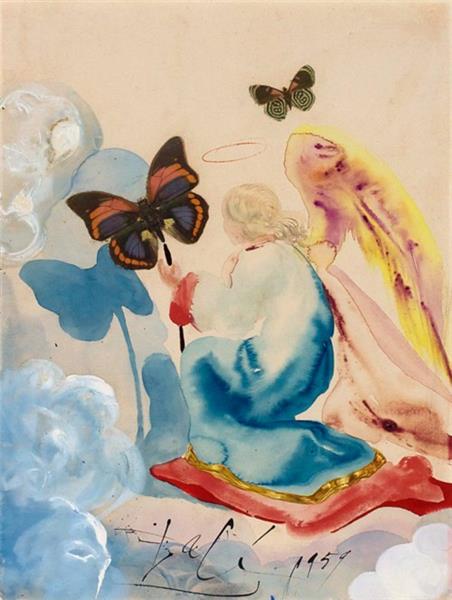
easter-angel-1959.jpg!Large

   “Easter Angel (1959) 

          Salvador Dali

               _______

                                  for Elizabeth, 
                                      who needs an oratorio right now,
                                           and who takes great comfort, 
                                                 she tells me, in this music


if The Seven Last Words of Our Saviour 
on the Cross is not a divertimento, it 
nevertheless didn’t come out of nowhere,
and a clue to its inspiration lies in the 
eventual transposition of the orchestra 
only piece to, a few years later, the piece 
with voice, its oratorio

Haydn had heard his original composition
rendered in a nearby provincial town, where
they’d added lyrics, however saccharine, to
the score, and he thought it entirely effective 
and appropriate, had new less sanctimonious 
lyrics composedand gave us what we now 
hear

oratorios go back quite a while, not 
surprisingly, they are quintessentially 
religious music, meant to inspire, a 
familiar convocational ploy, Bach and 
Handel made them especially immortal
in the early 18th Century

listen to Bach’s Easter Oratorio to see,
to hear rather, the connection to Haydn,
though you might not even notice much
significant difference, they’ve as many 
movements more or less, nine for Haydn,
Bach’s has eleven, but all the forces are 
the same, and in the same order

that Bach’s oratorio would be more 
joyous is not surprising, the occasion for 
the Easter Oratorio is one of celebration,
where The Words is more lugubrious, it 
describes a portentous demise, dance 
rhythms therefore are not in the former 
inappropriate

its dances, however, are rather gavottes
and sarabandes instead of the later 
minuets, a not not instructive alteration 
when you think that minuets not much
later than Haydn had become waltzes,
more about that later

in the Easter Oratorio“, the story is told
by the singers, whereas in The Seven 
Last Words“, the music is doing the 
telling, secured by the fact that the piece
was originally written without singers

The Words is more dramatic, more
use of contrasting volumes and tempi,
the piano hadn’t been invented at the 
time of Bach, long notes couldn’t be 
accommodated on the harpsichord,
which determined the pace of the plot,
the piano allowed with its soft pedal 
a moderation in volume, and with its 
hold pedal a moderation of a note’s 
resonance, which allowed for more 
expansive expression, which led 
eventually, nearly inescapably, to 
the Romantic Period, after passing, 
of course, through, Mozart and
Haydn

but listen to what Bach can do 
without these later interventions,
proof that a poet can inspire with 
merely matchstick, the second 
aria itself – My soul, the spice that 
embalms you shall no longer be 
myrrh – for soprano and baroque 
flute, spare as it is instrumentally, 
is manifestly entirely worth the 
priceless price of admission 


R ! chard
Divertimento no 17, K334 – Mozart

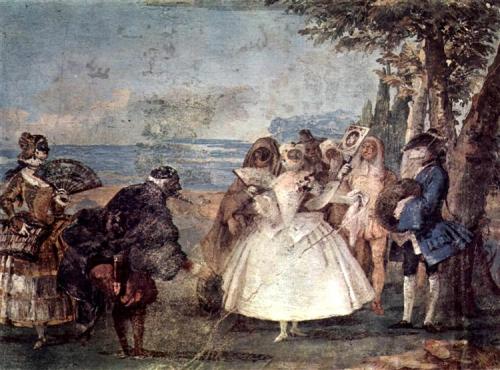
minuet-with-pantaloon-and-colombine-from-the-room-of-carnival-scenes-in-the-foresteria-1757.jpg!Large.jpg

Minuet with Pantaloon and Colombine, from the Room of Carnival Scenes
                                                                                                       in the Foresteria (1757)

     Giovanni Domenico Tiepolo

             ________________

already I can hear you asking, why is
The Seven Last Words“, with its nine
already movements, not a divertimento,
you’ll cry 

a divertimento is an entertainment, it 
doesn’t have the gravitas of Haydn’s 
composition, a sacred work, a 
divertimento is meant to delight

The Seven Last Words“, therefore,
by definition is not a divertimento,
it’s a completely different idea of a
piece with several movements, it 
has profoundly ulterior intentions,
following, rather, in the tradition of
Bach’s oratorios, though it had 
originally been conceived without 
words, the prelate in this work 
would be doing the talking

the piece gives itself a theme, a 
focus, a project, creating something 
like chapters in a book 

or think of the Stations of the Cross 
a metaphorically more apt, perhaps, 
unifying principle, instead of just a 
series of disparate airs, like singles 
were on albums until Pink Floyd 
similarly revolutionized music with 
a topic during my generation, The
Wall, with a little preparatory help
albeit, from the Beatles, earlier,
our friends

here’s Mozart, nevertheless, in order 
to compare, his Divertimento no 17,  
K334giving the aristocracy what 
they still, in 1780, wanted, something 
courtly

you’ll notice there are not just one 
but two minuets in the program, both 
with recapitulations, sure sign that 
we’re still in the Classical Era, though 
the minuet will die off as quickly as 
the divertimento will in the following 
decades, relics, both, of an earlier era

and indeed this is Mozart’s last for 
small orchestra, divertimenti would be 
composed from here on as merely 
tributes to an earlier period and its 
musical formulas

masses and oratorios would go the same 
way, incidentally, with some resurgence 
in the following centuries from a couple 
of Catholic organists who left profound 
influences individually on later centuries

but more about them later

meanwhile, here’s Mozart, feel the 
gentility, his genuflexion to propriety 
rather than to faith


R ! chard