Richibi’s Weblog

Just another WordPress.com weblog

Tag: the Romantic Era

how to listen to music if you don’t know your Beethoven from your Bach, XI

Funeral in the Snow near the Old Tower, 1883 - Vincent van Gogh

          Funeral in the Snow near the Old Tower (1883)


                        Vincent van Gogh

                            _________

having introduced, however peripherally, in my

last instalment, Chopin’s Piano Sonata no 2,

it wouldn’t be fair to not present Beethoven’s

Piano Sonata no 12 to compare, they both

contain iconic funeral marches, written, even

if you have no interest at all in such music, in 

the blood of our Western culture, like

Shakespeare, to be or not to be, you’ve

heard the line, somewhere, even if you have

no idea what he might’ve been talking about


I don’t need to point out the dirges among 

the movements, the solemn bits, they will

impose themselves, whether you’re paying

attention or not


Beethoven and Chopin sound a lot alike,

Beethoven, 1770 -1827, is earlier, pushed

the Classical Period into the Romantic Era,

pretty well, astonishingly, by himself


Chopin, 1810 – 1849, gives us the pinnacle

of Romantic music


I tell them apart by their beat, Chopin is

always on, Beethoven is always off, his

schtick, his revolutionary spirit, Chopin,

rather, played for the aristocracy, in

their courtly salons, much like Haydn,

but that’s another story


you might notice also that the last

movement in Chopin’s sonata is

all texture, a precursor to the later

Impressionism, in all of the arts


Beethoven, however, always takes

you on a journey, never gives you

merely background, there’s always

a core, a foundational melody


enjoy


R ! chard

how to listen to music if you don’t know your Beethoven from your Bach, V

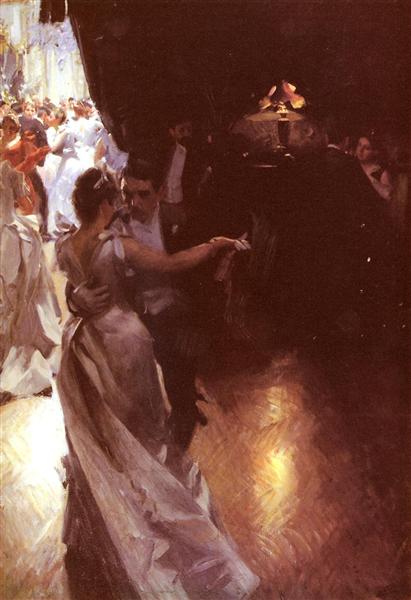
Waltz, 1891 - Anders Zorn


       Waltz” (1891)


        Anders Zorn


           ________


having brought up the idea of

longevity in my last communication,

the fantasiaa musical form that

lasted about 150 years, with hats

off nevertheless to the later Disney

classic, Fantasiaa tribute, which,

full of Classical music references,

followed in its spiritual mode, and,

after introducing Chopin, perhaps

the very representation of the

Romantic Era, that we carry, or

intuit, in our very bones, I thought

I’d talk about the waltz, a Chopin

specialty, where he created,

incontrovertibly, utter magic


who hears of the waltz anymore, an

antiquated curiosity, though even in

our not so distant blood we feel the

reverberations of its memory, the

throb of its still vibrant cultural

intensity, relevance, rhythm


tangos, incidentally followed, and

other intimate interactions, which

had been earlier frowned upon


the waltz had been the minuet,

the difference was the physical

contact, young nobles left their

aristocratic salons, however

discreetly, to frequent the

more liberal, if disreputable,

establishments – like to

speakeasies during Prohibition

– where they could explore the

new, licentious venues, as

young nobles, ever, would, for

the lure of intimate connection

with the partner


the waltz was thereby born,

couples touched, breast upon

breast, composers followed


Chopin was metaphysical, you

didn’t dance to his waltzes, you

experienced them, here’s his

Minute Waltz, Opus 64, no 1,

here’s his equally delightful

Opus 64, no 2, its companion


but Strauss ll, Johann l‘s son,

got all of Vienna to dance his, 

and everywhere else after, until  

the waltz fell out of favour 

somewhere in the 1950s, leaving

only its memories behind,  here’s          

his incandescent By the Beautiful

Blue Danubemakes you wish

you’d been there


in the one case, the waltz is

idealized, in the other, it’s the

waltz in action, listen, you can

tell the difference, you won’t 

want to dance, for instance, to 

Chopinthough you might give

it an ineffectual try, to Strauss

you’ll careen


R ! chard

tempo in Beethoven’s Piano Sonata no 32, Opus 111

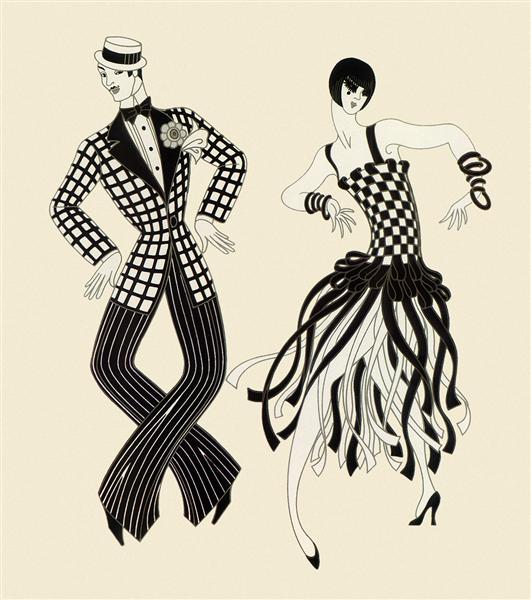
charleston-couple.jpg!Large

      Charleston Couple 

                Erte

                   _


                                     for Lajla, who wondered 

                                        where I’ve been these past 

                                             few weeks


if music is a communication, as I firmly  

believe it is, even listing it as one of my 

languages on all of my formal   

applications, it should have, much as 

in any other communication, a set of  

rules, a structure, a grammar, which  

indeed it does  


where the mood of a verb, for instance,

in English, indicative, I am, conditional, 

if I were, subjunctive, that I be, infinitive,

to be, or, indeed, again infinitive, not to 

be, that is, indicative once more, the 

question


whether ’tis, indicative, nobler in the 

mind to suffer, infinitive, the slings 

and arrows of outrageous fortune, 

or to take, infinitive, arms against a 

sea of troubles, and by opposing, 

participle, end, infinitive, them – but 

you get my drift, in music we have 

tempo, adagio, andante, allegro, 

presto, among others, to set, 

indeed, the mood 


as chamber music, an entertainment 

for aristocrats, moved from the dance 

rhythms of their salons during the 

Classical Period to the more diverse 

beats, the more varied and evocative 

tempi, especially with Beethoven, 

into the Romantic Era, music began 

to speak, evoke rather than lilt 


listen to Beethoven’s 32nd Piano

Sonata, for example, his Opus 111

in two contrasting movements, 

one fast, nearly even frenetic, the 

other slow, resigned, subdued, 

introspective, the first, angry, 

chaotic, frustrated, a burst of 

fulgurating intensity, resolving, 

in the second, into quiescence, 

submission, calm, if ultimately 

miraculous incandescence, one 

the antithesis of the other


Beethoven juxtaposes fury, 

tranquility, loud, soft, short, long 

– the serene adagio is twice 

length of the boisterous allegro 

– and by extension, war, peace, 

man, woman, strong, weak, hope,

despair, yin, in other words, yang, 

indissoluble dichotomies, a 

veritable musical existential 

philosophical tract, Beethoven’s 

treatise on existence


you can’t dance to it, though, 

don’t ask him


but you can thoroughly enjoy,

be inspired


R ! chard

String Quartet no 10, opus 74, “The Harp” – Beethoven

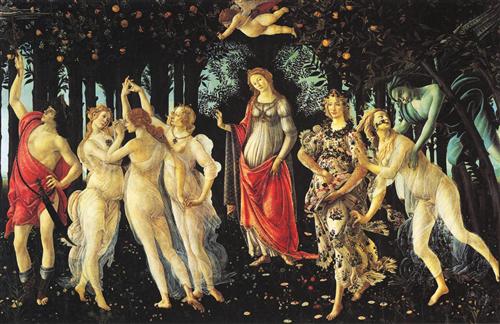
primavera-1478(1).jpg!Blog

   “Primavera (1478) 

         Sandro Botticelli 

                 ___________

it’s 1809 and Beethoven rules, essentially,
the musical environment, he’s setting the 
standard, the tone, for the century to 
come and no one is anywhere close to 
challenging his authority, music students 
will remember Carl CzernyMuzio Clementi
for instance, but none of these, however 
noteworthy, contemporaneous composers, 
are even part of, anymore, the recital 
curriculum, think of Salieri and Mozart, 
for instance, without their mischief, who’s 
heard recently of any Salieri 

we’re not in Kansas anymore, this is the 
start of the Romantic Era, four movements,
but not one of them is a minuet, a signature 
element in a Classical composition, nor 
could you, would you want to dance to 
any of them

and this is where Beethoven starts to talk
rather than sing, music that you don’t just
listen to but read, note the disjointed 
rhythms that interject rather than court,
if you’ll pardon the Classical reference, 
from the very beginning of each 
movement, of each, indeed, recapitulation, 
music that is not at all genteel, but rousing, 
commanding

how does he do this

note that his rhythms don’t fall on the 
anticipated beat, they’re off, and 
therefore disconcerting, you need to 
get your bearings

then a motive, a musical idea that, as 
the word suggests, motivates, like a 
key to start an engine, will have an
odd, rather than an even, number of 
notes, like trying to fit a square into   
a circle, or a circle into a square, a 
tricky combination for balanced, by
definition, bar lines, one’s intellectual 
functions are thus activated, one 
doesn’t rest in the comfort of a 
prescribed cadence, but confronts 
the rocky, though constantly 
astonishing, even miraculous, road 
of Beethoven’s invention, adventure, 
if, of course, one’s into that 

instead of Mary had a little lamb, in
other words, we’re hearing, little  
lamb has Marie, accent on the 
wrong syllable, though here we 
might call her Mary, she calls her 
lamb Mouton, not unsurprisingly, 
and it’s always, day after day, 
beside her, which Beethoven then 
sets, as idiosyncratically, to music

he’s, in other words, toying with 
tempo – note the caesurae, the 
pregnant pauses in a melody, the 
multiplication of tempi throughout 
the work as a whole, which imply  
a narrative, a story, especially 
without the traditional, and 
diversionary, dance element 

tonality remains essentially stable, 
despite unusual juxtapositions, odd
intervals – the tonal reach along the 
musical scale, A to G, between two
successive notes – which is to say, 
we’re not yet at Stravinsky

but I find it interesting to observe 
that recapitulation, the third 
Classical imperative, along with 
tempo and tonality, remains 
uninterrupted, not even 
questioned, indeed forcefully 
reinvented 

can there even be music without 
recapitulation, I wonder, whereas 
the other two have since lost their 
immutability – I’m not sure, I’ll have 
to check


thanks wholeheartedly for stopping 

by

R ! chard
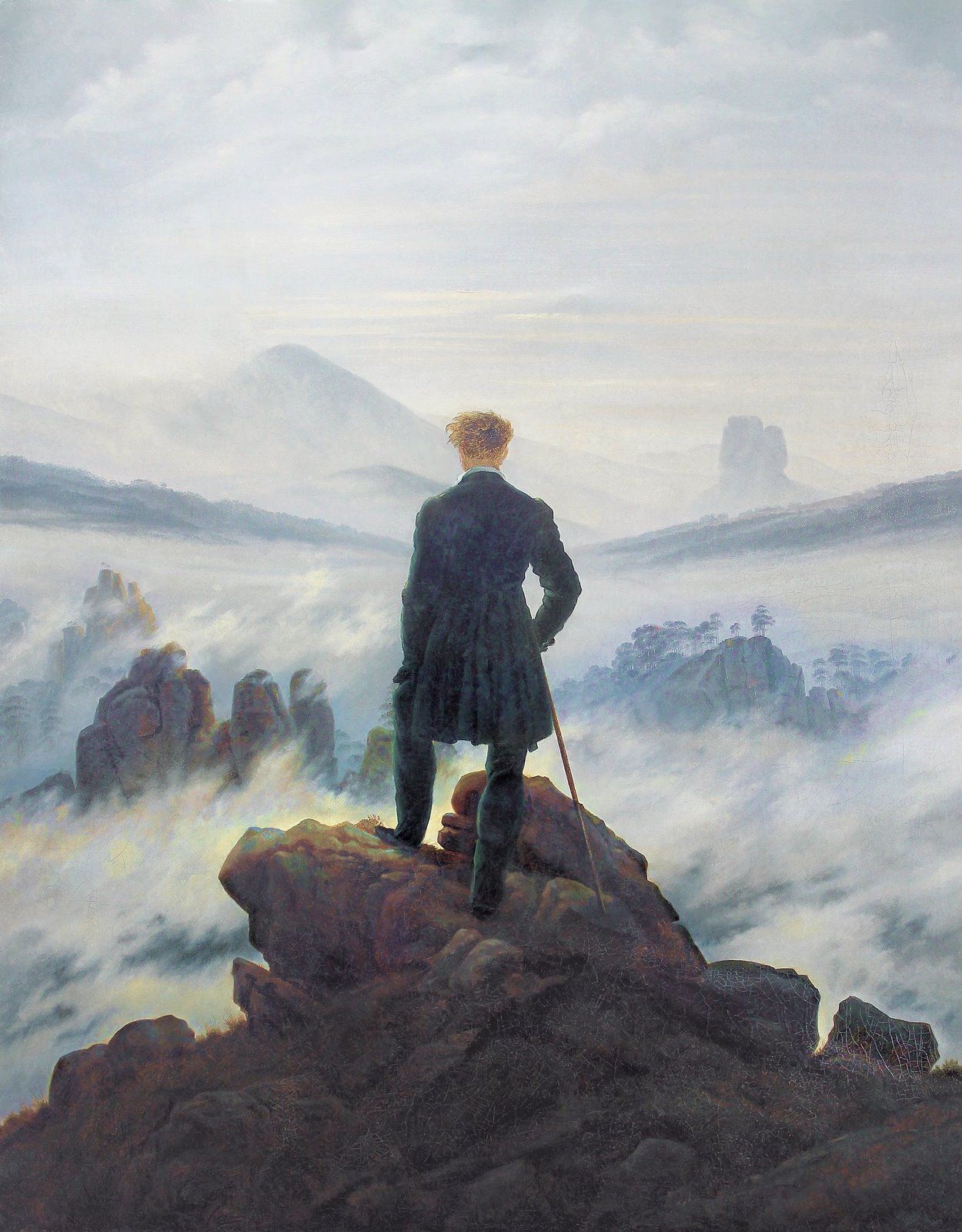
“Wanderer Above a Sea of Fog” – Caspar David Friedrich


                                   “Wanderer Above a Sea of Fog”  (1818)  
 
                                              Caspar David Friedrich
 
 
                                                     __________ 


upon further reflection I realized that the painting above had also “the same power, the same clarity and precision” to describe the Romantic Era as the first chord of Beethoven’s “Pathétique” Sonata, it is an equally powerful representation of the spirit of that highly introspective time
 
the Romantic Epoch championed nature, patriotism on the political heels of the French Revolution – and explorations of the soul, following the latter’s calls to liberty, equality, fraternity, the natural groundwork for what followed, our own period of reverence for human rights
 
we look with Caspar David Friedrich here upon a nebulous perspective, onto daunting horizons, reflecting, with him, through the painter’s psychological ingenuity and art, upon our own daunting choices, our own murky landscapes, our own obscure and imposing destinies, both physical and philosophical, a profoundly Romantic conception 
 
it was a time when the heart and its irreverent passions took centre stage, stood, in all its permutations, under the light
 
 
please excuse my egregious oversight
 
and of also the inspired Caspar David Friedrich I’ve begged pardon, expressed my heartfelt, humble compunction, and regret, for a not insignificant slight  
 
 
cheers
 
Richard