Richibi’s Weblog

Just another WordPress.com weblog

Tag: the  river Styx

“The Birth of Bacchus” (ll)– Ovid

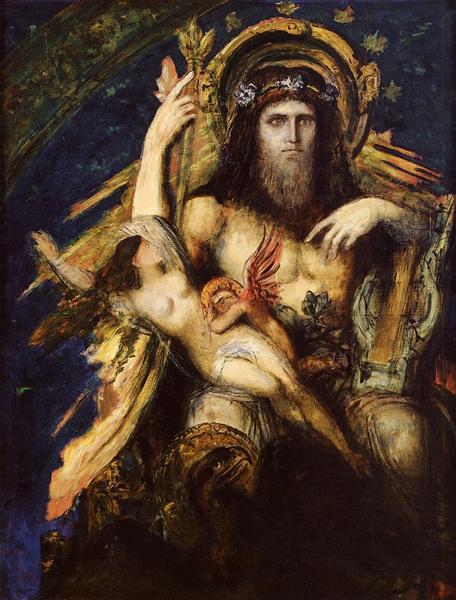
Jupiter and Semele, 1889 - 1895 - Gustave Moreau

         Jupiter and Semele” (1889 – 1895)


                 Gustave Moreau


                       _________


            Old Beroe’s decrepit shape she wears,

            Her wrinkled visage, and her hoary hairs;


Old Beroe, faithful servant of Semele


she, Juno / Hera, goddess


hoary hairs, love it


            Whilst in her trembling gait she totters on,

            And learns to tattle in the nurse’s tone.


Juno / Hera transforms herself into

Old Beroe, tattl[ing], talking idly, in

the nurse’s tone, impersonating her

in order to seek revenge, if you’ll

remember, on Semele, for bearing

her husband’s progeny


            The Goddess, thus disguis’d in age, beguil’d

            With pleasing stories her false foster-child.


foster-child, child who is fostered,

nurtured, by someone other than a

parent, Semele, by Old Beroe,

purportedly, in this instance


false, Juno / Hera is not Old Beroe,

but the nurse’s duplicitous, false,

in both senses of the word here,

double


beguil’d, enchanted, amused


            Much did she talk of love, and when she came

            To mention to the nymph her lover’s name,

            Fetching a sigh, and holding down her head,

            “‘Tis well,” says she, “if all be true that’s said.


Juliet’s nurse from Romeo and Juliet,

I thought, meets Sleeping Beauty’s

wicked stepmother, for a more

contemporary coupling


            But trust me, child, I’m much inclin’d to fear

            Some counterfeit in this your Jupiter:


Some counterfeit, yourJupiter is not

your [actual] Jupiter, Juno / Hera

suggests


            Many an honest well-designing maid

            Has been by these pretended Gods betray’d,


well-designing, without guile, with

no ulterior motive


pretended Gods, men who unjustifiably

beat their chest, tell tall tales, unequal

to their proclaimed accomplishments


            But if he be indeed the thund’ring Jove,

            Bid him, when next he courts the rites of love,

            Descend triumphant from th’ etherial sky,

            In all the pomp of his divinity,

            Encompass’d round by those celestial charms,

            With which he fills th’ immortal Juno’s arms.”


Juno / Hera, as Old Beroe, tells Semele

to ask her lover, when next he courts

the rites of love, to prove he is indeed

Jove / Jupiter / Zeus, to dress

appropriately


Encompass’d round, accoutred,

enveloped, in


the pomp, incidentally, the splendour

of his divinity, take on a couple of

extra poetic lines, verses, indicative

of that very splendour


note also that Semele seems to have

no qualms about Jove / Jupiter / Zeus‘s

marital status, about bearing the child

of another woman’s man, indeed that

of a very, in this instance, goddess,

the redoubtable Juno / Hera


            Th’ unwary nymph, ensnar’d with what she said, 


ensnar’d, ensnarled, caught up in


            Desir’d of Jove, when next he sought her bed,

            To grant a certain gift which she would chuse;


Desir’d of, asked of, requested of


chuse, choose


            “Fear not,” reply’d the God, “that I’ll refuse

            Whate’er you ask: may Styx confirm my voice,

            Chuse what you will, and you shall have your choice.”


Styx, goddess of the river Styx, which

forms the boundary between Earth and

the Underworld, had sided with Jove /

Jupiter / Zeus during the War of the

Titans and been granted by him that

oaths should henceforth all be sworn

upon her, and be punctiliously observed


Phoebus / Apollo had similarly granted

his own son Phaeton his wish upon very

Styx, if you’ll remember, with the direst,

for both, of consequences


            “Then,” says the nymph, “when next you seek my arms,

            May you descend in those celestial charms,

            And fill with transport Heav’n’s immortal dame.”


show me, Semele asks of her suitor,

what she gets, what Juno / Hera gets,

when next you seek my arms


go, girl, I thought, if you’re going

to be irreverent


            The God surpriz’d would fain have stopp’d her voice,

            But he had sworn, and she had made her choice.


on very Styx, he’d sworn, ever so

perilously


stay tuned


R ! chard

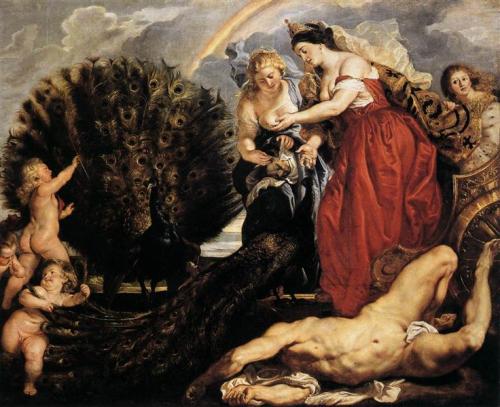
“The Eyes of Argus transform’d into a Peacock’s Train” – Ovid

juno-and-argus.jpg!Large

    Juno and Argus (c.1611) 


           Peter Paul Rubens


                         ______


                  While Hermes pip’d, and sung, and told his tale,
                  The keeper’s winking eyes began to fail, 


The keeper, Argus, of Io, nymph

become heifer


                  And drowsie slumber on the lids to creep; 
                  ‘Till all the watchman was at length asleep. 


all the watchman, all of Argus‘ eyes, 

were closed, asleep, at length, after 

a time 


                  Then soon the God his voice, and song supprest; 


the God, Hermes, messenger of the

gods, on a mission from Jove / 

Jupiter / Zeus to save Io, nymph 

become heifer


his voice, and song supprest, Hermes 

stopped talking, stopped playing his

song, his music


                  And with his pow’rful rod confirm’d his rest: 


his powerful rod, the caduceus, with

which Hermes could both waken those

asleep as well lull the wakeful to

slumber


                  Without delay his crooked faulchion drew, 


faulchion, now spelled falchion, 

is a short sword with only one 

sharp edge, a sort of sickle


since falchions go back only to the 

13th Century, Dryden‘s translation 

from the Latin has to be an 

anachronism


just saying


                  And at one fatal stroke the keeper slew.
                  Down from the rock fell the dissever’d head,
                  Opening its eyes in death; and falling, bled;
                  And mark’d the passage with a crimson trail:
                  Thus Argus lies in pieces, cold, and pale;
                  And all his hundred eyes, with all their light,
                  Are clos’d at once, in one perpetual night.
                  These Juno takes, that they no more may fail,
                  And spreads them in her peacock’s gaudy tail. 


see above


Juno, wife of Jove / Jupiter / Zeus,
queen, therefore, of the gods and 

goddesses


                  Impatient to revenge her injur’d bed, 


Juno had been offended by the fact 

that Jove / Jupiter / Zeus had

transgressed 


                  She wreaks her anger on her rival’s head; 


her rival, Io


                  With Furies frights her from her native home; 


Furies, also known as Erinyes

goddesses of vengeance, the 

oldest of all the deities, they live 

in Erebus, the Underworld, look 

frightful, snakes in their hair, bat’s 

wings, and haunt, unsettle, the 

disrespectful, the insolent, those 

who betray, are not true to, their 

word 


frights, frightens


                  And drives her gadding, round the world to roam: 


her, Io, nymph become heifer


to gad, to wander


                  Nor ceas’d her madness, and her flight, before
                  She touch’d the limits of the Pharian shore. 


Pharian, relating to Pharos, island off 

the coast of Alexandria, notable for 

its lighthouse, itself called Pharos

one of the Seven Wonders of the 

Ancient World


                  At length, arriving on the banks of Nile,
                  Wearied with length of ways, and worn with toil,
                  She laid her down; 


She laid her down, she laid herself 

down, stopped, stayed in place


                                                 and leaning on her knees,
                  Invok’d the cause of all her miseries: 


the cause of all her miseries, Jove /

Jupiter / Zeus, who’d abandoned 

her, Io, to the wrath of Juno, his 

wife, when she’d discovered him 

to be unfaithful 


                  And cast her languishing regards above,
                  For help from Heav’n, and her ungrateful Jove.
                  She sigh’d, she wept, she low’d; ’twas all she cou’d;
                  And with unkindness seem’d to tax the God. 


to tax, to accuse, to make 

responsible for


                  Last, with an humble pray’r, she beg’d repose,
                  Or death at least, to finish all her woes. 


repose, relief, Io, nymph become 

heifer, has completely had it


                  Jove heard her vows, and with a flatt’ring look,
                  In her behalf to jealous Juno spoke, 


a flatt’ring look, a seductive approach,

toward Juno, his reproachful wife


                  He cast his arms about her neck, and said,
                  Dame, rest secure; no more thy nuptial bed
                  This nymph shall violate; 


Dame, or Madam


                                                       by Styx I swear, 


Styx, one of the five rivers that 

separate Earth from the 

Underworld, also one of the 

earliest goddesses, after whom

the river itself was named, who 

had, significantly, sided with Jove /

Jupiter / Zeus during the Giants’ 

War, for which, upon having won, 

Jove / Jupiter / Zeus ordained that 

all oaths be sworn upon her, Styx

much as we, in our own day, swear 

upon Bibles


this all precedes, note, Bibles


                  And every oath that binds the Thunderer. 


the Thunderer, Jove / Jupiter, Zeus,

god, indeed, of Thunder


                  The Goddess was appeas’d;  


The Goddess, Juno


                                                       and at the word
                  Was Io to her former shape restor’d.
                  The rugged hair began to fall away;
                  The sweetness of her eyes did only stay,
                  Tho’ not so large; her crooked horns decrease;
                  The wideness of her jaws and nostrils cease:
                  Her hoofs to hands return, in little space: 


little space, the blink of an eye


                  The five long taper fingers take their place,
                  And nothing of the heyfer now is seen,
                  Beside the native whiteness of the skin.
                  Erected on her feet she walks again:
                  And two the duty of the four sustain. 


rather than walk on four feet, Io

now stands erect, [e]rected, on 

two


                  She tries her tongue; her silence softly breaks,
                  And fears her former lowings when she speaks: 


she can hardly believe she’s  

become, not just a nymph,

but indeed 


                  A Goddess now, through all th’ Aegyptian State:
                  And serv’d by priests, who in white linnen wait. 


Io has become the Egyptian 

goddess Isis


but that’s an entirely other story 


stay tuned


R ! chard


“Metamorphoses” (The Giants’ War, III) – Ovid

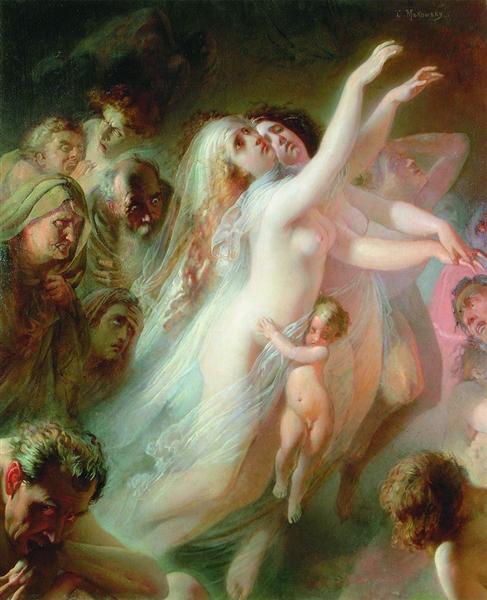
charon-carries-dead-souls-across-the-river-styx.jpg!Large

    “Charon Carries Dead Souls across the River Styx(1861)


           Konstantin Makovsky


                 ____________


Jove, god of Thunder, speaks


            I was not more concern’d in that debate
            Of empire, when our universal state
            Was put to hazard, and the giant race
            Our captive skies were ready to imbrace: 


I was not especially disturbed, Jove says,

when the state of our universe was 

challenged, or debate[d], when the giants 

tried to usurp our territory, were ready to 

imbrace, or embrace, take on, our  

vulnerable, [o]ur captive, skies


            For tho’ the foe was fierce, the seeds of all
            Rebellion, sprung from one original; 


because the enemy, then, the adversary, 

came from the one original source, its 

however manifold predations, its 

however myriad desecrations, would’ve

been identifiable to Jove, not foreign, not

unmanageable, he would’ve recognized

the black sheep of the Olympian family,

the giants  


            Now, wheresoever ambient waters glide,
            All are corrupt, and all must be destroy’d. 


ambient, nearby, related, infected, corrupt,

all has been corrupted


            Let me this holy protestation make,
            By Hell, and Hell’s inviolable lake, 


here’s another anachronism, for Hell wouldn’t’ve 

been even a concept in the era of Ovid, where

the Underworld, and Hades, entirely different

afterworlds, would’ve prevailed, areas of 

persistent gloom and shade, see Homer here,

for instance, or Virgil


the Underworld of the ancient world was 

surrounded by five rivers, Hell’s inviolable 

lake, the most famous of which was the 

river Styx


in the Divine Comedy, Dante updates this 

watery boundary for his own 14th Century

readers, and makes it the passageway to

the fifth circle of Hell, where Charon 

remains, after even over a thousand 

years, the very same ferryman


see above


nor was there either any of our present

conception of Heaven, Heaven would’ve 

been Olympus then, the exclusive domain 

of the Gods, either Greek or Roman 


            I try’d whatever in the godhead lay: 


Jove says, I tried everything a god 

could use


            But gangren’d members must be lopt away,
            Before the nobler parts are tainted to decay. 


you’ve got to lop[ ] away, cut off, the bad 

parts before they infect the more vital 

components of the body

 
            There dwells below, a race of demi-gods,
            Of nymphs in waters, and of fawns in woods:
            Who, tho’ not worthy yet, in Heav’n to live,
            Let ’em, at least, enjoy that Earth we give. 


not all beings are corrupt, but nymphs 

and fawns, innocents, Jove pleads, 

should be given consideration on 

Earth, if they be not yet worthy of the 

majesty of Heav’n, and granted earthly 

areas of enjoyment in the confines of 

their forsaken place 


            Can these be thought securely lodg’d below,
            When I my self, who no superior know,
            I, who have Heav’n and Earth at my command,
            Have been attempted by Lycaon’s hand? 


if Lycaon could attack me, Jove, god 

of Thunder, asks, how can these 

innocents, nymphs, fawns, ever be 

safe


             At this a murmur through the synod went,
             And with one voice they vote his punishment. 


the punishment of Lycaon, which we’ll 

soon encounter


             Thus, when conspiring traytors dar’d to doom
             The fall of Caesar, and in him of Rome,
             The nations trembled with a pious fear;
             All anxious for their earthly Thunderer: 


Thus, or in a similar manner, did the nations

of the earth tremble when Caesar, their 

earthly Thunderer, was assassinated 


nations, incidentally, is another anachronism,

nations didn’t appear on earth until the 

18th Century, with the French Revolution


             Nor was their care, o Caesar, less esteem’d
             By thee, than that of Heav’n for Jove was deem’d: 


Ovid addresses Caesar here, his contemporary,

and compares that emperor’s esteem for nations, 

his reliance on their allegiance, to the esteem 

Heav’n has for Jove


             Who with his hand, and voice, did first restrain
             Their murmurs, then resum’d his speech again. 


Jove calls for silence in the assembly

before speaking again


             The Gods to silence were compos’d, and sate
             With reverence, due to his superior state. 


The Gods … sate, or sat, then took heed,

bowing to Jove’s superior position


the tale of the punishment of Lycaon

will follow  


R ! chard