Richibi’s Weblog

Just another WordPress.com weblog

Tag: the Nile

The Story of Phaeton (VII) – Ovid
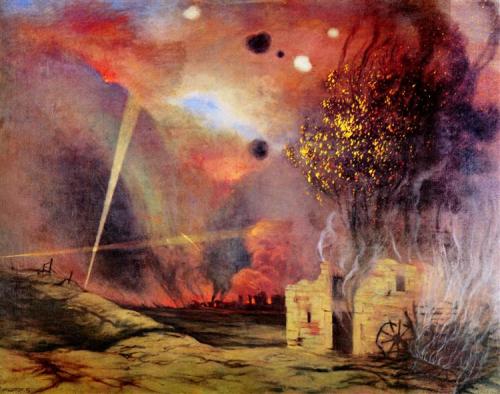
landscape-off-ruins-and-fires-1914.jpg!Large

   Landscape of Ruins and Fires (1914)


               Félix Vallotton


                   _______


                ‘Twas then, they say, the swarthy Moor begun
                To change his hue, and blacken in the sun. 


Moor, a flagrant anachronism here, 

as Moors, Muslim inhabitants of

North Africa, didn’t exist before the 

advent of Islam, which began in the 

Seventh Century CE, Ovid, in Latin,

uses Ethiopian, which would entirely 

throw off, note, Dryden‘s poetic 

metre, thus Moor


                Then Libya first, of all her moisture drain’d,
                Became a barren waste, a wild of sand. 


Libya, Ancient Libya, a much larger 

country of North Africa than the 

Libya we know of today


                The water-nymphs lament their empty urns,
                Boeotia, robb’s of silve Dirce, mourns, 


empty urns, the water has evaporated


Boeotia, a region still of Greece


Dirce, upon her gruesome death, which 

I won’t get into here, was transformed 

by Dionysus, god of revelry and fertility,  

into a fountain, which became revered


silve, sylvan, of the forest, the 

countryside


robb’s, I’ll guess robbers, because 

Boeotia is where Dirce, abducted,

became a fountain 


                Corinth Pyrene’s wasted spring bewails,
                And Argos grieves whilst Amymone fails. 


Corinth, a city still in Greece


Pyrene, a princess, who was, another 

distressing story, transformed into the 

Pyreneesby Heracles, her seducer,

as well as being a god renowned for 

his extraordinary exploits


Argos, a city still in Greece


Amymone, another unfortunate maiden,

who was granted by Poseidon, god of 

Water, for, throughout her tribulations, 

her probity, springs, sources of water, 

for her community, which, in the 

instance, all fail[ ] 


                The floods are drain’d from ev’ry distant coast,
                Ev’n Tanais, tho’ fix’d in ice, was lost. 


Tanais, the river today known as the 

Don in Russia, thus fix’d in ice


                Enrag’d Caicus and Lycormas roar, 


Caicus, a river in Asia Minor, now

given a different name in a different

script, Bakırçay, which I’ll let you 

try to pronounce 


Lycormas, a river in Ancient Greece, 

now called Evinos


                And Xanthus, fated to be burnt once more. 


Xanthus, or Xanthos, a river in Ancient

Asia Minor, which was yellowish already

due to its surrounding tainted soil, thus 

burnt once more    


                The fam’d Maeander, that unweary’d strays 


Maeander, a river in Ancient Asia

Minor


                Through mazy windings, smoaks in ev’ry maze. 


smoaks, smokes


mazy, maze, cute


                From his lov’d Babylon Euphrates flies;
                The big-swoln Ganges and the Danube rise
                In thick’ning fumes, and darken half the skies. 


the Euphrates, the Ganges, and the

Danube, rivers which still go by their

ancient names


                In flames Ismenos and the Phasis roul’d, 


Ismenos, or Ismenus, a river in 

Boeotia, Greece


Phasis, ancient name for the 

Rioni River in Georgia, Eurasia


roul’d, rolled


                And Tagus floating in his melted gold. 


Tagus, a river in the Iberian 

Peninsula


                The swans, that on Cayster often try’d
                Their tuneful songs, now sung their last and dy’d. 


Cayster, a river in Turkey


                The frighted Nile ran off, and under ground
                Conceal’d his head, nor can it yet be found:
                His sev’n divided currents all are dry,
                And where they row’ld, sev’n gaping trenches lye: 


it is being suggested that the Nile

had at one point seven tributaries,

some of which dried up, never

recovered


rowl’d, rolled


                No more the Rhine or Rhone their course maintain,
                Nor Tiber, of his promis’d empire vain. 


the Rhine, the Rhone, and the Tiber

are all European rivers


vain, deprived


                The ground, deep-cleft, admits the dazling ray,
                And startles Pluto with the flash of day. 


dazling, dazzling


Pluto, god of the Underworld, who 

would be understandably startle[d] 

by a flash of day


                The seas shrink in, and to the sight disclose
                Wide naked plains, where once their billows rose; 


billows, of [t]he seas


                Their rocks are all discover’d, and increase
                The number of the scatter’d Cyclades.

 discover’d, uncovered


Cyclades, a group of islands in the 

Aegean Sea, between present-day

Greece and Turkey


                The fish in sholes about the bottom creep, 


sholes, shoals


                Nor longer dares the crooked dolphin leap
                Gasping for breath, th’ unshapen Phocae die, 


Phocae, plural of Phoca, is the 

generic name, and therefore, 

interestingly, capitalized, for 

seals, walruses, sea lions


                And on the boiling wave extended lye. 


lye, lie


                Nereus, and Doris with her virgin train,
                Seek out the last recesses of the main; 


Nereus, and Doris, Sea god and 

goddess, parents, notably, of the 

Nereids, sea nymphs, the virgin 

train


the main, the ocean


                Beneath unfathomable depths they faint,
                And secret in their gloomy caverns pant. 


secret, unseen, alone, untended


                Stern Neptune thrice above the waves upheld
                His face, and thrice was by the flames repell’d. 


Neptune, principal god of the Sea


it is interesting to note that where 

earlier the earth had been 

submerged in water, during the 

Giants’ War, now the earth is

engulfed in flames, a primordial

global warming, as it were, the 

result, consider, of a human, 

Phaeton, trying to take on the 

duties of a god, a warning the 

Ancients were already delivering,

so many years, so many centuries, 

so many millennia, ago


I suspect, worldwide, indigenous 

people would be telling a similar 

tale were we able to access their 

own, unfortunately unwritten, 

though undoubtedly comparable, 

ancestral wisdom, going back,

perhaps, even as far 


R ! chard


“Metamorphoses” (The Giants’ War, XIV) – Ovid

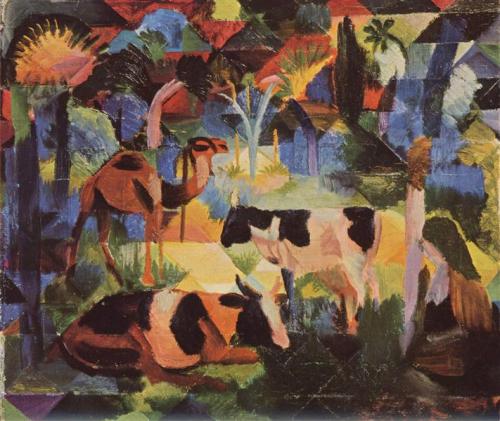
landscape-with-cows-and-a-camel.jpg!Large

    Landscape with Cows and a Camel (1914) 


               August Macke


                   ________


once Deucalion and Pyrrha had found

the way to bring humans back to life, 

it was time to turn to the creation, or

recreation, of other species


              The rest of animals, from teeming Earth
              Produc’d, in various forms receiv’d their birth. 


the rest of animals suggests that 

people were also considered to

be animals, of an however more

elevated, presumably, order


              The native moisture, in its close retreat,
              Digested by the sun’s aetherial heat,
              As in a kindly womb, began to breed: ,
              Then swell’d, and quicken’d by the vital seed. 


by means of the moisture naturally

created by the retreating flood waters, 

the native moisture, the heat of the sun, 

however aetherial, or etherial, which is 

to say of ether, which is to say invisible, 

swell[s], and quicken[s] … the vital seed

the seed which is pregnant with life, or

vital, and nurtures it, swell[s] and 

quicken[s] it, as though within a womb


              And some in less, and some in longer space, 


less, or longer space, of time


              Were ripen’d into form, and took a sev’ral face. 


different kinds of animals, animals with

sev’ral face[s], see, for instance, above

ripen’d, or evolved during longer or 

shorter periods of time, a notion that 

was decisively revisited some nearly 

two thousand years later, incidentally, 

by Charles Darwin 


              Thus when the Nile from Pharian fields is fled, 


Pharian fields, Egypt, from Pharos,

an island off the coast of Alexandria

notable for its lighthouse, itself called 

Pharos, one of the Seven Wonders of 

the Ancient World


              And seeks, with ebbing tides, his ancient bed, 


his ancient bed, the area of earth 

that the Nile had covered during 

the flood, its now exposed river 

banks


the Nile is, note, masculine here, 

his ancient bed


              The fat manure with heav’nly fire is warm’d; 


there’s the heat again


             And crusted creatures, as in wombs, are form’d; 


crusted, it is interesting to note that

apart from the animal feature of the 

womb, all of the terms to describe 

the process of coming to life refer

to plants, see also ripen’d above,

for instance, not to mention the 

vital seed


              These, when they turn the glebe, the peasants find; 


glebe, cultivated land, when the 

peasants plough their fields, they 

find [t]hese, the crusted creatures


              Some rude, and yet unfinish’d in their kind:
              Short of their limbs, a lame imperfect birth:
              One half alive; and one of lifeless earth. 


not all births are successful

              For heat, and moisture, when in bodies join’d,
              The temper that results from either kind
              Conception makes; 
 

life is the product of heat, and moisture

sparking, quicken[ing], matter, bodies, 

a succinct postulation, a metaphysical 

observation, presaging the 17th Century’s 

turn toward the natural sciences, Galileo

Isaac Newton, for instance, coming 

already, and not inaccurately, from the 

age of, at least, Julius Caesar 


it often appals me what was lost of

significant information during the

Middle, the Dark, the Annihilating,

Ages


                                             and fighting ’till they mix,
              Their mingled atoms in each other fix.
              Thus Nature’s hand the genial bed prepares
              With friendly discord, and with fruitful wars. 


generation is a struggle between 

chaos and order, at the most 

fundamental level, according to

Ovid 


              From hence the surface of the ground, with mud
              And slime besmear’d (the faeces of the flood), 


get down


              Receiv’d the rays of Heav’n: and sucking in
              The seeds of heat, 


you can hear the squelch here,

the slim[y] suction


                                             new creatures did begin:
              Some were of sev’ral sorts produc’d before,
              But of new monsters, Earth created more. 


among the new creatures, many 

had existed earlier, been already 

produc’d, but new monsters as 

well sprouted, apparently 

inescapably


              Unwillingly, but yet she brought to light
              Thee, Python too, the wondring world to fright, 


she, the Earth


Python, a mythological serpent, which

guarded Delphi, brought back to light,

or life, the wondring world to fright


              And the new nations, with so dire a sight:
              So monstrous was his bulk, so large a space
              Did his vast body, and long train embrace.
              Whom Phoebus basking on a bank espy’d; 


Phoebus, another name for Apollo

patron deity at Delphi


              E’re now the God his arrows had not try’d
              But on the trembling deer, or mountain goat; 


Phoebus had never needed to try[ ]

his arrow[ ] at anything other than 

game, trembling deer, … mountain 

goat


              At this new quarry he prepares to shoot.
              Though ev’ry shaft took place, he spent the store
              Of his full quiver; and ’twas long before
              Th’ expiring serpent wallow’d in his gore. 


it wasn’t easy


              Then, to preserve the fame of such a deed,
              For Python slain, he Pythian games decred. 


Pythian games, games installed, decreed,  

decred, to honour the slaying of the serpent


              Where noble youths for mastership shou’d strive,
              To quoit, to run, and steeds, and chariots drive. 


to quoit, to throw a ring in a game in

order to encircle at a distance a peg


              The prize was fame: in witness of renown
              An oaken garland did the victor crown. 


nothing other than a crown of oak 

leaves, an oaken garland, was the 

prize at the Pythian Games, but 

enough to assure the fame, the 

glory, of the exalted champion


              The laurel was not yet for triumphs born; 


a crown of laurel leaves, rather than 

of oak, eventually became the symbol 

of triumphs


              But every green alike by Phoebus worn,
              Did, with promiscuous grace, his flowing locks adorn. 


but until the laurel crown prevailed,

an honour associated later, notably, 

with the Ancient Greek Olympics

winners still sported with 

promiscuous grace, the green, the 

colour of Phoebus‘ chosen leaves,

in that god’s honour


later episodes of Metamorphoses

will describe the transformation of

particular people into other 

entities, trees, animals, stars, very

constellations, but for now the 

Creation is complete, the Giants’

War concluded, and the Earth 

replenished, given new life


I suspect that from now on I’ll only

intermittently comment on some 

of the stories in this extraordinary

collection, for this poem is ever as 

long as the very Bible, the only 

other Creation myth, incidentally,  

in the West, a task I expect I’ll 

follow mostly on my own, given

my admittedly idiosyncratic, often

maybe too forbidding, inclinations,

inspirations, interests


but thank you so much for having

listened in, partaken, during this, 

to my mind, fascinating exploration,

this conversation with, I think, 

enlightening, and indeed

ennobling, art


all the very best


R ! chard 


the essential Romantic violin concertos

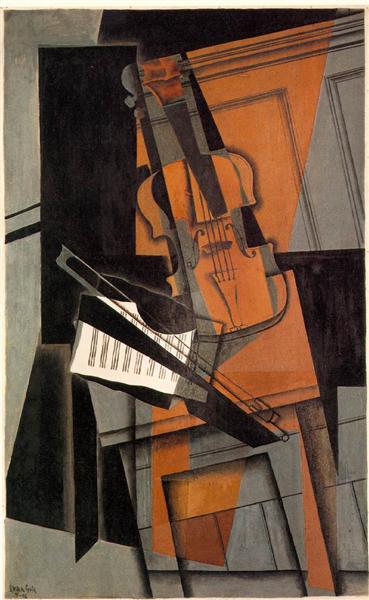
the-violin-1916.jpg!Large

   “The Violin (1916) 

        Juan Gris

            _____

if I was able to bring up a list of 
ten top Romantic piano concertos  
throughout the 19th Century earlier
can number of violin concertos 
only three essential ones, with,
however, two other significant 
such compositions, which remain, 
for one reason or another, 
peripheral, secondary  

more about which later

but the exalted three are situated
conveniently, the first, at the very 
beginning of the Romantic Era, 
Beethoven’s magisterial, even 
extraordinary, Opus 61 in D major
1806, and close doubly with the
two others, Tchaikovsky’s
resplendent workwords cannot 
do it justice, and Brahms’ no less
transcendental one, at its very end, 
1878, none are negligible, it’d be 
like missing the Eiffel Tower while 
in Paris, skipping the pyramids 
along the Nilethey are part of our 
cultural consciousness, it would 
be an utter shame to pass them 
by, they are our glory, our 
magnificent heritage

it should be noted that the 
concerto, be it for violin, piano, 
cello, what have you, a soloist 
in concert with an array of 
instruments, is the perfect allegory 
for the Romantic Era, an individual 
in contention with a community, 
under the influence of a conductor, 
a mayor, a mentor, a polity, the
individuality afforded by the 
proclamation of human rights in 
the aftermath of the French 
Revolution, and its social 
consequences, musically 
manifested

the match might be fraught, 
should be, though with 
compromise, considerate 
accommodation, fruitful, 
hopefully even transcendental, 
if not at least entertaining, 
cooperation, music seems to 
infer eventual concord, 
congress, harmony, a way out 
of, even dire, distress, or at 
least point the way toward it

concertos die out, incidentally, in 
the 20th Century, you don’t hear 
of very many, if any at all, after 
Rachmaninoff, they are gone,
much like later, in the 1950s, the 
waltz, forever, with the wind

may they rest in peace


R ! chard