Just another WordPress.com weblog
Tag: "The Birth of Bacchus" – Ovid
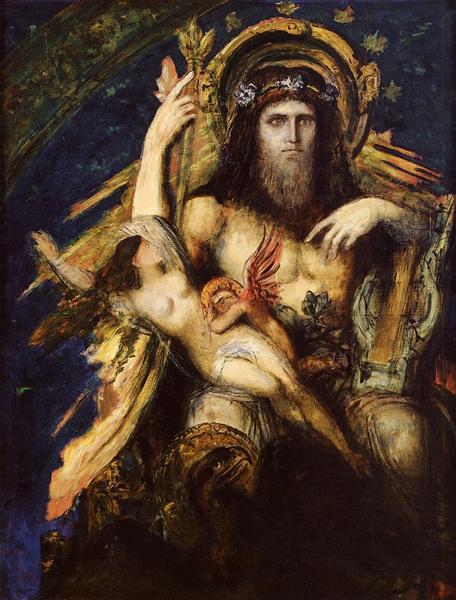
_________
Old Beroe’s decrepit shape she wears,
Her wrinkled visage, and her hoary hairs;
Old Beroe, faithful servant of Semele
hoary hairs, love it
Whilst in her trembling gait she totters on,
And learns to tattle in the nurse’s tone.
Juno / Hera transforms herself into
Old Beroe, tattl[ing], talking idly, in
the nurse’s tone, impersonating her
in order to seek revenge, if you’ll
her husband’s progeny
The Goddess, thus disguis’d in age, beguil’d
With pleasing stories her false foster-child.
foster-child, a child who is fostered,
nurtured, by someone other than a
parent, Semele, by Old Beroe,
purportedly, in this instance
false, Juno / Hera is not Old Beroe,
but the nurse’s duplicitous, false,
in both senses of the word here,
double
beguil’d, enchanted, amused
Much did she talk of love, and when she came
To mention to the nymph her lover’s name,
Fetching a sigh, and holding down her head,
“‘Tis well,” says she, “if all be true that’s said.
I thought, meets Sleeping Beauty’s
wicked stepmother, for a more
contemporary coupling
But trust me, child, I’m much inclin’d to fear
Some counterfeit in this your Jupiter:
Some counterfeit, yourJupiter is not
your [actual] Jupiter, Juno / Hera
suggests
Many an honest well-designing maid
Has been by these pretended Gods betray’d,
well-designing, without guile, with
no ulterior motive
pretended Gods, men who unjustifiably
beat their chest, tell tall tales, unequal
to their proclaimed accomplishments
But if he be indeed the thund’ring Jove,
Bid him, when next he courts the rites of love,
Descend triumphant from th’ etherial sky,
In all the pomp of his divinity,
Encompass’d round by those celestial charms,
With which he fills th’ immortal Juno’s arms.”
to ask her lover, when next he courts
the rites of love, to prove he is indeed
appropriately
Encompass’d round, accoutred,
enveloped, in
the pomp, incidentally, the splendour
of his divinity, take on a couple of
extra poetic lines, verses, indicative
of that very splendour
note also that Semele seems to have
marital status, about bearing the child
of another woman’s man, indeed that
of a very, in this instance, goddess,
Th’ unwary nymph, ensnar’d with what she said,
ensnar’d, ensnarled, caught up in
Desir’d of Jove, when next he sought her bed,
To grant a certain gift which she would chuse;
Desir’d of, asked of, requested of
chuse, choose
“Fear not,” reply’d the God, “that I’ll refuse
Whate’er you ask: may Styx confirm my voice,
Chuse what you will, and you shall have your choice.”
forms the boundary between Earth and
Titans and been granted by him that
oaths should henceforth all be sworn
upon her, and be punctiliously observed
his own son Phaeton his wish upon very
for both, of consequences
“Then,” says the nymph, “when next you seek my arms,
May you descend in those celestial charms,
And fill with transport Heav’n’s immortal dame.”
show me, Semele asks of her suitor,
what she gets, what Juno / Hera gets,
when next you seek my arms
go, girl, I thought, if you’re going
to be irreverent
The God surpriz’d would fain have stopp’d her voice,
But he had sworn, and she had made her choice.
on very Styx, he’d sworn, ever so
perilously
stay tuned
R ! chard
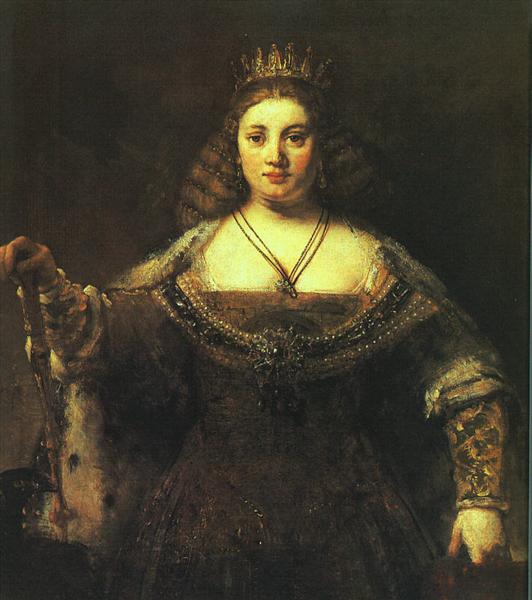
“Juno” (c.1662 – c.1665)
______
Actaeon’s suff’rings, and Diana’s rage,
Did all the thoughts of men and Gods engage;
Some call’d the evils which Diana wrought,
Too great, and disproportion’d to the fault:
Others again, esteem’d Actaeon’s woes
Fit for a virgin Goddess to impose.
The hearers into diff’rent parts divide,
And reasons are produc’d on either side.
remember, not all the gods were
on side
Juno alone, of all that heard the news,
Nor would condemn the Goddess, nor excuse:
queen, therefore, of the gods
She heeded not the justice of the deed,
But joy’d to see the race of Cadmus bleed;
For still she kept Europa in her mind,
And, for her sake, detested all her kind.
Europa had been whisked away
husband, and borne him several
children, to the enduring enmity
of the queen of the deities
Besides, to aggravate her hate, she heard
How Semele, to Jove’s embrace preferr’d,
Was now grown big with an immortal load,
And carry’d in her womb a future God.
philanderer apparently, had now
impregnated Semele, youngest
daughter of Cadmus, to Juno’s
utter disgust and dismay
Thus terribly incens’d, the Goddess broke
To sudden fury, and abruptly spoke.
let me reiterate here that the original
gods and goddesses of Olympus had
migrated with the Greeks to other
areas of the Mediterranean, but
became known, in the lands that
they’d settled, by other names
according to the languages and
customs that evolved in these new
territories, thus the Greek goddess
Hera was in Rome and its outlying
areas known as Juno, the Greek
though their home remained for
“Are my reproaches of so small a force?
‘Tis time I then pursue another course:
about his inveterate philandering,
her reproaches were not enough
to stop the god from his
determined activities
she therefore ordains
It is decreed the guilty wretch shall die,
If I’m indeed the mistress of the sky,
If rightly styl’d among the Pow’rs above
The wife and sister of the thund’ring Jove
(And none can sure a sister’s right deny);
It is decreed the guilty wretch shall die.
Juno / Hera is not only the wife of
sister, both children of Cronos /
were themselves children of the
earth goddess Gaia and the sky
She boasts an honour I can hardly claim,
Pregnant she rises to a mother’s name;
While proud and vain she triumphs in her Jove,
And shows the glorious tokens of his love:
though Juno / Hera did indeed have
she is probably no longer here
bearing him any, I am supposing,
while Semele, proud and vain, is
now show[ing] the glorious tokens
of his love
But if I’m still the mistress of the skies,
By her own lover the fond beauty dies.”
/ Zeus the cause of Semele’s
demise
This said, descending in a yellow cloud,
Before the gates of Semele she stood.
/ Zeus, would’ve been officiating at
the Cadmeia, the equivalent of the
Athenian Acropolis, at Thebes, the
city named after her father, its
sparks will surely fly
stay tuned
R ! chard

 Richibi's Weblog