Richibi’s Weblog

Just another WordPress.com weblog

Tag: Stalin

Symphony no 11 in G minor, opus 103 (The Year 1905) – Dmitri Shostakovich
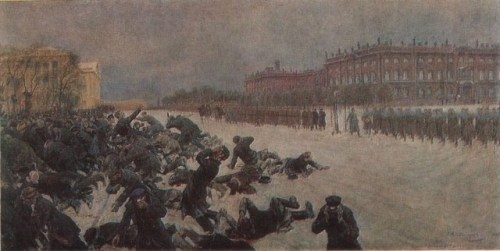
bloody-sunday-shooting-workers-near-the-winter-palace-january-9-1905-1  Bloody Sunday. Shooting workers near the Winter Palace January 9, 1905” 

       Ivan Vladimirov

            ________

if you don’t find a lot to hang on to in
Shostakovich’s 11th Symphony, as I
didn’t, apart from his everywhere
ravishing instrumentation, it’s that 
the piece is a commemoration of a 
particular event in Russian history, 
Bloody Sunday, when the Tsar’s 
Imperial Guard opened fire on a 
crowd of unarmed protestors who 
had come to petition Nicolas ll for 
better work conditions, akinindeed, 
to slavery then, there, January 22, 
1905, the first stirrings, thus, of the 
1917 Russian Revolution, which 
installed the Bolsheviks, Leninism, 
then Stalinism, and so forth

Bloody Sunday can be compared to 
China’s Tiananmen Square, June 4, 
1989it seems totalitarian states will 
blithely resort to such dire measures

Shostakovich had been commissioned 
to write a symphony for the 50th 
anniversary of the event, January 22, 
1955

he’d been reinstated by Khrushchev  
after the death of Stalin, who’d 
excused the tyrant’s condemnation 
of Shostakovich by saying the despot 
had been too subjective, and rescinded 
the law which that earlier ruler had 
imposed requiring all artists to  
conform to party ideology, see Hitler 
again on that one, his proscribed
entartete Kunsthis interdicted
degenerate art

but for personal reasons, Shostakovich 
was unable to compose this new work 
until 1957, the year after the Soviets had 
quashed the Hungarian uprising of 1956
with tanks and ammunition, an event 
too reminiscent of, to the composer, the
earlier tsarist massacre, and horrifying

furthermore, his father had been there,
and spoke of children having been shot 
out of the trees as they merely watched
the proceedings, felled too suddenly, 
apparently, to wipe the smiles off their 
innocent still faces 

the Symphony is called The Year 1905“,
it is mighty, but is too local to effect any
universal understanding, I think, the 
program is too specifically Russian to 
evoke more than historical attention to
an unacquainted observer, listener

I’d visited a church in Rome, Sant’Agnese
fuori le mura, St Agnes Outside the Walls,
once, a place I would not miss were I ever
to return to that illustrious city, before even 
the Vatican, the Coliseum, et cetera, the 
church was built in the 4th Century and 
has weathered the ages, the vicissitudes 
of time, with all their impositions 

the mass was in Italian, however, not the 
Latin that had once united all Catholics
in a common set of sounds that had been
internalized to represent the message of 
the service

but now I could only recognize the form,
no longer the content, something like the 
response a person without the history
of Russia would have here, I would 
contend

this is the dilemma of this, however 
significant, composition, I find

you might also imagine that a tribute to
Canadian soldiers who’d died at, say,
Vimy Ridge, or Passchendaele, might 
not be as moving to someone who    
wasn’t Canadian 


Shostakovich received the Lenin Prize
for his achievement, one of the Soviet 
Union’s most prestigious accolades


R ! chard
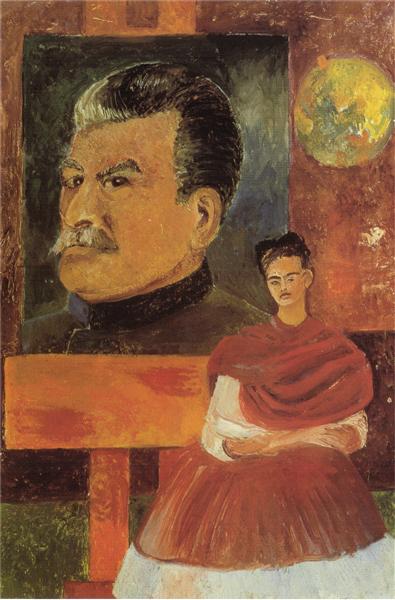
Symphony no 10 in E minor, op 93 – Dmitri Shostakovich

self-portrait-with-stalin-1954.jpg!Large.jpg

     “Self Portrait with Stalin (1954) 

             Frida Kahlo

                 ______

Shostakovich’s 10th Symphony was a
success from the moment I heard it, 
it resolved issues for me I found 
difficult in his earlier showpieces, for
that’s what symphonies are, indeed
blockbusters

from the very beginning, Shostakovich
gives a musical theme, a few notes 
played by a solo oboe, an obbligato
that is then repeated with variations by
other instruments, if not by the entire
orchestra, this is an old trick of 
Beethoven

later movements do the same thing 
with flute, piccolo, or bassoon
obbligati, a particular device of
Shostakovich to indicate a lone,
individual voice amidst the clamour 
of military brass and proletarian
violins

but the tactic of repeating a theme, 
like rhyming in poetry, gives one a 
sense of position, which is lost if 
there’s no reiteration, no reference 
point, it’s like wandering off into a 
forest instead of into a park you 
could safely be enjoying, that had 
trails at least to let you know you 
weren’t far from civilization, 
signposts pointing out directions, 
whereas a forest could be a tundra, 
vast for miles, one could walk for 
days without being found, that’s 
the role of repetition, rhyme, a 
refrain, in music, getting one’s 
bearings

and incidentally, one could be 
walking around in circles in that 
forest and atonality wouldn’t be 
any help at all 


the Tenth has, however, all the 
guideposts throughout, one can 
tell where the music ‘s going at 
each and every movement, it was 
like finding my way home, the, long  
even at nearly an hour, soundscape 
whipped by leaving me breathless, 
awestruck, Shostakovich has hit 
here, I thought, my big time, it took 
him long enough


it was first performed just after the 
death of Stalin, March, 1953, was 
thus probably composed somewhat 
earlier, belying the supposition that 
Stalin‘s demise had affected the 
spirit of his composition, which is 
uncharacteristically cheery for him, 
to my mind, seems to have unleashed 
in him the dogs not of war and 
disillusion, but of fun, something that 
was happening to the entire 20th 
Century, for that matter, especially 
after the Second World War, even, it 
appears, however grimly, in Russia, 
oops, in the U.S.S.R


an aside – Mrs Premise had said of 
Jean-Paul Sartre, the expositor of 
Existentialism in the Twentieth Century, 
implications of which he related to us,
of living in world without God, in his
magnum opusBeing and Nothingness“,
to her Monty Python counterpart, Mrs 
Conclusion, in a hilarious skit of theirs, 
that Sartre wasn’t receiving that day, he 
was, according to his housekeeper, 
especially moody

is he free, asks Mrs Premise, he’s been 
investigating that one for years, the 
woman at the door replies, the kind of 
joke – in musical terminology, a scherzo – 
utterly cherishwitty, pithy, trenchant, 
if you’ll pardon my giddy digression

but I sense Russian counterpart in the
dour Shostakovich

 
it should be noted here, that the 
orchestra in the link I provide, is
the Simon Bolivar Youth Orchestra
of Venezuela, a country with its 
own political history of oppression, 
under the direction of the deservedly 
celebrated conductor, Gustavo 
Dudamelhimself a Venezuelan 

the struggle doesn’t stop, the oracular 
hits must keep on coming, go, Gustavo
Dudamel, go, Simon Bolivar Youth
Orchestra, go, Shostakovich


 R ! chard

Symphony no 9 in E flat major, Op. 70 – Dmitri Shostakovich

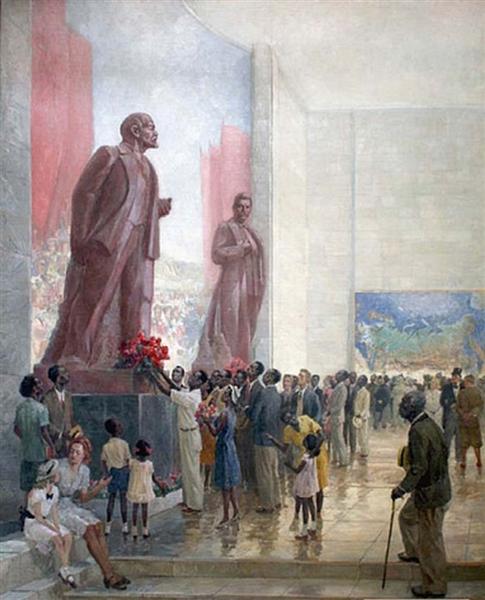
great-expectations-ussr-pavilion-on-1939-new-york-world-s-fair-1947.jpg!Large 

Great Expectations. USSR pavilion at 1939 New York World’s Fair (1947) 

       Veniamin Kremer

             ________

it’s become evident that Shostakovich’s 
symphonies require context, a backstory, 
it’s otherwise like listening to a film score
without the movie, though often even 
pleasant, it lacks the poignancy that a 
story would deliver to the music 
accompanying it

not that that’s impossible, John Williams  
has delivered, irrespective of if you’ve 
seen the relevant film, his Shindler’s
List for example, listen 

and I used to fall asleep to Alex North‘s
soundtrack for “Who’s Afraid of Virginia
Woolf”a film that changed, or rather 
defined, my life, much as Somerset 
Maugham’s Of Human Bondage“, the
book, had done a decade earlier,
these 
would be, I’d intuited,
my destiny  

but for specifically political reasons, 
the symphonies of Shostakovich
apart from a few exceptions, the 
Fifth, the Eighth, though only 
somewhat that one, for instance, 
without the accompanying history, 
don’t hold, the emotional connection 
is too abstruse, foreign, to catch


the Ninth was written in 1945, World
War ll had been won, by the Soviet 
Union as well as the Western Allies

Stalin was still in command, Russians 
were returning to their oppressive, 
indeed murderous, regime 

Shostakovich had been expected to 
bring glory to the Soviet system, he 
delivered instead a joke, in musical
terms, a scherzo, if you can listen to 
the language, a wry joke, instead of 
a paean to the glory of Stalin, he
delivered not at all a full on hour-long
special as he’d been doing before,
but a short, his shortest, symphony, 
full of exaggerated, which is to say,
hypocritical, fanfare

piccolos and flutes cheer, mimicking
flags and banners, trombones boast 
an only uncertain victory, deflating 
even, in the third movement 
decisively, though, I found, 
prolongedly, with winds sounding 
exhausted, but not succumbing to 
standing down, while violins portray 
the population in a frenzy, their 
military industrial complex having 
whipped them into feverish 
servitude

Stalin was not amused, the piece 
was banned until after the autocrat’s 
demise, for its “ideological weakness”

nor was the world then, for that matter,
impressed, who thought the Soviet
superstar’s response to victory was 
unusually trivial

but Shostakovich had been unable 
to applaud the tyrant, a politically 
required duty, if not even officially
commissioned, he could only put 
up surreptitiously pantomime, if  
he was to remain true to his 
principles

which he did

his work was a call to arms for the 
beleaguered denizens of his 
oppressed society, spoken in a
locally decipherable musicacode

as such it is a historical document 


listen to Leonard Bernstein give 
further invaluable information on
the subject


R ! chard 

Symphony no 8 in C minor, opus 65, “Stalingrad”- Dmitri Shostakovich

sky-and-water-ii.jpg!Large.jpg

     “Sky and Water II (1938) 

           M.C. Escher

              _______

stepping into Shostakovich’s Eighth 
Symphony was to me like knocking 
at someone’s apartment in the same 
building but on the wrong floor, 
everything was the same but 
different

that had happened to me once before 
when I‘d moved from the third floor  
of my building, facing the laneway, 
overlooking the dumpsters and the 
derelicts, I used to say, cause I liked 
the alliteration, just above the parking 
lot, too few levels up, that spewed 
exhaust from caridling there, 
interminablyespecially early 
mornings in winter

to the twelfth floor, with a view of the 
mountains from my living room and
of the ocean from my bedroom, where
I’ve always said I see God/dess every
morning, every day

the floor plan was identical but for 
being reversed, the living room on 
the left, and the kitchen, in the first, 
the bedroom straight ahead of you
as you entered, the living room on 
the right, and the kitchen, the 
bedroom straight ahead of you as 
you entered, in the second

I called it going through the looking 
glass, where indeed dumpsters and 
derelicts had turned to daily sightings 
of God/dess, a truly transcendental 
experience

this had happened as well when I 
went from atheism, crossedI said, 
the bridge of faith, but that’s 
another story


Shostakovich’s Eighth is indeed a 
reiteration of previous statements,
patterns are becoming familiar, the 
strident opening subsiding into 
plaintive laments is recognizable, 
links to the Fifth and the Seventh 
are evident, so are some of the, 
eventually, longueurs, as we say 
in French, excessive histrionics, 
to my mind

but the third movement here is 
nevertheless a stunner, worth 
the price of admission, I’ve been 
humming that one since in my, 
though interrupted, sleep  

here‘s a counterpart, however, 
a piece I found serendipitously 
as I pondered a response to a 
cousin who’d asked about 
Classical guitar, a piece written 
in 1939, the time Shostakovich
was writing his Fourth, though
protectively then retracted, by 
a Spanish composer, in another 
part of the world, but equally 
constricted, by Franco, a 
contemporary autocrat, who 
demanded art supportive of his 
particular political apparatus

Joaquín Rodrigo – but he’s 
another story – wrote his 
magisterialConcerto de 
Aranjuez“, an utter triumph, a 
strictly Classical composition, 
three movements, with all the 
tempi in the right order,
celebrating a palace, Aranjuez,
historically significant to the 
Spanish, like Versailles is to 
the French, thereby sidestepping 
the local tyrant’s official censure 
by skirting that ruler’s autocratic
political proscriptions

but Spain wasn’t massively 
obliterating its people either, 
as Stalin and Hitler were 
theirs then, a crucial 
consideration

in either case, these poets are  
witnesses to history, and have 
survived through their particular
statements, to tell individually,
and idiosyncratically, each his 
redoubtable story, each of 
which is forcefully telling, and 
amazing

listen


R ! chard

Symphony no 7 in C major, opus 60, the “Leningrad”- Dmitri Shostakovich

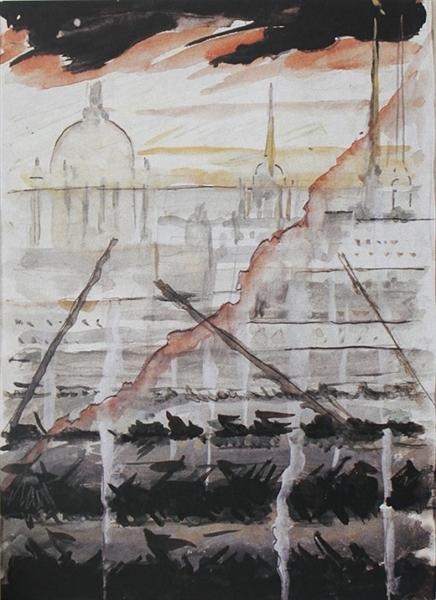
leningrad-in-blockade-sketch-on-the-theme-of-leningrad-symphony-of-d-d-shostakovich-1943.jpg!Large.jpg

Leningrad in blockade. Sketch on the theme of 
         “Leningrad Symphony” of D. D. Shostakovich. 
                                                                (c.1943) 

     Mstislav Dobuzhinsky

             __________

though I’ve been through the Seventh 
three times already, consecutively, it
doesn’t reach, for me, the heights the 
Fifth did, its first movement is
manifestly imperious, nearly even 
overwhelming, certainly unforgettable, 
I’ve been humming the ostinato in my 
sleep

but the following movements seem to 
me – not being Russian, nor having as
intimately incorporated their culture, 
where rhythms and history are 
inextricably intertwined – muddled 
about the reconstruction of its 
shattered world, melodies might be
lovely but are lost in a blur of musical
directions, there isn’t enough repetition 
of musical motifs to find solid ground, 
angry statements follow lyrical adagios
too often to get our bearings on what 
might be going on 

the first movement, however, remains a 
triumph, note the debt owed to Ravel’s 
Bolero in the rousing ostinato, the 
part where the same musical phrase 
obstinately repeats its peremptory and 
ever more vociferous mantra, its 
headlong incantation, an interesting 
blend in either symphonic work of the 
sinuous, the seductive, the beguiling,
turning into the overtly martial, all to 
do with pulse 

the Symphony no 7, the “Leningrad”,
was first presented in that very city 
during its siege by the Germans
which lasted from 1941 to 1944, 
however unbelievably, Shostakovich, 
already giant, was expected to deliver 
masterpiece by both the people and 
by the regime, imagine Bono doing a
concert for Syria 

Shostakovich doesn’t disappoint

players were culled from what remained 
of instrumentalists among the survivors
of both Stalin’s criminal purges and of 
the German siege itself left in the city, 
those who hadn’t survived the famine
there, Valery Gergiev, an exalted 
Russian conductor, describes them as
walking skeletonsmeagre from 
starvation, we’ve seen these before at 
Auschwitz

the world heard, and was moved, 
imperialism in any form was being 
vociferously condemned, going back 
to Napoleon even and his own failed 
invasion, if not also to Hannibal 
crossing the Alps, Caesar, his 
Rubicon

much of this symphony is about cultural 
resistance, the survival of a proud and 
resilient seed, any proud and resilient 
seed, hence its international standing

see Beethoven’s 9th Symphony for 
comparable fanfare, flourish, and 
circumstance, the only other work of
any such historical political importance
and, appreciably, still unsurpassed,

except for, maybe, Roger Waters
channeling Pink Floyd at the Berlin 
Wall, along with, not incidentally
thereagain Beethoven 


R ! chard

psst: the other great composer of the 
          20th Century, Messiaen, also 
          composed a commemoration of
          an awful moment in our history,
          the Holocaust, his Quartet for 
          the End of Time“, played originally
          in his very concentration camp by 
          similarly “walking skeletons”, does   
          for me everything Shostakovich’s 
          Seventh didn’t 


Dmitri Shostakovich – “Symphony No 4” in C minor, opus 43

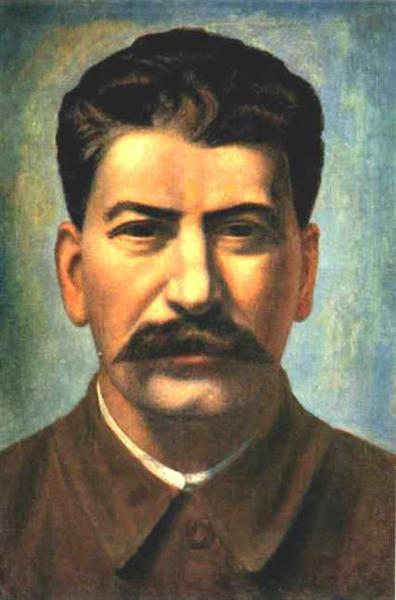
portrait-of-joseph-stalin-iosif-vissarionovich-dzhugashvili-1936.jpg!Large

   “Portrait of Joseph Stalin (Iosif Vissarionovich Dzhugashvili) (1936)

                   Pavel Filonov

                           _________

if you’ve been waiting for a Shostakovich 
to write home about among his early 
symphonies, here’s the one, his 
Symphony no 4 in C minor, opus 43 will
knock your socks off from its very 
opening gambit, have a seat, settle in, 
and get ready for an explosive hour

the Fourth was written in 1936, some 
years after the death of Lenin, and the 
instalment of Stalin as the supreme, 
and ruthless, authority, after several 
years throughout the Twenties of
maneuvering himself, cold-bloodedly,
into that position 

from Stalin, Death is the solution to 
all problems. No man – no problem.

fearing retribution after Stalin had 
criticized his recent opera, Lady 
Macbeth of Mtsensk“, Shostakovich 
cancelled the first performance of 
this new work, due to take place in 
December, ’36, others had already 
suffered internal exile or execution 
who had displeased the tyrant, a 
prelude to the infamous Great Terror

the Symphony was eventually played
in 1961, 25 years later, conducted by
no less than Kirill Kondrashin, who’d
partnered Van Cliburn a few years 
earlier in Cliburn’s conquest of Russia
but along with this time however the 
long-lived Leningrad Philharmonic 
Orchestra 

to a friend, I said, this is the biggest
thing since verily Beethoven, no one 
has so blown me away symphonically 
since then

he looked forward, he replied, to 
hearing it 

the Fourth Symphony has three distinct 
movements, to fit thus appropriately the 
definition of symphony, though the first 
and third have more than one section, 
something Shostakovich would have 
learned from already Beethoven, it gives 
the opportunity of experiencing a variety 
of emotions within one uninterrupted 
context, add several movements and 
you have a poignant, peripatetic musical 
journey, more intricate, psychologically 
complex, than many other even eminent
composers, Schubert, Chopin, 
Mendelssohn, even Brahms, for instance 

it’s helpful to think of film scores, and 
their multiple narrative incidents,
brimming with impassioned moments,   
however disparate, Shostakovich had 
already written several of them

let me point out that Shostakovich’s 
rhythms are entirely Classical, even 
folkloric in their essential aspects, 
everywhere sounds like a march, 
proud and bombastic, if not a 
veritable dance, peasants carousing,
courtiers waltzing, and repetition is
sufficiently present to not not 
recognize the essential music 
according to our most elementary
preconceptions

but the dissonances clash, as though 
somewhere the tune, despite its rigid 
rhythms, falls apart in execution, as 
though the participants had, I think,  
broken limbs, despite the indomitable 
Russian spirit

this is what Shostakovich is all about, 
you’ll hear him as we move along 
objecting, however surreptitiously,
cautiously, to the Soviet system, like 
Pasternak, like Solzhenitsyn, without 
ever, like them, leaving his country 
despite its manifest oppression, and 
despite the lure of Western accolades,
Nobel prizes, for instance, it was their 
home

and there is so much more to tell, but
first of all, listen

R ! chard 


Dmitri Shostakovich – String Quartet no 15, opus 144

several years ago when an angel I knew passed away
I read at his commemoration something I had written
for him, adagios, I said, always remind me of John

only a few days later, after I’d spoken, an adagio in
the distance was weaving its magic spell as I
abstractedly washed perennial dishes, a pivotal
spot, it would appear, for me, in my mystic
wanderings, my spiritual peregrinations

gradually I recognized the presence I’d apparently
inadvertently evoked with my unsuspecting but
thoughtful and caring script, opening a key, like
Ali Baba, it would transpire, to the very undiluted
infinite, something I’d wished for from my dad,
who’d died just a few months earlier, promising
me he’d speak to me if he could, though by then
I hadn’t yet heard from him

later when I was browsing for music to get into
to while away my pensive hours I happened upon
some Shostakovich in a nearby record store, I’d
recently been exploring his stuff, having reached
forward from the Romantics and even the
Impressionists, and looked to a relatively more
recent touch, the early Twentieth Century

which is to say the atonalists, Schoenberg, Berg,
Stravinsky and so forth, of which Shostakovich,
I would argue, has proven to be the most
significant voice, his music being that of a
desperate, nearly broken people enduring
the atrocities under Stalin

he is the most important composer of the
Twentieth Century, I think, along with Olivier
Messiaen, who survived a German prisoner of
war camp, two tough, even heroic, spirits

and here were not one, not two, not even three,
but six adagios in his 15th String Quartet, when
anything faster was too much for me to bear,
otherwise it would have to have been silence,
I was elated

I was not let down, Shostakovich’s 15th String
Quartet, opus 144, is a masterpiece, and helped
me through my rigorous Calvary with compassion,
grace, and ultimately golden hope, to health and
resignation

it is not an easy piece, you might find it
overwhelming, but it is the last word in adagios,
and for me it means the world, I couldn’t leave
it out

I found the distribution awkward however, I
haven’t found the quartet complete anywhere
on the Internet, you’ll have to access the movements
separately, pee breaks are therefore allowed, there
are six movements, not usual but we’ve seen
Beethoven do five already for his Sixth Symphony,
so not entirely unexpected

the first movement, Elegy (Adagio), is played by the
Rubio Quartet, but with only an image of war torn
Leningrad to inspire visually

the second, Serenade (Adagio), by the Borodin String
Quartet, perhaps Shostakovich’s best interpreters, are
also presented visuals inert

the third, fourth, and fifth – Intermezzo (Adagio),
Nocturne (Adagio), and Funeral March (Adagio molto)

in that order, are played live by the Shostakovich
Quartet, named of course in the composer’s honour

and the sixth, Epilogue (Adagio), again by the Borodin

may you be granted the poise and profound grace
of the adagio

Richard