Richibi’s Weblog

Just another WordPress.com weblog

Tag: Semele – consort of Jove / Jupiter / Zeus

“The Story of Pentheus” – Ovid

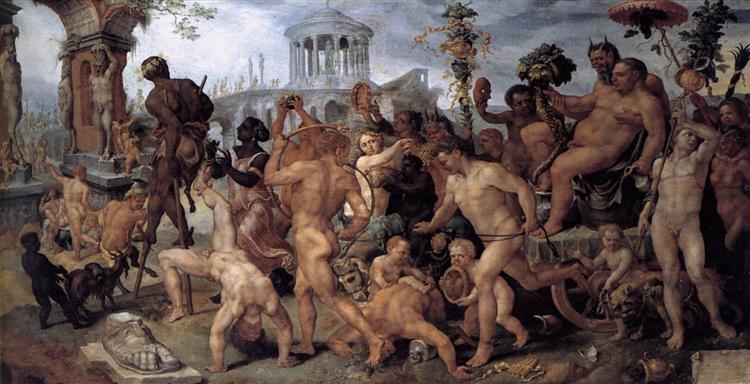
The Triumphal Procession of Bacchus, c.1536 - Maerten van Heemskerck

         The Triumphal Procession of Bacchus” (c.1536)


                   Maerten van Heemskerck


                             _______________


till now the separate stories in Ovid’s

Metamorphoses have been linked,

one being either a consequence of

the other,or its cause, but the story

of Pentheus, grandson of Cadmus,

king and founder of Thebes, who

earlier in this series had his own

tale told, starts, as my German

teacher used to say, from the

scratch


This sad event, therefore, in the

first line of the poem, refers to

what will follow, not what came

before


            This sad event gave blind Tiresias fame,

            Through Greece establish’d in a prophet’s name.


Tiresias, if you’ll remember, had been

blinded by Juno / Hera, goddess of the

gods, for having sided with Jove / Jupiter

/ Zeus, her husband, in a wager between

them he’d been called upon to decide,

Jove / Jupiter / Zeus, however, gave 

Tiresias, as consolation, having been

barred by a pact among the gods not

to undo each other’s spells, the gift

of insight, prophecy


the example that follows, of his divination,

establish[‘d] at that time his reputation

[t]hrough[out] Greece as a prophet


            Th’ unhallow’d Pentheus only durst deride

            The cheated people, and their eyeless guide.


unhallow’d, unholy, wicked, sinful


Pentheus, king of Thebes following

his grandfather, Cadmus, but that’s

an entirely other story


only, of all the people, none but

Pentheus durst, dared, deride,

mock, their eyeless guide, Tiresias

            To whom the prophet in his fury said,

            Shaking the hoary honours of his head:


hoary, grizzled, gray, aged


            “‘Twere well, presumptuous man, ’twere well forthee

            If thou wert eyeless too, and blind, like me:

            For the time comes, nay, ’tis already here,

            When the young God’s solemnities appear:


the young God[], Bacchus / Dionysus,

son of Semele and Jove / Jupiter / Zeus,

if you’ll remember, god of revelry,

intoxication, wild abandon


            Which, if thou dost not with just rites adorn,

            Thy impious carcass, into pieces torn,

            Shall strew the woods, and hang on ev’ry thorn.


impious carcass, dishonoured corpse, 

of any thou who wouldn’t’ve honoured

the celebrations


            Then, then, remember what I now foretel,

            And own the blind Tiresias saw too well.”


own, agree to, admit

            Still Pentheus scorns him, and derides his skill;

            But time did all the prophet’s threats fulfil.

            For now through prostrate Greece young Bacchus rode,


prostrate, beholden, reverent, observant

of the solemnities


            Whilst howling matrons celebrate the God:

            All ranks and sexes to his Orgies ran,

            To mingle in the pomps, and fill the train.


the rites of Bacchus were bacchanals,

orgies, celebrations of abandon, Mardi

Gras, for instance, in New Orleans,

annual Gay Parades, now everywhere,

or Hallowe’en since time immemorial


see above


            When Pentheus thus his wicked rage express’d:

            “What madness, Thebans, has your souls possess’d?

            Can hollow timbrels, can a drunken shout,


timbrels, tambourines


            And the lewd clamours of a beastly rout,

            Thus quell your courage;


quell your courage, overcome your

sense of discipline


                                            can the weak alarm

            Of women’s yells those stubborn souls disarm,


those stubborn souls, the Theban

spirit of pride and honour


            Whom nor the sword nor trumpet e’er could fright,

            Nor the loud din and horror of a fight?

            And you, our sires, who left your old abodes,


our sires, the older generation of

Thebans, of his grandfather

Cadmus‘ ilk


            And fix’d in foreign earth your country Gods;


foreign earth, very Thebes, from Tyre,

where Cadmus and his followers had

come from, in search of Europa, if

you’ll remember


            Will you without a stroak your city yield,


stroak, stroke


            And poorly quit an undisputed field?


undisputed field, there are no

military obstructions


            But you, whose youth and vigour should inspire

            Heroick warmth, and kindle martial fire,

            Whom burnish’d arms and crested helmets grace,

            Not flow’ry garlands and a painted face;


Remember him to whom you stand ally’d:


him, Pentheus himself, their king


            The serpent for his well of waters dy’d.


The serpenta reference here to the

dragon that Cadmus slew, which had

guarded the cavern where his crew

had been scouting for water, if you’ll

remember


            He fought the strong; do you his courage show,

            And gain a conquest o’er a feeble foe.


a feeble foe, licentiousness, abandon,

undisciplined revelry


            If Thebes must fall, oh might the fates afford

            A nobler doom from famine, fire, or sword.


Pentheus appeals to a loftier reason

for defeat, famine, fire, or sword, than

mere, and ignoble, debauchery


            Then might the Thebans perish with renown:

            But now a beardless victor sacks the town;


beardless victor, the young Bacchus /

Dionysus


            Whom nor the prancing steed, nor pond’rous shield,

            Nor the hack’d helmet, nor the dusty field,

            But the soft joys of luxury and ease,

            The purple vests, and flow’ry garlands please.


Bacchus / Dionysus is not impressed

by armour, military accomplishments,

prowess, but by grace, elegance, and

poetry


            Stand then aside, I’ll make the counterfeit

            Renounce his god-head, and confess the cheat.


the counterfeit, Bacchus / Dionysus


            Acrisius from the Grecian walls repell’d

            This boasted pow’r; why then should Pentheus yield?


Acrisius, a king of Argos, who must’ve

also repell’d from his city Bacchus /

Dionysus, according to the poem


            Go quickly drag th’ impostor boy to me;


th’ impostor boy, the counterfeit,

Bachus / Dionysus


            I’ll try the force of his divinity.”


try, test


            Thus did th’ audacious wretch those rites profane;


th’ audacious wretch, Pentheus


            His friends dissuade th’ audacious wretch in vain:

            In vain his grandsire urg’d him to give o’er

            His impious threats; the wretch but raves the more.


his grandsire, Cadmus

            So have I seen a river gently glide,

            In a smooth course, and inoffensive tide;

            But if with dams its current we restrain,

            It bears down all, and foams along the plain.


nature will have its way, so will the

gods, watch out, the narrator says,

who it is that you challenge

            But now his servants came besmear’d with blood,

            Sent by their haughty prince to seize the God;


his servants, Pentheus‘ men


the God, Bacchus / Dionysus


            The God they found not in the frantick throng,

            But dragg’d a zealous votary along.


votary, follower, adherent,

acolyte


the servants, Pentheus‘ men,

who did not, apparently, deliver


stay tuned


R ! chard
“The Birth of Bacchus” (lll) – Ovid

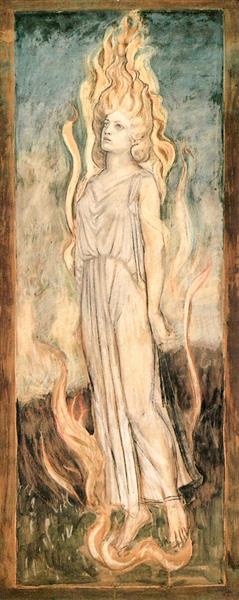
Semele, 1921 - John Duncan

        Semele” (1921)


             John Duncan


                    ____


         To keep his promise he ascends,


his promise, Jove / Jupiter / Zeus

had sworn by very Styx, if you’ll

remember, to Semele, his current

inamorata, that when next he[‘d]

court[ ] the rites of love, he’d

descend in those celestial charms

with which he enters Juno / Hera‘s

chambers, his goddess / wife, on

similar intimate occasions


                                                    and shrowds

         His awful brow in whirl-winds and in clouds;


shrowds, shrouds, covers in

darkness, shields


awful, inspiring awe, inspiring

consternation


         Whilst all around, in terrible array,

         His thunders rattle, and his light’nings play.


not only does Jove / Jupiter / Zeus

shrowd[ ] /His awful brow, which is

to say he actively effects changes,

consciously and manifestly producing

identifiable outcomes, a shrouded brow,

in this instance, but he also inspires the

very elements, thunders rattle 

light’nings play, to rally round his

enterprise


         And yet, the dazling lustre to abate,

         He set not out in all his pomp and state,


And yet, except that, Jove / Jupiter

/ Zeus chooses, set[s] … out, to rein

in, abate, elements of his pomp and

state, of his magnificence


         Clad in the mildest light’ning of the skies,

         And arm’d with thunder of the smallest size:

         Not those huge bolts, by which the giants slain

         Lay overthrown on the Phlegrean plain.

         ‘Twas of a lesser mould, and lighter weight;


Phlegrean plain, Phlegraean, site of the

war that won for the Olympians, Jove /

Jupiter / Zeus, Juno / Hera, and the

pantheon of other gods with whom

we’ve here become acquainted, control 

of the cosmos, against the Titans, who’d

earlier ruled, the children of Uranus,

Sky, and Gaia, Earth, though that’s

an entirely other, earlier story, equally

entrancing


         They call it thunder of a second-rate,

         For the rough Cyclops, who by Jove’s command

         Temper’d the bolt, and turn’d it to his hand,


Cyclops, any of the three Cyclopes,

Arges, Brontes, and Steropes, or in

English translation, Bright, Thunder,

and Lightning, sons of Uranus and

Gaia, one-eyed giants, who

manufactured Jove / Jupiter /

Zeus‘s thunderbolts


Cyclops here is probably Cyclopes,

this translation‘s early 18th-Century

spelling of the now singular “Cyclops”,

all of whom [t]emper’d the bolt, and

turn’d … to his hand Jove / Jupiter /
Zeus‘s commissioned arsenal


         Work’d up less flame and fury in its make,

         And quench’d it sooner in the standing lake.


this particular thunderbolt therefore

would have been less menacing, in

keeping with Jove / Jupiter / Zeus‘s

wish his dazling lustre to abate


         Thus dreadfully adorn’d, with horror bright,

         Th’ illustrious God, descending from his height,

         Came rushing on her in a storm of light.


I knew someone who came to me

like that once


         The mortal dame, too feeble to engage         

         The lightning’s flashes, and the thunder’s rage,

         Consum’d amidst the glories she desir’d,

         And in the terrible embrace expir’d.


I broke only into a thousand million

pieces, did not expire, but ruefully,

rather, survived, but that’s another

story, perhaps too intimate


         But, to preserve his offspring from the tomb,


his offspring, you’ll remember that

Semele was pregnant with Jove /

Jupiter / Zeus‘s child


         Jove took him smoaking from the blasted womb:


blasted, destroyed, [c]onsum’d[,]

amidst the glories she desir’d


see above


         And, if on ancient tales we may rely,

         Inclos’d th’ abortive infant in his thigh.


in order to allow it to complete

gestation, Jove / Jupiter / Zeus

incubated th’ abortive infant in

his [own] thigh


         Here when the babe had all his time fulfill’d,


Here, in his thigh


         Ino first took him for her foster-child;


Ino, sister of Semele, with too long

a story here, however fascinating


         Then the Niseans, in their dark abode,


Niseans, Nysians, of Nysa, a

mountainous mythical land

beyond Greece, with dark

abode[s], caves, among its

mountains, presumably


         Nurs’d secretly with milk the thriving God.


the thriving God, Bacchusthe Roman

Dionysus, god of wine, merriment, and

all kinds of mischievousness, which is

to say bacchanals, Dionysian revelries,

orgies


stay tuned


R ! chard

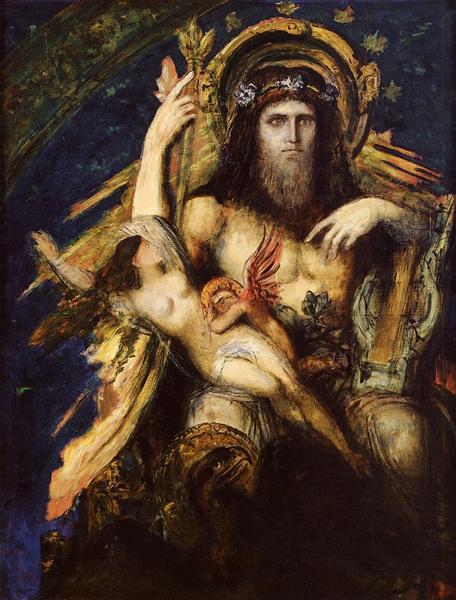
“The Birth of Bacchus” (ll)– Ovid

Jupiter and Semele, 1889 - 1895 - Gustave Moreau

         Jupiter and Semele” (1889 – 1895)


                 Gustave Moreau


                       _________


            Old Beroe’s decrepit shape she wears,

            Her wrinkled visage, and her hoary hairs;


Old Beroe, faithful servant of Semele


she, Juno / Hera, goddess


hoary hairs, love it


            Whilst in her trembling gait she totters on,

            And learns to tattle in the nurse’s tone.


Juno / Hera transforms herself into

Old Beroe, tattl[ing], talking idly, in

the nurse’s tone, impersonating her

in order to seek revenge, if you’ll

remember, on Semele, for bearing

her husband’s progeny


            The Goddess, thus disguis’d in age, beguil’d

            With pleasing stories her false foster-child.


foster-child, child who is fostered,

nurtured, by someone other than a

parent, Semele, by Old Beroe,

purportedly, in this instance


false, Juno / Hera is not Old Beroe,

but the nurse’s duplicitous, false,

in both senses of the word here,

double


beguil’d, enchanted, amused


            Much did she talk of love, and when she came

            To mention to the nymph her lover’s name,

            Fetching a sigh, and holding down her head,

            “‘Tis well,” says she, “if all be true that’s said.


Juliet’s nurse from Romeo and Juliet,

I thought, meets Sleeping Beauty’s

wicked stepmother, for a more

contemporary coupling


            But trust me, child, I’m much inclin’d to fear

            Some counterfeit in this your Jupiter:


Some counterfeit, yourJupiter is not

your [actual] Jupiter, Juno / Hera

suggests


            Many an honest well-designing maid

            Has been by these pretended Gods betray’d,


well-designing, without guile, with

no ulterior motive


pretended Gods, men who unjustifiably

beat their chest, tell tall tales, unequal

to their proclaimed accomplishments


            But if he be indeed the thund’ring Jove,

            Bid him, when next he courts the rites of love,

            Descend triumphant from th’ etherial sky,

            In all the pomp of his divinity,

            Encompass’d round by those celestial charms,

            With which he fills th’ immortal Juno’s arms.”


Juno / Hera, as Old Beroe, tells Semele

to ask her lover, when next he courts

the rites of love, to prove he is indeed

Jove / Jupiter / Zeus, to dress

appropriately


Encompass’d round, accoutred,

enveloped, in


the pomp, incidentally, the splendour

of his divinity, take on a couple of

extra poetic lines, verses, indicative

of that very splendour


note also that Semele seems to have

no qualms about Jove / Jupiter / Zeus‘s

marital status, about bearing the child

of another woman’s man, indeed that

of a very, in this instance, goddess,

the redoubtable Juno / Hera


            Th’ unwary nymph, ensnar’d with what she said, 


ensnar’d, ensnarled, caught up in


            Desir’d of Jove, when next he sought her bed,

            To grant a certain gift which she would chuse;


Desir’d of, asked of, requested of


chuse, choose


            “Fear not,” reply’d the God, “that I’ll refuse

            Whate’er you ask: may Styx confirm my voice,

            Chuse what you will, and you shall have your choice.”


Styx, goddess of the river Styx, which

forms the boundary between Earth and

the Underworld, had sided with Jove /

Jupiter / Zeus during the War of the

Titans and been granted by him that

oaths should henceforth all be sworn

upon her, and be punctiliously observed


Phoebus / Apollo had similarly granted

his own son Phaeton his wish upon very

Styx, if you’ll remember, with the direst,

for both, of consequences


            “Then,” says the nymph, “when next you seek my arms,

            May you descend in those celestial charms,

            And fill with transport Heav’n’s immortal dame.”


show me, Semele asks of her suitor,

what she gets, what Juno / Hera gets,

when next you seek my arms


go, girl, I thought, if you’re going

to be irreverent


            The God surpriz’d would fain have stopp’d her voice,

            But he had sworn, and she had made her choice.


on very Styx, he’d sworn, ever so

perilously


stay tuned


R ! chard

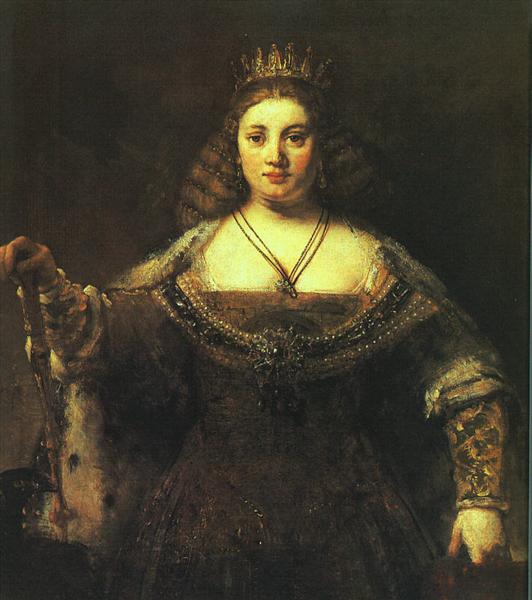
“The Birth of Bacchus” – Ovid

Juno, c.1662 - c.1665 - Rembrandt

           Juno” (c.1662 – c.1665)


                  Rembrandt


                      ______


             Actaeon’s suff’rings, and Diana’s rage,

             Did all the thoughts of men and Gods engage;

             Some call’d the evils which Diana wrought,

             Too great, and disproportion’d to the fault:

             Others again, esteem’d Actaeon’s woes

             Fit for a virgin Goddess to impose.

             The hearers into diff’rent parts divide,

             And reasons are produc’d on either side.


Diana / Artemis had transformed

Actaeon into a stag, if you’ll

remembernot all the gods were

on side


              Juno alone, of all that heard the news,

              Nor would condemn the Goddess, nor excuse:


Juno, wife of Jove / Jupiter / Zeus

queen, therefore, of the gods


               She heeded not the justice of the deed,

               But joy’d to see the race of Cadmus bleed;


Cadmus, founder of Thebes, brother

of Europa


               For still she kept Europa in her mind,

               And, for her sake, detested all her kind.


Europa had been whisked away

by Jove / Jupiter / Zeus, Juno’s

husband, and borne him several

children, to the enduring enmity

of the queen of the deities


               Besides, to aggravate her hate, she heard

               How Semele, to Jove’s embrace preferr’d,

               Was now grown big with an immortal load,

               And carry’d in her womb a future God.


Jove / Jupiter / Zeus, incorrigible

philanderer apparently, had now

impregnated Semele, youngest

daughter of Cadmus, to Juno’s

utter disgust and dismay


              Thus terribly incens’d, the Goddess broke

               To sudden fury, and abruptly spoke.


the Goddess, Juno / Hera


let me reiterate here that the original

gods and goddesses of Olympus had

migrated with the Greeks to other

areas of the Mediterranean, but

became known, in the lands that

they’d settled, by other names

according to the languages and

customs that evolved in these new

territories, thus the Greek goddess

Hera was in Rome and its outlying

areas known as Juno, the Greek

Zeus as both Jupiter and Jove,

though their home remained for

all Mount Olympus


              “Are my reproaches of so small a force?

               ‘Tis time I then pursue another course:


though Juno / Hera might’ve

harangued Jove / Jupiter / Zeus

about his inveterate philandering,

her reproaches were not enough

to stop the god from his

determined activities


she therefore ordains


              It is decreed the guilty wretch shall die,

               If I’m indeed the mistress of the sky,

              If rightly styl’d among the Pow’rs above

               The wife and sister of the thund’ring Jove

               (And none can sure a sister’s right deny);

               It is decreed the guilty wretch shall die.


Juno / Hera is not only the wife of

Jove / Jupiter / Zeus, but also his

sister, both children of Cronos /

Saturn and Rhea / Ops, who

were themselves children of the

earth goddess Gaia and the sky

god Uranus


              She boasts an honour I can hardly claim,

               Pregnant she rises to a mother’s name;

              While proud and vain she triumphs in her Jove,

               And shows the glorious tokens of his love:


though Juno / Hera did indeed have

children with Jove / Jupiter / Zeus,

she is probably no longer here

bearing him any, I am supposing,

while Semele, proud and vain, is

now show[ing] the glorious tokens

of his love


              But if I’m still the mistress of the skies,

               By her own lover the fond beauty dies.”


it appears that Juno / Hera will

contrive to make Jove / Jupiter

/ Zeus the cause of Semele’s

demise


              This said, descending in a yellow cloud,

               Before the gates of Semele she stood.


Semele, priestess of Jove / Jupiter

/ Zeus, would’ve been officiating at

the Cadmeia, the equivalent of the
Athenian Acropolis, at Thebes, the

city named after her father, its

founder, Cadmus


sparks will surely fly


stay tuned


R ! chard