Richibi’s Weblog

Just another WordPress.com weblog

Tag: “Romeo and Juliet” – Shakespeare

“The Birth of Bacchus” (ll)– Ovid
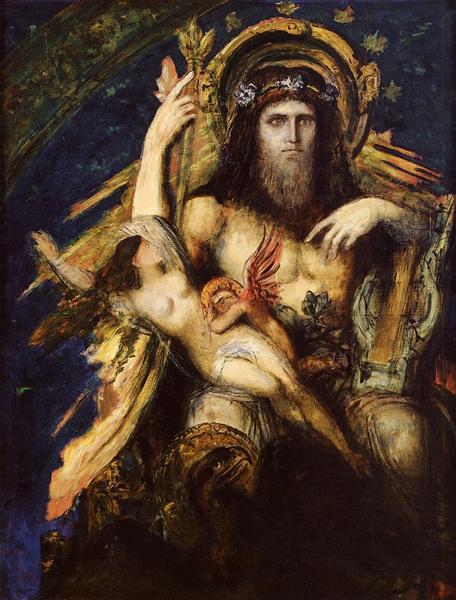
Jupiter and Semele, 1889 - 1895 - Gustave Moreau

         Jupiter and Semele” (1889 – 1895)


                 Gustave Moreau


                       _________


            Old Beroe’s decrepit shape she wears,

            Her wrinkled visage, and her hoary hairs;


Old Beroe, faithful servant of Semele


she, Juno / Hera, goddess


hoary hairs, love it


            Whilst in her trembling gait she totters on,

            And learns to tattle in the nurse’s tone.


Juno / Hera transforms herself into

Old Beroe, tattl[ing], talking idly, in

the nurse’s tone, impersonating her

in order to seek revenge, if you’ll

remember, on Semele, for bearing

her husband’s progeny


            The Goddess, thus disguis’d in age, beguil’d

            With pleasing stories her false foster-child.


foster-child, child who is fostered,

nurtured, by someone other than a

parent, Semele, by Old Beroe,

purportedly, in this instance


false, Juno / Hera is not Old Beroe,

but the nurse’s duplicitous, false,

in both senses of the word here,

double


beguil’d, enchanted, amused


            Much did she talk of love, and when she came

            To mention to the nymph her lover’s name,

            Fetching a sigh, and holding down her head,

            “‘Tis well,” says she, “if all be true that’s said.


Juliet’s nurse from Romeo and Juliet,

I thought, meets Sleeping Beauty’s

wicked stepmother, for a more

contemporary coupling


            But trust me, child, I’m much inclin’d to fear

            Some counterfeit in this your Jupiter:


Some counterfeit, yourJupiter is not

your [actual] Jupiter, Juno / Hera

suggests


            Many an honest well-designing maid

            Has been by these pretended Gods betray’d,


well-designing, without guile, with

no ulterior motive


pretended Gods, men who unjustifiably

beat their chest, tell tall tales, unequal

to their proclaimed accomplishments


            But if he be indeed the thund’ring Jove,

            Bid him, when next he courts the rites of love,

            Descend triumphant from th’ etherial sky,

            In all the pomp of his divinity,

            Encompass’d round by those celestial charms,

            With which he fills th’ immortal Juno’s arms.”


Juno / Hera, as Old Beroe, tells Semele

to ask her lover, when next he courts

the rites of love, to prove he is indeed

Jove / Jupiter / Zeus, to dress

appropriately


Encompass’d round, accoutred,

enveloped, in


the pomp, incidentally, the splendour

of his divinity, take on a couple of

extra poetic lines, verses, indicative

of that very splendour


note also that Semele seems to have

no qualms about Jove / Jupiter / Zeus‘s

marital status, about bearing the child

of another woman’s man, indeed that

of a very, in this instance, goddess,

the redoubtable Juno / Hera


            Th’ unwary nymph, ensnar’d with what she said, 


ensnar’d, ensnarled, caught up in


            Desir’d of Jove, when next he sought her bed,

            To grant a certain gift which she would chuse;


Desir’d of, asked of, requested of


chuse, choose


            “Fear not,” reply’d the God, “that I’ll refuse

            Whate’er you ask: may Styx confirm my voice,

            Chuse what you will, and you shall have your choice.”


Styx, goddess of the river Styx, which

forms the boundary between Earth and

the Underworld, had sided with Jove /

Jupiter / Zeus during the War of the

Titans and been granted by him that

oaths should henceforth all be sworn

upon her, and be punctiliously observed


Phoebus / Apollo had similarly granted

his own son Phaeton his wish upon very

Styx, if you’ll remember, with the direst,

for both, of consequences


            “Then,” says the nymph, “when next you seek my arms,

            May you descend in those celestial charms,

            And fill with transport Heav’n’s immortal dame.”


show me, Semele asks of her suitor,

what she gets, what Juno / Hera gets,

when next you seek my arms


go, girl, I thought, if you’re going

to be irreverent


            The God surpriz’d would fain have stopp’d her voice,

            But he had sworn, and she had made her choice.


on very Styx, he’d sworn, ever so

perilously


stay tuned


R ! chard

Piano Concerto no 2, opus 83 – Brahms

1024px-Notre_Dame_de_Chartres.jpg

      Chartres Cathedral

          _____________

if Brahms’ 2nd Piano Concerto is, to my 
mind, the last one of the Romantic Period,  
Beethoven’s First is, accordingly, the first
 
I thought it, therefore, instructive to pair 
them 

Beethoven, impelled by ideological 
speculations, built not only a variation
on what had come before, music as 
entertainment, a reason to dance, but
gave it a greater, which is to say, 
philosophical, dimension

by extending the reach of the cadence
beyond the usual metered rhythm, 
sending the melodic statement 
beyond an otherwise constricting bar 
line, Beethoven turned a lilt into a 
sentence, a ditty into a paragraph   

Shakespeare does the same thing to
poetry, for instance, with iambic 
pentameter devoid of rhyme

         “But, soft! what light through yonder window breaks?
          It is the east, and Juliet is the sun.
          Arise, fair sun, and kill the envious moon,
          Who is already sick and pale with grief,
          That thou her maid art far more fair than she”

                                  “Romeo and Juliet”, 2, 2, 2-6

and with this newfound oratory, 
peremptory, insistent, imbued, 
however, with utterly convincing 
honesty, unfettered emotion, 
which is to say, humanity, 
Beethoven establishes the 
sensibility of a very era, listen

that era, up to, eventually, Brahms
elaborates on that ethos, adding 
texture and enhanced authority 
to the original concept, setting 
the moral agenda for that, and 
other generations, to follow 

Brahms is more ponderous, mighty,
a cathedral instead of a church, a
commandment instead of an 
aspirational, merely, thrust, he 
adds even a fourth movement to 
an already magnificent structure, 
an extra steeple to towering 
edifice, a subliminally received 
reference to Beethoven‘s already 
inspiredbut tripartite only,  
architecture   

see Chartres for a comparable
ecclesiastical counterpart


R ! chard
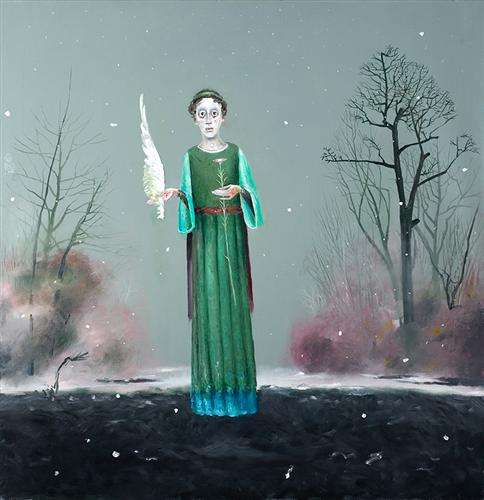
on art, its purpose

poet-with-flower-2008-jpgblog

                                Poet With Flower (2008)

                                          Stefan Caltia

                                                 _____

wherefore art, I’ve long and often wondered,
with only a wink to Juliet’s Romeo, for my
question dug deeper, why, indeed, itself art

we build our souls on the stories we’ve 
heard, the impressions we’ve received
from voices that spoke directly to our 
senses, painters with paint, musicians
with music, writers with words, poets 
with poems

it started with fairy tales, which told of
right and wrong, good and bad, courage,
kindness, responsibility, and dire 
consequences for discord

Biblical stories also took up a lot of my own
childhood, Jesus, Adam and Eve, Moses
and the Ten Commandments, this last 
reinforced by Cecil B. DeMille’s epic

but soon enough it was Oliver TwistLittle
Nell, and by an inescapable authorial leap, 
since these were all by an irresistible 
Charles Dickens for a guy my age, Sydney
Carton, who valiantly stands in for his
friend, Charles Darnay, at the guillotine, a 
quantum, even existential, leap from 
Peter Pan and Mary Poppins 

though I had the good fortune to learn to 
read and write music as a boy, play music, 
learn about Bach, Brahms and Beethoven, 
it didn’t take anyone else much more than
their enthusiasm to see what the Beatles
were similarly doing, the Rolling Stones, 
the Supremes, they were not only singing, 
but making history, shaping it, and us, we 
followed the questions they rose, their 
responses, the effects upon ourselves
for nothing is considered until it’s 
mentioned, spoken, made clear, and they
were those prophets

the same goes for art, we see as we see
cause Monet, Picasso, Warhol showed 
us how to see, what to look at

and of course poets, Shakespeare, 
RostandDanteGoethe, to inform, each,
their individual language, and culture

I have been Philip CareyScarlett O’Hara, 
Blanche DuboisGary Cooper in High
Noon“, both Martha and George in 
Who’s Afraid of Virginia Woolf“, lately 
I’ve been even Hank Williams

as Babette would say, a French doll who 
gets abducted in Raggedy Ann and Andy:
A Musical Misadventure“, an animated 
movie from the Seventies, – oo aahrr yoo 

Richard

psst: all of them have been me too,
      incidentally