Just another WordPress.com weblog
Tag: Pyrrha
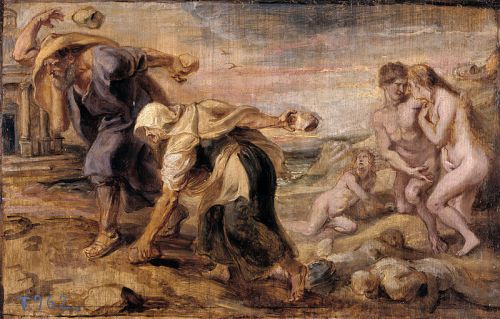
___________ for my mom and dad, my own Deucalion and Pyrrha Pyrrha pray to the goddess of Divine Justice O righteous Themis, if the Pow’rs above By pray’rs are bent to pity, and to love; If humane miseries can move their mind; humane, human If yet they can forgive, and yet be kind; Tell how we may restore, by second birth, Mankind, and people desolated Earth. the Pow’rs above are the deciding factors, can Jove, Neptune, the others, Deucalion asks, be moved by human[ ] miseries, can they forgive , can they restore…Mankind, people, people isa verb here, the world again, the desolated, or desolate, the dismal, the forsaken, Earth Then thus the gracious Goddess, nodding, said; Depart, and with your vestments veil your head: And stooping lowly down, with losen’d zones, Throw each behind your backs, your mighty mother’s bones. losen’d zones, across wide areas cover, veil, your heads, the goddess advises, stoop low, and throw your mother’s bones across wide areas, she instructs, however scandalously Amaz’d the pair, and mute with wonder stand, ‘Till Pyrrha first refus’d the dire command. Eve here, contrary, defiant of Heaven, however eventually, Pyrrha , blameless, but which of the progenitresses came first, which the chicken, which the egg, Eve or Pyrrha , is a question up for contemplation Forbid it Heav’n, said she, that I shou’d tear Those holy reliques from the sepulcher. surely, Pyrrha proclaims, Heav’n would never allow, Forbid it Heav’n, not to mention condone, that I should remove, tear, my mother’s bones, [t[hose holy reliques, relics, from their sepulcher, their grave, this would be profoundly unholy They ponder’d the mysterious words again, For some new sense; and long they sought in vain: At length Deucalion clear’d his cloudy brow, And said, the dark Aenigma Aenigma, Sphinx , the oracle will allow A meaning, which, if well I understand, From sacrilege will free the God’s command: if I can properly understand, decipher, the meaning of the God’s command, Aenigma’s oracular words, however cryptic, in such a way, Deucalion declares, that our actions be not sacrilegious, nor offensive in any way to the gods, we may proceed, he reasons This Earth our mighty mother is, the stones In her capacious body, are her bones: This Earth is our mighty mother, the stones in her capacious body [ ] are her bones, no comma after body the word order in each clause, note, has been reversed, instead of subject, verb, object, we have object, verb, subject but then, ever so felicitously, stones can rhyme with bones, and equally, and as liltingly, we’re still in iambic These we must cast behind. With hope, and fear, The woman did the new solution hear: The man diffides in his own augury, diffide, distrust, augury, prediction, Deucalion doubts, in other words,his own calculations And doubts the Gods; yet both resolve to try. when my mom is up against a dilemma, she calls on my dad, gone some over thirty years now, come on, Daddy, let’s go, she says, and confronts the issue with transcendental, by very definition, conviction Descending from the mount, they first unbind Their vests, and veil’d, they cast the stones behind: The stones (a miracle to mortal view, But long tradition makes it pass for true) what follows will seem miraculous to mortals, Ovid says, but the story has been around for such a while, which is to say by long tradition, that we let it pass for true Did first the rigour of their kind expel, the stones begin to lose, expel, their firmness, the rigour of their kind And suppled into softness, as they fell; suppled, became supple Then swell’d, and swelling, by degrees grew warm; And took the rudiments of human form. stones are being transformed, metamorphosized, into humans the Bible, if you’ll remember, would have it be clay Imperfect shapes: in marble such are seen, When the rude chizzel does the man begin; chizzel, chisel While yet the roughness of the stone remains, Without the rising muscles, and the veins. as the sculpture is being fashioned, certain parts of the human anatomy, the muscles, for instance, the veins, are not yet revealed, uncovered, discovered, extracted, by the chizzel, from under the roughness of the stone sculpting The sappy parts, and next resembling juice, sappy, from sap, which, emanating from stones, would be next to, but not as limpid as, juice, or the liquid required to create humans Were turn’d to moisture, for the body’s use: Supplying humours, blood, and nourishment; the circulatory, and notably viscous, system The rest, too solid to receive a bent, Converts to bones; and what was once a vein, Its former name and Nature did retain. veins, which hadn’t received enough sappy parts to become part of the circulatory system, retained their name of vein, but as understood in presumably replicated, in this story of the Creation, in human bones By help of pow’r divine, in little space, in little space, in no time at all What the man threw, assum’d a manly face; And what the wife, renew’d the female race. the stones that the man, Deucalion , threw became men, those that Pyrrha tossed became women Hence we derive our nature; born to bear Laborious life; and harden’d into care. we’ve inherited, through the labours nature, harden’d into, or conditioned, condemned, to care for better, I infer, or for worse R ! chard
_____
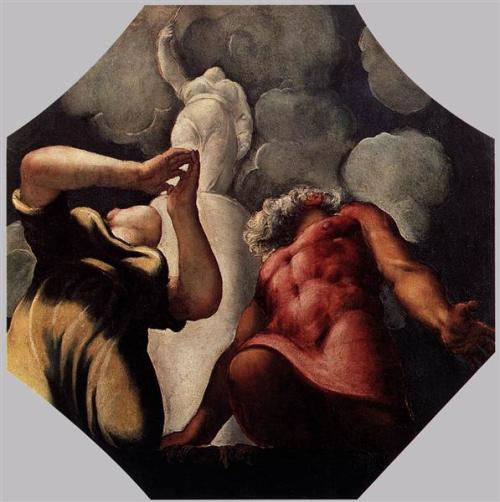
A mountain of stupendous height there stands Betwixt th’ Athenian and Boeotian lands, Boetia was, and still is, a region of Central Greece, its largest city is, and was, Thebes , a major rival in ancient times of Athens The bound of fruitful fields, while fields they were, bound, boundary, the fruitful fields within a certain limited area, between But then a field of waters did appear: Parnassus is its name; whose forky rise Mounts thro’ the clouds, and mates the lofty skies. Parnassus is a mountain in Central Greece, however forky, however forked, craggy, uneven, sacred especially to Apollo , god of too many things to list here, and the site, at Delphi , on its south-western slope, of his Oracle , famous for being consulted on a variety of matters, from personal to affairs of state, its high priestess was believed to incarnate the very Parnassus was also the home, incidentally, of the Muses , goddesses in their own right, of the several arts, who ministered to Apollo High on the summit of this dubious cliff, Deucalion wafting, moor’d his little skiff. counterpart, sole survivor, with his wife Pyrrha , of the flood the cliff is dubious because the mountain is still deep in water, its summit precarious yet He with his wife were only left behind Of perish’d Man; they two were human kind. they two alone were left of humankind, of perish’d Man The mountain nymphs, and Themis they adore, Themis , goddess of Divine Justice And from her oracles relief implore. at Delphi , its first high priestess, hungryfor, and heedful of, her oracles, counsel The most upright of mortal men was he; The most sincere, and holy woman, she. a chance at a new world R ! chard
 Richibi's Weblog