Richibi’s Weblog

Just another WordPress.com weblog

Tag: Prometheus

“Metamorphoses” (The Giants’ War, III) – Ovid
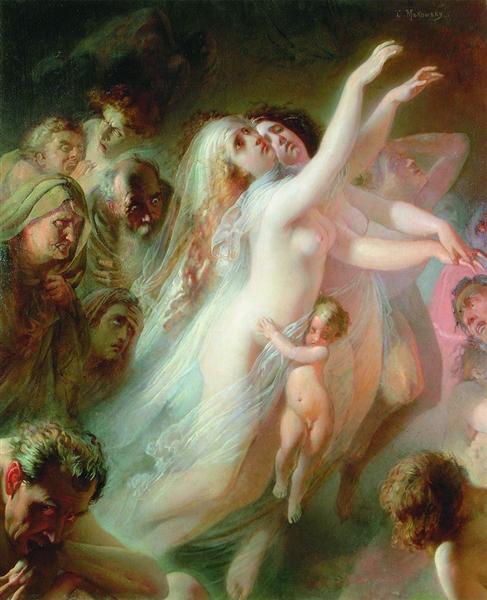
charon-carries-dead-souls-across-the-river-styx.jpg!Large

    “Charon Carries Dead Souls across the River Styx(1861)


           Konstantin Makovsky


                 ____________


Jove, god of Thunder, speaks


            I was not more concern’d in that debate
            Of empire, when our universal state
            Was put to hazard, and the giant race
            Our captive skies were ready to imbrace: 


I was not especially disturbed, Jove says,

when the state of our universe was 

challenged, or debate[d], when the giants 

tried to usurp our territory, were ready to 

imbrace, or embrace, take on, our  

vulnerable, [o]ur captive, skies


            For tho’ the foe was fierce, the seeds of all
            Rebellion, sprung from one original; 


because the enemy, then, the adversary, 

came from the one original source, its 

however manifold predations, its 

however myriad desecrations, would’ve

been identifiable to Jove, not foreign, not

unmanageable, he would’ve recognized

the black sheep of the Olympian family,

the giants  


            Now, wheresoever ambient waters glide,
            All are corrupt, and all must be destroy’d. 


ambient, nearby, related, infected, corrupt,

all has been corrupted


            Let me this holy protestation make,
            By Hell, and Hell’s inviolable lake, 


here’s another anachronism, for Hell wouldn’t’ve 

been even a concept in the era of Ovid, where

the Underworld, and Hades, entirely different

afterworlds, would’ve prevailed, areas of 

persistent gloom and shade, see Homer here,

for instance, or Virgil


the Underworld of the ancient world was 

surrounded by five rivers, Hell’s inviolable 

lake, the most famous of which was the 

river Styx


in the Divine Comedy, Dante updates this 

watery boundary for his own 14th Century

readers, and makes it the passageway to

the fifth circle of Hell, where Charon 

remains, after even over a thousand 

years, the very same ferryman


see above


nor was there either any of our present

conception of Heaven, Heaven would’ve 

been Olympus then, the exclusive domain 

of the Gods, either Greek or Roman 


            I try’d whatever in the godhead lay: 


Jove says, I tried everything a god 

could use


            But gangren’d members must be lopt away,
            Before the nobler parts are tainted to decay. 


you’ve got to lop[ ] away, cut off, the bad 

parts before they infect the more vital 

components of the body

 
            There dwells below, a race of demi-gods,
            Of nymphs in waters, and of fawns in woods:
            Who, tho’ not worthy yet, in Heav’n to live,
            Let ’em, at least, enjoy that Earth we give. 


not all beings are corrupt, but nymphs 

and fawns, innocents, Jove pleads, 

should be given consideration on 

Earth, if they be not yet worthy of the 

majesty of Heav’n, and granted earthly 

areas of enjoyment in the confines of 

their forsaken place 


            Can these be thought securely lodg’d below,
            When I my self, who no superior know,
            I, who have Heav’n and Earth at my command,
            Have been attempted by Lycaon’s hand? 


if Lycaon could attack me, Jove, god 

of Thunder, asks, how can these 

innocents, nymphs, fawns, ever be 

safe


             At this a murmur through the synod went,
             And with one voice they vote his punishment. 


the punishment of Lycaon, which we’ll 

soon encounter


             Thus, when conspiring traytors dar’d to doom
             The fall of Caesar, and in him of Rome,
             The nations trembled with a pious fear;
             All anxious for their earthly Thunderer: 


Thus, or in a similar manner, did the nations

of the earth tremble when Caesar, their 

earthly Thunderer, was assassinated 


nations, incidentally, is another anachronism,

nations didn’t appear on earth until the 

18th Century, with the French Revolution


             Nor was their care, o Caesar, less esteem’d
             By thee, than that of Heav’n for Jove was deem’d: 


Ovid addresses Caesar here, his contemporary,

and compares that emperor’s esteem for nations, 

his reliance on their allegiance, to the esteem 

Heav’n has for Jove


             Who with his hand, and voice, did first restrain
             Their murmurs, then resum’d his speech again. 


Jove calls for silence in the assembly

before speaking again


             The Gods to silence were compos’d, and sate
             With reverence, due to his superior state. 


The Gods … sate, or sat, then took heed,

bowing to Jove’s superior position


the tale of the punishment of Lycaon

will follow  


R ! chard


“Metamorphoses” – Ovid, 105

fullsizeoutput_5aa

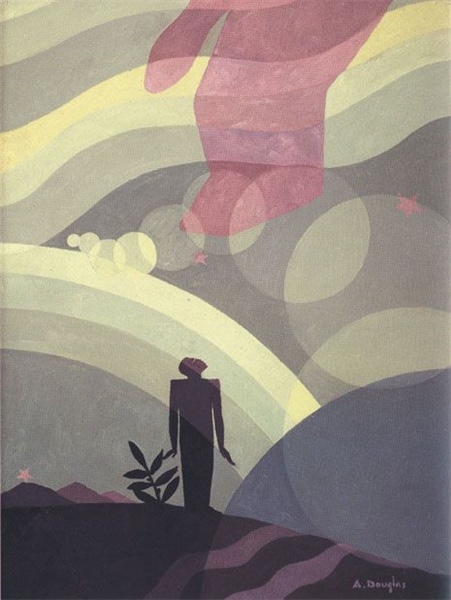
    The Creation(1935) 


           Aaron Douglas


               ________


it should be noted that this exemplary 

translation of Metamorphoses was 

done by a clutch of eminent poets, 

John Dryden principally, England’s 

first Poet Laureate, 1688, but with 

the help of, notably, Joseph Addison,  

Alexander Pope, and William 

Congreve, among a number of 

celebrated others, under the 

direction of the poet and physician,

Samuel Garth, in no later than 1717, 

over 300 hundred years ago


this will explain the sometimes 

disorienting spelling of some 

otherwise common words, you’ve

read alreadyfor instance, extreams” 

for “extremes”“watry” for “watery”, 

“blustring” for “blustering” 


it might also be that my own reading

of the text could be influenced by 

idiosyncratic interpretations given 

by the above poets, who would’ve 

written according to the perspectives 

of their own time, the 18th Century, 

somewhat altering, most likely, the 

pristine intentions of Ovid’s original


as I myself, however philologically 

scrupulously – mea culpa, mea 

culpa, mea maxima culpaI must 

contritely confess – can, can 


be forewarned


but onwards to the completion of 

the Creation


            High o’er the clouds, and empty realms of wind,
           The God a clearer space for Heav’n design’d;
           Where fields of light, and liquid aether flow; 


a description of Heaven, “fields of light and 

liquid aether”


            Purg’d from the pondrous dregs of Earth below. 


“the pondrous dregs of Earth”, our dwelling


             Scarce had the Pow’r distinguish’d these, when streight
            The stars, no longer overlaid with weight,
            Exert their heads, from underneath the mass;
           And upward shoot, and kindle as they pass, 


“the Pow’r”, or “the God, whatever God was he”, 

earlier noted


while gravitation again allows the “fields of light”, 

newly “distinguished”, or separated, from the 

pondrous dregs of Earth“, to “streight…upward 

shoot, and kindle”, or sparkle, like firewood, or 

nebulae, aurorae, very constellations 


             And with diffusive light adorn their heav’nly place.


diffusive, evanescent, aetherial, nearly 

transcendental


             Then, every void of Nature to supply,
           With forms of Gods he fills the vacant sky:
           New herds of beasts he sends, the plains to share:
           New colonies of birds, to people air:
           And to their oozy beds, the finny fish repair. 


note that all life forms are “forms of Gods”,

and “birds”, anthropomorphically, no less

than “people air”

             A creature of a more exalted kind
           Was wanting yet, and then was Man design’d: 


the design follows


             Conscious of thought, of more capacious breast,
           For empire form’d, and fit to rule the rest: 


though the specific initial progenitor will remain 

ever the secret of that Creator


           Whether with particles of heav’nly fire
           The God of Nature did his soul inspire,
           Or Earth, but new divided from the sky


was it “heav’nly fire” or Earth”, which malleable


             And, pliant, still retain’d th’ aetherial energy: 


we are, in other words, quintessentially, 

however muddied, starlight


             Which wise Prometheus temper’d into paste,
           And, mixt with living streams, the godlike image cast. 


Prometheus is the Titan who fashioned 

us of clay, and gifted us with fire despite 

the opposition of the Gods, for which he 

was cruelly punished, but that’s another

story


             Thus, while the mute creation downward bend
            Their sight, and to their earthly mother tend, 


mute creation, species who have no 

language, animals, lizards, insects


             Man looks aloft; and with erected eyes
            Beholds his own hereditary skies. 


hereditary, received from the Creator,

the primordial ancestor, generator


             From such rude principles our form began;
           And earth was metamorphos’d into Man.


R ! chard


“Is Art Truth?”

paradise-jpglarge

  “Paradise” 

        Hieronymus Bosch

                   __________

Is Art Truth?“, a friend asks after speaking of 
its benefits, “Art accepts and tells the truth-Is
that it ?“, she inquires, wonders

art, like truth itself and beauty, is in the eye 
of the beholder, I submit, and therefore my 
definition is, once again, entirely personal, 
though I’ve rigorously plumbed it

it requires background

art died for a thousand years, it was 
essentially unrecorded, dormant from 
the fall of Rome to the Renaissance, nor 
promoted but for Catholic purposes, 
hence the majestic cathedrals and the 
magisterial altarpieces, works produced 
by, however, communities until eventually 
certain artisans were recognized as more 
inspired than others, and given autonomy

enter Duccio, for instance

in time these new, necessarily idiosyncratic
perspectives – see Hieronymus BoschDante
Alighieri – dominated, veering in their search 
for truth in their art and beauty – selling points,
incidentally – towards less strictly orthodox 
utterances

see above

art, and its contemporary science, were 
chipping away at ecclesiastical dogma

till God died, and artists continued their 
prescient march forward, shaping our 
zeitgeist, our spirit of the times, with 
their pronouncements for lack of any 
other guides

but the voices grew personal, see Mozart
often profound and prophetic, see 
Beethoven, till the confluence of disparate 
realities gave us secularism, each soul for 
itself as a tenet, a credo, a belief, a truth

what did they have in common

I believe it was their quest for beauty 
through truth, their quest for truth 
through beauty, with a nod here to 
the salient Keats 

art is prayer, a search for, as well as a 
manifestation of, one’s personal 
identification with the sacred

it is not truth, it is not beauty, it is the 
fervent intention itself, linked with a 
correspondent workmanship, craft, 
which inspires 

see for instance van Gogh for this, who, 
remember, nevertheless shot himself, 
artists are mortal, merely, messengers, 
ever, therefore, fallible, unsure, fearful 
even, often, of their, perhaps 
Promethean, fire

for consolation, or even maybe 
transcendence, see again,
pertinently here, Beethoven  

listen

Richard

psst: thanks, Joan

Beethoven’s piano sonata no 29, “Hammerklavier”, revisited, as promised

upon listening to Beethoven’s 29th sonata
one doesn’t imagine its originality, having
been showered for centuries now with its
miracles and majesties, nothing would’ve
been heard like it before, so great a project,
a work of not only temporal magnitude, an
astonishing fifty minutes, but evidently of
more than just mere entertainment, a work
of philosophical, even, amplitude

Beethoven is not just trying to delight, he’s
trying to engage here, bring together, stir,
more profound human responses, evoke
thought, responsibility, compassion, a
spiritual complicity in the new
post-Revolutionary secular order, he is
establishing new metaphysical ground

the subject is existential, the audience
no longer merely aristocratic, masses
now were talking, an affluent bourgeoisie,
artists were responding to a new Romantic
Age, about rights, and what it means to be
human, both men and women, incidentally
– and I stress that newly pertinent at the time
conjunction – above and beyond those of
God, for each couldn’t both hold the
supreme, the earlier Classical, pinnacle,
the rights of Gods and, by extension,
Kings, Queens if you lived in England,
Russia

secularism was needing new oracles

see Elizabeth Barrett Browning, for
instance, for the emergence of
women

see also, of course, otherwise,
Beethoven

the difference with Beethoven is that
he achieved, ultimately, profound
wisdom, I can think of no other
comparable poet, save, of course,
Marcel Proust, both of whom proved
to be, in the same breath, philosophers,
able to stake that exalted claim, certainly
no painter, a difficult medium through
which to philosophize admittedly, to
bring logical and existential constructions
together to enunciate a transcendental
vision

then again, before Proust and Beethoven,
who’d ‘a’ thunk one could’ve transformed
words or music into very grace, mystically
transubstantiated gold, notwithstanding
the misguided alchemists

Pink Floyd did some of that in the Seventies
but retreated into historic and more personal,
less oracular, reminiscences, philosophizing
isn’t easy, see the punishment of Prometheus,
or, for that matter, John Lennon

Beethoven was completely deaf by the time
he composed the Hammerklavier“, lost in
his own isolation, like Homer, blind to,
though obviously not unaware of, his art

not lost, not unaware either, more like
having been given extrasensory, outright
extraordinary, manifestly, perception

to our utter and everlasting, both of them,
benefit

Richard

Beethoven piano sonata no 28 in A major, opus 101

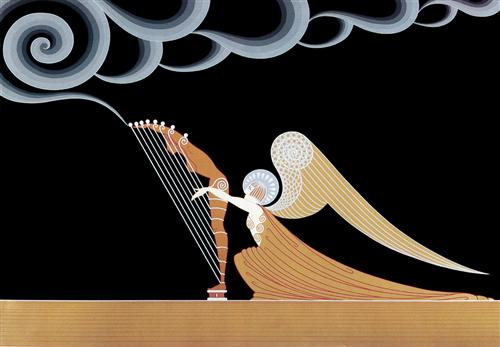
Erte - "The Angel"

The Angel

Erte

___

Beethoven’s piano sonata no 28, opus 101,
in A major
, is the first of what is considered
to be his late piano sonatas, as opposed to
early and middle, three entirely distinct
periods that are easily recognizable upon
closer listening, the early ones are bold,
even headstrong, with Beethoven’s ever
characteristic vigor and Promethean authority,
the length themselves of his early works are
a testament to his sense of his own great
personal validity, the first four, to my mind,
go on much longer than often enough they
should, a typically youthful presumption on
his part, and are musically at best trite, I find,
after their first expositions, the repeats come
as redundant, and tolerable merely, surprises,
even the famous 8th, the Pathétique“, opus 13,
is, I think, too brash and impudent, however in
this manner, nevertheless admittedly, entirely
effective, listen

the Pastorale“, of the middle period, opus 28,
no 15
, is where I deem the music to become
henceforward sublime, it has a settled
confidence that brims with not only technical
wizardry but with also positively enchanting
and entrancing musical ideas, bursting like
very flowers in springtime, with colour and
inspired, effervescent, imagination

the late period is where Beethoven becomes,
however, a sage, a prophet, and indeed a
hierarch in the new secular order of a
reconstituted Heaven, after all, someone
had to take the place of the now discredited
angels, Nietzsche called them Übermenschen,
Supermen

the 28th sonata starts out slowly, or rather,
more slowly than the earlier forthright ones,
already a sign of less physical, more
measured and considered reponses, my
impression here is of a grandfather visiting
his granchildren, jovial but not too disportive,
merely jaunty, always cheery but for a moment
of haunting melancholy, at the adagio, before
becoming congenial and avuncular again,
with then a big, boastful ending, snapping
staunchly his patriarchal suspenders,
getting the last, and traditional, word, with
a firm, which is to say, a foursquare-major-
chord, finish, the aural equivalent of turning
out the lights

musically, however, the progressions are
exploratory, incremental, more and more
layered with possible, and often apparently
rejected outcomes, in order to try out
something more fitting, maybe, more
accurate, a deconstruction, in other words,
of musical ideas, an investigation, in search
of a viable musically cohesive path

in the 28th sonata Beethoven, I think, is
doodling, however, coming up with the
methods of his great addresses, the
language here is not yet philosophically
precise, a smattering merely of pianistically
plausible ideas, musical sketches, the first
stirrings here, you’ll gather, of formal jazz

in the next sonata, the 29th, the still
unsurpassed “Hammerklavier”, he writes
the definitive book, speaking for music in
the forthcoming history of the world, and
determining its future path, we are still
moving along on his transcendent carpet,
no one ‘s come along still to give us a
more assured ride, kind of like Homer,
some would say Shakespeare, others
Albert Einstein, other, incidentally,
post-Christian, post Revolutionary
Supermen

who do you presently pray to, who are
your angels, who your Superwomen,
-men,
towards what do you aspire,
towards whom

Superwomen, -men, incidentally,
cultivate their own efflorescence,
manifest their own, I think, destinies,
or, if you like, their own Heaven

much as I believe angels also do

Mozart’s Fantasy in C minor on the
same program
shows him in a nearly
Beethovenian mode atavistically, much
more somber than he usually is, but he’s
nevertheless easily distinguished by
his much less intricate musical
accompaniment and his much more
rigorous melodic line, you’re more
likely to hum it

Mozart also composes from the nursery,
I find, the exhilaration of playful discovery,
you can see the toy soldiers, the golden
tresses on little milkmaids in dirndls with
red circles for cheeks

Mozart’s pieces are like nursery rhymes

Beethoven progresses to literature

before you judge me too harsh on Mozart,
by the way, consider that my favourite
piece of the two in this program is the
Mozart, it’s like comparing apples and
oranges, though, it depends on your
mood that day which you’ll favour

cheers

Richard

psst: just in case you missed it, this version
of the Pathétique is the best I’ve ever
heard, indeed, of all the pieces here
the most extraordinary, don’t miss it

Nemo – “Ennead I” by Plotinus (16)‏

 The School of Athens - Raphael

                                             The School of Athens

                                                         Raphael   

                                                     ____________


Date: Sat, 23 Mar 2013 22:47:05 +0000
To: Richibi’s Weblog
From: comment-reply@wordpress.com
Subject: [New comment] “Ennead I” by Plotinus
 
Richard,
 

As I said at the very beginning, you are “sensitive”, and I was right, because you rightly perceived that I was becoming impatient. My apologies. Patience is not my forte. 🙂 However, you have not “touched a nerve”, as this is by no means an emotional discussion from my pov. I have no intention to “vehemently reject” your position (after all it is yours not mine), but only to share my perspective, including what I perceive to be irrational arguments.

Here are the two statements you made;
” I, and the “demented” Nietzsche, incidentally, equally fervently mistrust, even deem fundamentally impossible”,
“I do not profess to “know what Nietzsche believes or “fervently mistrust[s]‘”.

Is that not a self-contradiction?

You say that you’re making an interpretation. But, what is knowledge but an interpretation? A translation from the concrete and the objective to the abstract and subjective, just as we translate a work of literature from one language to another? By interpreting Nietzsche to yourself, you gain a rational understanding of him, and by interpreting him to others, you share that understanding.

I think an important distinction should be made between a) the belief in the existence of Absolute Truth” and b) the belief of one’s monopoly of the Absolute Truth. You seem to be passionately rejecting b), which is quite understandable. But Platonism is not b) but a). It does not claim monopoly of the Absolute Truth, but instead, Plato and Socrates both exhort their listeners to pursue Beauty, Goodness and Truth, to pursue virtue, to be the lover of wisdom, which is the literal meaning of “philosophy”,

According to Einstein, this pursuit of the Absolute Truth is also the guiding principle of the scientists. Without this passionate pursuit of the truth, we would never discover that the earth is not flat. Now think about this: Can you still insist that it is uncertain whether or not the earth is flat, that it is impossible to have a rational understanding of the shape of the earth?

You argue that uncertainty makes people less likely to kill. But most people who kill are not driven by belief in the Absolute, but by their lust for pleasure, wealth and power. Some may kill in the name of Truth as a disguise for their ulterior motives, but it would be unfair and irrational to blame the Truth for their acts.

I’ll refrain from discussing the Catholic Church, partly because to me this discussion is about Platonism, and Christianity is not Platonism (though they share many similar aspects), and partly because I’m not associated with the Catholic Church and frankly don’t know enough about it to say anything useful


first of all let me raise a glass to our conversation,
a toast that it might live long
 
and thank you for your continued respectful and
penetrating participation, I will endeavour to as
assiduously hold up
  
 
that said, we get into, as I see it, the question
posed by Wittgenstein, an obstacle of the
most impenetrable sort, the egregious
unreliability of language, what do you mean
when you say something, and how does that
synch with the other guy’s interpretation of it,
or, indeed, girl’s 
 
your meat could be my poison, my Plato,
your Proust   
 
indeed which one of us is right about this,
is Plato a saint or a sinner, a boon or a
blight
 
though Proust, of course, would remain 
unquestionably and irreversibly here,
ever, surely, for both of us, benefactor
of positively Promethean, natch, 
proportions   
 
what has become here then of the
Absolute, gone up in a whiff of, just
as insubstantial, smoke, the exhalations,
note, of a fully material mens sana,
sound mind, which can be nothing
without the enveloping corpore sano,
sound body   
 
should there, in the instance, however, 
be a One, an Absolute, we would not, nor
can anyway ever, from our intrinsically
divergent perspectives, be able to, in
any meaningful way, know It
 
 
more practically and topically, when
my mother had her living room walls 
painted, my blue was her green, or vice
versa, in either case adamantly, trying
both of us to eke out from each other
concessions to a position, undyingly,
each, though ever politely, both, held, 
a model accommodation, which is to say,
without the often attendant bombs 
 
we remained puzzled, however, each,
ever, by insidious, and inescapable,
doubt, who saw the right colour 
  
 
there is a technical solution to my mother’s
wall, I know, but only after great psychological
adjustment, even torment, will the blue think
his or her visual impression another colour  
 
and who is mistaken 
 
or can some people be ever right, 
and ever wrong
 
this, incidentally, is the central problem
of philosophy, not just our own central
topic
 
and its resolution the central problem
of politics
 
 
in this instance when her cataracts were
removed, her blue became green, or vice
versa, I’d have to be in her apartment, I
can’t remember which colour, right now,
it was I saw, another philosophical
conundrum, but surely, you get the
picture, interpretation is highly
subjective, and porous 
 
which is why Science requires absolutely
unanimous approval, if you’ll forgive this
metaphorical only use of that prickly
adverb here, to determine Its still 
fundamentally ever tenuous theories
 
we’ve even only recently deconstructed
even time,
 
or Time
 
now there’s a God for you, Giver of context
 
however, even there, It would appear arbitrary,
there may be another Reality beyond our
particular three-dimensional Plato’s cave
 
but I digress
 
 
my misuse of the word “know” in citing
my apparently contradictory statements,
is at fault, I can never know, I can only
interpret, with custom we have come to
accept our suppositions as fact, and hope
that everyone else will do the same, which
we mostly do, except when we have wars
because of some intractable position,
where someone has set a price on his, her 
incontrovertible, but still fundamentally
arbitrary, opinion, even of ownership,
family structure, interpersonal affairs,
like this one 
 
but we are talking with only air, no
concrete certainty    
 
I believe Nietzsche, in other words, to
have thought my thoughts, or I, rather,  
to have incorporated his, but that is only
my understanding of it, which surely I
propound, though I might quite possibly
be wrong, but, Nemo, I can’t remember
the last time I was, I could check, I keep
a tally
 
 
scientists, I believe, are indeed seeking
always to know, perfecting their idea of
Reality, but Truth can only be the sum
of all things we think It is, nothing else,
nothing more, after all what other entity
that we know knows anything at all
about It, about Truth
 
we can only think there is a Real out
there, and make the best of It, the rest
is, Shakespeare again,  
 
           “…………………………………. such stuff
           As dreams are made on; and our little life
            Is rounded with a sleep.”
 
                                             The Tempest – act 4, scene 1
                                                                            lines 156 -158
 
 
cheers ever
 
Richard 


Paganini’s 24 “Caprices”‏

having heard one Caprice of Paganini it’s not
much of a stretch to want to hear them all, and 
to my delight and utter astonishment they are
available presently on the Internet in a
presentation so extraordinary it seems 
accorded by the very gods, the violinist, an
unchastened Prometheus this one, Alexander
Markov, delivers unadulterated fire, he is, it is, 
astounding, nothing short of outright Olympian
 
you’ve already heard him play the 24th, here are
 
 
the Capricesare for Paganini what the
“Études”, opus 10, opus 25were for Chopin,
each was exploring the intricacies of his own
particular instrument, which results to date
remain the standard, the Everest to be
conquered, of either by any aspirant
 
how do you keep your knees from knocking,
first of all, up there, in those headlights, I
would wonder of the performing artist, the
rest being of course, I’m aware, pure but
metaphysical merely physics, moderately
only incomprehensible  
 
 
Alexander Markov is fully at home in these
pieces, making them electric but for a picayune
quibble, being of Russian extraction he is not
the Paganini I would want him to be, sensuous
and seductive instead of the more Nordic
commanding and fiery, the Mediterranean
Paganini was famously, after all, a Lothario,
a Casanova, with an especially lubricious,  
apparently, fiddle
  
 
Paganini, incidentally, wrote the Caprices 
between 1805 and 1809, smack in the middle
of the Romantic Period, you can hear the altered
audience in the distant concert hall, surely not
the aristocrats who would’ve found this music
presumptuous, impudent, in their privileged
salons, but throngs of the newly franchised –
note the French root in the word “franchised”,
probably stemming from the very French
Revolution – who were looking towards their
bold and liberated future
 
 
the music is strictly rhythmic, which is to say,
still Classical, keys don’t change within the
individual pieces, the harmonies are still
sufficiently tonal not to distract, though the
melodies are not simple to follow, the stage
is being set for more abstract stuff, Beethoven,
for instance, writing at the same time, being
much less eccentric, and again maybe less
Mediterranean in his own always nevertheless
beguiling flights of Romanticism  
 
 
Richard
  
psst: the performance takes place at the
          in, I believe, 1989, for your info 
 
          note, incidentally, the white tie and tails,
          an aristocratic, which is to say, atavistic, 
          even then, notion
 
          we will always, all of us, conspire to 
          seem noble


Beethoven: Sonata no. 21 in C major, op. 53 (Waldstein)‏

the “Waldstein” Sonata, no. 21 in C major, opus 53, is
one of the few compositions that Beethoven named
himself, which is to say that he dedicated it to a
friend and patron, Count Ferdinand Ernst Gabriel
von Waldstein
, if you can call that naming it

the ones with descriptive titles, the Moonlight, the
Pastorale“, The Hunt“, for instance, were mostly so
labeled by his publisher for ease of identification in
the growing market place, a more affluent merchant
class eager to take on the refinements of the nobles,
see such an instance of social mobility, however
lampooned, updated and upended, in again the
engaging and not at all unperceptive The Beverly
Hillbillies

this means that the suggestive names we’ve come
to associate with his sonatas, Moonlight”, Pastorale“,
The Hunt“, were never conceived as such by
Beethoven, his compositions were ever purely musical
inventions, or more accurately inspirations, prophetic
pronouncements of a much more oracular order,
like Prometheus Beethoven was delivering nothing
short of fire

to match music to specific visual, or even emotive,
cues, incidentally, Pictures at an Exhibition“,
The Carnival of the Animals“, for example, came
later, already a nod to Beethoven’s even indirect
propositions

that titles were given to music, rather than the more
clinical and mnemonically difficult numbers, which
is to say, not easy to remember, isn’t very different
from the evolution of popular music in the early
1960′s

the Beatles, you’ll remember, had cuts on albums
that had nothing more than their group name in
the titles, or the title of one of the album’s cuts,
“Sgt Pepper’s Lonely Hearts Club Band” came
along to change all that, we saw the birth of the
concept album, where the whole extended affair
becomes a musical metaphysics, this is no
different from the move from the music of Mozart
to that of the more expansive Beethoven, music
is no longer a ditty but an extended technical
and philosophical text, listen to Pink Floyd take
on this mantle superbly in the Seventies, the only
other body since ever to effectively challenge
Beethoven in that especially rarefied field, with
the probable exception of the sublimely expressive
Schubert perhaps, who died much too young for us
to tell, for him to have decisively dialectically proven
himself beside these erudite peers, all having,
however, found ways to have us touch beyond the
sky, the very infinite, and into the no less infinite
confines of our more private and secret selves

what they state is that creation itself, absent any
other meaning, remains potent, perhaps even
ultimately redemptive

creation as a bold and noble response to eternity,
art as affirmation

you’ll note here that the structure of this sonata
is entirely Classical, unity of tone, unity of pace,
and the eventual return of the initial melody,
essential Classical components, what has
changed is the personal bravura of the composer,
Beethoven is not playing for the aristocratic court,
but for a wider, an infinite, audience, he is
pronouncing his and, by extension, our own place
and validity in the universe, by our ability as humans
to create, to respond creatively, and even sublimely,
out of only our otherwise flailing and indeterminate
existence

it is the Romantic response to the waning belief
in God, and incidentally a profound spur to,
argument for, our present notion of inalienable
individual rights

the personal soul has taken over from the earlier
unchallenged deity, the wavering concept of God
has had a seismic fall, and all the king’s horses
and all the king’s men will never be able to put it
together undiminished again

Beethoven is showing us that future

Richard

psst: Helena Bonham Carter plays excerpts from the
Waldstein“, incidentally, in A Room with A View“,
a movie entirely worth a revisit

a Chopin Fantasia‏, opus 61

 
to be specific, opus 61, you’ll more easily notice 
already the more abstract peregrinations of his
disciple, Debussyand even the first stirrings of
improvisation incidentally, which is to say the
free-wheeling of idiosyncratic jazz, the very 
inversion of Classical order, personal expression
was trumping even ecclesiastical dictates, those 
very earlier immutable fundamentals of the long
unimpeachable Ten Commandments  
 
Oh Moses, Moses you stubborn, splendid, adorable 
fool, as Anne Baxter, Nefertiri, pagan, therefore 
insidious seductress, would admonish in the film
pronouncementsa film which of course fashioned 
the Biblical iconography of my entire generation,
a veritable Divine Comedy” for our still recent
enough times, nothing has come up to displace it
meanwhile, though a progressively alternative
cultural morality seems steadily to harken
 
was Moses then a fool, a Prometheus in Christian
clothing 
 
time alone tells, and time is an inveterately
temperamental arbiter
 
 
it would appear now that faith equals
unconditional conformity, when I thought
that faith could not, by definition, be
constrained, faith had been meticulously
a considered personal conviction, an
individual emancipation rather than a
conformist, and nefarious ultimately, it
would appear, code 
 
I count on thoughtful efflorescence then,
and a garden of societal consideration, 
a pantheistic and cooperative accord
 
not excluding, let it be noted, the indeed
worthiest, by thoughtful process, of those
very Ten Commandments 
 
without my own children, for instance, I
still recommend honouring one’s parents,
this will bring, I knowlegeably warrant, 
untold benefits, indeed grace, peace and
profound satisfaction, plenary solace to
the very reaches of each our indeterminate
soul
 
take it right here from an appropriately  
distinctive Chopin, unparalleled poet to
the panoply of possible gods   
 
 
Richard