Richibi’s Weblog

Just another WordPress.com weblog

Tag: Phoebus / Apollo – god of the Sun

“The Birth of Bacchus” (ll)– Ovid

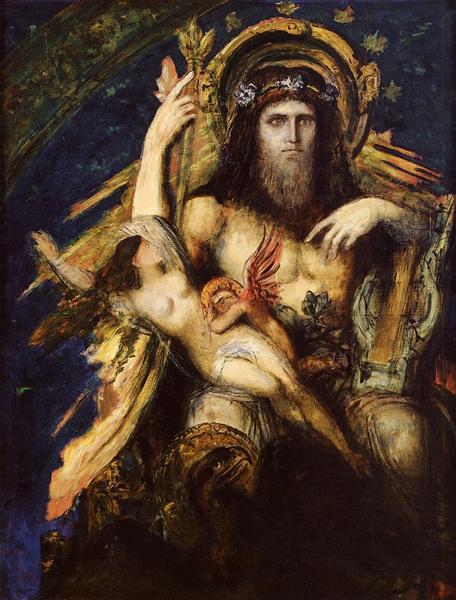
Jupiter and Semele, 1889 - 1895 - Gustave Moreau

         Jupiter and Semele” (1889 – 1895)


                 Gustave Moreau


                       _________


            Old Beroe’s decrepit shape she wears,

            Her wrinkled visage, and her hoary hairs;


Old Beroe, faithful servant of Semele


she, Juno / Hera, goddess


hoary hairs, love it


            Whilst in her trembling gait she totters on,

            And learns to tattle in the nurse’s tone.


Juno / Hera transforms herself into

Old Beroe, tattl[ing], talking idly, in

the nurse’s tone, impersonating her

in order to seek revenge, if you’ll

remember, on Semele, for bearing

her husband’s progeny


            The Goddess, thus disguis’d in age, beguil’d

            With pleasing stories her false foster-child.


foster-child, child who is fostered,

nurtured, by someone other than a

parent, Semele, by Old Beroe,

purportedly, in this instance


false, Juno / Hera is not Old Beroe,

but the nurse’s duplicitous, false,

in both senses of the word here,

double


beguil’d, enchanted, amused


            Much did she talk of love, and when she came

            To mention to the nymph her lover’s name,

            Fetching a sigh, and holding down her head,

            “‘Tis well,” says she, “if all be true that’s said.


Juliet’s nurse from Romeo and Juliet,

I thought, meets Sleeping Beauty’s

wicked stepmother, for a more

contemporary coupling


            But trust me, child, I’m much inclin’d to fear

            Some counterfeit in this your Jupiter:


Some counterfeit, yourJupiter is not

your [actual] Jupiter, Juno / Hera

suggests


            Many an honest well-designing maid

            Has been by these pretended Gods betray’d,


well-designing, without guile, with

no ulterior motive


pretended Gods, men who unjustifiably

beat their chest, tell tall tales, unequal

to their proclaimed accomplishments


            But if he be indeed the thund’ring Jove,

            Bid him, when next he courts the rites of love,

            Descend triumphant from th’ etherial sky,

            In all the pomp of his divinity,

            Encompass’d round by those celestial charms,

            With which he fills th’ immortal Juno’s arms.”


Juno / Hera, as Old Beroe, tells Semele

to ask her lover, when next he courts

the rites of love, to prove he is indeed

Jove / Jupiter / Zeus, to dress

appropriately


Encompass’d round, accoutred,

enveloped, in


the pomp, incidentally, the splendour

of his divinity, take on a couple of

extra poetic lines, verses, indicative

of that very splendour


note also that Semele seems to have

no qualms about Jove / Jupiter / Zeus‘s

marital status, about bearing the child

of another woman’s man, indeed that

of a very, in this instance, goddess,

the redoubtable Juno / Hera


            Th’ unwary nymph, ensnar’d with what she said, 


ensnar’d, ensnarled, caught up in


            Desir’d of Jove, when next he sought her bed,

            To grant a certain gift which she would chuse;


Desir’d of, asked of, requested of


chuse, choose


            “Fear not,” reply’d the God, “that I’ll refuse

            Whate’er you ask: may Styx confirm my voice,

            Chuse what you will, and you shall have your choice.”


Styx, goddess of the river Styx, which

forms the boundary between Earth and

the Underworld, had sided with Jove /

Jupiter / Zeus during the War of the

Titans and been granted by him that

oaths should henceforth all be sworn

upon her, and be punctiliously observed


Phoebus / Apollo had similarly granted

his own son Phaeton his wish upon very

Styx, if you’ll remember, with the direst,

for both, of consequences


            “Then,” says the nymph, “when next you seek my arms,

            May you descend in those celestial charms,

            And fill with transport Heav’n’s immortal dame.”


show me, Semele asks of her suitor,

what she gets, what Juno / Hera gets,

when next you seek my arms


go, girl, I thought, if you’re going

to be irreverent


            The God surpriz’d would fain have stopp’d her voice,

            But he had sworn, and she had made her choice.


on very Styx, he’d sworn, ever so

perilously


stay tuned


R ! chard

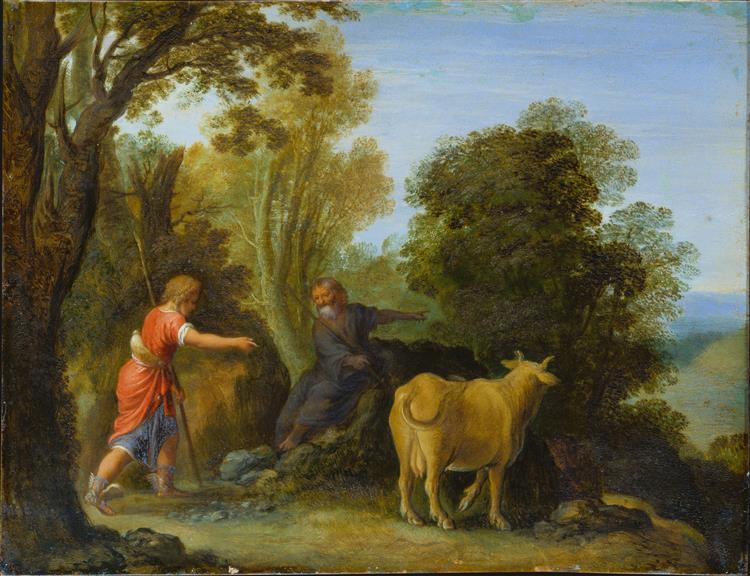
“The Transformation of Battus to a Touch Stone” – Ovid

adam-elsheimer-merkur-und-battus-1.jpg!Large

      Mercury and Battus(1610)


             Adam Elsheimer


                     _________


            Sore wept the centaur, and to Phoebus pray’d;


Phoebus, the Latin name for Apollo,

the Greek name for the same god of 

the Sun among several other things


Phoebus / Apollo was the centaur

Chiron‘s father


            But how could Phoebus give the centaur aid?
            Degraded of his pow’r by angry Jove,
            In Elis then a herd of beeves he drove;


Jove / Jupiter / Zeus, god of gods

had [d]egraded Phoebus of his

pow’r by overruling him in having

him return, however unwillingly,

to his position as Charioteer of

the Sun after having just killed

his son, Phaeton


Elis, a region still of Greece


beeves, plural of beef, however

presently obsolete, but compare

leaf, leaves, or loaf, loaves, wife,

wives, shelf, shelves for similar

etymologies


            And wielded in his hand a staff of oak,
            And o’er his shoulders threw the shepherd’s cloak;
            On sev’n compacted reeds he us’d to play,
            And on his rural pipe to waste the day.


Phoebus / Apollo was god, as well,

of Music


            As once attentive to his pipe he play’d,
            The crafty Hermes from the God convey’d
            A drove, that sep’rate from their fellows stray’d.


the grammar is here incorrect, he

in the first verse should agree with

the subject of the principal clause,

[t]he crafty Hermes, of the second,

but it refers, rather, to Phoebus /

Apollo, who’d been attentive to the

same rural pipe he’d been playing,

wast[ing] the day, in the earlier

line


Hermes, the messenger god, was

leading, convey[ing], away from

its fellows, indeed stealing, some

of the God Phoebus / Apollo‘s

beeves, his cattle


drove, a large group, singular of

droves


            The theft an old insidious peasant view’d
            (They call’d him Battus in the neighbourhood),
            Hir’d by a vealthy Pylian prince to feed
            His fav’rite mares, and watch the gen’rous breed.


Pylian, of Pylos, a town still in

Greece


vealthy, wealthy, surely a typo,

however unusual in so respected

an edition


Battus, an old insidious peasant,

had seen, view’d, Hermes, god

as well of Thieves, incidentally,

steal Phoebus / Apollo‘s beeves


            The thievish God suspected him, and took
            The hind aside, and thus in whispers spoke:


suspected, Hermes, [t]he thievish

God, supposed that Battus had

seen him stealing the cattle


            “Discover not the theft, whoe’er thou be,
            And take that milk-white heifer for thy fee.”


Discover not, don’t tell


the milk-white heifer, [t]he hind


            “Go, stranger,” cries the clown, “securely on,
            That stone shall sooner tell,” and show’d a stone.


the clown, Battus, assures Hermes

that [t]hat stone, an inanimate, and

therefore mute, thing, is more likely

to tell about the theft than he, Battus,

would be


            The God withdrew, but strait return’d again,
            In speech and habit like a country swain;


The God this time is Hermes, who

has returned disguised as a country

swain, a bumpkin


            And cries out, “Neighbour, hast thou seen a stray
            Of bullocks and of heifers pass this way?
            In the recov’ry of my cattle join,
            A bullock and a heifer shall be thine.”


help me find my cattle, Hermes asks

of Battusand I’ll reward you with 

[a] bullock and a heifer


            The peasant quick replies, “You’ll find ’em there
            In yon dark vale”; and in the vale they were.


Battus has gone back on his word to

the first stranger who’d accosted him,

and reveals the whereabouts of the

stolen herd to the second


            The double bribe had his false heart beguil’d:


double bribe, the first, the milk-white

heifer, the second, a bullock and

[another] heifer


            The God, successful in the tryal, smil’d;


tryal, trial, it’s interesting to see

here the root of the word trial


            “And dost thou thus betray my self to me?
            Me to my self dost thou betray?” says he:


Battus has in either instance

unwittingly betrayed both Hermes,

the original stranger, then Hermes

again, the country swain


            Then to a Touch stone turns the faithless spy;
            And in his name records his infamy.


Touch stone, or touchstone, a stone

used for testing the purity of precious

metals, a criterion, a basis


in his name, Battusrecords his infamy,

though unclear, this verse suggests to

me that the name Battus will always be

associated with being a faithless spy,

a betrayer


R ! chard


psst: Mercury, or Mercurius, is the

          Latin equivalent of Hermes,

          see above