Richibi’s Weblog

Just another WordPress.com weblog

Tag: “Othello” – Shakespeare

from act 4, scene 3 – Othello

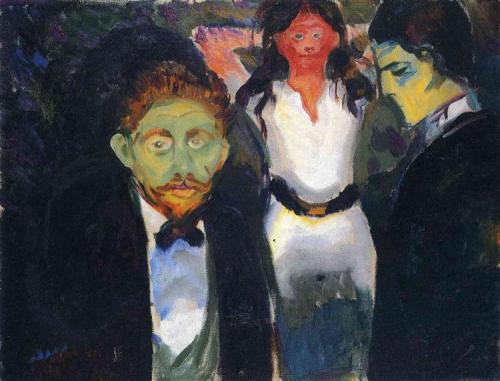
jealousy-from-the-series-the-green-room-1907.jpg!Large


when Desdemona learns that Othello

suspects her of adultery, she asks 

her maidservant


      Dost thou in conscience think,–tell me, Emilia,–
      That there be women do abuse their husbands
      In such gross kind?


Emilia, older, wiser, replies


      There be some such, no question.


       But I do think it is their husbands’ faults
       If wives do fall: say that they slack their duties,
       And pour our treasures into foreign laps,
       Or else break out in peevish jealousies,
       Throwing restraint upon us; or say they strike us,
       Or scant our former having in despite;
       Why, we have galls, and though we have some grace,
       Yet have we some revenge. Let husbands know
       Their wives have sense like them: they see and smell
       And have their palates both for sweet and sour,
       As husbands have. What is it that they do
       When they change us for others? Is it sport?
       I think it is: and doth affection breed it?
       I think it doth: is’t frailty that thus errs?
       It is so too: and have not we affections,
       Desires for sport, and frailty, as men have?
       Then let them use us well: else let them know,
       The ills we do, their ills instruct us so.


fall” in the second verse, for this is 

indeed a poem, in iambic pentameter, 

could easily be replaced by “fail

nearly even calls out for it, 

homophones but for the timbre of 

their vowels 


say that their husbands slack, she says,

then lists the several manners in which 

husbands might betray their marital 

duties, by “foreign, she means “other“, 

foreign to the family circle  


laps“, incidentally, is a wonderful 

metaphor to accompany “treasures,

suggesting intimate physical contact,

much more so, say, than hands

would’ve, for instance, been


restraint” means conditions, stress,

impositions  


scant our former having“, to diminish

that which formerly had been given,

of either material or psychological 

goods – “having” is a noun here, not

a participle


in despite, which is to say, “out of 

spite


galls“, a synecdoche for internal

organs, a synecdoche, the word

that means a part which signifies

the whole  


affection” is “lust


we’re equal partners, Shakespeare 

says, men and women, in a shared 

humanity, indeed Shakespeare is

one of the first Humanists after  

centuries of religious subjugation,

centuries of the suppression of

independent thought, a defining

notion, not incidentally, of the

Renaissance


R ! chard


up my idiosyncrasies – Albertine‏

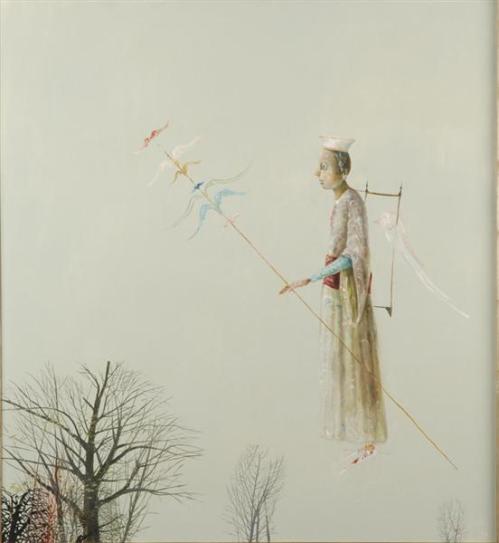
wing-seller-2006.jpg!Large

            Wing Seller (2006)

               Stefan Caltia


                        _______ 

 
what are you doing, a friend of mine
asked when he called 
 
I’m reading my Proust, I answered,
comfy enough with my textafter 
years waking up side by side, to 
use the possessive adjective 
 
what’s going on, he inquired
 
Albertine is lying on his bed, 
recounted, asleep, she’s been there 
for the past ten pages, and she’s 
just now turned onto her stomach
 
 
there is not so much story as 
paintings, in Proustdetailed 
descriptions applied like strokes of 
colour to a canvas, that of recovered 
time, colours that are specific to a 
place and a period, like photographs 
showing in their very fabric their 
ancestry, their lineage
 
but in the elucidation of what he 
sees, or, more accurately, of what
he remembers, Proust delivers 
a work of the very highest art, a 
mixture of poetry and philosophy,
Beethoven did as much, see his
 
 
Proust’s French is essentially 
immaculate, his tone, however 
intimate, always erudite, aristocratic, 
perspicacious, wise, penetrating,
embracing, which is to say, French,
though German can be also
incidentally, pretty cerebral, English 
is narrative, just the facts, please, 
though often, I think, hilarious
 
 
Albertine had been one of the “young
girls in bloom” he’d met at Balbec, a 
seaside resort, with whom he’d 
undertaken an illicit affair, but 
whose faithfulness he doubted
 
as she lay on his bed at his Paris
apartmenthe replays all the 
speculations his imagination could 
provide, an endless set of variations
on his anguish, which is to say, his
jealousy, worthy of a very Othello
 
for ten pages he paints a picture of 
infidelities completely of his making,
which, of course, becomes the world 
he will respond to
 
it is all in our little heads, I surmise, 
however informed, intelligent, that 
we create our little realities, they 
have never been nearly enough, 
though, indeed, our lives depend 
on themhowever dutifully
considered, however unconsciously,
and ever convincingly, contrived   
 
make them, I submit, good ones
  
I imagine myself a poet, for instance,
how’s that for a shot in the improbable 
dark
 
 
Richard