Richibi’s Weblog

Just another WordPress.com weblog

Tag: Mozart

Quartet 1 in B major (“La chasse”), op. 1 no. 1 – Haydn

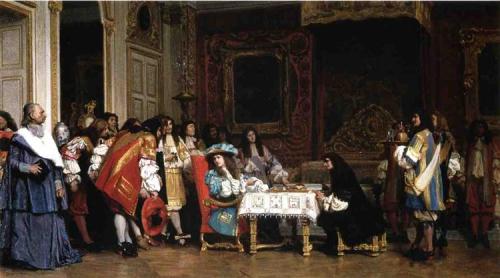
louis-xiv-and-moliere.jpg!Large

        “Louis XIV and Molière (1862) 

              Jean-Léon Gérôme

                     ________

the string quartet didn’t come out of nowhere,
as nothing does – I think – but probably, I 
suspect, from the earlier period’s suites, the
Baroque’s, Bach’sfor instance

suites are a series of dance pieces, stylized 
for the purpose of the musical poet, a popular 
appropriation, an even natural one for 
composers

the aristocracy, by the middle of the 18th
Century, demanded erudite entertainment,
something that Louis XlV, the Sun King,  
had instilled, a little earlier, during his 
Radiant Reign – see Racine, Corneille
Molière, see above, as well, incidentally –
1643 to 1715, up at Versaillesas 
prerequisite for excellence in being a
monarch, a sovereign, sponsorship of 
culture, painting, poetry, music

dukes and counts and barons and 
princesses got onto the bandwagon 
and the arts consequently flourished

witness Haydn and Mozart then, still, 
now, giants 

here’s Haydn’s first, his Quartet no 1
in B major, (“La chasse”), op. 1 no. 1,
the first significant string quartet in 
our Western culture

you’ll note five movements, following 
the suite model described above, with 
mirrored minuets sandwiched between 
opposing mirrored prestos, and an 
adagio in the very middle, as though  
their crowning moment 

an adagio, to my mind, always gives 
away a composer’s worth, listen to 
this one, it’s melting

and he’s got 67 more to go through, I    
marvel, a veritable, and utter,
however improbable, musical
cornucopia 


R ! chard

on string quartets – Opus 76, no 1 – Joseph Haydn

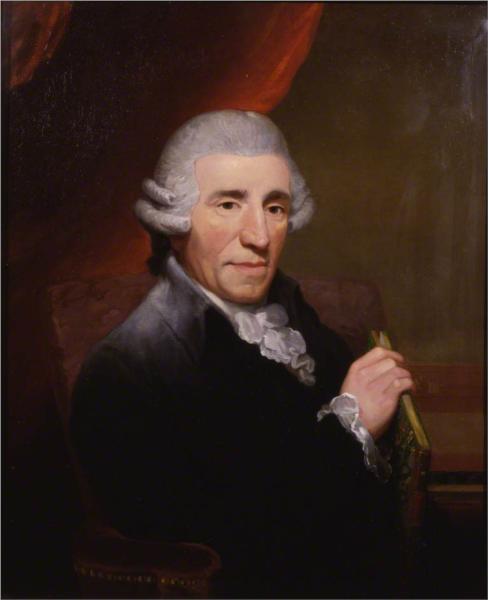
joseph-haydn-1791.jpg!Large.jpg

                                   “Joseph Haydn (1791) 

                                          Thomas Hardy

                                                 ______

to not consider other musical forms of
Shostakovich would be unfair, his
symphonies are mostly propaganda,
however often, though somewhat 
culturally specific, riveting

my favourite works of his, works I 
consider iconic, are mostly chamber 
pieces, piano solos, string quartets

a string quartet, after a symphony, is
like sitting down to dinner with four,
at the very least, acquaintances, 
rather than being a guest at a party,  
the conversation is more intimate,
every person plays hir part, everyone
is heeded, if even only with courtesy,
a social, a Classical, an aristocratic,
prerequisite 

movements can be compared to 
courses, distinct and identifiable for
their particular culinary, musical, 
propriety

later variations on this reflect the 
variations in social mores, where 
restaurants, the modern way of
socializing, allow for disparate 
choices, often superimposed, 
throughout the meal for any,
every, occasion

dim sum, tapas, celebrate this, not
unhappily 


but string quartets can be tricky, I 
thought I’d start from the beginning,
with some Haydn, their recognized 
Father, you’ll understand when you
hear this, his Opus 76, no 1, an 
outstanding string quartet to live 
up to

Haydn set the standard for string 
quartets when the norms of Western 
music were being established, Bach
had given us the alphabet, the
well-tempered clavier, Mozart, the 
grammar, the structure of music,
tempo, tonality, repetition, Beethoven 
gave us the literature, the poetry, the 
philosophical, the transcendent

Haydn is somewhere between these 
last two, but decidedly, still, the king  
of the string quartet, though Beethoven  
does a good job of trying to best him,  
and so does Shostakovich, you’ll have 
to pick

but first, let’s start with Haydn, that’ll
be already, you’ll see, or hear, enough

later, I’ll get into it


R ! chard

an homage to the victims of the Titanic

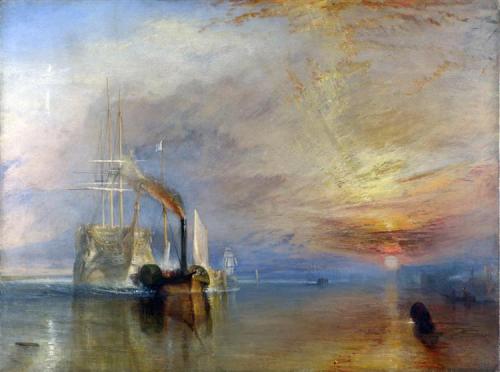
the-fighting-temeraire-tugged-to-her-last-berth-to-be-broken-up-1839.jpg!Large

  The Fighting Temeraire tugged to her last berth to be broken up (1839) 

          William Turner

                _______

while I’m on the subject of threnodies
which is to say “song[s] of lamentation
for the dead”, as I earlier statedlet me 
bring your attention to this extraordinary 
piece, an homage to the victims of the
Titanic
 
it doesn’t even have a title, much as 
Mozart and Haydn didn’t before music 
went mainstream, into public forums 
rather than merely aristocratic salons, 
and when an identifying moniker 
instead of a number became manifestly 
more practical, especially when the 
emerging Middle Classes were 
becoming the ones who were paying 
the composer’s bills, at the opera 
houses and the other sprouting 
concert venues, when some composers 
had even up to 32 sets of piano sonatas 
to remember, three and four often to 
a single set, opus number, as many as 
there are movements in a very sonata

and that’s not counting the numbered 

symphonies and string quartets of 
theirs, left to similarly calculate, 
decipher, extricate

it doesn’t have a title, I think, because
to my knowledge, it is the first of its
kind, a composition created by 
computer, for computer, an entirely 
self-contained digital work of, 
manifestly, art – I’d been waiting, 
diligently, for one – and like Beethoven, 
after the work was done, the artist(s)
just felt the title best left to the 
wordsmiths, thus – you’re welcome –  
Threnody for the Victims of the 
Titanic

sure, computers have done practical
things before, admirably, but never 
told a story, and certainly never one 
as profound as this one

these are the last moments of the 
Titanic, digitally reproduced, in real 
time, 2 hours and 40 minutes, they
are mesmerizing, you don’t want 
to miss a thing

there are no voices, apart from a 
few radio transmissions at the 
start, spotting the iceberg, calling 
out commands to beware, stop 
the engines

afterwards only silence, and the 
sound of the waves, the churning
of the engines, which have been 
restarted, sounding as rhythmic, 
incidentally, and numbing, as the 
wheels on the railroad tracks of
Steve Reich‘s Different Trains“,
another powerful threnody 

later the flash and crack of flares,
the crunch of the ship sinking  

the pervasive, however disrupted, 
silence and the inexorable passage 
of ever ticking time combine to be, 
thereafter, transfixing, meditative, 
ultimately transcendent, a fitting 
setting for a threnody 

I know of only another work to take
you to that venerable place,
Beethoven’s opus 111

and often enough Pink Floyd, for 
that matter, and the visionary 
Alan Parsons Project, of course, 
discoursing on inexorable Time 

and, now that I think of it, Elgar‘s
The Dream of Gerontius, whose 
character goes from his deathbed 
in the first act, to his afterlife in 
the second, effecting transcendence
for us by, yes, ingenious 
metaphorical proxy

but I digress

what I call Threnody for the Victims 
of the Titanic is a narrative with 
sound, not a movie, not a television
program, it has more commonality 
with a musical production than 
anything else but painting in art 
history, though its means are 
intuitively literary, ship stories go
back to The Odyssey through
Gulliver’s TravelsTreasure 
Island and to one of my very 
favourites, Ship of Fools“,
relatively recently

I could add Mutiny on the Bounty“,
Moby Dick“, “The Caine Mutiny 

in art, a precedent would’ve been set
in our collective consciousness by 
William Turner‘s celebratedThe 
Fighting Temeraire …, but I would 
mention as well Caspar David 
Friedrich‘s The Wanderer above 
the Sea of Fog for its existential
pertinence

a few literary points I’d like to stress
to back up my overt adulation, I find  
it impressive that the Classical rules
of tragedy have been maintained, 
unity of action, time, and place, 
prescriptions going back to 
Aristotle‘s Poetics in our cultural 
history, to profoundly express 
tragedy, iconic, epic, misfortune

not to mention the Classical musical
imperatives of tempo, tonality and 
repetition, none of which can be 
faulted here in this consummate 
composition

there is a no greater leveller of tempo 
than time, larghissimo here*, in the 
largest sense of that word, the 
cosmic, the inexorable pace of 
temporality in our brief heavens

a greater leveller of tonality neither  
is there than the rigorously impartial 
hum of the imperturbable Cosmos 

nor is there greater repetition than 
uniformity, however disrupted by  
however fervent ever human 
intervention, see Sisyphus, or 
Martha in “Who’s Afraid of Virginia
Woolf for iconic disrupters

R ! chard

*   Shostakovich had asked the 
     Beethoven Quartet to play the first 
     movement of his 15th String Quartet,
     “Elegy: Adagio“, so that flies 
     drop dead in mid-air, and the 
     audience start leaving the hall from 
     sheer boredom  

     well this inspired elucidation is even  
     slower than that
“Is Art Truth?”

paradise-jpglarge

  “Paradise” 

        Hieronymus Bosch

                   __________

Is Art Truth?“, a friend asks after speaking of 
its benefits, “Art accepts and tells the truth-Is
that it ?“, she inquires, wonders

art, like truth itself and beauty, is in the eye 
of the beholder, I submit, and therefore my 
definition is, once again, entirely personal, 
though I’ve rigorously plumbed it

it requires background

art died for a thousand years, it was 
essentially unrecorded, dormant from 
the fall of Rome to the Renaissance, nor 
promoted but for Catholic purposes, 
hence the majestic cathedrals and the 
magisterial altarpieces, works produced 
by, however, communities until eventually 
certain artisans were recognized as more 
inspired than others, and given autonomy

enter Duccio, for instance

in time these new, necessarily idiosyncratic
perspectives – see Hieronymus BoschDante
Alighieri – dominated, veering in their search 
for truth in their art and beauty – selling points,
incidentally – towards less strictly orthodox 
utterances

see above

art, and its contemporary science, were 
chipping away at ecclesiastical dogma

till God died, and artists continued their 
prescient march forward, shaping our 
zeitgeist, our spirit of the times, with 
their pronouncements for lack of any 
other guides

but the voices grew personal, see Mozart
often profound and prophetic, see 
Beethoven, till the confluence of disparate 
realities gave us secularism, each soul for 
itself as a tenet, a credo, a belief, a truth

what did they have in common

I believe it was their quest for beauty 
through truth, their quest for truth 
through beauty, with a nod here to 
the salient Keats 

art is prayer, a search for, as well as a 
manifestation of, one’s personal 
identification with the sacred

it is not truth, it is not beauty, it is the 
fervent intention itself, linked with a 
correspondent workmanship, craft, 
which inspires 

see for instance van Gogh for this, who, 
remember, nevertheless shot himself, 
artists are mortal, merely, messengers, 
ever, therefore, fallible, unsure, fearful 
even, often, of their, perhaps 
Promethean, fire

for consolation, or even maybe 
transcendence, see again,
pertinently here, Beethoven  

listen

Richard

psst: thanks, Joan

at the XVth International Tchaikovsky Competition – Shino Hidaka

  "The Musical Contest" -  Jean-Honoré Fragonard

The Musical Contest (1754-5)

Jean-Honoré Fragonard

______

with only four contestants to go,
I already crown Shino Hidaka the
winner of the XVth Tchaikovsky
Competition
, this kind of affinity
only comes around once in a
lifetime, her Bach was not only
perfect but inspired, probing,
her ensuing Chopin,
mesmerizing, the Beethoven
that followed aptly, though ever
unexpectedly, transcendental,
transcendence not ever
happening without absolute
mystical concentration, her
Tchaikovsky, an evocation
rather than a mere description
of a Russian village, her
Rachmaninov, on utter fire

Dmitry Shishkin, before her,
neither was un-brilliant, a
consummate technician,
however, rather than an outright
revelation, his spirited Bach was
a turning point for me, finally
someone who got it, his Mozart,
as frivolous and delightful as
Mozart would’ve wanted it to be,
the rest appropriately everywhere
dazzling, second, therefore, ever
so illustrious, nevertheless,
prize, bravo

neither, incidentally, milked any
of their notes, just played what
was written

Richard

psst: compare Fragonard, above, to
Mozart, a synaesthetic match,
where sight and sound are
interwoven, giving you social
intimations of the mid-18th
Century

at the XVth International Tchaikovsky Competition – Bach‏

"J.S. Bach, Wohltemp. Klav. Bd. I, No. IV. (Extrait) / (Duo de Tristesse)" -  Robert Strûbin

“J.S. Bach, Wohltemp. Klav. Bd. I, No. IV. (Extrait) / (Duo de Tristesse)” (1957)

Robert Strûbin

________

if I’ve been getting on their backs
about their Bachs at the Tchaikovsky
Competition
, it’s that they’re playing
Bach as though he were mediocre
Beethoven, it’s like asking Duke
Ellington to be Pink Floyd, it’s just
a completely different generation,
era

Bach wrote for the harpsichord, a
precursor to the piano, it could not
control the volume, nor the length
of a note, the pianoforte came
along to resolve both issues

therefore before Beethoven, who
made full use of the new invention
and worked hard the pianissimos
and the fortissimos, to degrees that
often became either inappropriate
or too authoritative, indelicate or
obnoxious if you’re not in the mood
– I remember wanting to play his so
solemn 111 at my father’s funeral,
but realized late that the first
movement was not especially in
that situation warranted, nor even
parts of the transcendental, but not
always not obstreperous, adagio –
and thumbed thus his nose at the
aristocracy, who earlier, before
the citoyens had demanded their
rights and when the world had
been considered to be of a
rational, logical order, a clock,
and as regular, would never have
tolerated such impudence

Bach and Mozart do not sway
much from strict rhythm, neither
do they alter volume much at all

so that the constant display of
heartfelt Bach and passionate
Mozart becomes cloying, and
not at all what these Classical
and Baroque masters would
have approved of

nor Beethoven, nor Chopin, for
that matter, whose strict tempo
markings didn’t include much
rubato, ritardandos, which you
could think of as milking a note,
putting velvet on your canvas,
it doesn’t work, the composition
itself unaided by bathos, pathos,
delivers, check out, of course,
Glenn Gould

Andrei Korobeinikov sat me right
down the other night with his
arresting BWV868, thrilling,
followed by more dazzling
pyrotechnics, though he fizzled,
and fractured his Beethoven, the
very 111 I care so much for, I
couldn’t even finish, you don’t
need a velvet canvas behind the
111, neither cloying ritardandos,
just skill, nor tangles of notes,
for that matter

Richard

at the XVth International Tchaikovsky Competition – the program‏‏

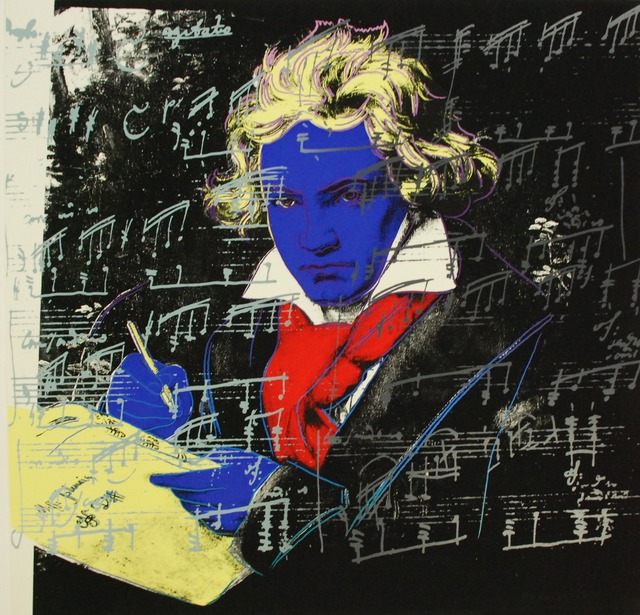
"Beethoven, 1987" -  Andy Warhol

Beethoven, 1987 (1987)

Andy Warhol

______

you’ll probably have noted, if you’ve
been following the Tchaikovsky
Competition
, that, unlike the
Rubinstein, the selection of works
is much more constrained, though
the mighties nevertheless
predominate

after the third day and into the
fourth, only one contestant has
started with anything other than
Bach, a Tchaikovsky

but unfortunately none of them but
one had given us a Bach worthy of
his name, then followed through
with, not surprisingly, a quite
competent Mozart, the cultural
conditions being not yet all that
different, aristocrats were looking
for their own music instead of the
church’s, secular instead of
ecclesiastical, therefore a tune
rather than an oratorio, Beethoven
and the Revolution would change
all that

afterwards a sonata of Mozart,
Haydn or Beethoven, the Classical
triumvirate, after which Tchaikovsky,
appropriately at this competition,
then études, either “-tableaux”,
“transcendentales”, or plain and
simple, by Rachmaninov, Liszt, or
Chopin, that’s it, you get to hear
the “Appassionata” or the “Grandes
études de Paganini”
several times
that way, sharpening discernibly
your musical ear

one was riveting, Andrey Dubov‘s

another, Lukas Geniušas transfixed
me with his opus 2, no 3, of
Beethoven, a work I usually only
ever tolerate, sending it soaring
into the bard’s later mature, and
revelatory, period

others have been competent, even
admirable, several, however, not
ready for this trial, they’ve come
without adequate preparation for
the ball

though I’ve been watching it in
my pajamas, I should talk

Richard

at the XVth International Tchaikovsky Competition‏ – June 16, 2015

Emmanuel Rimoldi

Emmanuel Rimoldi

__________

perhaps was I precipitous in my prompt
appraisal of a promising participant on
the first day of the XVth International
Tchaikovsky Competition, for every
other pianist, but two, was not
unequal to the plaudits I’d earlier
pronounced for this powerful
preliminary performer

it appears there are, indeed,
several

after an egregious error in her
Beethoven, a rhythmic miscalculation
that erupts like breaking wind at a
formal function, and needs to be
recovered by something, someone,
who will, which will, overwhelm the
unwelcome air, Maria Mazo quickly
rallies and delivers a Beethoven
you’re not likely to forget, followed
by a bouquet of other marvellous
concoctions

but Emanuel Rimoldi eventually
wins the day, June 16th, to my mind,
with a resplendent, and revelatory
Mozart, followed by other equally
dazzling interpretations

check them out

Richard

“Le Jazz Hot” – Henry Mancini‏

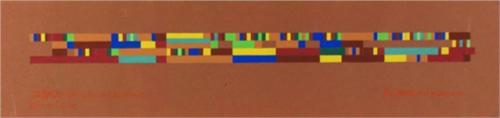
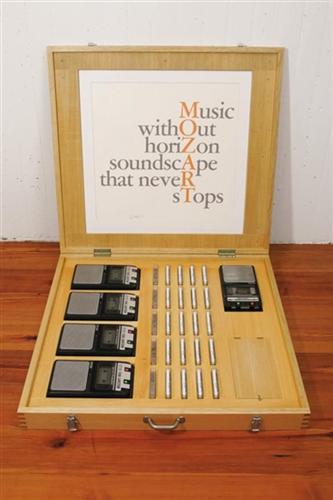
  John Cage - "Mozart Mix" (1991)

Mozart Mix (1991)

John Cage

_______

in a movie,“Victor Victoria”, that should’ve
gotten more Oscars than it finally did,
Le Jazz Hot sizzles, Henry Mancini
received one for the music, Lesley Anne
Warren should’ve too for her incandescent
moll

lock the door, she says to Julie Andrews,
in an otherwise compromising moment,
a line one should never forget

in Julie Andrews’ category, who could’ve
taken it away from Meryl Streep for
“Sophie’s Choice”

but jazz here is a misnomer, jazz merely
dolls up in this number an otherwise
entirely Classical structure, the melody
is right out of Mozart, rigid rhythm,
unflinching tonality, and repetition after
repetition, you can sing along just as you
can for Mozart, try doing that with anyone
after him, try to hum along with real jazz

but I’ll entirely agree that this
whatever-it-is is hot, steaming

catch the astounding vocal glissando
at the very end, just before the final
whispered recitative, riveting

Richard

my reply to BookInhabiter, a.k.a. Brain

a reader writes

“Hello Richard,
Recently I’ve been watching up on many dance competitions. I knew of the existence of piano competitions but never thought that they would be filmed. I must listen to the top contenders. How did you hear about this competition?”

here is my, admittedly extended, answer, with pertinent links

Richard

_____________


I haven’t missed So You Think You
Can Dance
“,
Brain, for 11 years, so
we’ve probably been watching the
same “many dance competitions”

“piano competitions” aren’t much
different, just another art, judged
here by professionals throughout,
rather than entire publics

the competitions are fierce, to a
person the competitors are world
class

the music is often sublime, utterly
transcendent, though more rigorously
intellectual than popcorn – pace
Mozart – this puts some people off

much as you probably find covers of
songs you like, I go out looking for
sonatas, string quartets, concerti I
already know of and admire, I check
out the big names, Chopin, Beethoven,
Rachmaninov, see what might be up

the Internet abounds with nearly
anything you might want to find, the
only obstacle is the quality

the Van Cliburn competition, from
Houston, was dreadful, enough to
put me off it, but looking for musical
counterparts to pieces of interest, I
found the Rubinstein one in Tel
Aviv
offering sterling performances

I quickly flew across the globe,
virtually, of course, speaking

the experience has been well worth
it, I heard miracles of music, haven’t
had so much fun since reading Proust,
in French of course, but you must
understand I’m an inveterate egghead,
totally chronic

this week I started Edward Gibbon’s
The Decline and Fall of the Roman
Empire”
, text and, to my delight,
audiotape, its reader is extraordinary

check out the Chopin Competition
for, up to this point anyway in my
investigation, only Chopin, but he’ll
do for a significant while, his music
is consistently breathtaking

I’ll also check out the Russian
Tchaikovsky Competition, which Van
Cliburn made famous for us in the late
50’s
, by winning it, despite the rancours
of the Cold War, with a still paramount
rendition of Tchaikovsky’s own
monumental First Concerto

wow, I’ve been hooked ever since

thanks for stopping by my blog, Brain,
you’ll find, incidentally, a lot of excellent
performances highlighted there, several
of the best, in fact, from the most recent
Rubinstein Competition
, none of which,
to my utter consternation, managed to
win

other recommendations follow, check
it out

I think your blog is wonderful, keep
it up

Richard