Richibi’s Weblog

Just another WordPress.com weblog

Tag: Mount Parnassus

“The Transformation of Daphne into a Lawrel” (I) – Ovid
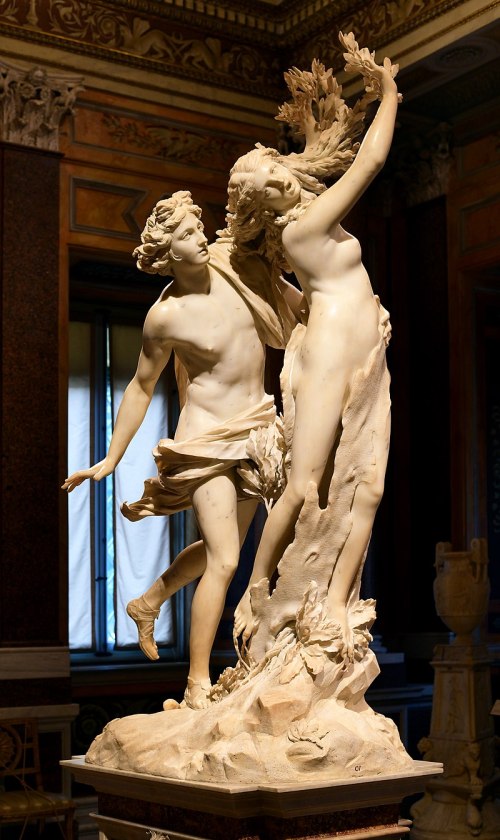
800px-Apollo_and_Daphne_(Bernini)_(cropped)

     “Apollo and Daphne(1622 – 1625) 


            Gian Lorenzo Bernini


                  ___________


Phoebus has just killed Python, and 

now his thoughts are turned to other 

things 


               The first and fairest of his loves, was she
               Whom not blind fortune, but the dire decree
               Of angry Cupid forc’d him to desire: 


that Phoebus should fall in love, indeed

for the first time, was not the work of 

blind fortune, but the decree, the will, 

rather, of Cupid, son of Mars, god of 

War, and Venus, goddess of Love, 

himself, Cupid, god of Desire, who’d 

been, we’ll see, unacceptably 

disrespected


               Daphne her name, and Peneus was her sire. 


her sire, her father, Peneus


               Swell’d with the pride, that new success attends,
               He sees the stripling, while his bow he bends,
               And thus insults him: 


Phoebus, fresh from his triumphant

bout with Python, thus [s]well’d with … 

pride at his new success, sees Cupid

the stripling, the youth, handling his 

own celebrated bow, and derisively

insults him


                                                    Thou lascivious boy,
               Are arms like these for children to employ? 


arms, weapons


               Know, such atchievements are my proper claim; 


arrows, Phoebus says, are my domain,

my proper claim, my undisputed

territory


               Due to my vigour, and unerring aim:
               Resistless are my shafts, and Python late
               In such a feather’d death, has found his fate. 


the death of Python is proof of my 

unparalleled ability, Phoebus 

proclaims


feather’d death, from the feathers that

are attached to the arrows to direct 

and speed their aim


               Take up the torch (and lay my weapons by), 


my weapons, weapons which should

be mine alone 


               With that the feeble souls of lovers fry. 


Take up the torch, take responsibility,

Phoebus says, lay down your 

weapons, your arrows, the ones that 

fry, he accuses Cupid, that frazzle, 

the feeble, incapacitated, souls of 

lovers


               To whom the son of Venus thus reply’d, 


the son of Venus here is Cupid 


               Phoebus, thy shafts are sure on all beside,
               But mine of Phoebus, mine the fame shall be
               Of all thy conquests, when I conquer thee. 


thy shafts, Cupid says, will always

prevail, surpass others, but my own

arrows will be the ones to best you, 

and yours, at which point the glory 

will be, notoriously, mine, over 

yours, forever


               He said, and soaring, swiftly wing’d his flight: 


Cupid is one of the very few ancient

deities to have wings, incidentally,

there’s also Mercury, the Roman 

Hermesmessenger god, god of

travel, communication


               Nor stopt but on Parnassus’ airy height. 


Parnassus, a mountain in Greece,

site of the Oracle of Delphi, site 

indeed where Python has just 

been killed


               Two diff’rent shafts he from his quiver draws;
               One to repel desire, and one to cause.
               One shaft is pointed with refulgent gold:
               To bribe the love, and make the lover bold:
               One blunt, and tipt with lead, whose base allay 


allay, alloy, combination of metals


               Provokes disdain, and drives desire away.
               The blunted bolt against the nymph he drest:
               But with the sharp transfixt Apollo’s breast.


gotcha


               Th’ enamour’d deity pursues the chace; 


Th’ enamour’d deity, Phoebus, is

now under the spell of Cupid‘s

pointed arrow


               The scornful damsel shuns his loath’d embrace:
               In hunting beasts of prey, her youth employs;
               And Phoebe rivals in her rural joys. 


The scornful damsel, Daphne, in the 

spirit of Phoebe, goddess of the Hunt, 

preferred rural joys, indeed rivalled 

Phoebe‘s own enjoyment of rustic 

sports


to explain the similarity in their names,

it should be noted that Phoebe and 

Phoebus were twins, both children 

of Zeus, god of gods, the equivalent 

of the Roman Jove, also known as 

Jupiter, she, Phoebe, goddess of

the Moon, as well as of the Hunt, he, 

Phoebus, god of the Sun, as well as 

of several other things


it should be noted that the gods and

goddesses of Ancient Greece, firmly 

installed during its period of glory, the

4th and 5th Centuries BCE, travelled 

throughout Europe and Asia, 

migrating, but were adapted to the 

local customs, consequently becoming 

known by different names according to 

the language and culture, you can see 

a parallel in the spread of Latin, for

instance, during the Roman conquests 

of, specifically, Europe, evolving into 

the several derivative languages, 

starting with, historically, Italian itself, 

little by little, achieved through the

effects of time rather than of distance, 

then French, Portuguese, Spanish in

the outlying, eventually impermeated,

areas, see the infiltration of English,

for instance, in the modern world


               With naked neck she goes, and shoulders bare;
               And with a fillet binds her flowing hair. 


fillet, a ribbon


               By many suitors sought, she mocks their pains,
               And still her vow’d virginity maintains.
               Impatient of a yoke, the name of bride
               She shuns, and hates the joys, she never try’d.
               On wilds, and woods, she fixes her desire:
               Nor knows what youth, and kindly love, inspire. 


she’s not the marrying kind


               Her father chides her oft: Thou ow’st, says he, 


Thou ow’st, you owe


               A husband to thy self, a son to me. 


that’s his position


               She, like a crime, abhors the nuptial bed: 


she’d, categorically, rather hunt


               She glows with blushes, and she hangs her head.
               Then casting round his neck her tender arms,
               Sooths him with blandishments, and filial charms: 


filial, can apply to both son or

daughter


blandishments, sweet nothings


               Give me, my Lord, she said, to live, and die,
               A spotless maid, without the marriage tye. 


allow me to live[ ] and die[ ] a spotless 

maid, a virgin, she asks, best, that

line, read without commas 


girls would’ve been at the mercy 

of their fathers’ wishes at the time, 

would’ve needed permission not to 

marry


               ‘Tis but a small request; I beg no more
               Than what Diana’s father gave before. 


Diana is the Roman equivalent 

of Phoebe, a virgin goddess, by

the grace of her father, Zeus, the 

Greek counterpart of the Roman 

Jupiter, or Jove, see above


               The good old sire was soften’d to consent;
               But said her wish wou’d prove her punishment:
               For so much youth, and so much beauty join’d,
               Oppos’d the state, which her desires design’d. 


good luck with that, Zeus prophesies, 

men will find you, so much youth, and 

so much beauty, very hard to resist,

you’ll surely suffer consequences


to be continued


R ! chard


“Metamorphoses” (The Giants’ War, XII) – Ovid

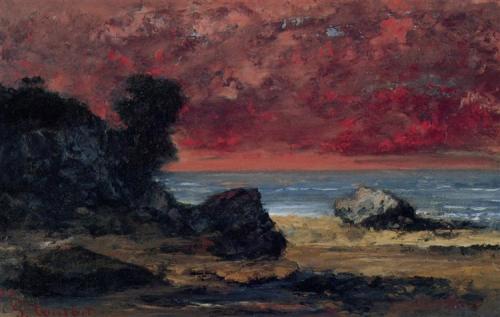
after-the-storm-1872.jpg!Large

      “After the Storm (1872)


            Gustave Courbet


                __________


                  A thin circumference of land appears;
                  And Earth, but not at once, her visage rears,
                  And peeps upon the seas from upper grounds; 


as the land begins to peep[ ] through 

the water, a circumference of land 

appears, a circle of Earth within the 

earlier universal water


to rear, to raise upright, boldly, the better,

here, for Earth‘s visage, Earth‘s face, to 

peep[ ] upon the seas from newly gained 

upper grounds


                  The streams, but just contain’d within their bounds,
                  By slow degrees into their channels crawl; 


streams, just recently redefining their  

boundaries, or bounds[b]y slow 

degrees settle, become waterways, 

channels, rivers, rivulets, rills


I love crawl here, incidentally, the slow, 

insidious, infiltration of a territory, silent 

and immutable, as [t]he streams, at the 

dispassionate pace of nature, find their 

individual course


                  And Earth increases, as the waters fall. 


the waters fall, the waters recede


                  In longer time the tops of trees appear, 


[i]n longer time, after a while


                  Which mud on their dishonour’d branches bear. 


for which the only solution here, would

be, I thought, however ironically, a

shower, rain


but I digress

                 
                  At length the world was all restor’d to view;

                  But desolate, and of a sickly hue:  

see, for instance, above


                  Nature beheld her self, and stood aghast,
                  A dismal desart, and a silent waste. 


desart, is desert, even my spellcheck 

insisted


meanwhile, back on Mount Parnassus

our two survivors, look around


                  Which when Deucalion, with a piteous look
                  Beheld, he wept, and thus to Pyrrha spoke: 


let me point out that what follows, 

which is to say when Deucalion 

… thus to Pyrrha spoke, we have 

an extended monologue, rather 

than a narration, the poet, Ovid

has given a voice to Deucalion

his character, his creation


I was reminded of Shakespeare‘s 

monologues, especially since the 

metre is iambic pentameter,

Shakespeare‘s signature poetic

rhythm 


it should be noted that this translation

of Metamorphoses is from 1717, a

century and a very year after 

Shakespeare‘s demise, in 1616, time 

for poets to have imbibed his already 

profound influence


nor could they not have been marked

by the spirit of their own time, and the 

many transformative epochs since 

Metamorphoses had been written, in 

the year 1, that would’ve affected the 

translation 


the original Latin text, for instance,

was in dactylic hexameter, not 

iambic pentameter


                  Oh wife, oh sister, oh of all thy kind
                  The best, and only creature left behind,
                  By kindred, love, and now by dangers joyn’d;
                  Of multitudes, who breath’d the common air,
                  We two remain; a species in a pair:
                  The rest the seas have swallow’d; nor have we
                  Ev’n of this wretched life a certainty.
                  The clouds are still above; and, while I speak,
                  A second deluge o’er our heads may break.
                  Shou’d I be snatcht from hence, and thou remain,
                  Without relief, or partner of thy pain,
                  How cou’dst thou such a wretched life sustain?
                  Shou’d I be left, and thou be lost, the sea
                  That bury’d her I lov’d, shou’d bury me.
                  Oh cou’d our father his old arts inspire,
                  And make me heir of his informing fire,
                  That so I might abolisht Man retrieve,
                  And perisht people in new souls might live.
                  But Heav’n is pleas’d, nor ought we to complain,
                  That we, th’ examples of mankind, remain. 


cou’d our father, JoveDeucalion asks,

breathe into me his inspiration, his old 

arts, his informing fire, so that I could 

reconstitute Man, retrieve him, and 

supply the perisht people with new, and

presumably more honourable, souls


                  He said; the careful couple joyn their tears: 


He said, or this he spoke, and the

couple joyn their tears


                  And then invoke the Gods, with pious prayers.
                  Thus, in devotion having eas’d their grief,
                  From sacred oracles they seek relief;
                  And to Cephysus’ brook their way pursue: 


Cephysus, or Cephissus, was a river god,

associated with the river Cephissus, which 

runs through Central Greece


                  The stream was troubled, but the ford they knew; 


the ford, the way across the stream


                  With living waters, in the fountain bred, 


living waters would gush from a 

spring, around which a fountain 

would’ve been built


                  They sprinkle first their garments, and their head,
                  Then took the way, which to the temple led.
                  The roofs were all defil’d with moss, and mire,
                  The desart altars void of solemn fire.
                  Before the gradual, prostrate they ador’d;
                  The pavement kiss’d; and thus the saint implor’d.


the gradual is a hymn sung within

the context of a full religious service


desart here is again desert, but in

this instance signifying deserted


the saint, an anachronism here, 

for saints were not at all even a

concept at the time of Ovid

would’ve been Themis, goddess,

at Delphi, on Mount Parnassus

of Divine Justice


R ! chard


“Metamorphoses” (The Giants’ War, X) – Ovid

deucalion-and-pyrrha-praying-before-the-statue-of-the-goddess-themis.jpg!Large

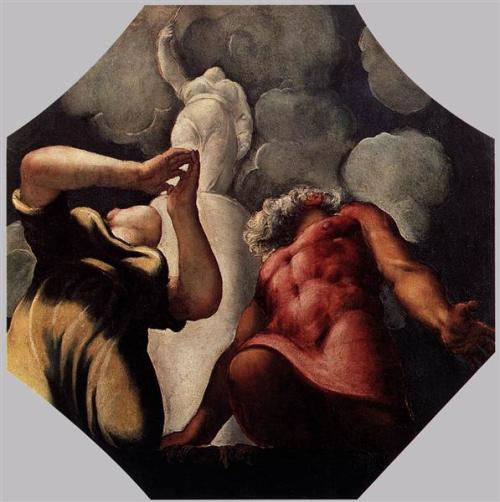
  “Deucalion and Pyrrha Praying before the Statue of the Goddess Themis (c.1542) 


          Tintoretto


             _____


              A mountain of stupendous height there stands
              Betwixt th’ Athenian and Boeotian lands, 


Boetia was, and still is, a region of 

Central Greece, its largest city is,

and was, Thebes, a major rival in

ancient times of Athens


              The bound of fruitful fields, while fields they were, 


bound, boundary, the fruitful fields

within a certain limited area, between 

Athens, here, and Boetia


              But then a field of waters did appear: 


              Parnassus is its name; whose forky rise
              Mounts thro’ the clouds, and mates the lofty skies. 


Parnassus is a mountain in Central 

Greece, however forky, however 

forked, craggy, uneven, sacred 

especially to Apollo, god of too 

many things to list here, and the 

site, at Delphi, on its south-western 

slope, of his Oracle, famous for 

being consulted on a variety of 

matters, from personal to affairs 

of state, its high priestess was 

believed to incarnate the very 

voice of Apollo


Parnassus was also the home, 

incidentally, of the Muses, goddesses 

in their own right, of the several arts, 

who ministered to Apollo


              High on the summit of this dubious cliff,
              Deucalion wafting, moor’d his little skiff. 


Deucalion is the Abrahamic Noah‘s

counterpart, sole survivor, with his 

wife Pyrrha, of the flood 


the cliff is dubious because the

mountain is still deep in water,

its summit precarious yet 


              He with his wife were only left behind
              Of perish’d Man; they two were human kind. 


they two alone were left of humankind,

of perish’d Man


              The mountain nymphs, and Themis they adore, 


Themis, goddess of Divine Justice


              And from her oracles relief implore. 


Deucalion and Pyrrha pray to Themis

at Delphi, its first high priestess, hungry

for, and heedful of, her oracles, counsel


see above


              The most upright of mortal men was he;
              The most sincere, and holy woman, she. 


a chance at a new world


R ! chard