Richibi’s Weblog

Just another WordPress.com weblog

Tag: Michelangelo

“The Story of Phaeton” (II) – Ovid
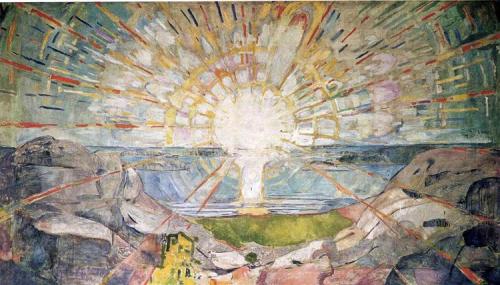
the-sun-1916.jpg!Large

   “The Sun (1911 – 1916) 


            Edvard Munch


                _______


                    The Sun’s bright palace, on high columns rais’d, 


The Sun, Helios / Phoebus / Apollo


                    With burnish’d gold and flaming jewels blaz’d;
                    The folding gates diffus’d a silver light,
                    And with a milder gleam refresh’d the sight; 


since the folding gates of the bright

palace shimmered with a silver light 

rather than with the glow of the gold 

and flaming jewels of the palace itself,

their milder gleam was easier on the 

eyes, refresh’d the sight


                    Of polish’d iv’ry was the cov’ring wrought: 


the palace was covered with polish’d

wrought ivory


                    The matter vied not with the sculptor’s thought, 


the execution of the palace was  

everything that its sculptor, its

architect, had had in mind to 

create


                    For in the portal was display’d on high
                    (The work of Vulcan) a fictitious sky


Vulcan, god of fire, metal, smiths, 

metalworkers


at the entrance to the palace, the

portal, Vulcan had painted the ceiling, 

he’d display’d on high … a fictitious 

sky, I suspect Dryden must’ve had 

Michelangelo and his ceiling of the  

Sistine Chapel in mind during his 

translation of this passage of Ovid


                    A waving sea th’ inferiour Earth embrac’d, 


inferiour, Earth, surging from under the 

greater masses of water dominating it, 

especially after the flood, is, therefore, 

beneath the waving sea, inferiour to it


                    And Gods and Goddesses the waters grac’d. 


remember that Ovid is describing a 

painting here, on the ceiling at the

entrance, the portal, to the palace 

of the god of the Sun


                    Aegeon here a mighty whale bestrode; 


Aegeon, marine god, god of storms,

note the similarity of the name with 

that of the Aegean Sea, but which 

came first, the chicken or the egg, 

the god or the expanse of water, 

remains, as far as I’ve been able 

to determine, undetermined


                    Triton, and Proteus (the deceiving God) 


Triton, another god of the Sea, you’ll 

remember him coming to the aid of 

Neptune, his father, in settling the

waters after the flood at the request 

of Jove / Jupiter / Zeus


Proteus, still another sea god, 

described as deceiving, for his 

ability to effortlessly, and 

spontaneously, change his shape, 

from which, incidentally, we get 

the adjective protean, for easily 

changeable, or versatile 


                    With Doris here were carv’d, and all her train, 


Doris, sea goddess, and all her train,

her following of nymphs, the Nereids,

her fifty daughters, if you’ll remember,

are carv’d, etched, given graphic 

representation


                    Some loosely swimming in the figur’d main, 


figur’d, painted, depicted, drawn


main, the open ocean, but, probably 

also here, the main, or central, part 

of the painting itself


                    While some on rocks their dropping hair divide, 


their hair divide, they loosen strands 

of their wet hair 


                    And some on fishes through the waters glide: 


sea gods and goddesses are often

shown riding sea creatures, dolphins, 

seahorses, even whales, see Aegeon

above

                    Tho’ various features did the sisters grace,
                    A sister’s likeness was in ev’ry face. 


the sisters, the Nereids, all have different

features, but a family resemblance, sister’s 

likeness, can always be detected in each

individual sibling’s rendering


                    On Earth a diff’rent landskip courts the eyes, 


Earth doesn’t look, court[ ] the eyes,

at all like what’s painted on the 

palace’s ceiling


landskip, landscape


                    Men, towns, and beasts in distant prospects rise, 


distant prospects, from a distance, one 

can see [m]en, towns, and beasts 

appear, rise, arise


                    And nymphs, and streams, and woods, and rural deities. 


nymphs, consigned, it appears, to 

earthly duties, streams, and woods, 

are not a feature of the Sun god’s 

palace


                    O’er all, the Heav’n’s refulgent image shines; 


the Heav’n’s refulgent, brightly shining,

image, expression, is manifest [o]’er all,

everywhere, the rays of the sun cast a

light on everything


                    On either gate were six engraven signs. 


again I’m reminded of a Renaissance

wonder, Lorenzo Ghiberti‘s gilded bronze 

doors for the Florence Baptistery, which 

Michelangelo himself called the Gates of

Paradise, a work nearly as famous, then 

and now, as his own Sistine Chapel ceiling   


Ovid would never have known of these 

masterworks, of course, having lived 

over a millenium earlier, but I suspect 

John Dryden, a cultured man, a couple 

of hundred years later than these 

cultural icons, would no doubt have 

been fully aware of them, much as we, 

however disinterested we might be, 

can’t help but have heard of, say, 

RembrandtChopinCharles Dickens,

for instance, though they be, similarly, 

centuries separated from us 


my point is that, without knowledge of 

the original Latin, Dryden‘s cultural

heritage must’ve slipped, I think, 

consciously or not, into his 

translation, for better, or for worse


it should be remembered, however,

that Dryden was writing for an early 

18th Century audience, much as I 

am presently doing myself with 

Dryden for a 21st, and maybe also

similarly skewing his idiom to better 

adapt it to our own time, for better, 

also, or for worse 


                    Here Phaeton still gaining on th’ ascent, 


gaining on th’ ascent, going faster 

and faster, climbing higher and 

higher


                    To his suspected father’s palace went


suspected father, Phaeton doesn’t

yet know if Helios / Phoebus / Apollo

is indeed his father


                    ‘Till pressing forward through the bright abode,
                    He saw at distance the illustrious God:
                    He saw at distance, or the dazling light
                    Had flash’d too strongly on his aking sight. 


had Phaeton not been as far, at

distance, from what he was seeing,

the illustrious God, the dazling, or 

dazzling, light would’ve hurt his 

eyes, hurt his aking, or aching, 

sight


                     The God sits high, exalted on a throne
                    Of blazing gems, with purple garments on; 


Tyrian, surely, purple, a hue we’ve 

seen here before, indicative of 

stature, of imperial, if not even

divine, as in this instance, 

pedigree


                     The Hours, in order rang’d on either hand,
                    And Days, and Months, and Years, and Ages stand.
                    Here Spring appears with flow’ry chaplets bound;
                    Here Summer in her wheaten garland crown’d;
                    Here Autumn the rich trodden grapes besmear;
                    And hoary Winter shivers in the reer. 


this is no longer a picture, but the 

real thing, Phoebus / Apollo / Helios

sits high, exalted on a throne /  Of 

blazing gems, with purple garments 

on, while Time and all of the Seasons 

hold court around him


                     Phoebus beheld the youth from off his throne;
                    That eye, which looks on all, was fix’d in one. 


Phoebus, who sees everything, who 

looks on all, beholds, fixes his eye on, 

his son


                     He saw the boy’s confusion in his face,
                    Surpriz’d at all the wonders of the place;
                    And cries aloud, “What wants my son? for know
                    My son thou art, and I must call thee so.” 


Phaeton, according to Phoebus / 

Apollo / Helios‘ forthright admission,

is truly his son


                     “Light of the world,” the trembling youth replies,
                    “Illustrious parent! since you don’t despise
                    The parent’s name, 


despise, refute


                                                some certain token give,
                    That I may Clymene’s proud boast believe,
                    Nor longer under false reproaches grieve.” 


your word is good, Phaeton allows,

but incontrovertibly, now, prove it, 

some certain token give, he 

challenges 


                     The tender sire was touch’d with what he said,
                    And flung the blaze of glories from his head, 


flung the blaze of glories from his head, 

reduced the intensity of his presence,

the impact of his charisma, took off 

his dazling crown, if only, maybe,

metaphorically, to be father to his son


                    And bid the youth advance: “My son,” said he,
                    “Come to thy father’s arms! for Clymene
                    Has told thee true; a parent’s name I own,
                    And deem thee worthy to be called my son.
                    As a sure proof, make some request, and I,
                    Whate’er it be, with that request comply;
                    By Styx I swear, whose waves are hid in night,
                    And roul impervious to my piercing sight.” 


an oath upon Styx is incontrovertible, 

like swearing on a Bible, as earlier 

noted


                     The youth transported, asks, without delay,
                    To guide the sun’s bright chariot for a day. 


Phaeton wants to drive his father’s 

car, the sun’s bright chariot, how 

contemporary, how immediate, 

how timeless 


stay tuned


R ! chard
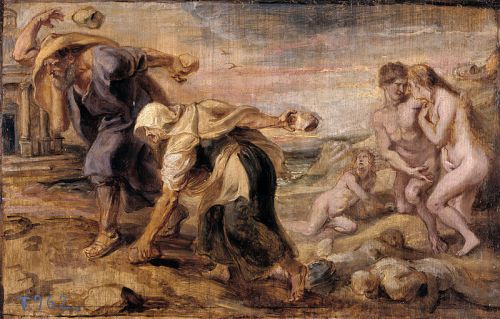


“Metamorphoses” (The Giants’ War, XIII) – Ovid

800px-Peter_Paul_Rubens_-_Deucalion_and_Pyrrha,_1636

      Deucalion and Pyrrha (1636) 


             Peter Paul Rubens


                 ___________


                                          for my mom and dad, my own

                                                   Deucalion and Pyrrha


at Cephysus‘ shrine, Deucalion and 

Pyrrha pray to the goddess of

Divine Justice


              O righteous Themis, if the Pow’rs above
              By pray’rs are bent to pity, and to love;
              If humane miseries can move their mind; 


humane, human


              If yet they can forgive, and yet be kind;
              Tell how we may restore, by second birth,
              Mankind, and people desolated Earth. 


the Pow’rs above are the deciding 

factors, can Jove, Neptune, the others, 

Deucalion asks, be moved by human[ ] 

miseries, can they forgive, can they 

restore…Mankind, people, people is

a verb here, the world again, the 

desolated, or desolate, the dismal, 

the forsaken, Earth


              Then thus the gracious Goddess, nodding, said;
              Depart, and with your vestments veil your head:
              And stooping lowly down, with losen’d zones,
              Throw each behind your backs, your mighty mother’s bones. 


losen’d zones, across wide areas


cover, veil, your heads, the goddess 

advises, stoop low, and throw your 

mother’s bones across wide areas, 

she instructs, however scandalously


              Amaz’d the pair, and mute with wonder stand,
              ‘Till Pyrrha first refus’d the dire command. 


Pyrrha is a counterpart for the Christian 

Eve here, contrary, defiant of Heaven, 

however eventually, Pyrrha, blameless, 

but which of the progenitresses came

first, which the chicken, which the egg, 

Eve or Pyrrha, is a question up for 

contemplation


              Forbid it Heav’n, said she, that I shou’d tear
              Those holy reliques from the sepulcher. 


surely, Pyrrha proclaims, Heav’n would 

never allow, Forbid it Heav’n, not to 

mention condone, that I should remove, 

tear, my mother’s bones, [t[hose holy 

reliques, relics, from their sepulcher, 

their grave, this would be profoundly 

unholy 


              They ponder’d the mysterious words again,
              For some new sense; and long they sought in vain:
              At length Deucalion clear’d his cloudy brow,
              And said, the dark Aenigma  


Aenigma, Sphinx, the oracle


                                                                will allow
              A meaning, which, if well I understand,
              From sacrilege will free the God’s command: 


if I can properly understand, decipher,

the meaning of the God’s command, 

Aenigma’s oracular words, however 

cryptic, in such a way, Deucalion 

declares, that our actions be not 

sacrilegious, nor offensive in any 

way to the gods, we may proceed,

he reasons


              This Earth our mighty mother is, the stones
              In her capacious body, are her bones: 


This Earth is our mighty mother, the

stones in her capacious body [ ] are 

her bones, no comma after body


the word order in each clause, note, has 

been reversed, instead of subject, verb,

object, we have object, verb, subject


but then, ever so felicitously, stones 

can rhyme with bones, and equally,

and as liltingly, we’re still in iambic 

pentameter


              These we must cast behind. With hope, and fear,
              The woman did the new solution hear:
              The man diffides in his own augury, 


diffide, distrust, augury, prediction,

Deucalion doubts, in other words,

his own calculations


              And doubts the Gods; yet both resolve to try. 


when my mom is up against a 

dilemma, she calls on my dad,

gone some over thirty years now,

come on, Daddy, let’s go, she 

says, and confronts the issue 

with transcendental, by very 

definition, conviction


see above


              Descending from the mount, they first unbind
              Their vests, and veil’d, they cast the stones behind:
              The stones (a miracle to mortal view,
              But long tradition makes it pass for true) 


what follows will seem miraculous

to mortals, Ovid says, but the story 

has been around for such a while,

which is to say by long tradition, 

that we let it pass for true


              Did first the rigour of their kind expel, 


the stones begin to lose, expel, their 

firmness, the rigour of their kind


              And suppled into softness, as they fell; 


suppled, became supple


              Then swell’d, and swelling, by degrees grew warm;
              And took the rudiments of human form. 


stones are being transformed, 

metamorphosized, into humans 


the Bible, if you’ll remember, would 

have it be clay


              Imperfect shapes: in marble such are seen,
              When the rude chizzel does the man begin; 


chizzel, chisel


              While yet the roughness of the stone remains,
              Without the rising muscles, and the veins. 


as the sculpture is being fashioned, 

certain parts of the human anatomy, 

the muscles, for instance, the veins, 

are not yet revealed, uncovered, 

discovered, extracted, by the 

chizzel, from under the roughness 

of the stone


think of Michelangelo, or Rodin,

sculpting


              The sappy parts, and next resembling juice, 


sappy, from sap, which, emanating 

from stones, would be next to, but 

not as limpid as, juice, or the liquid

required to create humans


              Were turn’d to moisture, for the body’s use:
              Supplying humours, blood, and nourishment; 


the circulatory, and notably viscous, 

system


              The rest, too solid to receive a bent,
              Converts to bones; and what was once a vein,
              Its former name and Nature did retain. 


veins, which hadn’t received enough 

sappy parts to become part of the

circulatory system, retained their 

name of vein, but as understood in

relation to rocks, geological veins

presumably replicated, in this story 

of the Creation, in human bones


              By help of pow’r divine, in little space, 


in little space, in no time at all


              What the man threw, assum’d a manly face;
              And what the wife, renew’d the female race. 


the stones that the man, Deucalion

threw became men, those that 

Pyrrha tossed became women 


              Hence we derive our nature; born to bear
              Laborious life; and harden’d into care.


we’ve inherited, through the labours 

of Deucalion and Pyrrha, our driven

nature, harden’d into, or conditioned, 

condemned, to care 


for better, I infer, or for worse 


R ! chard


Brahms Piano Concerto no 2 in B flat major, opus 83‏

though I’d no intention of presenting a piano concerto
quite yet I’d been trolling Celibidaches on the Internet,
after marvelling at his wondrous Boléro”, and couldn’t
hold back this gem I found of his, Brahms’ Piano 
 
same venue, same Münchner Philharmoniker, same
starched ceremonial ruffles, I thought, same even age
of the conductor, to the very minute, it appeared, in 
his unchanged eye and perspective, wise, serene,
omnipotent, perhaps the very same concert as in the
illustrious Ravel, I said to myself, though later couldn’t
especially recognize individual instrumentalists
 
Daniel Barenboim, who conducted earlier the speedy
“Boléro”, wears another hat here, he’s the pianist, but
in this incarnation he is transcendental, carried aloft,
I think, notably, by the Olympian Celibidache, who
cedes his fire and glory to the younger Barenboim
throughout, who supremely is up for the challenge,
a ready and rearing Apollo, taking on the treacherous
musical task, defying obstreperous planets, perilous
astrological constellations in nefarious conjunctions, 
stray or fleeting stars, to foster safely home to its
final hearth his solar chariot, in a towering sunset,
finale of apocalyptic proportions, each purveyor
casting unutterable light, god and mere immortal, 
from his own particular perch, upon our beholden
world
  
Celibidache, as would Zeus, cedes serenely to his 
younger avatar his bow, his deserved adulation,
safe in his own unquestionable omnipotence
 
 
this concerto has four movements incidentally, greater
length always suggests more gravitas, more substance 
 
is it warranted
 
you be the judge 
 
 
Richard
 
psst: in another mythological context, note the hand of
         Celibidache resting on air, intermittently fluttering,
         at the beginning of the slowest movement, the
         andante, the third, the hand of God ministering, 
         according to Michelangelo, in the “Creation of 
         Adam”, should you not yet be convinced of the 
         maestro’s august and unequivocal stature


“Benefits Supervisor Sleeping” – Lucian Freud


                            “Benefits Supervisor Sleeping” (1995)

                                               Lucian Freud  
  
                                                 _________ 

 
nudes go back of course to Eden, female nudes to Eve,
but only after genitalia had long given way to fig leaves, 
during the somber and endless Middle Ages,
after the fall of the more licentious Rome, 
did they flourish unadorned again
 
men have had to wait much longer to be faithfully depicted,
we’re still under the sway, it would seem, of original sin 
 
paintings which have made historical inroads,
often accompanied by scandal, much indeed as was this one,
though here the shock was arguably less prurient than financial,  
The Toilet of Venus” for instance of Diego Velázquez
or Olympia” of Édouard Manet,
are obvious progenitors 
 
but see especially Egon Schiele in this case for matching townscapes
though most similarly subversive are their unexpurgated, indeed, males 
 
Lucian Freud‘s Benefits Supervisor Sleeping incidentally
sold at auction for $33.6 million, in May 2008  
 
what would Saint Augustine have had to say about that 
 
watch what Sue Tilly, the sitter, said
 
 
Richard  
  
psst: “In Farrell v. Burke … the following exchange from the testimony
          of a police officer who had charged a convicted sex offender for
          violating the terms of his probation by possessing obscene materials:
  
         ‘MR. NATHANSON: Are you saying, for example, that that condition of
          parole would prohibit Mr. Farrell from possessing, say, Playboy magazine?
          P.O. BURKE: Yes.
          MR. NATHANSON: Are you saying that that condition of parole would

          prohibit Mr. Farrell from possessing a photograph of Michelangelo[’s]
          David?
          P.O. BURKE: What is that?
          MR. NATHANSON: Are you familiar with that sculpture?
          P.O. BURKE: No. 
          MR. NATHANSON: If I tell you it’s a large sculpture of a nude youth with his 

          genitals exposed and visible, does that help to refresh your memory of what
          that is? 
          P.O. BURKE: If he possessed that, yes, he would be locked up for that.” 
                                                                               
                               from the New Yorker (“Number Nine” by Lauren Collins),

                                                                               January 11,2010 


Diane Arbus – 1923-1971

     Diane Arbus, Identical Twins, Roselle, N.J.

                                    “Identical Twins, Roselle, N.J.“, 1967
 
                                                        Diane Arbus  
                                                                                                                                                                                                                                                                                                                   1923 -1971
                               
                                                          _______
 
                                                                                                                                                                                                                                                      with the camera the shutter becomes the brush, the art only a click away, the artistry, the creativity, debatable
 
where is the skill, the ingenuity, indeed the art
 
the snapshot is a picture of an imagination taken on the spot, the art must be in the very brain, not in, as one would expect, the dextrous fingers, the articulation, the prestidigitation, must be already sorted out, already calibrated, technical prowess not required, just able, artful observation
 
the shutter will do the rest
 
can a point of view then, a take, one will reasonably inquire, be art

 
Diane Arbus had been a fashion photographer, gave it up for something, it would appear, more meaningful, became thereby, in my estimation, unforgettable, broke down for me reservations about photography as art 
 
witness
 
Identical Twins, Roselle, N.J., 1967, is not about these twins, these unexceptional twins – otherwise merely a portrait, an indifferent even portrait – but about something much more relevant
 
two little girls in black and white – though this may be itself the kind of photography – look straight into the camera, you look to tell them apart
 
their little dress adorned by each the same white ruffle at the collar, recalling incidentally the Reformation Dutch, a witty touch, give no clue, they could be matching dolls, flat cut-outs, for that matter, given the minimal use of perspective
 
a matching hair band, the same hair, the same nose, the same mouth, don’t either, the eyes do but only just 

they tell though the entire story, their different light, their different incandescence, though even ever so slight, though ever even so elusive, is what finally tells them apart 

but the focus has switched, you’re observing something now immaterial, incorporeal, insubstantial, become simultaneously something mystical, metaphysical, transcendental, some might call God  
 
Michelangelo’s did the same thing for Adam, another much wittier art history touch

 
two other girls, “Untitled“, 1970-71, speak even more clearly perhaps about this 
 
note the angel come through in the girl on the left, in all its magnificent splendour


                                           Untitled“, 1970-71
 
                                                   Diane Arbus 

                                                   1923 -1971
                                                 
                                                      _______

                                                                                                                                                                                                                                                  Diane Arbus committed suicide on July 26, 1971, undoubtedly
undone by what she’d sought to witness, perhaps the too bright light
                                                                                                                                                                                                                                                     psst: why is it that those who are “Untitled” would never think of taking their own life, perhaps they’ve been blessed with an extra measure of courage


_________________________________________________

ekphrasis

                                                                                                                                 ekphrasis

                                                                                                                                      poring among the possibilities the nearby university had to offer – they’re listed in a catalogue they seasonally send around – one on poetry, of course, how to make one out of a painting, stood out, how to make of something visual, a Monet, a Van Gogh, a Renoir, a poem 

ekphrasis, there’s a word for that, I thought

and ate it up

the picture I got to ekphrase, my word for that, was one of a set the teacher sent around of Kobayashis, snapshots, I’d never heard of him, her, either, Milt Kobayashi, all of them intriguing

I quickly snapped one up, letting my instinct instead of my judgment pick it out – I find it’s usually more accurate – in order to keep the ball rolling, not slow things up

a waif in especially blue, the colour also of chairs behind her – like skies in winter, I thought, when the pressure’s up and the light is pale, colours aren’t crisp but muted – making that sort of association, hoping that wouldn’t be unintelligent

rudimentary roses, wine red, spotted here and there her blue skirt, more like patches than ornamental flowers, a black top the colour of her jet black hair was cut low in a U at her neck, she leaned against a wall, itself nondescript, at the right of the picture, her left, far to that side, and in her own black shadow there splashed upon the wall, a fathomless apparently abyss, seemed to find refuge, a respite, like a womb, pushing herself and it nearly right out of the picture

her arms were crossed, but one reached for her shoulder, lightly resting there, covering inadvertently, or not, her chest, and by my inference her soul, her modesty, her bosom, whereupon, like Michelangelo’s God touched Adam, with love, light and understanding, inadvertently again or not, she touched mine

and her black, plaintive eyes were looking right back

                                                                                                                                     there’s next to nothing on the spartan walls, the table is somewhat set, but light reflected off some glasses there, and dishes, is gleaming, like in Dutch still lifes, artfully, and delightfully

“The Last Table” it’s called, though I’m not too sure what that’s about, a waitress calling it a day, a playful reference somehow to da Vinci’s “The Last Supper” maybe 

that’s what I’d have to make into a poem, ekphrase


  _____________________________________________