Just another WordPress.com weblog
Tag: Mars / god of War
_______ Cadmus salutes the soil, and gladly hails The new-found mountains, and the nameless vales, And thanks the Gods, and turns about his eye To see his new dominions round him lye; Europa , has , on the advice of thethe lonely cow, / Unworn with yokes, unbroken to the plow had stoop’d, and couch’d amid the rising grass,
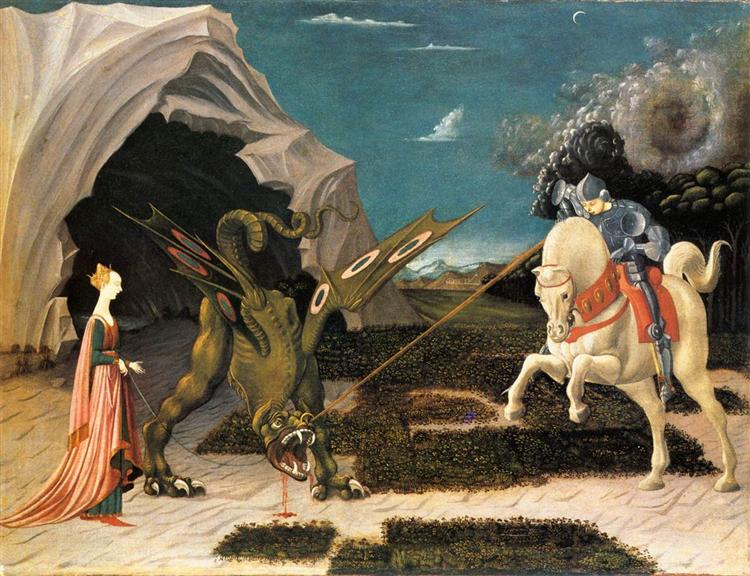
vales, valleys Then sends his servants to a neighb’ring grove For living streams, a sacrifice to Jove. Cadmus , a prince, would’ve hada retinue, followers, Hamlet for instance, his Horatio , his Jove , note, is the god who abductedto our story, isn’t yet supposed to know this, never having found his sister, nor identified, consequently, her ravisher, namely Jove , the god to whom Cadmus is now about to give sacrifice, give thanks O’er the wide plain there rose a shady wood Of aged trees; in its dark bosom stood A bushy thicket, pathless and unworn, O’er-run with brambles, and perplex’d with thorn: perplex’d, a wonderful metaphor here for entangled, enmeshed Amidst the brake a hollow den was found, With rocks and shelving arches vaulted round. brake, bracken, brush Deep in the dreary den, conceal’d from day, Sacred to Mars, a mighty dragon lay, Mars , god of War a mighty dragon, dragons, it appears,go back to very prehistory, perhaps dinosaurs, and the like, that made its way into our poetic imagination Bloated with poison to a monstrous size; Fire broke in flashes when he glanc’d his eyes: glanc’d his eyes, threw glances at His tow’ring crest was glorious to behold, crest, as in roosters, or reptiles His shoulders and his sides were scal’d with gold; scal’d, having scales, plates,overlapping surfaces Three tongues he brandish’d when he charg’d his foes; His teeth stood jaggy in three dreadful rowes. rowes, rows, three dreadful ones,one behind the other The Tyrians in the den for water sought The Tyrians, Cadmus and his men,all originally from Tyre
And with their urns explor’d the hollow vault: urns, to collect from living streams within the vault a sacrifice to Jove From side to side their empty urns rebound, rebound, knock against a hardersurface repeatedly And rowse the sleeping serpent with the sound. rowse, rouse Strait he bestirs him, and is seen to rise; he bestirs him, he bestirs himself And now with dreadful hissings fills the skies, And darts his forky tongues, and rowles his glaring eyes. rowles, rolls The Tyrians drop their vessels in the fright, vessels, urns All pale and trembling at the hideous sight. Spire above spire uprear’d in air he stood, Spire above spire, scale upon scale uprear’d, reared up he, the serpent And gazing round him over-look’d the wood: overlook’d, looked over, surveyed Then floating on the ground in circles rowl’d; rowl’d, rolled Then leap’d upon them in a mighty fold. fold , embrace, encirclement Of such a bulk, and such a monstrous size The serpent in the polar circle lyes, That stretches over half the northern skies. The serpent in the polar circle, Serpens ,a constellation in the Northern Hemisphere in close proximity to the North Pole lyes, lies In vain the Tyrians on their arms rely, their arms, their weapons In vain attempt to fight, in vain to fly: All their endeavours and their hopes are vain; Some die entangled in the winding train; the winding train, the serpent’stail Some are devour’d, or feel a loathsom death, Swoln up with blasts of pestilential breath. stay tuned R ! chard
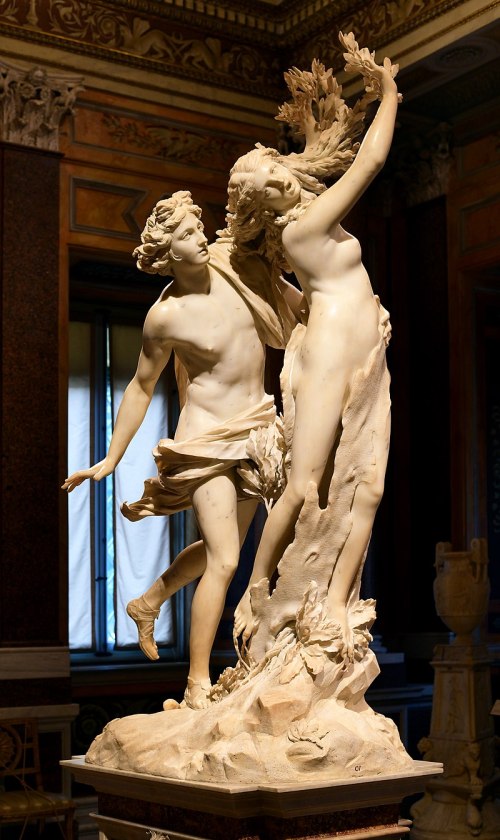
___________ now his thoughts are turned to other things The first and fairest of his loves, was she Whom not blind fortune, but the dire decree Of angry Cupid forc’d him to desire: that Phoebus should fall in love, indeed for the first time, was not the work of blind fortune, but the decree, the will, rather, of Cupid , son of Mars , god of War, and Venus , goddess of Love, himself, Cupid , god of Desire, who’d been, we’ll see, unacceptably disrespected Daphne her name, and Peneus was her sire. her sire, her father, Peneus Swell’d with the pride, that new success attends, He sees the stripling, while his bow he bends, And thus insults him: Phoebus , fresh from his triumphantbout with Python , thus [s]well’d with … pride at his new success, sees Cupid , the stripling, the youth, handling his own celebrated bow, and derisively insults him Thou lascivious boy, Are arms like these for children to employ? arms, weapons Know, such atchievements are my proper claim; arrows, Phoebus says, are my domain, my proper claim, my undisputedterritory Due to my vigour, and unerring aim: Resistless are my shafts, and Python late In such a feather’d death, has found his fate. the death of Python is proof of my unparalleled ability, Phoebus proclaims feather’d death, from the feathers thatare attached to the arrows to direct and speed their aim Take up the torch (and lay my weapons by), my weapons, weapons which shouldbe mine alone With that the feeble souls of lovers fry. Take up the torch, take responsibility,Phoebus says, lay down your weapons, your arrows, the ones that fry, he accuses Cupid , that frazzle, the feeble, incapacitated, souls of l overs To whom the son of Venus thus reply’d, Phoebus, thy shafts are sure on all beside, But mine of Phoebus, mine the fame shall be Of all thy conquests, when I conquer thee. thy shafts, Cupid says, will alwaysprevail, surpass others, but my own arrows will be the ones to best you, and yours, at which point the glory will be, notoriously, mine, over yours, forever He said, and soaring, swiftly wing’d his flight: Cupid is one of the very few ancientdeities to have wings, incidentally, there’s also Mercury , the Roman Hermes , messenger god, god of travel, communication Nor stopt but on Parnassus’ airy height. Parnassus , a mountain in Greece,indeed where Python has just been killed Two diff’rent shafts he from his quiver draws; One to repel desire, and one to cause. One shaft is pointed with refulgent gold: To bribe the love, and make the lover bold: One blunt, and tipt with lead, whose base allay allay, alloy, combination of metals Provokes disdain, and drives desire away. The blunted bolt against the nymph he drest: But with the sharp transfixt Apollo’s breast. gotcha Th’ enamour’d deity pursues the chace; Th’ enamour’d deity, Phoebus , isnow under the spell of Cupid ‘s pointed arrow The scornful damsel shuns his loath’d embrace: In hunting beasts of prey, her youth employs; And Phoebe rivals in her rural joys. The scornful damsel, Daphne , in the spirit of Phoebe , goddess of the Hunt, preferred rural joys, indeed rivalled Phoebe ‘s own enjoyment of rustic sports to explain the similarity in their names, it should be noted that Phoebe and Phoebus were twins, both children of Zeus , god of gods, the equivalent of the Roman Jove , also known as the Moon, as well as of the Hunt, he, Phoebus , god of the Sun, as well as of several other things it should be noted that the gods and goddesses of Ancient Greece, firmly installed during its period of glory, the 4th and 5th Centuries BCE, travelled throughout Europe and Asia, migrating, but were adapted to the local customs, consequently becoming known by different names according to the language and culture, you can see a parallel in the spread of Latin, for instance, during the Roman conquests of, specifically, Europe, evolving into the several derivative languages, starting with, historically, Italian itself, little by little, achieved through the effects of time rather than of distance, then French, Portuguese, Spanish in the outlying, eventually impermeated, areas, see the infiltration of English, for instance, in the modern world With naked neck she goes, and shoulders bare; And with a fillet binds her flowing hair. fillet, a ribbon By many suitors sought, she mocks their pains, And still her vow’d virginity maintains. Impatient of a yoke, the name of bride She shuns, and hates the joys, she never try’d. On wilds, and woods, she fixes her desire: Nor knows what youth, and kindly love, inspire. she’s not the marrying kind Her father chides her oft: Thou ow’st, says he, Thou ow’st, you owe A husband to thy self, a son to me. that’s his position She, like a crime, abhors the nuptial bed: she’d, categorically, rather hunt She glows with blushes, and she hangs her head. Then casting round his neck her tender arms, Sooths him with blandishments, and filial charms: filial, can apply to both son ordaughter blandishments, sweet nothings Give me, my Lord, she said, to live, and die, A spotless maid, without the marriage tye. allow me to live[ ] and die[ ] a spotless maid , a virgin, she asks, best, thatline, read without commas girls would’ve been at the mercy of their fathers’ wishes at the time, would’ve needed permission not to marry ‘Tis but a small request; I beg no more Than what Diana’s father gave before. Diana is the Roman equivalent of Phoebe , a virgin goddess, by the grace of her father, Zeus , the Greek counterpart of the Roman The good old sire was soften’d to consent; But said her wish wou’d prove her punishment: For so much youth, and so much beauty join’d, Oppos’d the state, which her desires design’d. good luck with that, Zeus prophesies, men will find you, so much youth, and so much beauty, very hard to resist,you’ll surely suffer consequences to be continued R ! chard
 Richibi's Weblog