Richibi’s Weblog

Just another WordPress.com weblog

Tag: Julius Caesar

“The Transformation of Daphne into a Lawrel” (III) – Ovid
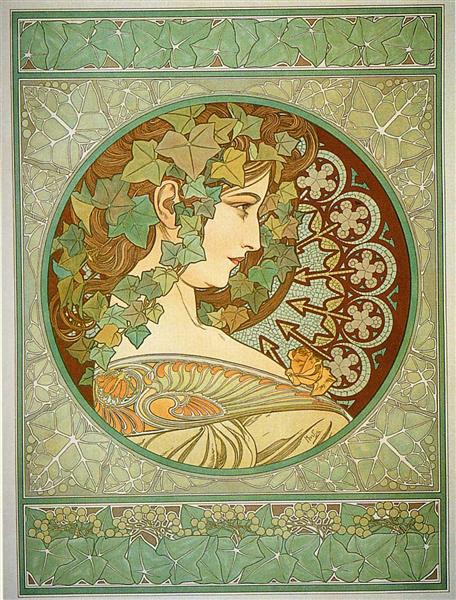
laurel-1901.jpg!Large

       Laurel”  (1901) 


             Alphonse Mucha


                         _______


however ardently might’ve Phoebus 

been pleading his case before 

Daphne, his, however recalcitrant,  

intended, flashing his divine pedigree, 

vowing to put all that aside to serve 

only her


               She heard not half; so furiously she flies;
               And on her ear th’ imperfect accent dies, 


th’ imperfect accent might be the 

unnatural tone of a divinity Daphne 

might be hearing, the unusual timbre 

of a deity’s voice, I can’t imagine Ovid 

would be suggesting that Daphne and 

Phoebus spoke different Greek dialects


perhaps th’ imperfect accent is the

unsettling manner of his entreaties,

his indecorous urgency


poets can be confounding


               Fear gave her wings; and as she fled, the wind
               Increasing, spread her flowing hair behind;
               And left her legs and thighs expos’d to view:
               Which made the God more eager to
pursue. 


the pagan gods were notoriously 

mischievous, spirited, impulsive,

quite human, never sublime and

irreproachable as is the Abrahamic 

Supreme Deity


the pagan gods lived in the fields

and streams, the hills and vales,

the seas and mountains, that 

surrounded Greek and Roman 

communities, Olympus was their 

steepest height, never the 

supernatural elevations, beyond 

even our visible heaven, that our 

present pervasive monotheism 

proclaims


               The God was young, and was too hotly bent
               To lose his time in empty compliment:
               But led by love, and fir’d with such a sight,
               Impetuously pursu’d his near delight. 


often, the gods of antiquity were

perverse, not at all blameless,

not innocent, not irreproachable, 

like the one and only god that, 

today, in its several interpretations, 

even murderously conflicting, rules,

oversees, mostly, our present, at 

least Western, faith communities


               As when th’ impatient greyhound slipt from far,

               Bounds o’er the glebe to course the fearful hare,


glebe, fields


               She in her speed does all her safety lay; 
               And he with double speed pursues the prey; 
               O’er-runs her at the sitting turn, and licks 
               His chaps in vain, and blows upon the flix: 


flix, fur, the greyhound’s pelt 


perhaps greyhounds do this, blow

upon their flix, you’ll have to ask 

Ovid, or maybe Dryden, his 

translator


               She scapes, and for the neighb’ring covert strives, 


 a covert, a bush in which to hide


               And gaining shelter, doubts if yet she lives: 


doubts if yet she lives, she can’t 

believe she made it 


               If little things with great we may compare,
               Such was the God, and such the flying fair, 


the flying fair, Daphne, the God,

Phoebus


               She urg’d by fear, her feet did swiftly move,
               But he more swiftly, who was urg’d by love. 


love, as Ovid, or is it, once again,  

Drydenwho defines it, urg’d, 

compelled by hormones, not at all 

our romantic conception of it


               He gathers ground upon her in the chace:
               Now breathes upon her hair, with nearer pace;
               And just is fast’ning on the wish’d embrace. 


Red Riding Hood and the Big

Bad Wolf


               The nymph grew pale, and in a mortal fright,
               Spent with the labour of so long a flight; 


Spent, defeated


               And now despairing, cast a mournful look
               Upon the streams of her paternal brook; 


her father, Peneus, was a river god, 

if you’ll remember, paternal brook, 

the rill, the rivulet, of her father


               Oh help, she cry’d, in this extreamest need!
               If water Gods are deities indeed: 


if there is a god, be with me, she 

cry’d, you, yourself, I’m sure, have 

been there, though Daphne‘s faith 

was grounded in help, in this case, 

from her father, god of, appropriately

in this instance, streams


               Gape Earth, and this unhappy wretch intomb; 


I’d rather die, Daphne pleads, I’d

rather the earth swallowed me up, 

I’d rather be intomb[ed]


               Or change my form, whence all my sorrows come. 


transform me, rid me of what makes 

me appealing, Daphne pleads


               Scarce had she finish’d, when her feet she found
               Benumb’d with cold, and fasten’d to the ground:
               A filmy rind about her body grows; 


a condition I’ve found not unlike the 

ravages I call, ironically, bark, crusty 

imperfections that afflict my own 

ageing body


               Her hair to leaves, her arms extend to boughs:
               The nymph is all into a lawrel gone; 


Daphne is turning into a tree,

a lawrel 


               The smoothness of her skin remains alone. 


of Daphne, only her smoothness 

remains


               Yet Phoebus loves her still, and casting round
               Her bole, his arms, some little warmth he found. 


bole, the stem of a tree


               The tree still panted in th’ unfinish’d part: 


where Daphne had not yet become

a tree, she still panted, pulsed


               Not wholly vegetive, and heav’d her heart. 


heav’d her heart, passionately

reacted


               He fixt his lips upon the trembling rind; 


rind, bark


               It swerv’d aside, and his embrace declin’d. 


kisses not at all sweeter than wine,

said the lawrel 


               To whom the God, Because thou canst not be
               My mistress, I espouse thee for my tree: 


Phoebus begins to speak directly 

here, Because thou canst not be, /

My mistress, he says, I espouse 

thee for my tree: 


espouse, marry


               Be thou the prize of honour, and renown; 


you will be, he continues, the 

prize that will represent heroes


               The deathless poet, and the poem, crown. 


honour, first of all, worthy, deathless, 

poets, Phoebus commands, let the 

laurel wreath crown deserving 

wordsmiths


Ovid had reason to champion poets,

he’d been exiled from Rome by the

Emperor, Augustus, his catering to

the Roman ruler becomes 

intermittently evident throughout 

this masterpiece


               Thou shalt the Roman festivals adorn,
               And, after poets, be by victors worn. 


victors, Olympic champions, notably


               Thou shalt returning Caesar’s triumph grace; 


Ovid curries imperial favour here with 

Augustus, by simply immortalizing in

poetry the name of Caesar, the new

Emperor’s great-uncle, and adoptive

father, making his own personal 

nemesis shine, for what it might be 

worth, by association


               When pomps shall in a long procession pass. 


the parades will be long ones


               Wreath’d on the posts before his palace wait; 


the laurel leaves will garland the 

posts, stations, before, in front of, 

the imperial palace


               And be the sacred guardian of the gate.
               Secure from thunder, and unharm’d by Jove, 


even Jove / Jupiter, god of gods,

will stand by, honour, the symbol 

of the laurel


               Unfading as th’ immortal Pow’rs above: 


Unfading, into very eternity


it’s interesting to note that the 

laurel has not lost its significance

despite the intervening centuries, 

epochs, we find reference to it even 

in the honorific title of laureate, as 

in Nobel laureate, or even in the

accolade of baccalaureate, the

bachelor’s degree, the prestigious

academic accomplishment 


Unfading indeed


               And as the locks of Phoebus are unshorn, 


Phoebus always sports perfect 

hair


               So shall perpetual green thy boughs adorn.


it would seem that, according to 

this, laurel leaves, perpetual 

green, don’t ever lose their 

colour, but I can’t attest to this,

being a poet rather than an

arborist, a gardener, though

bay leaves, laurel, even dry,

don’t turn brown, I’ve since

noticed


               The grateful tree was pleas’d with what he said;
               And shook the shady honours of her head. 


and they all lived happily ever 

after


or didn’t


myths are the enduring fairy tales 

that adults continue to believe in, 

according to their culture, about 

men and women rather than 

boys and girls, they help us, like

fairy tales, make up our moral 

order


R ! chard


“Metamorphoses” (The Giants’ War, XIV) – Ovid

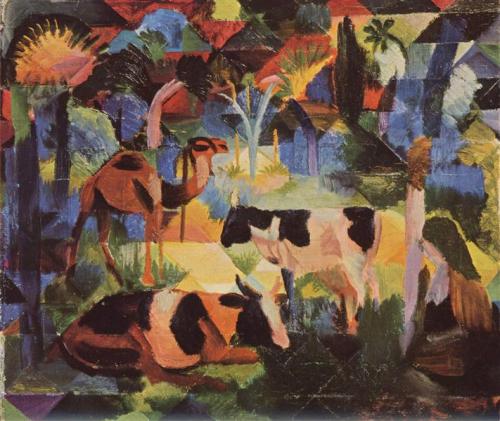
landscape-with-cows-and-a-camel.jpg!Large

    Landscape with Cows and a Camel (1914) 


               August Macke


                   ________


once Deucalion and Pyrrha had found

the way to bring humans back to life, 

it was time to turn to the creation, or

recreation, of other species


              The rest of animals, from teeming Earth
              Produc’d, in various forms receiv’d their birth. 


the rest of animals suggests that 

people were also considered to

be animals, of an however more

elevated, presumably, order


              The native moisture, in its close retreat,
              Digested by the sun’s aetherial heat,
              As in a kindly womb, began to breed: ,
              Then swell’d, and quicken’d by the vital seed. 


by means of the moisture naturally

created by the retreating flood waters, 

the native moisture, the heat of the sun, 

however aetherial, or etherial, which is 

to say of ether, which is to say invisible, 

swell[s], and quicken[s] … the vital seed

the seed which is pregnant with life, or

vital, and nurtures it, swell[s] and 

quicken[s] it, as though within a womb


              And some in less, and some in longer space, 


less, or longer space, of time


              Were ripen’d into form, and took a sev’ral face. 


different kinds of animals, animals with

sev’ral face[s], see, for instance, above

ripen’d, or evolved during longer or 

shorter periods of time, a notion that 

was decisively revisited some nearly 

two thousand years later, incidentally, 

by Charles Darwin 


              Thus when the Nile from Pharian fields is fled, 


Pharian fields, Egypt, from Pharos,

an island off the coast of Alexandria

notable for its lighthouse, itself called 

Pharos, one of the Seven Wonders of 

the Ancient World


              And seeks, with ebbing tides, his ancient bed, 


his ancient bed, the area of earth 

that the Nile had covered during 

the flood, its now exposed river 

banks


the Nile is, note, masculine here, 

his ancient bed


              The fat manure with heav’nly fire is warm’d; 


there’s the heat again


             And crusted creatures, as in wombs, are form’d; 


crusted, it is interesting to note that

apart from the animal feature of the 

womb, all of the terms to describe 

the process of coming to life refer

to plants, see also ripen’d above,

for instance, not to mention the 

vital seed


              These, when they turn the glebe, the peasants find; 


glebe, cultivated land, when the 

peasants plough their fields, they 

find [t]hese, the crusted creatures


              Some rude, and yet unfinish’d in their kind:
              Short of their limbs, a lame imperfect birth:
              One half alive; and one of lifeless earth. 


not all births are successful

              For heat, and moisture, when in bodies join’d,
              The temper that results from either kind
              Conception makes; 
 

life is the product of heat, and moisture

sparking, quicken[ing], matter, bodies, 

a succinct postulation, a metaphysical 

observation, presaging the 17th Century’s 

turn toward the natural sciences, Galileo

Isaac Newton, for instance, coming 

already, and not inaccurately, from the 

age of, at least, Julius Caesar 


it often appals me what was lost of

significant information during the

Middle, the Dark, the Annihilating,

Ages


                                             and fighting ’till they mix,
              Their mingled atoms in each other fix.
              Thus Nature’s hand the genial bed prepares
              With friendly discord, and with fruitful wars. 


generation is a struggle between 

chaos and order, at the most 

fundamental level, according to

Ovid 


              From hence the surface of the ground, with mud
              And slime besmear’d (the faeces of the flood), 


get down


              Receiv’d the rays of Heav’n: and sucking in
              The seeds of heat, 


you can hear the squelch here,

the slim[y] suction


                                             new creatures did begin:
              Some were of sev’ral sorts produc’d before,
              But of new monsters, Earth created more. 


among the new creatures, many 

had existed earlier, been already 

produc’d, but new monsters as 

well sprouted, apparently 

inescapably


              Unwillingly, but yet she brought to light
              Thee, Python too, the wondring world to fright, 


she, the Earth


Python, a mythological serpent, which

guarded Delphi, brought back to light,

or life, the wondring world to fright


              And the new nations, with so dire a sight:
              So monstrous was his bulk, so large a space
              Did his vast body, and long train embrace.
              Whom Phoebus basking on a bank espy’d; 


Phoebus, another name for Apollo

patron deity at Delphi


              E’re now the God his arrows had not try’d
              But on the trembling deer, or mountain goat; 


Phoebus had never needed to try[ ]

his arrow[ ] at anything other than 

game, trembling deer, … mountain 

goat


              At this new quarry he prepares to shoot.
              Though ev’ry shaft took place, he spent the store
              Of his full quiver; and ’twas long before
              Th’ expiring serpent wallow’d in his gore. 


it wasn’t easy


              Then, to preserve the fame of such a deed,
              For Python slain, he Pythian games decred. 


Pythian games, games installed, decreed,  

decred, to honour the slaying of the serpent


              Where noble youths for mastership shou’d strive,
              To quoit, to run, and steeds, and chariots drive. 


to quoit, to throw a ring in a game in

order to encircle at a distance a peg


              The prize was fame: in witness of renown
              An oaken garland did the victor crown. 


nothing other than a crown of oak 

leaves, an oaken garland, was the 

prize at the Pythian Games, but 

enough to assure the fame, the 

glory, of the exalted champion


              The laurel was not yet for triumphs born; 


a crown of laurel leaves, rather than 

of oak, eventually became the symbol 

of triumphs


              But every green alike by Phoebus worn,
              Did, with promiscuous grace, his flowing locks adorn. 


but until the laurel crown prevailed,

an honour associated later, notably, 

with the Ancient Greek Olympics

winners still sported with 

promiscuous grace, the green, the 

colour of Phoebus‘ chosen leaves,

in that god’s honour


later episodes of Metamorphoses

will describe the transformation of

particular people into other 

entities, trees, animals, stars, very

constellations, but for now the 

Creation is complete, the Giants’

War concluded, and the Earth 

replenished, given new life


I suspect that from now on I’ll only

intermittently comment on some 

of the stories in this extraordinary

collection, for this poem is ever as 

long as the very Bible, the only 

other Creation myth, incidentally,  

in the West, a task I expect I’ll 

follow mostly on my own, given

my admittedly idiosyncratic, often

maybe too forbidding, inclinations,

inspirations, interests


but thank you so much for having

listened in, partaken, during this, 

to my mind, fascinating exploration,

this conversation with, I think, 

enlightening, and indeed

ennobling, art


all the very best


R ! chard 


“Metamorphoses” (The Giants’ War, III) – Ovid

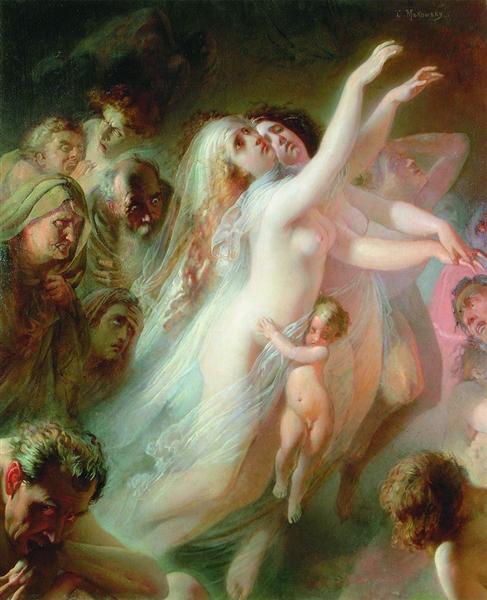
charon-carries-dead-souls-across-the-river-styx.jpg!Large

    “Charon Carries Dead Souls across the River Styx(1861)


           Konstantin Makovsky


                 ____________


Jove, god of Thunder, speaks


            I was not more concern’d in that debate
            Of empire, when our universal state
            Was put to hazard, and the giant race
            Our captive skies were ready to imbrace: 


I was not especially disturbed, Jove says,

when the state of our universe was 

challenged, or debate[d], when the giants 

tried to usurp our territory, were ready to 

imbrace, or embrace, take on, our  

vulnerable, [o]ur captive, skies


            For tho’ the foe was fierce, the seeds of all
            Rebellion, sprung from one original; 


because the enemy, then, the adversary, 

came from the one original source, its 

however manifold predations, its 

however myriad desecrations, would’ve

been identifiable to Jove, not foreign, not

unmanageable, he would’ve recognized

the black sheep of the Olympian family,

the giants  


            Now, wheresoever ambient waters glide,
            All are corrupt, and all must be destroy’d. 


ambient, nearby, related, infected, corrupt,

all has been corrupted


            Let me this holy protestation make,
            By Hell, and Hell’s inviolable lake, 


here’s another anachronism, for Hell wouldn’t’ve 

been even a concept in the era of Ovid, where

the Underworld, and Hades, entirely different

afterworlds, would’ve prevailed, areas of 

persistent gloom and shade, see Homer here,

for instance, or Virgil


the Underworld of the ancient world was 

surrounded by five rivers, Hell’s inviolable 

lake, the most famous of which was the 

river Styx


in the Divine Comedy, Dante updates this 

watery boundary for his own 14th Century

readers, and makes it the passageway to

the fifth circle of Hell, where Charon 

remains, after even over a thousand 

years, the very same ferryman


see above


nor was there either any of our present

conception of Heaven, Heaven would’ve 

been Olympus then, the exclusive domain 

of the Gods, either Greek or Roman 


            I try’d whatever in the godhead lay: 


Jove says, I tried everything a god 

could use


            But gangren’d members must be lopt away,
            Before the nobler parts are tainted to decay. 


you’ve got to lop[ ] away, cut off, the bad 

parts before they infect the more vital 

components of the body

 
            There dwells below, a race of demi-gods,
            Of nymphs in waters, and of fawns in woods:
            Who, tho’ not worthy yet, in Heav’n to live,
            Let ’em, at least, enjoy that Earth we give. 


not all beings are corrupt, but nymphs 

and fawns, innocents, Jove pleads, 

should be given consideration on 

Earth, if they be not yet worthy of the 

majesty of Heav’n, and granted earthly 

areas of enjoyment in the confines of 

their forsaken place 


            Can these be thought securely lodg’d below,
            When I my self, who no superior know,
            I, who have Heav’n and Earth at my command,
            Have been attempted by Lycaon’s hand? 


if Lycaon could attack me, Jove, god 

of Thunder, asks, how can these 

innocents, nymphs, fawns, ever be 

safe


             At this a murmur through the synod went,
             And with one voice they vote his punishment. 


the punishment of Lycaon, which we’ll 

soon encounter


             Thus, when conspiring traytors dar’d to doom
             The fall of Caesar, and in him of Rome,
             The nations trembled with a pious fear;
             All anxious for their earthly Thunderer: 


Thus, or in a similar manner, did the nations

of the earth tremble when Caesar, their 

earthly Thunderer, was assassinated 


nations, incidentally, is another anachronism,

nations didn’t appear on earth until the 

18th Century, with the French Revolution


             Nor was their care, o Caesar, less esteem’d
             By thee, than that of Heav’n for Jove was deem’d: 


Ovid addresses Caesar here, his contemporary,

and compares that emperor’s esteem for nations, 

his reliance on their allegiance, to the esteem 

Heav’n has for Jove


             Who with his hand, and voice, did first restrain
             Their murmurs, then resum’d his speech again. 


Jove calls for silence in the assembly

before speaking again


             The Gods to silence were compos’d, and sate
             With reverence, due to his superior state. 


The Gods … sate, or sat, then took heed,

bowing to Jove’s superior position


the tale of the punishment of Lycaon

will follow  


R ! chard


Symphony no 7 in C major, opus 60, the “Leningrad”- Dmitri Shostakovich

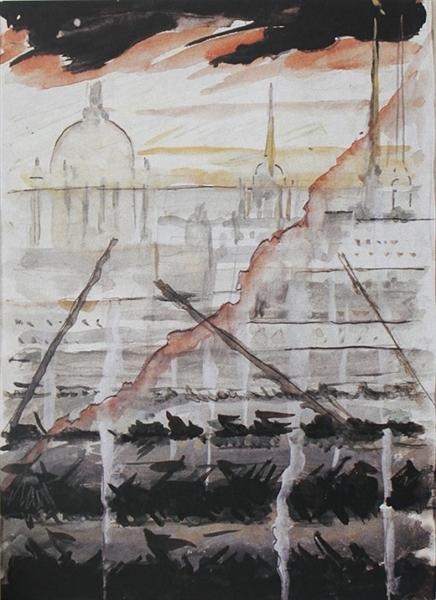
leningrad-in-blockade-sketch-on-the-theme-of-leningrad-symphony-of-d-d-shostakovich-1943.jpg!Large.jpg

Leningrad in blockade. Sketch on the theme of 
         “Leningrad Symphony” of D. D. Shostakovich. 
                                                                (c.1943) 

     Mstislav Dobuzhinsky

             __________

though I’ve been through the Seventh 
three times already, consecutively, it
doesn’t reach, for me, the heights the 
Fifth did, its first movement is
manifestly imperious, nearly even 
overwhelming, certainly unforgettable, 
I’ve been humming the ostinato in my 
sleep

but the following movements seem to 
me – not being Russian, nor having as
intimately incorporated their culture, 
where rhythms and history are 
inextricably intertwined – muddled 
about the reconstruction of its 
shattered world, melodies might be
lovely but are lost in a blur of musical
directions, there isn’t enough repetition 
of musical motifs to find solid ground, 
angry statements follow lyrical adagios
too often to get our bearings on what 
might be going on 

the first movement, however, remains a 
triumph, note the debt owed to Ravel’s 
Bolero in the rousing ostinato, the 
part where the same musical phrase 
obstinately repeats its peremptory and 
ever more vociferous mantra, its 
headlong incantation, an interesting 
blend in either symphonic work of the 
sinuous, the seductive, the beguiling,
turning into the overtly martial, all to 
do with pulse 

the Symphony no 7, the “Leningrad”,
was first presented in that very city 
during its siege by the Germans
which lasted from 1941 to 1944, 
however unbelievably, Shostakovich, 
already giant, was expected to deliver 
masterpiece by both the people and 
by the regime, imagine Bono doing a
concert for Syria 

Shostakovich doesn’t disappoint

players were culled from what remained 
of instrumentalists among the survivors
of both Stalin’s criminal purges and of 
the German siege itself left in the city, 
those who hadn’t survived the famine
there, Valery Gergiev, an exalted 
Russian conductor, describes them as
walking skeletonsmeagre from 
starvation, we’ve seen these before at 
Auschwitz

the world heard, and was moved, 
imperialism in any form was being 
vociferously condemned, going back 
to Napoleon even and his own failed 
invasion, if not also to Hannibal 
crossing the Alps, Caesar, his 
Rubicon

much of this symphony is about cultural 
resistance, the survival of a proud and 
resilient seed, any proud and resilient 
seed, hence its international standing

see Beethoven’s 9th Symphony for 
comparable fanfare, flourish, and 
circumstance, the only other work of
any such historical political importance
and, appreciably, still unsurpassed,

except for, maybe, Roger Waters
channeling Pink Floyd at the Berlin 
Wall, along with, not incidentally
thereagain Beethoven 


R ! chard

psst: the other great composer of the 
          20th Century, Messiaen, also 
          composed a commemoration of
          an awful moment in our history,
          the Holocaust, his Quartet for 
          the End of Time“, played originally
          in his very concentration camp by 
          similarly “walking skeletons”, does   
          for me everything Shostakovich’s 
          Seventh didn’t 


a coronation anthem – Handel‏

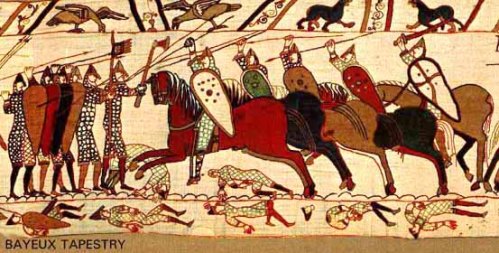
Normans_Bayeux

                      “the Battle of Hastings” –  the Bayeux Tapestry 

                                       ______________________ 

among the ruling entities in our, indeed,
global history, none apart from the Catholic
Church has lasted so long as the English
monarchy, not even the Roman Empire, 
from Julius Caesar in 48 BCE, the year he 
took power, called himself emperor, until
Charlemagne, King of the Franks, who on 
the highly political date of December 25, 
800 CE, and at St Peter’s very Basilica in 
Rome, wrenched power from Leo lllthen 
Pope, and claimed the title of Holy Roman 
Emperor, Protector, thus, of the Church, 
changing thereby the face of Europe, and
burying forever Ancient Rome’s aegis
yes, aegis, protectorate
 
in 1066, once again on the propitious, 
apparently, date of Christmas Day, 
William the Conqueror, after his Norman 
Conquest, and the Battle of Hastings
proclaimed himself first king of England
in London
 
we count from there to Queen Elizabeth ll,
still monarch after all these years
 
here’s a pictorial rundown to the tune of 
England’s musical specialty, the ceremonial, 
one of Handel‘s Coronation Anthems 
commissioned for George ll by his dad, 
George l, for his 1727 coronation, though 
not, this time, on Christmas Day, sung at 
coronations apparently ever since
 
the Priest after the mystic who anointed 
 
long live the Queen, I guess
 
 
Richard