Richibi’s Weblog

Just another WordPress.com weblog

Tag: Jove / Jupiter

“The Transformation of Daphne into a Lawrel” (III) – Ovid

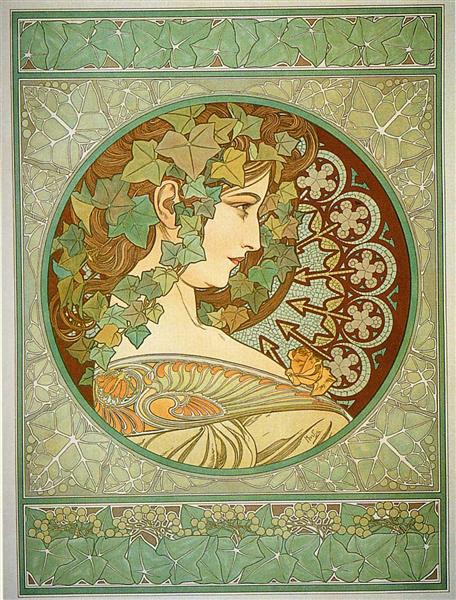
laurel-1901.jpg!Large

       Laurel”  (1901) 


             Alphonse Mucha


                         _______


however ardently might’ve Phoebus 

been pleading his case before 

Daphne, his, however recalcitrant,  

intended, flashing his divine pedigree, 

vowing to put all that aside to serve 

only her


               She heard not half; so furiously she flies;
               And on her ear th’ imperfect accent dies, 


th’ imperfect accent might be the 

unnatural tone of a divinity Daphne 

might be hearing, the unusual timbre 

of a deity’s voice, I can’t imagine Ovid 

would be suggesting that Daphne and 

Phoebus spoke different Greek dialects


perhaps th’ imperfect accent is the

unsettling manner of his entreaties,

his indecorous urgency


poets can be confounding


               Fear gave her wings; and as she fled, the wind
               Increasing, spread her flowing hair behind;
               And left her legs and thighs expos’d to view:
               Which made the God more eager to
pursue. 


the pagan gods were notoriously 

mischievous, spirited, impulsive,

quite human, never sublime and

irreproachable as is the Abrahamic 

Supreme Deity


the pagan gods lived in the fields

and streams, the hills and vales,

the seas and mountains, that 

surrounded Greek and Roman 

communities, Olympus was their 

steepest height, never the 

supernatural elevations, beyond 

even our visible heaven, that our 

present pervasive monotheism 

proclaims


               The God was young, and was too hotly bent
               To lose his time in empty compliment:
               But led by love, and fir’d with such a sight,
               Impetuously pursu’d his near delight. 


often, the gods of antiquity were

perverse, not at all blameless,

not innocent, not irreproachable, 

like the one and only god that, 

today, in its several interpretations, 

even murderously conflicting, rules,

oversees, mostly, our present, at 

least Western, faith communities


               As when th’ impatient greyhound slipt from far,

               Bounds o’er the glebe to course the fearful hare,


glebe, fields


               She in her speed does all her safety lay; 
               And he with double speed pursues the prey; 
               O’er-runs her at the sitting turn, and licks 
               His chaps in vain, and blows upon the flix: 


flix, fur, the greyhound’s pelt 


perhaps greyhounds do this, blow

upon their flix, you’ll have to ask 

Ovid, or maybe Dryden, his 

translator


               She scapes, and for the neighb’ring covert strives, 


 a covert, a bush in which to hide


               And gaining shelter, doubts if yet she lives: 


doubts if yet she lives, she can’t 

believe she made it 


               If little things with great we may compare,
               Such was the God, and such the flying fair, 


the flying fair, Daphne, the God,

Phoebus


               She urg’d by fear, her feet did swiftly move,
               But he more swiftly, who was urg’d by love. 


love, as Ovid, or is it, once again,  

Drydenwho defines it, urg’d, 

compelled by hormones, not at all 

our romantic conception of it


               He gathers ground upon her in the chace:
               Now breathes upon her hair, with nearer pace;
               And just is fast’ning on the wish’d embrace. 


Red Riding Hood and the Big

Bad Wolf


               The nymph grew pale, and in a mortal fright,
               Spent with the labour of so long a flight; 


Spent, defeated


               And now despairing, cast a mournful look
               Upon the streams of her paternal brook; 


her father, Peneus, was a river god, 

if you’ll remember, paternal brook, 

the rill, the rivulet, of her father


               Oh help, she cry’d, in this extreamest need!
               If water Gods are deities indeed: 


if there is a god, be with me, she 

cry’d, you, yourself, I’m sure, have 

been there, though Daphne‘s faith 

was grounded in help, in this case, 

from her father, god of, appropriately

in this instance, streams


               Gape Earth, and this unhappy wretch intomb; 


I’d rather die, Daphne pleads, I’d

rather the earth swallowed me up, 

I’d rather be intomb[ed]


               Or change my form, whence all my sorrows come. 


transform me, rid me of what makes 

me appealing, Daphne pleads


               Scarce had she finish’d, when her feet she found
               Benumb’d with cold, and fasten’d to the ground:
               A filmy rind about her body grows; 


a condition I’ve found not unlike the 

ravages I call, ironically, bark, crusty 

imperfections that afflict my own 

ageing body


               Her hair to leaves, her arms extend to boughs:
               The nymph is all into a lawrel gone; 


Daphne is turning into a tree,

a lawrel 


               The smoothness of her skin remains alone. 


of Daphne, only her smoothness 

remains


               Yet Phoebus loves her still, and casting round
               Her bole, his arms, some little warmth he found. 


bole, the stem of a tree


               The tree still panted in th’ unfinish’d part: 


where Daphne had not yet become

a tree, she still panted, pulsed


               Not wholly vegetive, and heav’d her heart. 


heav’d her heart, passionately

reacted


               He fixt his lips upon the trembling rind; 


rind, bark


               It swerv’d aside, and his embrace declin’d. 


kisses not at all sweeter than wine,

said the lawrel 


               To whom the God, Because thou canst not be
               My mistress, I espouse thee for my tree: 


Phoebus begins to speak directly 

here, Because thou canst not be, /

My mistress, he says, I espouse 

thee for my tree: 


espouse, marry


               Be thou the prize of honour, and renown; 


you will be, he continues, the 

prize that will represent heroes


               The deathless poet, and the poem, crown. 


honour, first of all, worthy, deathless, 

poets, Phoebus commands, let the 

laurel wreath crown deserving 

wordsmiths


Ovid had reason to champion poets,

he’d been exiled from Rome by the

Emperor, Augustus, his catering to

the Roman ruler becomes 

intermittently evident throughout 

this masterpiece


               Thou shalt the Roman festivals adorn,
               And, after poets, be by victors worn. 


victors, Olympic champions, notably


               Thou shalt returning Caesar’s triumph grace; 


Ovid curries imperial favour here with 

Augustus, by simply immortalizing in

poetry the name of Caesar, the new

Emperor’s great-uncle, and adoptive

father, making his own personal 

nemesis shine, for what it might be 

worth, by association


               When pomps shall in a long procession pass. 


the parades will be long ones


               Wreath’d on the posts before his palace wait; 


the laurel leaves will garland the 

posts, stations, before, in front of, 

the imperial palace


               And be the sacred guardian of the gate.
               Secure from thunder, and unharm’d by Jove, 


even Jove / Jupiter, god of gods,

will stand by, honour, the symbol 

of the laurel


               Unfading as th’ immortal Pow’rs above: 


Unfading, into very eternity


it’s interesting to note that the 

laurel has not lost its significance

despite the intervening centuries, 

epochs, we find reference to it even 

in the honorific title of laureate, as 

in Nobel laureate, or even in the

accolade of baccalaureate, the

bachelor’s degree, the prestigious

academic accomplishment 


Unfading indeed


               And as the locks of Phoebus are unshorn, 


Phoebus always sports perfect 

hair


               So shall perpetual green thy boughs adorn.


it would seem that, according to 

this, laurel leaves, perpetual 

green, don’t ever lose their 

colour, but I can’t attest to this,

being a poet rather than an

arborist, a gardener, though

bay leaves, laurel, even dry,

don’t turn brown, I’ve since

noticed


               The grateful tree was pleas’d with what he said;
               And shook the shady honours of her head. 


and they all lived happily ever 

after


or didn’t


myths are the enduring fairy tales 

that adults continue to believe in, 

according to their culture, about 

men and women rather than 

boys and girls, they help us, like

fairy tales, make up our moral 

order


R ! chard


“Metamorphoses” (The Giants’ War, IV) – Ovid

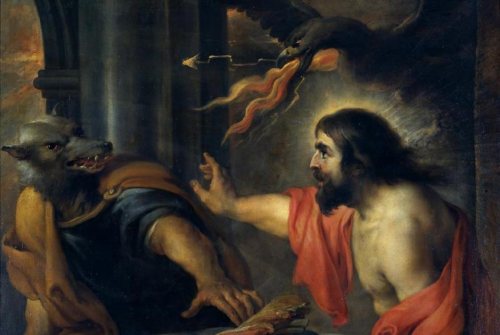
Lycaon-Greece

    “Jupiter and Lycaon” 


          Jan Cossiers


              _______


having already warned his court of Lycaon’s

excesses, Jove instructs his deities to


             Cancel your pious cares; already he
             Has paid his debt to justice, and to me. 


job accomplished


             Yet what his crimes, and what my judgments were,
             Remains for me thus briefly to declare. 


let me tell you briefly, however, how

I came about it, Jove confides


             The clamours of this vile degenerate age,
             The cries of orphans, and th’ oppressor’s rage,
             Had reach’d the stars: 


he tells them


                                               I will descend, said I,
             In hope to prove this loud complaint a lye. 


in order to prove that these clamours 

stood for nothing, this loud complaint 

a lye, or lie, he would, Jove explains,  

descend to Earth in order to investigate  


             Disguis’d in humane shape, I travell’d round
             The world, and more than what I heard, I found. 


from his travels around the world,  

his proofs, Jove claims, were mostly 

personally obtained, rather than 

having been merely hearsay


humane here, note, is an archaic 

spelling of human


             O’er Maenalus I took my steepy way, 


Mount Maenalus, Latin for Mainalo, was 

mountain in Ancient Greece, sacred, 

incidentally, to the god Pan, god of 

rusticity, undomesticated nature 


             By caverns infamous for beasts of prey: 


beasts of prey, note, would not have

been unexpected in Pan‘s territory


             Then cross’d Cyllene, and the piny shade
             More infamous, by curst Lycaon made: 


Mount Cyllene, or Kyllini, is again a 

mountain in Ancient Greece, this one 

sacred to the god Hermes, god of 

messages, communication, travellers, 

speedy deliveries


what Lycaon did to make the piny shade 

of Mount Cyllene more infamous, I’m 

afraid I haven’t been able to ferret out


             Dark night had cover’d Heaven, and Earth, before
             I enter’d his unhospitable door. 


nighttime permeates Jove’s arrival in

this new, and unfamiliar, unhospitable,

environment 


            Just at my entrance, I display’d the sign
            That somewhat was approaching of divine. 


as he entered this unfamiliar place, 

Jove says, he display’d the sign of

his divinity, but one only approaching 

of divine, he specifies, a subtle sign, 

something merely suggestive 


             The prostrate people pray; the tyrant grins; 


[t]he prostrate people get it, prostrate,

face down in reverence or submission, 

Lycaon, the tyrant, however, doesn’t


            And, adding prophanation to his sins, 


prophanation, profanation


            I’ll try, said he, and if a God appear,
            To prove his deity shall cost him dear. 


Lycaon challenges the god, any god,

to, should he appear, prove his divinity,

goddesses, surely also, would’ve been 

similarly confronted, otherwise any

impostor would grievously suffer


            ‘Twas late; the graceless wretch my death prepares,
             When I shou’d soundly sleep, opprest with cares: 


while Jove sleeps, giving respite to 

his cares, Lycaon plots his murder


             This dire experiment he chose, to prove
             If I were mortal, or undoubted Jove: 


[t]his, or what is to follow, Jove points out, is

the method Lycaon had already decided he

would try out to determine Jove’s undoubted, 

or indubitable, divinity


             But first he had resolv’d to taste my pow’r; 


the test


             Not long before, but in a luckless hour,
             Some legates, sent from the Molossian state,
             Were on a peaceful errand come to treat: 


legates, ambassadors


the Molossians, a tribe of Ancient 

Greece come to peacefully confer 

with Lycaon


             Of these he murders one, he boils the flesh;
             And lays the mangled morsels in a dish:
             Some part he roasts; then serves it up, so drest,
             And bids me welcome to this humane feast. 


humane here again is an olden form

of human, as in they were feasting 

on human flesh


             Mov’d with disdain, the table I o’er-turn’d;
             And with avenging flames, the palace burn’d. 


Jove thunders, see above


             The tyrant in a fright, for shelter gains
             The neighb’ring fields, and scours along the plains. 


Lycaon has realized that this guest is 

indeed a god


             Howling he fled, and fain he wou’d have spoke;
             But humane voice his brutal tongue forsook. 


fain, or most willingly


again here humane means human, 

Lycaon could no longer speak in a 

human voice

 
             About his lips the gather’d foam he churns,
             And, breathing slaughters, still with rage he burns, 


though his voice and lips begin to be

affected, Lycaon continues through 

this channel to fume, rage, breath[e] 

slaughters 


             But on the bleating flock his fury turns. 


but his anger, his fury, is now directed 

towards flocks of bleating sheep


             His mantle, now his hide, with rugged hairs
             Cleaves to his back; a famish’d face he bears;
             His arms descend, his shoulders sink away
             To multiply his legs for chase of prey. 


the metamorphosis of Lycaon has 

begun, he wears a hide instead of 

a mantle, an overgarment, his back 

becomes hairy, his arms become 

legs as his shoulders sink away

a transformation appropriate to 

hunt prey 


             He grows a wolf, his hoariness remains, 


hoariness, the condition of being 

old and grey, a remnant of his 

earlier human self


             And the same rage in other members reigns.
             His eyes still sparkle in a narr’wer space:
             His jaws retain the grin, and violence of his face 


Lycaon’s members, or limbs, rage, 

or exhibit fury


his eyes become narrower


Lycaon has turned into a wolf


R ! chard


“Metamorphoses” (The Giants’ War, II) – Ovid, 110

the-marriage-at-cana-1563.jpg!Large

      “The Marriage at Cana (1563) 


              Paolo Veronese


                  _________


Jove “sigh’d;” if you’ll remember, “nor 

longer with his pity strove; / But kindled 

to a wrath” which was worthy of him


           Then call’d a general council of the Gods;

           Who summon’d, issue from their blest abodes,

           And fill th’ assembly with a shining train. 


Jove calls the gods together to discuss 

the abhorrent conditions on Earth, who, 

upon being summon’d, leave their blest, 

or blessed, homes, and fill Jove’s 

assembly hall with their glittering train, 

their advancing pageantry


           A way there is, in Heav’n’s expanded plain,

           Which, when the skies are clear, is seen below,

           And mortals, by the name of Milky, know. 


when the skies are clear in Heaven’s

expanded plain, its wide expanse, 

mortals can see the Milky Way


           The ground-work is of stars; through which the road

           Lyes open to the Thunderer’s abode: 


this Milky Way is paved with stars, which

lead to Jove’s, the Thunderer’s, domain


           The Gods of greater nations dwell around, 

           And, on the right and left, the palace bound;


the dwellings of the gods who represent 

the greater nations of the era, of Rome, 

for instance, or Greece, surround,

encircle, the Thunderer’s abode, his 

palace 


           The commons where they can: the nobler sort

           With winding-doors wide open, front the court. 


the more common gods, those of 

lesser nations, live where they can, 

while the winding-doors of the nobler 

gods, doors which can be activated

mechanically, on hinges, though 

perhaps here divinely, stand wide 

open for this colloquy, this exalted 

conference, before the celestial 

court 


           This place, as far as Earth with Heav’n may vie,

           I dare to call the Louvre of the skie. 


if one were to compare [t]his place

this court, to anything on Earth, have 

it vie with, one would liken it, Ovid 

says, to the Louvre


there’s evidently an anachronism 

here since the Louvre didn’t exist at

the time of Ovid, so that the translators 

have replaced the “Palatia” of Ovid’s 

original Latin, which refers to the 

Palatine, the most central of Rome’s

Seven Hillswhere imperial palaces

were built at the time of Augustus

63 B.C. to 14 A.D., which is to say 

during Ovid’s time, 43 B.C. to 

17 /18 A.D., by this relatively more 

recent palatial residence, the Louvre,

in order to make the text more

contemporary, like settings and 

attire are used in Renaissance

art to kindle the viewer’s sense 

of connection


see, for instance, above, where 

Veronese depicts the scene of Jesus 

attending a marriage at Cana, a village 

in Galilee, and transforms water there 

into wine to accommodate a shortage,

midst Roman, note, rather than Galilean, 

trappings, splendour


           When all were plac’d, in seats distinctly known, 

           And he, their father, had assum’d the throne,


seats distinctly known means the

traditionally assigned places, with 

Jove, “their father”, at the head of

the convocation 


           Upon his iv’ry sceptre first he leant,
           Then shook his head, that shook the firmament: 


leant, or leaned, [t]hen shook his head

in revulsion


           Air, Earth, and seas, obey’d th’ almighty nod;
           And, with a gen’ral fear, confess’d the God. 


the elements, Air, Earth, and seas“, 

acknowledge, or confess’d, the God, 

with quivering anxiety


           At length, with indignation, thus he broke
           His awful silence, and the Pow’rs bespoke. 


Jove, after a silence, bespeaks, or 

addresses, the assembled Pow’rs, 

the other divinities


R ! chard


Metamorphoses (The Silver Age) – Ovid

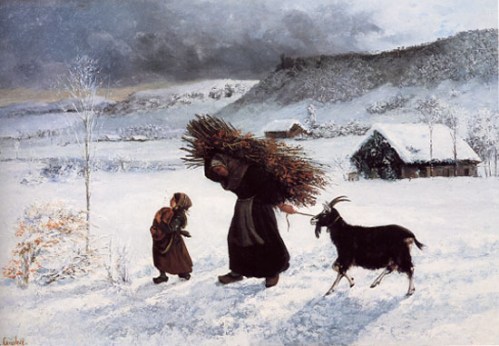
poor-woman-of-the-village

      “Poor Woman of the Village” 


              Gustave Courbet


                 ___________


the good times wouldn’t last, however,

discord among the gods would bring 

on the Silver Age 


           But when good Saturn, banish’d from above,
           Was driv’n to Hell, the world was under Jove. 


Saturn, god of plenty, had presided over 

the Golden Age


Jove, or Jupiter, god of thunder, was 

king of the gods


there would be consequences for this

disarrangement, this strife


           Succeeding times a silver age behold,
           Excelling brass, but more excell’d by gold. 


silver might not have been gold, but it

was still better than brass, as, later,

we’ll see


           Then summer, autumn, winter did appear:
           And spring was but a season of the year. 


no longer “immortal” 


by casting Saturn into the Underworld, Jove

set off the cycle of the seasons, whereby

Saturn, clutching his way back to the realm

of the deities, after his initial fall, would inspire

regeneration, the return of springtime, for a

while, before being ousted again, and again, 

and again


           The sun his annual course obliquely made,
           Good days contracted, and enlarg’d the bad. 


in keeping with the suns “oblique[ ]” 

progressions, not parallel, not at  

right angles


           Then air with sultry heats began to glow;
           The wings of winds were clogg’d with ice and snow; 


the emergence of heat and cold


           And shivering mortals, into houses driv’n,
           Sought shelter from th’ inclemency of Heav’n. 


see above


           Those houses, then, were caves, or homely sheds;
           With twining oziers fenc’d; and moss their beds. 


oziers, or osiers, shrubs of which the 

branches have traditionally been used 

to make baskets, basketry


           Then ploughs, for seed, the fruitful furrows broke, 
           And oxen labour’d first beneath the yoke.


not to mention Man, the advent of agriculture,

toil


R ! chard