Richibi’s Weblog

Just another WordPress.com weblog

Tag: Haydn

Quartet 1 in B major (“La chasse”), op. 1 no. 1 – Haydn
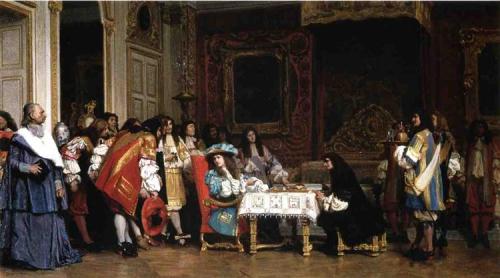
louis-xiv-and-moliere.jpg!Large

        “Louis XIV and Molière (1862) 

              Jean-Léon Gérôme

                     ________

the string quartet didn’t come out of nowhere,
as nothing does – I think – but probably, I 
suspect, from the earlier period’s suites, the
Baroque’s, Bach’sfor instance

suites are a series of dance pieces, stylized 
for the purpose of the musical poet, a popular 
appropriation, an even natural one for 
composers

the aristocracy, by the middle of the 18th
Century, demanded erudite entertainment,
something that Louis XlV, the Sun King,  
had instilled, a little earlier, during his 
Radiant Reign – see Racine, Corneille
Molière, see above, as well, incidentally –
1643 to 1715, up at Versaillesas 
prerequisite for excellence in being a
monarch, a sovereign, sponsorship of 
culture, painting, poetry, music

dukes and counts and barons and 
princesses got onto the bandwagon 
and the arts consequently flourished

witness Haydn and Mozart then, still, 
now, giants 

here’s Haydn’s first, his Quartet no 1
in B major, (“La chasse”), op. 1 no. 1,
the first significant string quartet in 
our Western culture

you’ll note five movements, following 
the suite model described above, with 
mirrored minuets sandwiched between 
opposing mirrored prestos, and an 
adagio in the very middle, as though  
their crowning moment 

an adagio, to my mind, always gives 
away a composer’s worth, listen to 
this one, it’s melting

and he’s got 67 more to go through, I    
marvel, a veritable, and utter,
however improbable, musical
cornucopia 


R ! chard
an homage to the victims of the Titanic

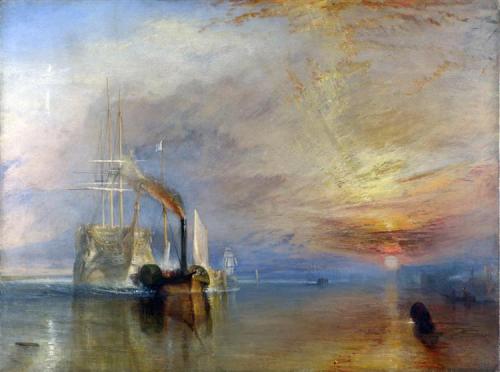
the-fighting-temeraire-tugged-to-her-last-berth-to-be-broken-up-1839.jpg!Large

  The Fighting Temeraire tugged to her last berth to be broken up (1839) 

          William Turner

                _______

while I’m on the subject of threnodies
which is to say “song[s] of lamentation
for the dead”, as I earlier statedlet me 
bring your attention to this extraordinary 
piece, an homage to the victims of the
Titanic
 
it doesn’t even have a title, much as 
Mozart and Haydn didn’t before music 
went mainstream, into public forums 
rather than merely aristocratic salons, 
and when an identifying moniker 
instead of a number became manifestly 
more practical, especially when the 
emerging Middle Classes were 
becoming the ones who were paying 
the composer’s bills, at the opera 
houses and the other sprouting 
concert venues, when some composers 
had even up to 32 sets of piano sonatas 
to remember, three and four often to 
a single set, opus number, as many as 
there are movements in a very sonata

and that’s not counting the numbered 

symphonies and string quartets of 
theirs, left to similarly calculate, 
decipher, extricate

it doesn’t have a title, I think, because
to my knowledge, it is the first of its
kind, a composition created by 
computer, for computer, an entirely 
self-contained digital work of, 
manifestly, art – I’d been waiting, 
diligently, for one – and like Beethoven, 
after the work was done, the artist(s)
just felt the title best left to the 
wordsmiths, thus – you’re welcome –  
Threnody for the Victims of the 
Titanic

sure, computers have done practical
things before, admirably, but never 
told a story, and certainly never one 
as profound as this one

these are the last moments of the 
Titanic, digitally reproduced, in real 
time, 2 hours and 40 minutes, they
are mesmerizing, you don’t want 
to miss a thing

there are no voices, apart from a 
few radio transmissions at the 
start, spotting the iceberg, calling 
out commands to beware, stop 
the engines

afterwards only silence, and the 
sound of the waves, the churning
of the engines, which have been 
restarted, sounding as rhythmic, 
incidentally, and numbing, as the 
wheels on the railroad tracks of
Steve Reich‘s Different Trains“,
another powerful threnody 

later the flash and crack of flares,
the crunch of the ship sinking  

the pervasive, however disrupted, 
silence and the inexorable passage 
of ever ticking time combine to be, 
thereafter, transfixing, meditative, 
ultimately transcendent, a fitting 
setting for a threnody 

I know of only another work to take
you to that venerable place,
Beethoven’s opus 111

and often enough Pink Floyd, for 
that matter, and the visionary 
Alan Parsons Project, of course, 
discoursing on inexorable Time 

and, now that I think of it, Elgar‘s
The Dream of Gerontius, whose 
character goes from his deathbed 
in the first act, to his afterlife in 
the second, effecting transcendence
for us by, yes, ingenious 
metaphorical proxy

but I digress

what I call Threnody for the Victims 
of the Titanic is a narrative with 
sound, not a movie, not a television
program, it has more commonality 
with a musical production than 
anything else but painting in art 
history, though its means are 
intuitively literary, ship stories go
back to The Odyssey through
Gulliver’s TravelsTreasure 
Island and to one of my very 
favourites, Ship of Fools“,
relatively recently

I could add Mutiny on the Bounty“,
Moby Dick“, “The Caine Mutiny 

in art, a precedent would’ve been set
in our collective consciousness by 
William Turner‘s celebratedThe 
Fighting Temeraire …, but I would 
mention as well Caspar David 
Friedrich‘s The Wanderer above 
the Sea of Fog for its existential
pertinence

a few literary points I’d like to stress
to back up my overt adulation, I find  
it impressive that the Classical rules
of tragedy have been maintained, 
unity of action, time, and place, 
prescriptions going back to 
Aristotle‘s Poetics in our cultural 
history, to profoundly express 
tragedy, iconic, epic, misfortune

not to mention the Classical musical
imperatives of tempo, tonality and 
repetition, none of which can be 
faulted here in this consummate 
composition

there is a no greater leveller of tempo 
than time, larghissimo here*, in the 
largest sense of that word, the 
cosmic, the inexorable pace of 
temporality in our brief heavens

a greater leveller of tonality neither  
is there than the rigorously impartial 
hum of the imperturbable Cosmos 

nor is there greater repetition than 
uniformity, however disrupted by  
however fervent ever human 
intervention, see Sisyphus, or 
Martha in “Who’s Afraid of Virginia
Woolf for iconic disrupters

R ! chard

*   Shostakovich had asked the 
     Beethoven Quartet to play the first 
     movement of his 15th String Quartet,
     “Elegy: Adagio“, so that flies 
     drop dead in mid-air, and the 
     audience start leaving the hall from 
     sheer boredom  

     well this inspired elucidation is even  
     slower than that

at the XVth International Tchaikovsky Competition – the program‏‏

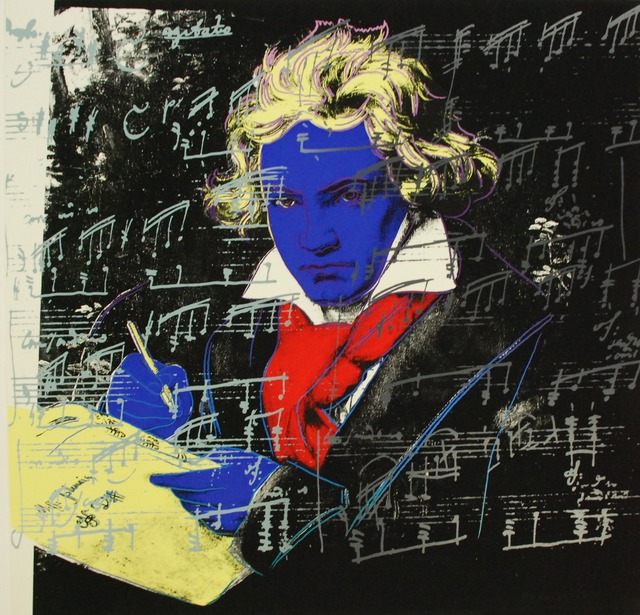
"Beethoven, 1987" -  Andy Warhol

Beethoven, 1987 (1987)

Andy Warhol

______

you’ll probably have noted, if you’ve
been following the Tchaikovsky
Competition
, that, unlike the
Rubinstein, the selection of works
is much more constrained, though
the mighties nevertheless
predominate

after the third day and into the
fourth, only one contestant has
started with anything other than
Bach, a Tchaikovsky

but unfortunately none of them but
one had given us a Bach worthy of
his name, then followed through
with, not surprisingly, a quite
competent Mozart, the cultural
conditions being not yet all that
different, aristocrats were looking
for their own music instead of the
church’s, secular instead of
ecclesiastical, therefore a tune
rather than an oratorio, Beethoven
and the Revolution would change
all that

afterwards a sonata of Mozart,
Haydn or Beethoven, the Classical
triumvirate, after which Tchaikovsky,
appropriately at this competition,
then études, either “-tableaux”,
“transcendentales”, or plain and
simple, by Rachmaninov, Liszt, or
Chopin, that’s it, you get to hear
the “Appassionata” or the “Grandes
études de Paganini”
several times
that way, sharpening discernibly
your musical ear

one was riveting, Andrey Dubov‘s

another, Lukas Geniušas transfixed
me with his opus 2, no 3, of
Beethoven, a work I usually only
ever tolerate, sending it soaring
into the bard’s later mature, and
revelatory, period

others have been competent, even
admirable, several, however, not
ready for this trial, they’ve come
without adequate preparation for
the ball

though I’ve been watching it in
my pajamas, I should talk

Richard

Chopin Preludes, opus 28‏

you will remember surely preludes from Bach’s
Well-Tempered Clavier, but as indeed an
introduction to, there, fugues  
 
it might be interesting to note that preludes
were originally ditties instrumentalists cooked up,
spontaneously and improvisationally, to warm up
and tune their muse, one would expect the form
then to be short, sweet and pithy
 
and, by definition, unfinished, which is why Bach
added the fugue  
 
Chopin in 1839 gets them to stand alone, they 
have become by then of course entirely stylized,
less improvisational than formal  
 
Chopin gives them their rightful eminence by simply
validating their claim to the role, they have no trouble
at all standing forthrightly in the footlights, and are
even still individually commanding, unblemished yet
by the infelicities of most lacerating time   
 
like Bach they are still an intellectual exercise, there’s
a prelude for every key, all 24 of them, major and minor, 
like the “Études”, they are technical challenges to the
pianist, an Everest to climb, the work of an eminently
able nevertheless practitioner who didn’t shirk at 
challenging himself heroically, though surely goaded
by the most magnanimous, if unrelenting, of gods
 
others of course took up the contest for the sake of
both the prestidigitational Olympics his compositions 
represented as well as for itself the rapturous music, 
works for the deftest of fingers as well as for the
newly stranded, existentially unfettered and
hungering, 19th-Century soul   
 
you’ll note the humanity that didn’t appear in Mozart,
the intensely emotional appeal of both a more ardent
fury, a tip of the hat here to Beethoven, and a more
melting, sentimental tone  
 
 
incidentally I find Chopin infinitely more aristocratic
than Mozart ever, despite being the epitome of the
more democratic Romanticism, whereas it had been 
the more unruly Mozart who’d written for the
“Classical” courts 
 
Haydn is temperamentally the only other so courtly
composer, appropriately and most efficiently fitting
in his case his own Classical mold, even up until now,
no others have had that distinct personal pedigree 
 
 
allow me to submit my prose therefore to your most
good and gentle graces, as well as the illustrious
music contained therein
 
 
yours
 
Richard 
 
psst: here‘s a version played in a castle, noteworthy
         for its aristocratic allusions not to mention its
         accomplished artistry   


Mozart Sonata no 16, in C major, K545‏

though his Sonata no 16, K545, was not officially submitted
by Mozart until 1788, when he was 32, it sounds musically
now so elementary, so even folkloric in its structure and
cultural impact, that it seems composed at a much earlier
age, but no one knows 
 
it is also to my mind the most clear example of what is
meant when we speak of Classical music 
 
the structure is simple, each movement, of which there
are Classically three, and later four for gravitas, though
Mozart himself in his sonatas never exceeded three,
present an air, followed by a contrasting air, followed
by the whole thing over again, these segments, call and
response, like verse and refrain in folkloric melodies,
are easily identified and even to follow, with Mozart
I often sing along, even in the grander concert stuff 
 
significantly there is no other motive in Classical music
but entertainment, the Church had ceded its hold on
composers to aristocrats, who collected them like
paintings to adorn their courts, and the idea of
personal expression, as implanted by Beethoven
hadn’t yet taken hold, nor had the French Revolution 
 
for a good time, in other words, call Mozart, Haydn
is a lot of unadulterated fun too
 
Beethoven will allow us to express our feelings,
which in our age has permitted the wails of the
disconsolate to soar to often, I think, too egregious 
heights, to replace stalwart courage and honour,
exemplified symbolically in a culture by strict
refinement and courtesy, the very stuff of
Classical sensibility 
 
the piano had been a very recent invention, able for
having been tempered, where notes of all keys had
been adjusted in order to be superimposed on a
keyboard to easily swing, or to modulate, from one
key to another, A, Bb, C#, et cetera, and was in the
process of determining the very sonic landscape 
the new era would handle, the very adjustment,
the tempering, by definition supplanted the exact
tone of the key, to fit of course the more convenient
superimpositions, in other words we’ve become
fundamentally attuned to atonality, gotcha, do ré,
mi are off
 
you change keys for reasons of mood, major, minor,
or to accompany for instance in a more comfortable 
range another instrument or a singer 
 
in early Classical pieces keys don’t change much 
within a movement, if indeed at all, but do contrast,
at this point in musical history, from one movement
to another, this of course will change    
 
the Sonata no 16, K545, of Mozart, his Sonata facile,
or semplice, is played here by Gavin M. George, age 7
 
this doesn’t seem at all in this context inappropriate,
Mozart too was a wunderkind, a wonder, at that
precocious age 
 
 
Richard


Debussy, “L’isle joyeuse”‏ (“The Joyous Island”)

here’s Daphne doing Debussy, his L’isle joyeuse, from 1904,
a long way from Beethoven, 1798 
 
had it not been for Beethoven though, making music into a
language, instead of merely a Mozartean, a Haydnesque
aristocratic entertainment, Debussy wouldn’t have even
been possible, where were their “Moonlight Sonata“s, their
Tempest“s, their “Appassionata“s for that matter, their
Hammerklavier“s, these earlier composers, for a weightier,
more abstract, topic, Mozart and Haydn were having courtly,
though ever so inspired, fun, while Beethoven would proclaim,
pronounce, discover and describe, open up to the imagination,
upon these earlier, nevertheless mighty, Classical shoulders,
a whole new, transfigured, world
 
 
L’isle joyeuse is not a sonata, it only has one movement,
I would call it a soundscape, were I to define it, Monet,
1840-1926, is written all over it, the same shimmer,
ephemerality, must’ve been the light, not to mention of
course, at his most ethereal, Beethoven
 
 
Richard      


a couple of Mozart sonatas

if a symphony is a concerto without a soloist, a sonata
is a concerto without an orchestra, the soloist plays
alone, must deliver the same enchantment 
 
there are nevertheless always therefore the prerequisite
several movements, otherwise no sonata
 
 
the sonata, as we know it, originated in the mid-18th
century with more or less Mozart, earlier the term
applied to other structural notions in music
 
to still my consternation they were often not continuous,
movements were performed indiscriminately among other
eclectic acts in an evening of diverse entertainments, it
was Beethoven who put a decisive stop to that, though
the fame and popularity of Haydn and a few other
contemporaries, Clementi, Salieri, as well of course as
himself Mozart, had probably settled the matter for all
practical purposes somewhat earlier
 
Beethoven among his other theoretical principles codified
that, indeed wrote the book on it, like Moses delivering
the commandments, except that Beethoven presented
horizons in his mythology, miraculous and infinite,
instead of castigation and luxurious sin
 
his understanding of music, still now unsurpassed, is
demonstrable in his works through all the musical
innovations that have since, through all the very ages,
transpired, down to even his bagatelles, musical trifles,
which I’ll approach later, if you’ll stick around
    
 
but it starts essentially with Mozart 
 
Mitsuko Uchida, who is unsurpassed in Mozart, plays
Ludwig von Köchel, who catalogued finally, in 1862,
nearly a hundred years after Mozart’s death, in 1791,
the complete works of the master, other works have
been intermittently added since so that several
revised editions have dutifully followed, lettered a, b,
c according to the revision, the last Köchel number is 
626 
 
 
Mozart’s music is sprightly, effervescent, magical, but
not especially intellectually challenging, I think of toy
soldiers and candy cane, innocence and a child’s delight
in the infinite possibilities of creation, Creation  
 
 
Alfred Brendel  who stands shoulder to shoulder with
the iconic Glenn Gould when it comes to Beethoven,
 
of 18 piano sonatas, the D major K.576 above, was
his last 
 
 
Brendel is too commanding to play authentic Mozart,
though his technique is irreproachable, admirable,
spotless, wonderful 
 
he is Beethoven playing Mozart however, an uneven
fit 
 
comparing the two interpretations is instructive, Brendel
will dazzle, inevitably, but Uchida will make you fly
 
don’t believe me, count on it 
 
 
Richard 


Beethoven’s Symphony no 6, in F major, opus 68, “Pastoral”‏

symphonies are not my preferred musical form, they are
generally too broad, grand, impersonal, they are nevertheless
the other most impactful order of presentation among musical
instruments, along with the concerto
 
a symphony is a concerto without a soloist, or it might be more
appropriate to say that a concerto is a symphony accommodating
a soloist, or soloists, in either case the musical elements remain
the same, you don’t have a symphony without movements   
 
a symphony is also of course another name for that very orchestra,
just to confuse you
 
 
despite my indifference to that particular form of entertainment 
some symphonies are nevertheless still for me impressive, some
even meaningful, poignant, several of Beethoven’s, most of the
works of the transcendental Bruckner, Brahms’ magnificent Fourth,
most others you can keep, as far as I’m concerned, I need a firm
anchoring principle, not the amorphous peregrinations of an
unbridled, often cacophonous crowd 
 
 
those that I love however have touched me deeply, Beethoven’s 
Sixth for instance, wherein through its second movement a loved
one spoke to me unmistakably from heaven, there and then made
me believe in an afterlife and angels, I remember the day clearly
and cherish still that powerful metaphysical moment  
 
 
in the “Pastoral” Beethoven apotheosizes nature, the movements
themselves, of which there are an unconventional five, are named
after rural settings, like paintings
 
     
I imagine Beethoven channeling the idyllic Classical Fragonard, or
prefiguring the bucolic and more Romantic Constable, Beethoven
straddles triumphally both epochs 
 
you will hear the birds sing, the rippling of the brook, it is as fresh
as ever springtime, as profound and expansive as itself time
 
Beethoven here speaks as clearly as actual language, and thereby
suggests that music is indeed itself an expressive tongue, earlier
it had been, though moving and undeniably evocative, essentially
an entertainment, a courtly device, though often enough sublime,
see Haydn, Mozart
 
Beethoven is not courtly, he is bold, assured, and mighty, of a new
breed of colonizers of the new and exhilarating democracy, the
French Revolution had just happened and their aristocracy was
dead and gone, indeed guillotined, a new day had dawned for
the common people, the idea of human rights
 
Beethoven spoke to these as a prophet, Moses at a secular Mount,
declaring the ideals of the Age of Reason, of which we still carry
the torch, to the multitudes and to their ensuing spawn
 
 
Klemperer at first seemed slow to me, nearly tired, but little by
little established a mesmerizing solemnity
 
by the end of the piece I’d again been touched by heaven 
 
 
Richard