Richibi’s Weblog

Just another WordPress.com weblog

Tag: Deucalion

“Metamorphoses” (The Giants’ War, XIII) – Ovid

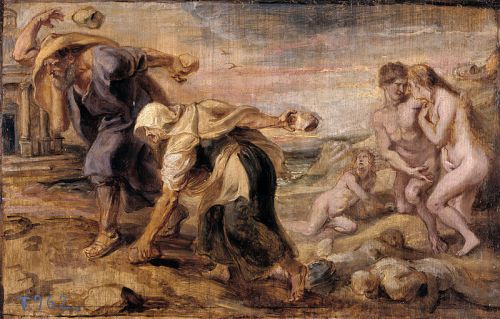
800px-Peter_Paul_Rubens_-_Deucalion_and_Pyrrha,_1636

      Deucalion and Pyrrha (1636) 


             Peter Paul Rubens


                 ___________


                                          for my mom and dad, my own

                                                   Deucalion and Pyrrha


at Cephysus‘ shrine, Deucalion and 

Pyrrha pray to the goddess of

Divine Justice


              O righteous Themis, if the Pow’rs above
              By pray’rs are bent to pity, and to love;
              If humane miseries can move their mind; 


humane, human


              If yet they can forgive, and yet be kind;
              Tell how we may restore, by second birth,
              Mankind, and people desolated Earth. 


the Pow’rs above are the deciding 

factors, can Jove, Neptune, the others, 

Deucalion asks, be moved by human[ ] 

miseries, can they forgive, can they 

restore…Mankind, people, people is

a verb here, the world again, the 

desolated, or desolate, the dismal, 

the forsaken, Earth


              Then thus the gracious Goddess, nodding, said;
              Depart, and with your vestments veil your head:
              And stooping lowly down, with losen’d zones,
              Throw each behind your backs, your mighty mother’s bones. 


losen’d zones, across wide areas


cover, veil, your heads, the goddess 

advises, stoop low, and throw your 

mother’s bones across wide areas, 

she instructs, however scandalously


              Amaz’d the pair, and mute with wonder stand,
              ‘Till Pyrrha first refus’d the dire command. 


Pyrrha is a counterpart for the Christian 

Eve here, contrary, defiant of Heaven, 

however eventually, Pyrrha, blameless, 

but which of the progenitresses came

first, which the chicken, which the egg, 

Eve or Pyrrha, is a question up for 

contemplation


              Forbid it Heav’n, said she, that I shou’d tear
              Those holy reliques from the sepulcher. 


surely, Pyrrha proclaims, Heav’n would 

never allow, Forbid it Heav’n, not to 

mention condone, that I should remove, 

tear, my mother’s bones, [t[hose holy 

reliques, relics, from their sepulcher, 

their grave, this would be profoundly 

unholy 


              They ponder’d the mysterious words again,
              For some new sense; and long they sought in vain:
              At length Deucalion clear’d his cloudy brow,
              And said, the dark Aenigma  


Aenigma, Sphinx, the oracle


                                                                will allow
              A meaning, which, if well I understand,
              From sacrilege will free the God’s command: 


if I can properly understand, decipher,

the meaning of the God’s command, 

Aenigma’s oracular words, however 

cryptic, in such a way, Deucalion 

declares, that our actions be not 

sacrilegious, nor offensive in any 

way to the gods, we may proceed,

he reasons


              This Earth our mighty mother is, the stones
              In her capacious body, are her bones: 


This Earth is our mighty mother, the

stones in her capacious body [ ] are 

her bones, no comma after body


the word order in each clause, note, has 

been reversed, instead of subject, verb,

object, we have object, verb, subject


but then, ever so felicitously, stones 

can rhyme with bones, and equally,

and as liltingly, we’re still in iambic 

pentameter


              These we must cast behind. With hope, and fear,
              The woman did the new solution hear:
              The man diffides in his own augury, 


diffide, distrust, augury, prediction,

Deucalion doubts, in other words,

his own calculations


              And doubts the Gods; yet both resolve to try. 


when my mom is up against a 

dilemma, she calls on my dad,

gone some over thirty years now,

come on, Daddy, let’s go, she 

says, and confronts the issue 

with transcendental, by very 

definition, conviction


see above


              Descending from the mount, they first unbind
              Their vests, and veil’d, they cast the stones behind:
              The stones (a miracle to mortal view,
              But long tradition makes it pass for true) 


what follows will seem miraculous

to mortals, Ovid says, but the story 

has been around for such a while,

which is to say by long tradition, 

that we let it pass for true


              Did first the rigour of their kind expel, 


the stones begin to lose, expel, their 

firmness, the rigour of their kind


              And suppled into softness, as they fell; 


suppled, became supple


              Then swell’d, and swelling, by degrees grew warm;
              And took the rudiments of human form. 


stones are being transformed, 

metamorphosized, into humans 


the Bible, if you’ll remember, would 

have it be clay


              Imperfect shapes: in marble such are seen,
              When the rude chizzel does the man begin; 


chizzel, chisel


              While yet the roughness of the stone remains,
              Without the rising muscles, and the veins. 


as the sculpture is being fashioned, 

certain parts of the human anatomy, 

the muscles, for instance, the veins, 

are not yet revealed, uncovered, 

discovered, extracted, by the 

chizzel, from under the roughness 

of the stone


think of Michelangelo, or Rodin,

sculpting


              The sappy parts, and next resembling juice, 


sappy, from sap, which, emanating 

from stones, would be next to, but 

not as limpid as, juice, or the liquid

required to create humans


              Were turn’d to moisture, for the body’s use:
              Supplying humours, blood, and nourishment; 


the circulatory, and notably viscous, 

system


              The rest, too solid to receive a bent,
              Converts to bones; and what was once a vein,
              Its former name and Nature did retain. 


veins, which hadn’t received enough 

sappy parts to become part of the

circulatory system, retained their 

name of vein, but as understood in

relation to rocks, geological veins

presumably replicated, in this story 

of the Creation, in human bones


              By help of pow’r divine, in little space, 


in little space, in no time at all


              What the man threw, assum’d a manly face;
              And what the wife, renew’d the female race. 


the stones that the man, Deucalion

threw became men, those that 

Pyrrha tossed became women 


              Hence we derive our nature; born to bear
              Laborious life; and harden’d into care.


we’ve inherited, through the labours 

of Deucalion and Pyrrha, our driven

nature, harden’d into, or conditioned, 

condemned, to care 


for better, I infer, or for worse 


R ! chard


“Metamorphoses” (The Giants’ War, XII) – Ovid

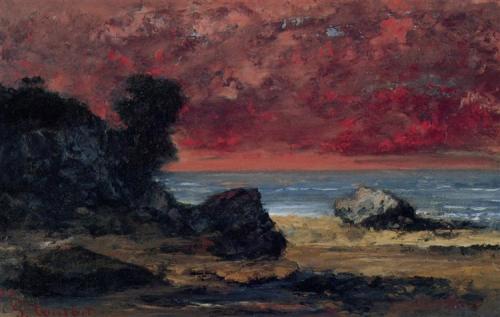
after-the-storm-1872.jpg!Large

      “After the Storm (1872)


            Gustave Courbet


                __________


                  A thin circumference of land appears;
                  And Earth, but not at once, her visage rears,
                  And peeps upon the seas from upper grounds; 


as the land begins to peep[ ] through 

the water, a circumference of land 

appears, a circle of Earth within the 

earlier universal water


to rear, to raise upright, boldly, the better,

here, for Earth‘s visage, Earth‘s face, to 

peep[ ] upon the seas from newly gained 

upper grounds


                  The streams, but just contain’d within their bounds,
                  By slow degrees into their channels crawl; 


streams, just recently redefining their  

boundaries, or bounds[b]y slow 

degrees settle, become waterways, 

channels, rivers, rivulets, rills


I love crawl here, incidentally, the slow, 

insidious, infiltration of a territory, silent 

and immutable, as [t]he streams, at the 

dispassionate pace of nature, find their 

individual course


                  And Earth increases, as the waters fall. 


the waters fall, the waters recede


                  In longer time the tops of trees appear, 


[i]n longer time, after a while


                  Which mud on their dishonour’d branches bear. 


for which the only solution here, would

be, I thought, however ironically, a

shower, rain


but I digress

                 
                  At length the world was all restor’d to view;

                  But desolate, and of a sickly hue:  

see, for instance, above


                  Nature beheld her self, and stood aghast,
                  A dismal desart, and a silent waste. 


desart, is desert, even my spellcheck 

insisted


meanwhile, back on Mount Parnassus

our two survivors, look around


                  Which when Deucalion, with a piteous look
                  Beheld, he wept, and thus to Pyrrha spoke: 


let me point out that what follows, 

which is to say when Deucalion 

… thus to Pyrrha spoke, we have 

an extended monologue, rather 

than a narration, the poet, Ovid

has given a voice to Deucalion

his character, his creation


I was reminded of Shakespeare‘s 

monologues, especially since the 

metre is iambic pentameter,

Shakespeare‘s signature poetic

rhythm 


it should be noted that this translation

of Metamorphoses is from 1717, a

century and a very year after 

Shakespeare‘s demise, in 1616, time 

for poets to have imbibed his already 

profound influence


nor could they not have been marked

by the spirit of their own time, and the 

many transformative epochs since 

Metamorphoses had been written, in 

the year 1, that would’ve affected the 

translation 


the original Latin text, for instance,

was in dactylic hexameter, not 

iambic pentameter


                  Oh wife, oh sister, oh of all thy kind
                  The best, and only creature left behind,
                  By kindred, love, and now by dangers joyn’d;
                  Of multitudes, who breath’d the common air,
                  We two remain; a species in a pair:
                  The rest the seas have swallow’d; nor have we
                  Ev’n of this wretched life a certainty.
                  The clouds are still above; and, while I speak,
                  A second deluge o’er our heads may break.
                  Shou’d I be snatcht from hence, and thou remain,
                  Without relief, or partner of thy pain,
                  How cou’dst thou such a wretched life sustain?
                  Shou’d I be left, and thou be lost, the sea
                  That bury’d her I lov’d, shou’d bury me.
                  Oh cou’d our father his old arts inspire,
                  And make me heir of his informing fire,
                  That so I might abolisht Man retrieve,
                  And perisht people in new souls might live.
                  But Heav’n is pleas’d, nor ought we to complain,
                  That we, th’ examples of mankind, remain. 


cou’d our father, JoveDeucalion asks,

breathe into me his inspiration, his old 

arts, his informing fire, so that I could 

reconstitute Man, retrieve him, and 

supply the perisht people with new, and

presumably more honourable, souls


                  He said; the careful couple joyn their tears: 


He said, or this he spoke, and the

couple joyn their tears


                  And then invoke the Gods, with pious prayers.
                  Thus, in devotion having eas’d their grief,
                  From sacred oracles they seek relief;
                  And to Cephysus’ brook their way pursue: 


Cephysus, or Cephissus, was a river god,

associated with the river Cephissus, which 

runs through Central Greece


                  The stream was troubled, but the ford they knew; 


the ford, the way across the stream


                  With living waters, in the fountain bred, 


living waters would gush from a 

spring, around which a fountain 

would’ve been built


                  They sprinkle first their garments, and their head,
                  Then took the way, which to the temple led.
                  The roofs were all defil’d with moss, and mire,
                  The desart altars void of solemn fire.
                  Before the gradual, prostrate they ador’d;
                  The pavement kiss’d; and thus the saint implor’d.


the gradual is a hymn sung within

the context of a full religious service


desart here is again desert, but in

this instance signifying deserted


the saint, an anachronism here, 

for saints were not at all even a

concept at the time of Ovid

would’ve been Themis, goddess,

at Delphi, on Mount Parnassus

of Divine Justice


R ! chard


“Metamorphoses” (The Giants’ War, X) – Ovid

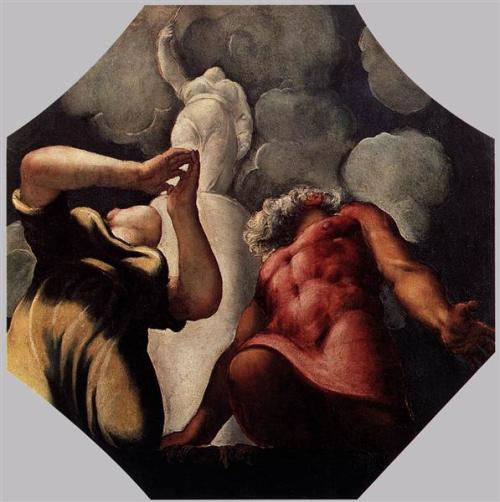
deucalion-and-pyrrha-praying-before-the-statue-of-the-goddess-themis.jpg!Large

  “Deucalion and Pyrrha Praying before the Statue of the Goddess Themis (c.1542) 


          Tintoretto


             _____


              A mountain of stupendous height there stands
              Betwixt th’ Athenian and Boeotian lands, 


Boetia was, and still is, a region of 

Central Greece, its largest city is,

and was, Thebes, a major rival in

ancient times of Athens


              The bound of fruitful fields, while fields they were, 


bound, boundary, the fruitful fields

within a certain limited area, between 

Athens, here, and Boetia


              But then a field of waters did appear: 


              Parnassus is its name; whose forky rise
              Mounts thro’ the clouds, and mates the lofty skies. 


Parnassus is a mountain in Central 

Greece, however forky, however 

forked, craggy, uneven, sacred 

especially to Apollo, god of too 

many things to list here, and the 

site, at Delphi, on its south-western 

slope, of his Oracle, famous for 

being consulted on a variety of 

matters, from personal to affairs 

of state, its high priestess was 

believed to incarnate the very 

voice of Apollo


Parnassus was also the home, 

incidentally, of the Muses, goddesses 

in their own right, of the several arts, 

who ministered to Apollo


              High on the summit of this dubious cliff,
              Deucalion wafting, moor’d his little skiff. 


Deucalion is the Abrahamic Noah‘s

counterpart, sole survivor, with his 

wife Pyrrha, of the flood 


the cliff is dubious because the

mountain is still deep in water,

its summit precarious yet 


              He with his wife were only left behind
              Of perish’d Man; they two were human kind. 


they two alone were left of humankind,

of perish’d Man


              The mountain nymphs, and Themis they adore, 


Themis, goddess of Divine Justice


              And from her oracles relief implore. 


Deucalion and Pyrrha pray to Themis

at Delphi, its first high priestess, hungry

for, and heedful of, her oracles, counsel


see above


              The most upright of mortal men was he;
              The most sincere, and holy woman, she. 


a chance at a new world


R ! chard