Richibi’s Weblog

Just another WordPress.com weblog

Tag: Delphi

“The Story of of Cadmus” (V) – Ovid

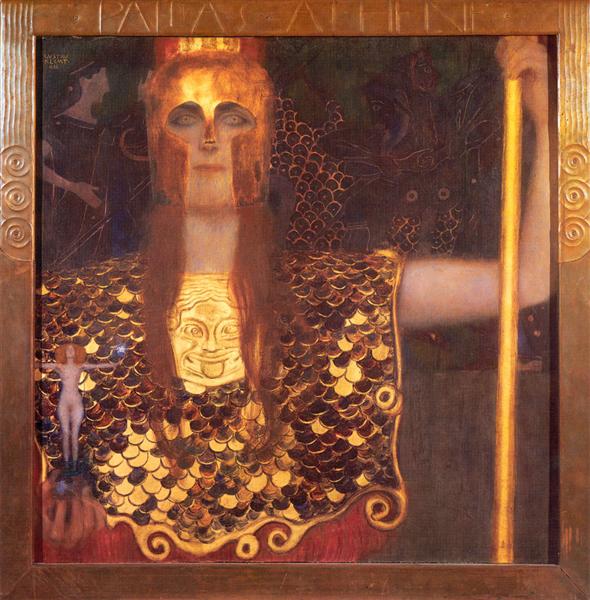
Minerva or Pallas Athena, 1898 - Gustav Klimt

         Minerva or Pallas Athena” (1898)


                Gustav Klimt


                       ______


an interesting thing has happened with

the story of Cadmus, he is not only a

mythical figure, but also a legendary

one, which is to say that Cadmus has

roots in actual history, he’s not just an

imaginary construct like those that

until now have peopled Ovid’s text


Cadmus appears to have actually

founded Thebes, whose origins,

however, are lost in antiquity, going

back to, it appears, the late Bronze

Age, around 2000 BC, goodness


stories evidently grew around

Cadmus, that transformed him into

our first documented hero, indeed

superhero


counterparts exist in other traditions,

consider David, for instance, who

slew his own dragon, Goliath, before

becoming king of the Israelites, 10th

Century BCE, at Jerusalem, where

he consorted, incidentally, later, with

Bathsheba, however illicitly, but

that’s another story


King Arthur, late 5th to early 6th

Centuries CE, stems from British

lore, though his historical actuality

has been contested, is also a hero

with preternatural capabilities based

on some historical accountability


in our day, there’s James Bond,

based on real, living and breathing,

personalities


or, dare I say, even Jesus


the point here is that actual people

are being included in the, however

culturally specific, mythologies,

which, in each, had earlier consisted

of metaphorical constructs merely,

the concept of History, in other words,

was being born, memorable events

were to be remembered, recorded,

documented, if only, originally, orally,

around, say, campfires, however

aggrandized might have been their

recollected heroes


Cadmus, meanwhile, in our story, is

about to establish his own historical,

and archeologically confirmed, note,

credentials


            The dire example ran through all the field,
            ‘Till heaps of brothers were by brothers kill’d;


The dire example, the dragon’s teeth,

grown into men, had begun, if you’ll

remember, to slaughter one another


example, display


            The furrows swam in blood: and only five
            Of all the vast increase were left alive.
            Echion one, at Pallas’s command,
            Let fall the guiltless weapon from his hand,


Echion, one of the five surviving

brothers


Pallas, Pallas Athena, goddess of

Wisdom, also of War


see above


            And with the rest a peaceful treaty makes,
            Whom Cadmus as his friends and partners takes;


the rest, the four other survivors


            So founds a city on the promis’d earth,
            And gives his new Boeotian empire birth.


promis’d earth, the premonition of

the oracles whose counsel Cadmus

had sought at Delphi, if you’ll

remember


            Here Cadmus reign’d; and now one would have guess’d
            The royal founder in his exile blest:


his exile, from Tyre, Cadmus’ original

home, from which his father, Agenor,

had sent him, not to return, he’d

warnedwithout his sister, Europa


            Long did he live within his new abodes,
            Ally’d by marriage to the deathless Gods;


Ally’d by marriage, at the end of a

period of penance for having killed

the dragon, which had been sacred

to Ares, god of War, the gods gave

Cadmus Harmonia, goddess of

Concord, to be his wife


Ares would eventually exact mighty

vengeance, but that’s another story


            And, in a fruitful wife’s embraces old,
            A long increase of children’s children told:
            But no frail man, however great or high,
            Can be concluded blest before he die.


even Cadmus, though he might

enjoy a long life, and many, a long

increase of, children, is not immune

to any of the vicissitudes of life either

until his own time has come, the poet

advises, however ominously


and here Ovid also introduces the

subject of his next metamorphosis,

Actaeon, however early, luring us

thereby, deftly, literarily, towards

his next instalment, Actaeon’s

story, eponymously, there, given

its title


            Actaeon was the first of all his race,

            Who griev’d his grandsire in his borrow’d face;

            Condemn’d by stern Diana to bemoan
            The branching horns, and visage not his own;


his grandsire, his grandfather,

Cadmus was the father of Autonoë,

who was the mother of Actaeon


borrow’d face, Actaeon was

transformed into a stag by the

goddess Diana / Artemis, of the

Hunt, of the Moon, of Chastity,

for having seen her naked as

she was bathing


he now has the face, the visage, of

someone, something, he hadn’t

been before, borrow’d


            To shun his once lov’d dogs, to bound away,
            And from their huntsman to become their prey,


having been transformed into a

stag, or metamorphized, Actaeon

would end up hunted, and worse,

by his own, once lov’d, dogs


            And yet consider why the change was wrought,
            You’ll find it his misfortune, not his fault;
            Or, if a fault, it was the fault of chance:
            For how can guilt proceed from ignorance?


to have been at the wrong place

at the wrong time, yet to suffer,

however unfairly, the consequences,

that, Ovid asks, is the question, the

conundrum


stay tuned


R ! chard

“The Story of of Cadmus” – Ovid

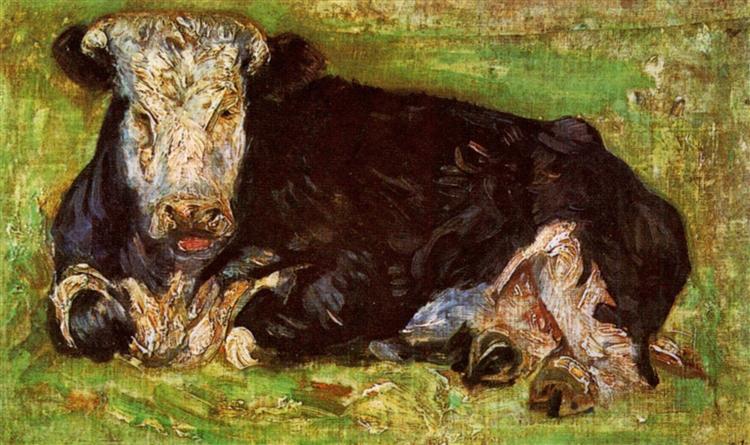
Lying Cow, 1883 - Vincent van Gogh

        Lying Cow(1883)


             Vincent van Gogh


                           ______

            When now Agenor had his daughter lost,


Agenor, king of Tyre, father of

Europahis daughter lost


            He sent his son to search on ev’ry coast;


his son, Agenor’s son, Cadmus,

Europa’s brother


            And sternly bid him to his arms restore
            The darling maid, or see his face no more,
            But live an exile in a foreign clime;
            Thus was the father pious to a crime.


pious to a crime, intent on, devoted to,

having justice restored


            The restless youth search’d all the world around;
            But how can Jove in his amours be found?


amours, loves, trysts, entanglements


            When, tir’d at length with unsuccessful toil,
            To shun his angry sire and native soil,


his angry sire, Agenor, father, sire


            He goes a suppliant to the Delphick dome;


suppliant, supplicant, petitioner,

one in search of a favour


Delphick dome, the Temple of Apollo

at Delphi, where the oracle, Pythia,

proclaimed her cryptic prognostications,

her famously ambiguous prophecies


Delphi, incidentally, was one of several

sacred sites in Greece, sanctuaries,

open to any Greek, or person who

could speak Greek, regardless of

geographical provenance, any

city-statefor instance then, or

kingdom, akin to embassies today,

or places where people can expect

to find similar political haven


Delphi was the destination then also of

pilgrimages, comparable to our own

Santiago de Compostela today, an

ancient path I dearly would’ve, but

never have, unfortunately, undertaken


though I did walk to Mission B.C. some

several years ago, from my home in

Vancouver, to a monastery there, a

place of recuperation when I needed

one, three days there, and a half, three

days and an equal half back, my feet

were blistered, I noticed at one point,

but hadn’t at all registered any pain,

a truth I gathered about the power of

intention, one’s very aim can be a

salve, a balm, a solace, against any

adversity


but back to Cadmus


            There asks the God what new appointed home
            Should end his wand’rings, and his toils relieve.


where do I land, asks Cadmus,where

is my appointed home, my final

destination


            The Delphick oracles this answer give.


The Delphick oracles, subordinates

to Pythia, the high priestess at Delphi


            “Behold among the fields a lonely cow,

            Unworn with yokes, unbroken to the plow;

            Mark well the place where first she lays her down,

            There measure out thy walls, and build thy town,

            And from thy guide Boeotia call the land,

            In which the destin’d walls and town shall stand.”


Boeotiaa region still of Greece


            No sooner had he left the dark abode,
            Big with the promise of the Delphick God,


the Delphick God, Apollo, god of

music, dance, truth, prophecy,

healing, the sun, light, poetry,

among many other things


            When in the fields the fatal cow he view’d,
            Nor gall’d with yokes, nor worn with servitude:


fatal, fateful


gall’d, irritated, frustrated


            Her gently at a distance he pursu’d;
            And as he walk’d aloof, in silence pray’d
            To the great Pow’r whose counsels he obey’d.


the great Pow’r, Apollo, by way of his

Delphick oracles,the high priestesses,

through their counsel, their divinations


            Her way thro’ flow’ry Panope she took,


Panope, plural, were sea nymphs, not

places, in Ancient Greece, therefore

Cadmus must’ve been crossing water,

however flow’ry, I’ll have to check my

Latin text for, maybe, inaccuracies in

the translation


            And now, Cephisus, cross’d thy silver brook;


Cephisus, or Cephissus, a river in Boeotia,

a brook, a stream, anthropomorphized here,

which is to say Cephissus, the flow, the

waterway, is being addressed as a rational

being, I have cross’d thy silver brook, he 

says, speaking to the torrent


meanwhile, to brook, to conquer, to

overcome, a wonderful, a shimmering,

literarily speaking, homonym, which is

to say, a word with two faces


            When to the Heav’ns her spacious front she rais’d,
            And bellow’d thrice, then backward turning gaz’d
            On those behind, ’till on the destin’d place
            She stoop’d, and couch’d amid the rising grass.


she, the fatal cow, see abovehas led

Cadmus to his famed, his mythic,

destination, destin’d place, destiny


stay tuned


R ! chard

“Metamorphoses” (The Giants’ War, XIV) – Ovid

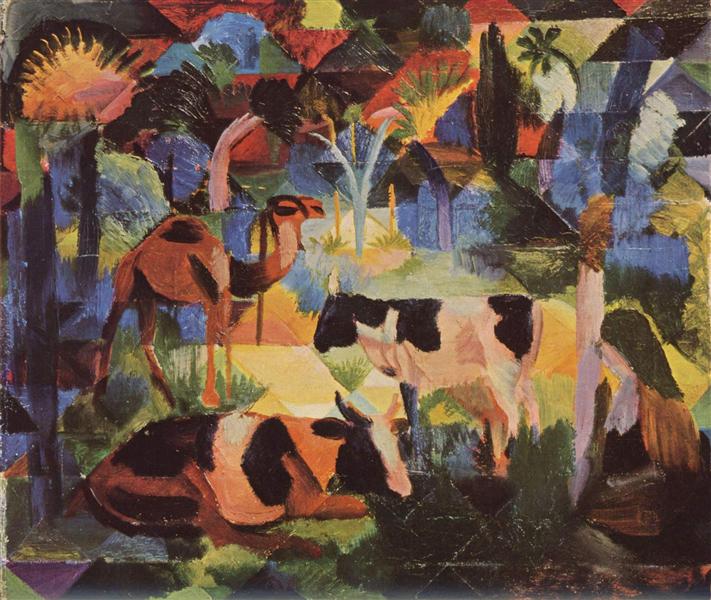
landscape-with-cows-and-a-camel.jpg!Large

    Landscape with Cows and a Camel (1914) 


               August Macke


                   ________


once Deucalion and Pyrrha had found

the way to bring humans back to life, 

it was time to turn to the creation, or

recreation, of other species


              The rest of animals, from teeming Earth
              Produc’d, in various forms receiv’d their birth. 


the rest of animals suggests that 

people were also considered to

be animals, of an however more

elevated, presumably, order


              The native moisture, in its close retreat,
              Digested by the sun’s aetherial heat,
              As in a kindly womb, began to breed: ,
              Then swell’d, and quicken’d by the vital seed. 


by means of the moisture naturally

created by the retreating flood waters, 

the native moisture, the heat of the sun, 

however aetherial, or etherial, which is 

to say of ether, which is to say invisible, 

swell[s], and quicken[s] … the vital seed

the seed which is pregnant with life, or

vital, and nurtures it, swell[s] and 

quicken[s] it, as though within a womb


              And some in less, and some in longer space, 


less, or longer space, of time


              Were ripen’d into form, and took a sev’ral face. 


different kinds of animals, animals with

sev’ral face[s], see, for instance, above

ripen’d, or evolved during longer or 

shorter periods of time, a notion that 

was decisively revisited some nearly 

two thousand years later, incidentally, 

by Charles Darwin 


              Thus when the Nile from Pharian fields is fled, 


Pharian fields, Egypt, from Pharos,

an island off the coast of Alexandria

notable for its lighthouse, itself called 

Pharos, one of the Seven Wonders of 

the Ancient World


              And seeks, with ebbing tides, his ancient bed, 


his ancient bed, the area of earth 

that the Nile had covered during 

the flood, its now exposed river 

banks


the Nile is, note, masculine here, 

his ancient bed


              The fat manure with heav’nly fire is warm’d; 


there’s the heat again


             And crusted creatures, as in wombs, are form’d; 


crusted, it is interesting to note that

apart from the animal feature of the 

womb, all of the terms to describe 

the process of coming to life refer

to plants, see also ripen’d above,

for instance, not to mention the 

vital seed


              These, when they turn the glebe, the peasants find; 


glebe, cultivated land, when the 

peasants plough their fields, they 

find [t]hese, the crusted creatures


              Some rude, and yet unfinish’d in their kind:
              Short of their limbs, a lame imperfect birth:
              One half alive; and one of lifeless earth. 


not all births are successful

              For heat, and moisture, when in bodies join’d,
              The temper that results from either kind
              Conception makes; 
 

life is the product of heat, and moisture

sparking, quicken[ing], matter, bodies, 

a succinct postulation, a metaphysical 

observation, presaging the 17th Century’s 

turn toward the natural sciences, Galileo

Isaac Newton, for instance, coming 

already, and not inaccurately, from the 

age of, at least, Julius Caesar 


it often appals me what was lost of

significant information during the

Middle, the Dark, the Annihilating,

Ages


                                             and fighting ’till they mix,
              Their mingled atoms in each other fix.
              Thus Nature’s hand the genial bed prepares
              With friendly discord, and with fruitful wars. 


generation is a struggle between 

chaos and order, at the most 

fundamental level, according to

Ovid 


              From hence the surface of the ground, with mud
              And slime besmear’d (the faeces of the flood), 


get down


              Receiv’d the rays of Heav’n: and sucking in
              The seeds of heat, 


you can hear the squelch here,

the slim[y] suction


                                             new creatures did begin:
              Some were of sev’ral sorts produc’d before,
              But of new monsters, Earth created more. 


among the new creatures, many 

had existed earlier, been already 

produc’d, but new monsters as 

well sprouted, apparently 

inescapably


              Unwillingly, but yet she brought to light
              Thee, Python too, the wondring world to fright, 


she, the Earth


Python, a mythological serpent, which

guarded Delphi, brought back to light,

or life, the wondring world to fright


              And the new nations, with so dire a sight:
              So monstrous was his bulk, so large a space
              Did his vast body, and long train embrace.
              Whom Phoebus basking on a bank espy’d; 


Phoebus, another name for Apollo

patron deity at Delphi


              E’re now the God his arrows had not try’d
              But on the trembling deer, or mountain goat; 


Phoebus had never needed to try[ ]

his arrow[ ] at anything other than 

game, trembling deer, … mountain 

goat


              At this new quarry he prepares to shoot.
              Though ev’ry shaft took place, he spent the store
              Of his full quiver; and ’twas long before
              Th’ expiring serpent wallow’d in his gore. 


it wasn’t easy


              Then, to preserve the fame of such a deed,
              For Python slain, he Pythian games decred. 


Pythian games, games installed, decreed,  

decred, to honour the slaying of the serpent


              Where noble youths for mastership shou’d strive,
              To quoit, to run, and steeds, and chariots drive. 


to quoit, to throw a ring in a game in

order to encircle at a distance a peg


              The prize was fame: in witness of renown
              An oaken garland did the victor crown. 


nothing other than a crown of oak 

leaves, an oaken garland, was the 

prize at the Pythian Games, but 

enough to assure the fame, the 

glory, of the exalted champion


              The laurel was not yet for triumphs born; 


a crown of laurel leaves, rather than 

of oak, eventually became the symbol 

of triumphs


              But every green alike by Phoebus worn,
              Did, with promiscuous grace, his flowing locks adorn. 


but until the laurel crown prevailed,

an honour associated later, notably, 

with the Ancient Greek Olympics

winners still sported with 

promiscuous grace, the green, the 

colour of Phoebus‘ chosen leaves,

in that god’s honour


later episodes of Metamorphoses

will describe the transformation of

particular people into other 

entities, trees, animals, stars, very

constellations, but for now the 

Creation is complete, the Giants’

War concluded, and the Earth 

replenished, given new life


I suspect that from now on I’ll only

intermittently comment on some 

of the stories in this extraordinary

collection, for this poem is ever as 

long as the very Bible, the only 

other Creation myth, incidentally,  

in the West, a task I expect I’ll 

follow mostly on my own, given

my admittedly idiosyncratic, often

maybe too forbidding, inclinations,

inspirations, interests


but thank you so much for having

listened in, partaken, during this, 

to my mind, fascinating exploration,

this conversation with, I think, 

enlightening, and indeed

ennobling, art


all the very best


R ! chard 


“Metamorphoses” (The Giants’ War, XII) – Ovid

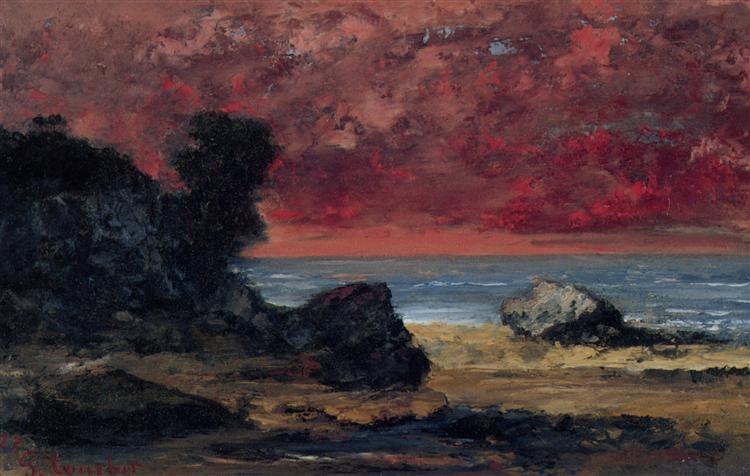
after-the-storm-1872.jpg!Large

      “After the Storm (1872)


            Gustave Courbet


                __________


                  A thin circumference of land appears;
                  And Earth, but not at once, her visage rears,
                  And peeps upon the seas from upper grounds; 


as the land begins to peep[ ] through 

the water, a circumference of land 

appears, a circle of Earth within the 

earlier universal water


to rear, to raise upright, boldly, the better,

here, for Earth‘s visage, Earth‘s face, to 

peep[ ] upon the seas from newly gained 

upper grounds


                  The streams, but just contain’d within their bounds,
                  By slow degrees into their channels crawl; 


streams, just recently redefining their  

boundaries, or bounds[b]y slow 

degrees settle, become waterways, 

channels, rivers, rivulets, rills


I love crawl here, incidentally, the slow, 

insidious, infiltration of a territory, silent 

and immutable, as [t]he streams, at the 

dispassionate pace of nature, find their 

individual course


                  And Earth increases, as the waters fall. 


the waters fall, the waters recede


                  In longer time the tops of trees appear, 


[i]n longer time, after a while


                  Which mud on their dishonour’d branches bear. 


for which the only solution here, would

be, I thought, however ironically, a

shower, rain


but I digress

                 
                  At length the world was all restor’d to view;

                  But desolate, and of a sickly hue:  

see, for instance, above


                  Nature beheld her self, and stood aghast,
                  A dismal desart, and a silent waste. 


desart, is desert, even my spellcheck 

insisted


meanwhile, back on Mount Parnassus

our two survivors, look around


                  Which when Deucalion, with a piteous look
                  Beheld, he wept, and thus to Pyrrha spoke: 


let me point out that what follows, 

which is to say when Deucalion 

… thus to Pyrrha spoke, we have 

an extended monologue, rather 

than a narration, the poet, Ovid

has given a voice to Deucalion

his character, his creation


I was reminded of Shakespeare‘s 

monologues, especially since the 

metre is iambic pentameter,

Shakespeare‘s signature poetic

rhythm 


it should be noted that this translation

of Metamorphoses is from 1717, a

century and a very year after 

Shakespeare‘s demise, in 1616, time 

for poets to have imbibed his already 

profound influence


nor could they not have been marked

by the spirit of their own time, and the 

many transformative epochs since 

Metamorphoses had been written, in 

the year 1, that would’ve affected the 

translation 


the original Latin text, for instance,

was in dactylic hexameter, not 

iambic pentameter


                  Oh wife, oh sister, oh of all thy kind
                  The best, and only creature left behind,
                  By kindred, love, and now by dangers joyn’d;
                  Of multitudes, who breath’d the common air,
                  We two remain; a species in a pair:
                  The rest the seas have swallow’d; nor have we
                  Ev’n of this wretched life a certainty.
                  The clouds are still above; and, while I speak,
                  A second deluge o’er our heads may break.
                  Shou’d I be snatcht from hence, and thou remain,
                  Without relief, or partner of thy pain,
                  How cou’dst thou such a wretched life sustain?
                  Shou’d I be left, and thou be lost, the sea
                  That bury’d her I lov’d, shou’d bury me.
                  Oh cou’d our father his old arts inspire,
                  And make me heir of his informing fire,
                  That so I might abolisht Man retrieve,
                  And perisht people in new souls might live.
                  But Heav’n is pleas’d, nor ought we to complain,
                  That we, th’ examples of mankind, remain. 


cou’d our father, JoveDeucalion asks,

breathe into me his inspiration, his old 

arts, his informing fire, so that I could 

reconstitute Man, retrieve him, and 

supply the perisht people with new, and

presumably more honourable, souls


                  He said; the careful couple joyn their tears: 


He said, or this he spoke, and the

couple joyn their tears


                  And then invoke the Gods, with pious prayers.
                  Thus, in devotion having eas’d their grief,
                  From sacred oracles they seek relief;
                  And to Cephysus’ brook their way pursue: 


Cephysus, or Cephissus, was a river god,

associated with the river Cephissus, which 

runs through Central Greece


                  The stream was troubled, but the ford they knew; 


the ford, the way across the stream


                  With living waters, in the fountain bred, 


living waters would gush from a 

spring, around which a fountain 

would’ve been built


                  They sprinkle first their garments, and their head,
                  Then took the way, which to the temple led.
                  The roofs were all defil’d with moss, and mire,
                  The desart altars void of solemn fire.
                  Before the gradual, prostrate they ador’d;
                  The pavement kiss’d; and thus the saint implor’d.


the gradual is a hymn sung within

the context of a full religious service


desart here is again desert, but in

this instance signifying deserted


the saint, an anachronism here, 

for saints were not at all even a

concept at the time of Ovid

would’ve been Themis, goddess,

at Delphi, on Mount Parnassus

of Divine Justice


R ! chard