Richibi’s Weblog

Just another WordPress.com weblog

Tag: Corneille

Quartet 1 in B major (“La chasse”), op. 1 no. 1 – Haydn
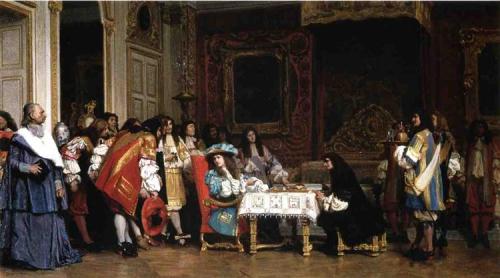
louis-xiv-and-moliere.jpg!Large

        “Louis XIV and Molière (1862) 

              Jean-Léon Gérôme

                     ________

the string quartet didn’t come out of nowhere,
as nothing does – I think – but probably, I 
suspect, from the earlier period’s suites, the
Baroque’s, Bach’sfor instance

suites are a series of dance pieces, stylized 
for the purpose of the musical poet, a popular 
appropriation, an even natural one for 
composers

the aristocracy, by the middle of the 18th
Century, demanded erudite entertainment,
something that Louis XlV, the Sun King,  
had instilled, a little earlier, during his 
Radiant Reign – see Racine, Corneille
Molière, see above, as well, incidentally –
1643 to 1715, up at Versaillesas 
prerequisite for excellence in being a
monarch, a sovereign, sponsorship of 
culture, painting, poetry, music

dukes and counts and barons and 
princesses got onto the bandwagon 
and the arts consequently flourished

witness Haydn and Mozart then, still, 
now, giants 

here’s Haydn’s first, his Quartet no 1
in B major, (“La chasse”), op. 1 no. 1,
the first significant string quartet in 
our Western culture

you’ll note five movements, following 
the suite model described above, with 
mirrored minuets sandwiched between 
opposing mirrored prestos, and an 
adagio in the very middle, as though  
their crowning moment 

an adagio, to my mind, always gives 
away a composer’s worth, listen to 
this one, it’s melting

and he’s got 67 more to go through, I    
marvel, a veritable, and utter,
however improbable, musical
cornucopia 


R ! chard
“Medea” – Euripides

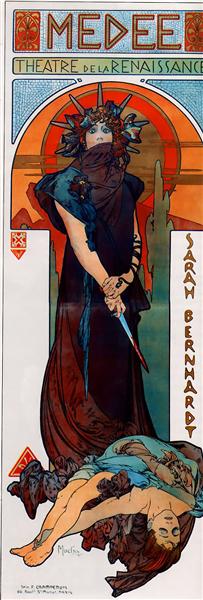
medea-1898-jpglarge

       Medea (1898) 

       Alphonse Mucha

          ____________

catching up on my Greek tragedies 
for a course I’m following online, I
happened upon this marvel

Medea, by Euripides, was written 
in 431 BCE, the next significant 
playwright in world history was
Shakespeare, the Dark Ages had
been “Dark” indeed, it took a 
Renaissance, in fact a new 
flowering of Greek and Roman
arts and institutions to get us 
moving forward again, you’ll 
notice how much of Euripides 
there is in Shakespearenot to 
mention in the French Classicists, 
Racine and Corneille

none of these, incidentally, have 
yet been equalled, never mind 
surpassed, except by maybe 
Anton Checkov, the superb 
Russian playwright

Zoe Caldwell won the 1982 Tony 
Award for best actress for her
incarnation of Medea, she was 
up against Katharine Hepburn 
and Geraldine Pageno less, 
among other distinguished 
luminaries, this is, in other 
words, no ordinary performance, 
watch her turn a mere script, 
however incandescent, into 
set of spoken arias worthy of 
the most celebrated divas

everyone else in the play is also
strong, excellent, impeccable

note the application of the three 
unities, of time, place, and action,
there is no set change, everything 
takes place within 24 hours,
according to the dictates of the 
very plot, the action surrounds 
the expulsion from Corinth of 
Medea and her two, and Jason’s, 
sons, the restrictions of the form 
put the tension, the drama, utterly 
in the hands of the poet, the 
success of the work depends not
on stunts, special effects, but on
words, poetry

Aristotle says in his Poetics“, 
section I, part VI, “The Spectacle has, indeed, an
emotional attraction of its own, but, of all the parts,
it is the least artistic, and connected least with the
art of poetry. … Besides, the production of
spectacular effects depends more on the art
of the stage machinist than on that of the poet.”  

the three unities have no room,
therefore, for Spectacle“, their 
product must be reflections of 
the poet’s humanity, heart, 
straight through, if s/he can, 
to ours

Richard

“Poem for Piano in C# minor” – Arno Babajanian‏

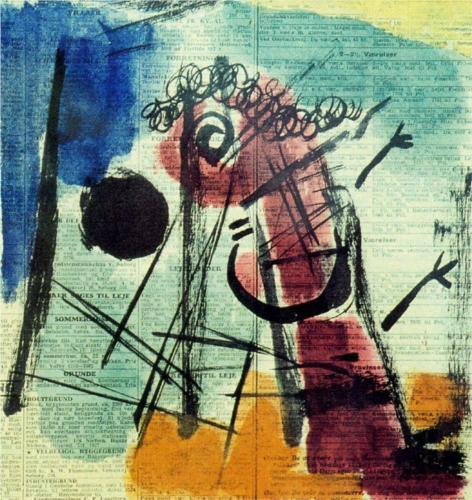
Corneille - "Music" (1949)

Music (1949)

Corneille

______

in the spirit of unusual juxtapositions,
the very stuff, let me suggest, of art,
here’s a Poem for Piano, in C# minor“,
by Arno Babajanian, an Armenian
composer, 1921 to 1983, played by a
countryman of his, Armen Babakhanian

a Poem for Piano begs the question,
what is a poem, can a poem be devoid
of stanzas and words, can music be a
poem

you tell me

Richard

psst: can music, incidentally, be a painting,
see here, or above