Richibi’s Weblog

Just another WordPress.com weblog

Tag: Charles Darwin

“Metamorphoses” (The Giants’ War, XIV) – Ovid
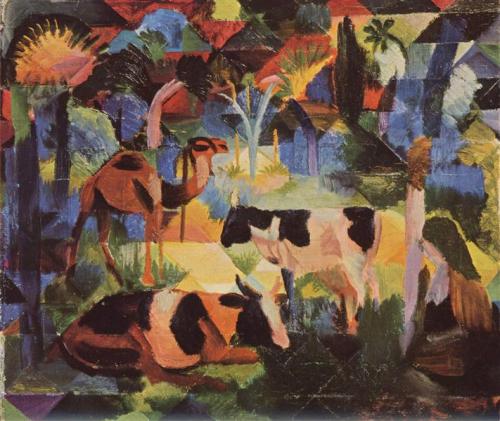
landscape-with-cows-and-a-camel.jpg!Large

    Landscape with Cows and a Camel (1914) 


               August Macke


                   ________


once Deucalion and Pyrrha had found

the way to bring humans back to life, 

it was time to turn to the creation, or

recreation, of other species


              The rest of animals, from teeming Earth
              Produc’d, in various forms receiv’d their birth. 


the rest of animals suggests that 

people were also considered to

be animals, of an however more

elevated, presumably, order


              The native moisture, in its close retreat,
              Digested by the sun’s aetherial heat,
              As in a kindly womb, began to breed: ,
              Then swell’d, and quicken’d by the vital seed. 


by means of the moisture naturally

created by the retreating flood waters, 

the native moisture, the heat of the sun, 

however aetherial, or etherial, which is 

to say of ether, which is to say invisible, 

swell[s], and quicken[s] … the vital seed

the seed which is pregnant with life, or

vital, and nurtures it, swell[s] and 

quicken[s] it, as though within a womb


              And some in less, and some in longer space, 


less, or longer space, of time


              Were ripen’d into form, and took a sev’ral face. 


different kinds of animals, animals with

sev’ral face[s], see, for instance, above

ripen’d, or evolved during longer or 

shorter periods of time, a notion that 

was decisively revisited some nearly 

two thousand years later, incidentally, 

by Charles Darwin 


              Thus when the Nile from Pharian fields is fled, 


Pharian fields, Egypt, from Pharos,

an island off the coast of Alexandria

notable for its lighthouse, itself called 

Pharos, one of the Seven Wonders of 

the Ancient World


              And seeks, with ebbing tides, his ancient bed, 


his ancient bed, the area of earth 

that the Nile had covered during 

the flood, its now exposed river 

banks


the Nile is, note, masculine here, 

his ancient bed


              The fat manure with heav’nly fire is warm’d; 


there’s the heat again


             And crusted creatures, as in wombs, are form’d; 


crusted, it is interesting to note that

apart from the animal feature of the 

womb, all of the terms to describe 

the process of coming to life refer

to plants, see also ripen’d above,

for instance, not to mention the 

vital seed


              These, when they turn the glebe, the peasants find; 


glebe, cultivated land, when the 

peasants plough their fields, they 

find [t]hese, the crusted creatures


              Some rude, and yet unfinish’d in their kind:
              Short of their limbs, a lame imperfect birth:
              One half alive; and one of lifeless earth. 


not all births are successful

              For heat, and moisture, when in bodies join’d,
              The temper that results from either kind
              Conception makes; 
 

life is the product of heat, and moisture

sparking, quicken[ing], matter, bodies, 

a succinct postulation, a metaphysical 

observation, presaging the 17th Century’s 

turn toward the natural sciences, Galileo

Isaac Newton, for instance, coming 

already, and not inaccurately, from the 

age of, at least, Julius Caesar 


it often appals me what was lost of

significant information during the

Middle, the Dark, the Annihilating,

Ages


                                             and fighting ’till they mix,
              Their mingled atoms in each other fix.
              Thus Nature’s hand the genial bed prepares
              With friendly discord, and with fruitful wars. 


generation is a struggle between 

chaos and order, at the most 

fundamental level, according to

Ovid 


              From hence the surface of the ground, with mud
              And slime besmear’d (the faeces of the flood), 


get down


              Receiv’d the rays of Heav’n: and sucking in
              The seeds of heat, 


you can hear the squelch here,

the slim[y] suction


                                             new creatures did begin:
              Some were of sev’ral sorts produc’d before,
              But of new monsters, Earth created more. 


among the new creatures, many 

had existed earlier, been already 

produc’d, but new monsters as 

well sprouted, apparently 

inescapably


              Unwillingly, but yet she brought to light
              Thee, Python too, the wondring world to fright, 


she, the Earth


Python, a mythological serpent, which

guarded Delphi, brought back to light,

or life, the wondring world to fright


              And the new nations, with so dire a sight:
              So monstrous was his bulk, so large a space
              Did his vast body, and long train embrace.
              Whom Phoebus basking on a bank espy’d; 


Phoebus, another name for Apollo

patron deity at Delphi


              E’re now the God his arrows had not try’d
              But on the trembling deer, or mountain goat; 


Phoebus had never needed to try[ ]

his arrow[ ] at anything other than 

game, trembling deer, … mountain 

goat


              At this new quarry he prepares to shoot.
              Though ev’ry shaft took place, he spent the store
              Of his full quiver; and ’twas long before
              Th’ expiring serpent wallow’d in his gore. 


it wasn’t easy


              Then, to preserve the fame of such a deed,
              For Python slain, he Pythian games decred. 


Pythian games, games installed, decreed,  

decred, to honour the slaying of the serpent


              Where noble youths for mastership shou’d strive,
              To quoit, to run, and steeds, and chariots drive. 


to quoit, to throw a ring in a game in

order to encircle at a distance a peg


              The prize was fame: in witness of renown
              An oaken garland did the victor crown. 


nothing other than a crown of oak 

leaves, an oaken garland, was the 

prize at the Pythian Games, but 

enough to assure the fame, the 

glory, of the exalted champion


              The laurel was not yet for triumphs born; 


a crown of laurel leaves, rather than 

of oak, eventually became the symbol 

of triumphs


              But every green alike by Phoebus worn,
              Did, with promiscuous grace, his flowing locks adorn. 


but until the laurel crown prevailed,

an honour associated later, notably, 

with the Ancient Greek Olympics

winners still sported with 

promiscuous grace, the green, the 

colour of Phoebus‘ chosen leaves,

in that god’s honour


later episodes of Metamorphoses

will describe the transformation of

particular people into other 

entities, trees, animals, stars, very

constellations, but for now the 

Creation is complete, the Giants’

War concluded, and the Earth 

replenished, given new life


I suspect that from now on I’ll only

intermittently comment on some 

of the stories in this extraordinary

collection, for this poem is ever as 

long as the very Bible, the only 

other Creation myth, incidentally,  

in the West, a task I expect I’ll 

follow mostly on my own, given

my admittedly idiosyncratic, often

maybe too forbidding, inclinations,

inspirations, interests


but thank you so much for having

listened in, partaken, during this, 

to my mind, fascinating exploration,

this conversation with, I think, 

enlightening, and indeed

ennobling, art


all the very best


R ! chard 


on Beethoven’s Symphony no. 6, the “Pastorale”

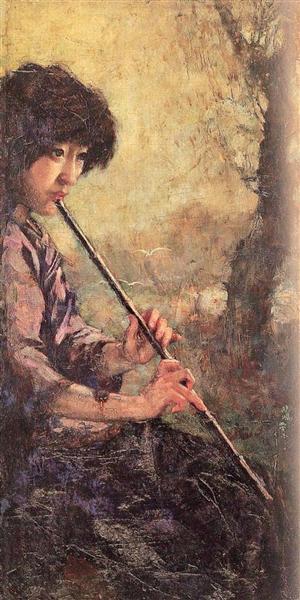
the-sound-of-the-flute.jpg!Large

      The Sound of the Flute 


               Xu Beihong


                 ________


                                    for Susan, who urges

                                               me ever to write


a friend wrote recently, extolling a

performance of Beethoven’s Sixth

Symphony he’d just seen, a 

noteworthy conductor conducting 


then again, how can you go wrong, 

I wrote back, with that already 

enchanting music, sent him, in

return, a version I’d ferreted out,

tried out for him, had been duly

enchanted, had laughed, had cried, 

taken shelter from the storm, come 

out the other side transported, again  


I wondered about the power of music, 

during my intermittent musings

throughout the variegated movements, 

as the peregrinations ambled on along 

their own magical explorations, long 

irrepressible arpeggios running up or 

down the scales, performing 

arabesques at their peaks, rumbling 

tremolos at their grumbling bottoms, 

before returning to the more stable 

middle ground of the melody


where, wondered, does it all find its 

source


sounds, individual sounds, would 

have been signals of danger, 

originally, a single note from a horn

warning of strangers on the way to

a community of otherwise peaceful

cohabitants if not only family, twig 

cracking in the forest when you 

believe you’re all alone


individual sounds would’ve picked

up meaning beyond their own pitch

and volume, resonance, reverberation,

rotundity, through Darwinian, even, 

time


a mother’s voice, for instance, 

identified immediately, upon a single

note, perenially, by any of her brood


it’s a long way from there to a symphony

but those are its roots, why we laugh, why

we cry, take shelter from the storm, and 

come out the other side transported


notes are written, emblazoned, on 

our consciousness, our lives depended,

depend still, on it 


listen


R ! chard


psst: interestingly, our Darwinian evolution

          has produced pitch as an identifying

          factor for our species, a female voice 

          is higher than a male’s, this has 

          allowed us, as a species, to sing

String Quartet no 15 in A minor, opus 132 – Beethoven

the-garden-of-earthly-delights-1515-7.jpg!Large

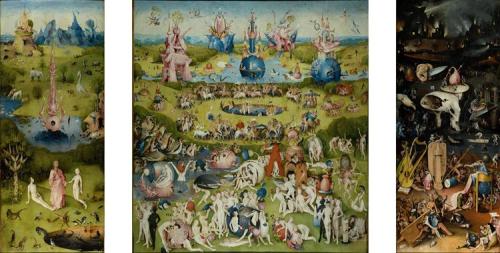
   “The Garden of Earthly Delights (1510 – 1515) 

          Hieronymus Bosch

               ____________

if I’ve been spending a lot of time on
Beethoven, it’s that, apart from 
besides him Napoleon, no one else 
dominates in the public imagination 
the early 19th Century, there is no 
one else of such comparable 
importance 

let me also point out that when 
Nietzsche identified his model for  
the Übermensch, Superman, it was  
not the French General, the French 
Emperor, however formidable, 
however illustrious, he named, but 
Beethoven 

Nietzsche had already understood 
that in the future, a future where the
idea of God had been put into question,
an issue which had begun irreversibly 
with the splintering of the Catholic 
supremacy, when the several 
Protestantisms, Lutheran, Calvinist
Anglican then, presented differing 
opinions of each their vehemently
defended deity, the eventual 
resolution would be inescapably up 
for metaphysical grabs, which set 
philosophers, scientists, poets in 
search of answers, which by 
definition must be as varied as 
there are voices

the outcome was the eventual 
declaration of human rights before
the court of international opinion 
as the ruling moral consideration
above the demands of any one 
faith

Nietzsche‘s pronouncement was that
a powerful opinion could therefore 
sway very populations towards its 
vision, however ultimately 
sometimes dire, Nietzsche was 
therefore blamed for predicting, 
for instance, Hitler, as though 
Nietzsche were himself responsible, 
rather than prescient 

one of his books, indeed, entitled 
Beyond Good and Evil“, illustrates
the breakdown of the traditional, 
which is to say Christian, moral
order, powerful people will take us 
where they want to, for better or 
for worse, he prophesied

therefore, note, the very present

but there is also Beethoven, the 
incandescent prophet, Charles 
Darwin, the biologist, who 
changed the way we understand 
ourselves, Sigmund Freud, who 
pushed that understanding even 
further, Albert Einstein, who gave 
us an alternate picture of the 
universe, John Lennon, who 
called upon us all to Imagine“, 
Princess Diana, who demonstrated 
what it was to be good in a world 
that was losing its compass, each 
shaping by force of personality 
our present age, their future
 
all was not, by their examples, 
lost, in other words, some of our 
leaders would be benevolent, 
verily even inspiring, despite the 
prevalence in their midst, the 
existential threat of, nefarious, 
indeed ruthless, and, too often, 
appalling, despots, a category 
too long to even begin to list

here’s, however, Beethoven doing 
again his stuff to inform the tenor
of his time, his 15th String Quartet
another forceful and foundational 
step towards the world that lay,
before him, ahead, our world, for 
better or for worse


R ! chard

the 50 greatest books in English

should you have been following the contest in the Globe and Mail, here’s the latest:
 
THE 50 GREATEST BOOKS, to date
 
Mark Twain, The Adventures of Huckleberry Finn
Marcel Proust, Remembrance of Things Past
Charles Darwin, On the Origin of Species
Dante Alighieri, Commedia (The Divine Comedy)
Plato, The Republic
Miguel de Cervantes, Don Quixote
James Joyce, Ulysses
Karl Marx, Das Kapital
St. Augustine, Confessions
Niccolo Machiavelli, The Prince
 
 
my recent response :
 
first of all of the first ten choices of the 50 greatest books in English only three strictly fit the bill, the others are culled from everything already from French and German to verily Ancient Greek and Latin, by way of medieval Spanish no less, and Italian
 
with this I have no cavil but for not paying proper heed to translations, translators, and their varied abilities for delivering accurate goods, both in substance and in spirit, some references should be made to preferred renditions, I would suspect Dante for instance in even competent prose would be no match at all for nearly any in thoughtful verse, and these superior options should be duly credited and recommended, otherwise where is the “English” in these “50 greatest books”
 
“Remembrance of Things Past” got me off, it is my supreme masterpiece along with “The Iliad”, it got me interested in this contest, further choices did not disinterest, and I held back scepticism
 
however having just read Plato on essentially your instigation, and found him outrageous, indeed offensive, not least of all because he actually proposes to castrate Homer, censor parts of him, to fit a cockeyed political agenda, a tyranny in fact – for where is the line between tyranny and even enlightened kingship – a tyranny he would of course administer himself
 
Plato throughout merrily essentially rambles, nearly incoherently, certainly without any real relevance to ourselves, unless you want to start a tyranny, while his audience, Thrasymachus, Glaucon and the rest, let him ramble, tyrannically, for over four hundred nearly interminable pages
 
could they be thinking, could we
 
 
and where is Homer for that matter on your list
 
to propose a list of the 50 greatest books one would have to have read a good part of the canon, or have a pool of such people, for where otherwise is the validity of the contest, you can’t even begin to make those choices without having read too many of the masters that haven’t made the list yet
 
where is of course Shakespeare in all this, where is this pinnacle of English literature, where is Dickens, where is Henry Fielding and the boisterous “Tom Jones”, the gothic Emily Brontë of “Wuthering Heights, the ethereal and unforgettable Virginia Woolf, where, closer to home, are Truman Capote, Vladimir Nabokov, with each their masterful groundbreakers, “In Cold Blood”, “Lolita”
 
I won’t even start on literary titans in other languages
 
 
the choices in English to date have been quaint, “Ulysses” belongs there, “Tom Sawyer” instead of “Huckkleberry Finn”, but with next week F. Scott Fitzgerald’s “The Great Gatsby” the choices of your panel become questionable
 
where is Somerset Maugham’s “The Razor’s Edge” then, “Of Human Bondage”, or any of his perfect short stories if you’ll first give precedence to the entertaining but not nearly as prolific, nor able, Fitzgerald
 
I suspect not read  
                                                                                

or closer to home where is “The Grapes of Wrath”, one of, just one of, John Steinbeck’s towering achievements
 
James Agee’s “Let Us Now Praise Famous Men” with Walker Evans, or his sublime “A Death in the Family”, right up there with “To Kill a Mockingbird”, Harper Lee’s triumph, where are these, could they have been read but still not trump next week’s trifle
 
where is “Gone With the Wind”, Margaret Mitchell’s magnum opus, in every sense of that first word, magnum great, magnum wonderful
 
where is the sensuous and searing “Alexandria Quartet” of Lawrence Durrell
 
more esoterically perhaps but no less deservedly where are the sublime “Diaries of Anaïs Nin”, an unparalleled account of a life lived at the very centre of cultural exchange in New York and Paris starting at the Jazz Age, moment by telling moment,  and ending in the psychedelia of the Sixties and Seventies, written with stark and consummate ablility, artistry, and frankness
 
where for that matter is Anne Frank’s diary, about which a moment of silence would rather do than my mere words to sing its highest praises
 
there are only 40 places left, please fill them thoughtfully

                                                                                                                                                                    thank you


  __________________________________