Richibi’s Weblog

Just another WordPress.com weblog

Tag: “The Creation”

“Metamorphoses” (The Giants’ War, XIII) – Ovid

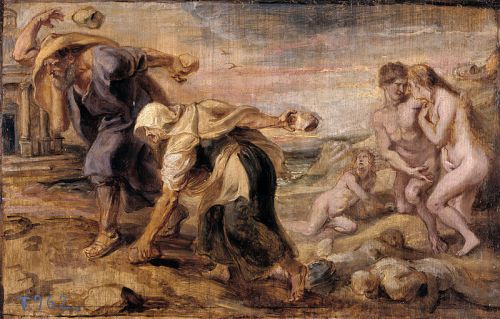
800px-Peter_Paul_Rubens_-_Deucalion_and_Pyrrha,_1636

      Deucalion and Pyrrha (1636) 


             Peter Paul Rubens


                 ___________


                                          for my mom and dad, my own

                                                   Deucalion and Pyrrha


at Cephysus‘ shrine, Deucalion and 

Pyrrha pray to the goddess of

Divine Justice


              O righteous Themis, if the Pow’rs above
              By pray’rs are bent to pity, and to love;
              If humane miseries can move their mind; 


humane, human


              If yet they can forgive, and yet be kind;
              Tell how we may restore, by second birth,
              Mankind, and people desolated Earth. 


the Pow’rs above are the deciding 

factors, can Jove, Neptune, the others, 

Deucalion asks, be moved by human[ ] 

miseries, can they forgive, can they 

restore…Mankind, people, people is

a verb here, the world again, the 

desolated, or desolate, the dismal, 

the forsaken, Earth


              Then thus the gracious Goddess, nodding, said;
              Depart, and with your vestments veil your head:
              And stooping lowly down, with losen’d zones,
              Throw each behind your backs, your mighty mother’s bones. 


losen’d zones, across wide areas


cover, veil, your heads, the goddess 

advises, stoop low, and throw your 

mother’s bones across wide areas, 

she instructs, however scandalously


              Amaz’d the pair, and mute with wonder stand,
              ‘Till Pyrrha first refus’d the dire command. 


Pyrrha is a counterpart for the Christian 

Eve here, contrary, defiant of Heaven, 

however eventually, Pyrrha, blameless, 

but which of the progenitresses came

first, which the chicken, which the egg, 

Eve or Pyrrha, is a question up for 

contemplation


              Forbid it Heav’n, said she, that I shou’d tear
              Those holy reliques from the sepulcher. 


surely, Pyrrha proclaims, Heav’n would 

never allow, Forbid it Heav’n, not to 

mention condone, that I should remove, 

tear, my mother’s bones, [t[hose holy 

reliques, relics, from their sepulcher, 

their grave, this would be profoundly 

unholy 


              They ponder’d the mysterious words again,
              For some new sense; and long they sought in vain:
              At length Deucalion clear’d his cloudy brow,
              And said, the dark Aenigma  


Aenigma, Sphinx, the oracle


                                                                will allow
              A meaning, which, if well I understand,
              From sacrilege will free the God’s command: 


if I can properly understand, decipher,

the meaning of the God’s command, 

Aenigma’s oracular words, however 

cryptic, in such a way, Deucalion 

declares, that our actions be not 

sacrilegious, nor offensive in any 

way to the gods, we may proceed,

he reasons


              This Earth our mighty mother is, the stones
              In her capacious body, are her bones: 


This Earth is our mighty mother, the

stones in her capacious body [ ] are 

her bones, no comma after body


the word order in each clause, note, has 

been reversed, instead of subject, verb,

object, we have object, verb, subject


but then, ever so felicitously, stones 

can rhyme with bones, and equally,

and as liltingly, we’re still in iambic 

pentameter


              These we must cast behind. With hope, and fear,
              The woman did the new solution hear:
              The man diffides in his own augury, 


diffide, distrust, augury, prediction,

Deucalion doubts, in other words,

his own calculations


              And doubts the Gods; yet both resolve to try. 


when my mom is up against a 

dilemma, she calls on my dad,

gone some over thirty years now,

come on, Daddy, let’s go, she 

says, and confronts the issue 

with transcendental, by very 

definition, conviction


see above


              Descending from the mount, they first unbind
              Their vests, and veil’d, they cast the stones behind:
              The stones (a miracle to mortal view,
              But long tradition makes it pass for true) 


what follows will seem miraculous

to mortals, Ovid says, but the story 

has been around for such a while,

which is to say by long tradition, 

that we let it pass for true


              Did first the rigour of their kind expel, 


the stones begin to lose, expel, their 

firmness, the rigour of their kind


              And suppled into softness, as they fell; 


suppled, became supple


              Then swell’d, and swelling, by degrees grew warm;
              And took the rudiments of human form. 


stones are being transformed, 

metamorphosized, into humans 


the Bible, if you’ll remember, would 

have it be clay


              Imperfect shapes: in marble such are seen,
              When the rude chizzel does the man begin; 


chizzel, chisel


              While yet the roughness of the stone remains,
              Without the rising muscles, and the veins. 


as the sculpture is being fashioned, 

certain parts of the human anatomy, 

the muscles, for instance, the veins, 

are not yet revealed, uncovered, 

discovered, extracted, by the 

chizzel, from under the roughness 

of the stone


think of Michelangelo, or Rodin,

sculpting


              The sappy parts, and next resembling juice, 


sappy, from sap, which, emanating 

from stones, would be next to, but 

not as limpid as, juice, or the liquid

required to create humans


              Were turn’d to moisture, for the body’s use:
              Supplying humours, blood, and nourishment; 


the circulatory, and notably viscous, 

system


              The rest, too solid to receive a bent,
              Converts to bones; and what was once a vein,
              Its former name and Nature did retain. 


veins, which hadn’t received enough 

sappy parts to become part of the

circulatory system, retained their 

name of vein, but as understood in

relation to rocks, geological veins

presumably replicated, in this story 

of the Creation, in human bones


              By help of pow’r divine, in little space, 


in little space, in no time at all


              What the man threw, assum’d a manly face;
              And what the wife, renew’d the female race. 


the stones that the man, Deucalion

threw became men, those that 

Pyrrha tossed became women 


              Hence we derive our nature; born to bear
              Laborious life; and harden’d into care.


we’ve inherited, through the labours 

of Deucalion and Pyrrha, our driven

nature, harden’d into, or conditioned, 

condemned, to care 


for better, I infer, or for worse 


R ! chard


“Metamorphoses” (The Golden Age) – Ovid

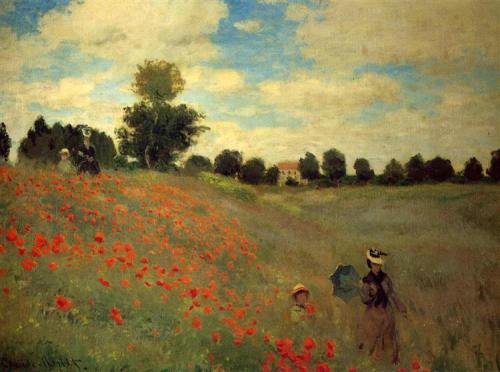
field-of-poppies.jpg!Large

    “Field of Poppies (1873) 


           Claude Monet


               _______


once the Creation is complete, Time 

becomes one of its components, ages, 

or eras, or epochs ensue giving credence 

to the fact of an evolutionary process,

instead of stasis a continuation of the 

inner workings of primordial Chaos still 

roils, bristles, but among more orderly 

elements now 


so that the first age, The Golden Age,

is positively blissful 


             The golden age was first; when Man yet new,
             No rule but uncorrupted reason knew: 


Evil was not yet even a concept 


             And, with a native bent, did good pursue. 


a native bent, naturally, by instinct, inately


             Unforc’d by punishment, un-aw’d by fear,
             His words were simple, and his soul sincere; 


therefore


             Needless was written law, where none opprest: 


where no one offended, laws were 

unnecessary


             The law of Man was written in his breast: 


a function of his emotions


             No suppliant crowds before the judge appear’d,
             No court erected yet, nor cause was heard: 


suppliant crowds, petitioners for justice


             But all was safe, for conscience was their guard. 


remember conscience, something that too

often now has fallen, it seems, by the 

wayside


though we’re a long way off at present, 

admittedly, from the Golden Age


             The mountain-trees in distant prospect please, 


please is a verb here, as in the mountain-trees 

bring pleasure


but


             E’re yet the pine descended to the seas: 


E’re, or before, the pine trees descended, 

grew closer to, gravitated toward, the water


compare here, ” About her coasts, unruly 

waters roar; / And rising, on a ridge, 

insult the shore.”, from earlierwhere 

“water vies with earth for its place upon 

the strand”


instead of water, Earth encroaches here, 

an equally formidable opponent 


             E’re sails were spread, new oceans to explore: 


E’re, or before, ships set out to conquer,

see Columbus for the archetypal example


             And happy mortals, unconcern’d for more,
             Confin’d their wishes to their native shore. 


a world without an economy


             No walls were yet; nor fence, nor mote, nor mound,
             Nor drum was heard, nor trumpet’s angry sound: 


drums and trumpets at any distance 

would’ve been cause for alarm, or at

the very least caution


             Nor swords were forg’d; but void of care and crime, 


note the negative no, nor, nor hammered out

through the last three verses, describing by 

omission the state of the original age, 

what there was not


             The soft creation slept away their time. 


soft creation, not inclined to struggle


             The teeming Earth, yet guiltless of the plough,
             And unprovok’d, did fruitful stores allow: 

             Content with food, which Nature freely bred,
             On wildings and on strawberries they fed; 


the subject here throughout is the “teeming 

Earth”, the Earth, metonymized, becomes 

earthlings – therefore “they” replaces 

“teeming Earth” as subject in the last two 

lines – who’d feed on wildings, uncultivated 

plants, crab apples, for instance, strawberries


             Cornels and bramble-berries gave the rest,
             And falling acorns furnish’d out a feast. 


Cornels, shrubs 


             The flow’rs unsown, in fields and meadows reign’d: 


flowers bloomed unbidden, covering fields


see above 


I watch the cherry blossoms grace our 

streets with their opulence as I speak,

decking our April days with springtime, 

still, even thousands of years later“,

a remnant, a bequest, of that golden 

past 


             And Western winds immortal spring maintain’d. 


like very Paradise, stretching into even 

immortality


             In following years, the bearded corn ensu’d
             From Earth unask’d, nor was that Earth renew’d. 


renew’d, tilled, harvested


             From veins of vallies, milk and nectar broke; 


valleys engender streams that create 

the conditions for milk and nectar


             And honey sweating through the pores of oak.


or our own indigenous syrup of maple


R ! chard


the ensuing Ages – Ovid‏

    The Silver Age - Lucas Cranach the Elder

                            The Siver Age  (c.1516)

                              Lucas Cranach the Elder

                                                     ________


it is interesting to note how profoundly Ovid‘s mythological
setting marked Christian notions of the Creation, which at
least in the West have held sway now for some nearly two
thousand years
 
it is a tale then twice told, the last time however with not
half even the first one’s contagious exuberance, I think  
 
I believe more in Ovid then, also in Cranach and da Cortona,
worthy indeed proponents of that earlier oracular deity 
 
 
Richard
 
                       ____________________


But when good Saturn, banish’d from above,
Was driv’n to Hell, the world was under Jove.
Succeeding times a silver age behold,
Excelling brass, but more excell’d by gold.
Then summer, autumn, winter did appear:
And spring was but a season of the year.
The sun his annual course obliquely made,
Good days contracted, and enlarg’d the bad.
Then air with sultry heats began to glow;
The wings of winds were clogg’d with ice and snow;
And shivering mortals, into houses driv’n,
Sought shelter from th’ inclemency of Heav’n.
Those houses, then, were caves, or homely sheds;
With twining oziers fenc’d; and moss their beds.
Then ploughs, for seed, the fruitful furrows broke,
And oxen labour’d first beneath the yoke.
 
 
To this came next in course, the brazen age:
A warlike offspring, prompt to bloody rage,
Not impious yet…


   The Age of Iron - Pietro da Cortona
 
                             The Age of Iron”  (1637)
 
                                      Pietro da Cortona
 
                                            __________


Hard steel succeeded then:
And stubborn as the metal, were the men.
Truth, modesty, and shame, the world forsook:
Fraud, avarice, and force, their places took.
Then sails were spread, to every wind that blew.
Raw were the sailors, and the depths were new:
Trees, rudely hollow’d, did the waves sustain;
E’re ships in triumph plough’d the watry plain.

Then land-marks limited to each his right:
For all before was common as the light.
Nor was the ground alone requir’d to bear
Her annual income to the crooked share,
But greedy mortals, rummaging her store,
Digg’d from her entrails first the precious oar;
Which next to Hell, the prudent Gods had laid;
And that alluring ill, to sight display’d.
Thus cursed steel, and more accursed gold,
Gave mischief birth, and made that mischief bold:
And double death did wretched Man invade,
By steel assaulted, and by gold betray’d,
Now (brandish’d weapons glittering in their hands)
Mankind is broken loose from moral bands;
No rights of hospitality remain:
The guest, by him who harbour’d him, is slain,
The son-in-law pursues the father’s life;
The wife her husband murders, he the wife.
The step-dame poyson for the son prepares;
The son inquires into his father’s years.
Faith flies, and piety in exile mourns;
And justice, here opprest, to Heav’n returns.

 
                                               Ovid 
                                                                    
                                   (fromMetamorphoses“, Book I, in a translation by
                                   Sir Samuel Garth, John Dryden, Alexander Pope,
                                   Joseph Addison, William Congreve and other
                                   eminent hands)