String Quintets – Mozart / Beethoven


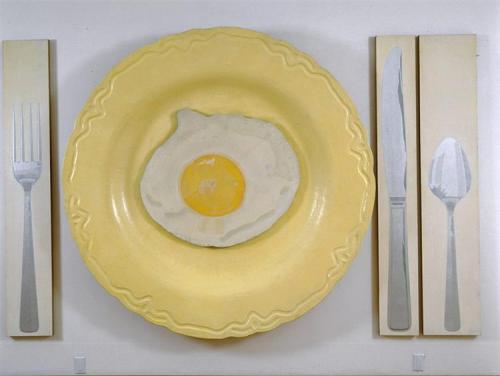
“Egg on Plate with Knife, Fork, and Spoon“ (1964)
____
after my somewhat prolonged side trip
into Bach country, though it is a land
of many more wonders, I’ll get back
on track, more or less, here, with
Beethoven’s Second Cello Sonata,
the other half of his Opus 5
till then, the cello had served as
accompaniment, essentially, for other
more discursive, higher pitched, less
sonorous, less stentorious
instruments
but Beethoven puts the cello back
into the hottest seat in the house, right
next to the ubiquitous piano, a
requirement in any instance following
the neglect of the cello during the
intervening Classical Period, despite
Bach’s earlier luminous illustration of
its incandescent potential
the Opus 5, no 2 starts, audaciously,
with an adagio, not always a wise
choice, as you’ve heard me repeat
here before, it can be unentertaining
but Beethoven gives his adagio tension
by introducing breaks often, which,
rather than stultify, creates momentum,
therefore a narrative, a story to follow
the rhythm is no longer adjusted to
dance essentially, such a spin as is
heard in the second and third
movements, for instance, would
surely sweep one off one’s feet
but the art is in the dance that
Beethoven allows and creates between
the piano and the cello, the first the
filigree on the arm of the more grounded,
more entrenched latter, the crystal, the
silverware that adorn, symbolically, an
however majestic oak table, the creamy
Hollandaise that makes an egg, however
elemental, irresistible, the literary turns
that might transform mere prose into,
verily, poetry, icing on a cake, in a word,
to complement, in stunning and equal
cooperation, the inextricable
counterpart
there is even a moral lesson transmitted
here
Beethoven can often be long-winded,
I’ve found, but there’s always, always,
at the end of the road something
entirely worth the extra minute, the
even several extra minutes
R ! chard

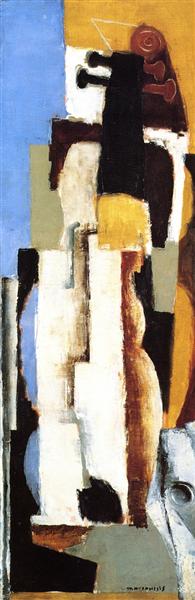
“A Cello“ (1921)
___________
between Bach’s transcendent Suites for
Cello and Beethoven’s reinvention of that
instrument, two only cello works occupy
the last half of that century, both by
Haydn
his Second, however, Concerto, written
several years later than his First, 1783,
indeed nearly twenty years later, seems
to me less accomplished, though ever,
nevertheless, unimpeachably, and
impressively, Haydn
the first movement is long, long works
only until you start thinking it’s long
the initial melody in the adagio, the
second movement, struck me as artificial,
saccharine, though Haydn weaves magic,
not unexpectedly, still, and
continuously, around it in its
development, his elaboration of it
and the pace of the third movement,
following the second, is disconcerting
rather than surprising, rather than,
were it effective, delightful
Mozart wrote a Cello Concerto too,
apparently, but, if so, it is lost
otherwise we’re on to the next historical
epoch, Beethoven’s, after this inauspicious
turn at this generation for the cello, lost
for a while among the more assertive
instruments of that prim, and proper,
Classical Era
R ! chard

“St. George and the Dragon“ (c.1470)
________
it isn’t easy for me to leave Bach behind
whenever I start listening to him, I could
ride his musical train forever
but the middle of the 18th Century did, put
him aside, for about a hundred years, until
Mendelssohn rediscovered him
Bach’s Cello Suites were themselves only
reinstated in the 1930s by Pablo Casals,
the Classical 18th Century had considered
Bach too fussy, his pieces, they thought,
were technical exercises rather than
actual entertainments, form was
overtaking, for them, function
there’s a wonderful book about all this,
“The Cello Suites“, written by Eric Siblin,
a Canadian journalist, which is not only
amazingly informed and probing, but also
beautifully written, it holds a place of
honour on my bookshelf, along with other
inspired, and inspiring, texts
not only was Bach set asunder, dismissed,
during the Classical Era, but all of the
formative music also he had written, for
cello, violin, keyboard, in other words,
the entire curriculum
which, since Bach’s reinstatement, has
become, paradoxically, the very
foundation for learning these instruments
imagine playing a tune with the right
hand, then a few notes later, picking
it up in the left hand while the right
hand keeps on going, imagine what
that does to your fingers, never mind
to your mind, that’s what his Two-Part
Inventions are all about, fifteen of
them, eight in major keys, seven in
minor, consider the technical
difficulties, intricacies, imposed
both compositionally and upon
the harried performer
then Bach follows through with his
Three-Part Inventions to top it all
off, for the keyboard at least, and
only for the moment – there’ll still
be his transcendental “Goldberg
Variations” among other
incandescent masterpieces –
wherein one juggles three tunes at
a time, and all of them in the same
assortment of fifteen contrasting,
foundational, keys, the “Inventions“
– if you can do that, you’re on your
way, one would think, to knowing
entirely what you’re doing
but time marches on, the Classical
Era hits, Haydn takes over, not
unimpressively
the same thing happened in my
generation to Frank Sinatra via
the Beatles, not to mention, a little
later, to either, with Pink Floyd
listen to Haydn’s First Cello Concerto,
note the bravura inherent in the
composition, this is not Bach’s
meditative music, the very Romantic
Period is, through Classical reserve,
expressing already its imminence,
individual prowess is taking over
from community, which is to say
religious, affiliation, the same way
the Renaissance artists, Duccio,
Giotto, Fra Angelico, Filippo Lippi,
Uccello had stood out, incidentally,
from their brethren in the standard
communal art schools dedicated to
decorating the ever burgeoning
churches sprouting out in the still
fervent European environment
musical, though unaristocratic,
talents, this time, were beginning,
within a German context, to flex
their decidedly not unimpressive
muscles, and gaining some
significant purchase
and who wouldn’t when a Cello
Concerto would’ve sounded like
this, listen
R ! chard

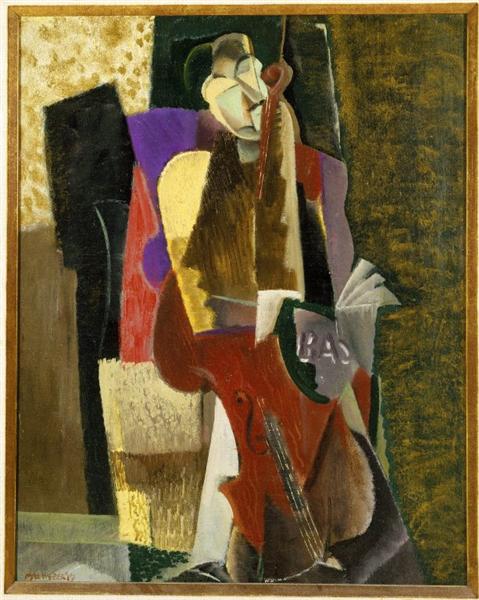
“The Cellist“ (c.1917)
______
what struck me immediately upon hearing
the bow’s very first strokes on the violin in
this Fifth Cello Suite of Bach was that the
mood was not only brashly Romantic, but
quite specifically Russian Romantic, right
up there with Dostoyevsky, and “Fiddler
on the Roof“, dark brooding colours at
first, followed by long plaintive musical
phrases, you can even hear the sound of
the steppes, I thought, stretching out into
the endless distance, this performance,
I surmised, is not, other than
compositionally, Baroque, not to mention
not even German
yet as played by Mischa Maisky, it’s one
of the best versions of the Fifth I’ve ever
heard, and if it works, who’s to complain
but more context – Bach never gave not
only textural indications, but not even
tempos to his pieces, apart from the
very dance terms that identify the
movements, so what, therefore, is the
specific pace, you’ll ask, of a courante,
for instance, you tell me, I’ll reply
in other words, the modular terms were
significantly looser in the early 18th
Century than later, when metronome
markings would begin to demand more
accurate replication of the artist’s
explicit specifications – Beethoven
especially made sure of that, by
requiring accurate renderings of his
mood or pace indications, largo,
allegro, andante, for instance, still less
strict than the stipulation later for exact
musical beats per minute – trying to
keep pace with a prerecorded tape, for
example, as in again the industrially
driven, which is to say emotionally
indifferent, context of the seismic
“Different Trains“, a masterpiece of a
more technically conditioned era
I don’t think that Bach would at all have
been disappointed that the heirs of his
fervent, though more genteel, creations
might’ve morphed into something
profound for other groups, be they
national, or of a class, or of even a
generation, of people, which is to say
that these works have superseded
their merely regional intent, and have
reached beyond space and time, the
very purview of music, to speak a
common and cooperative, indeed a
binding, language
I said to my mom the other day that if
we all sang together, we could save
the world
R ! chard
psst: Maisky’s encore,, incidentally, is from
the “Bourrée” of Bach’s Third Cello
Suite, note this contrasting, more
courtly – more refinement, more
reserve – rendition, you can even
hear, not to mention see, in this
particular instance, not Russian
steppes, but European trees on
their baronial estates, if you lend
an attentive ear

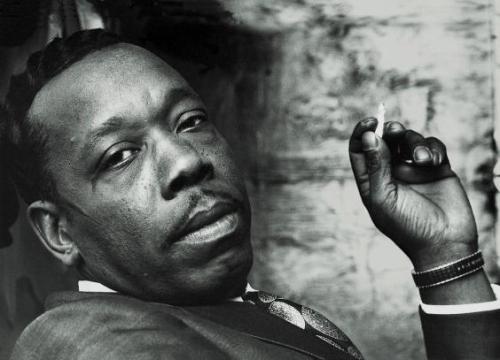
Slim Harpo (1924 – 1970)
______
for Barbara
having read my musings on the guitar‘s
superior practicality, easy portability,
as a carry-along instrument on the range,
a friend replied, “how about a cowboy
with a harmonica“, and mentioned Slim
Harpo, I told her I’d look into it, how
could I not, though I’d never at all
ever heard of Slim Harpo
here’s Slim Harpo, he’s a treat
but a harmonica, finally, is too brash
an instrument to easily fashion out
of it love songs, so I’ll hold onto my
guitar
you’ll note that despite the entirely
different style of music from the
Classical stuff I’ve been bringing
up, the three essentials, tonality,
tempo, and reiteration still apply,
this trinity is the foundation of all
of our Western musical culture,
the output changes only according
to geographical place and time
within those European parameters
Asia has its own, indeed several,
distinct musical idioms
Slim‘s is manifestly the American
Deepest South
R ! chard

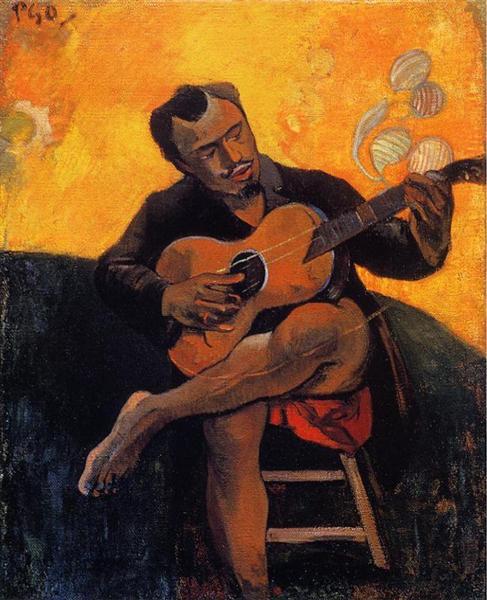
“The guitar player“ (1894)
________
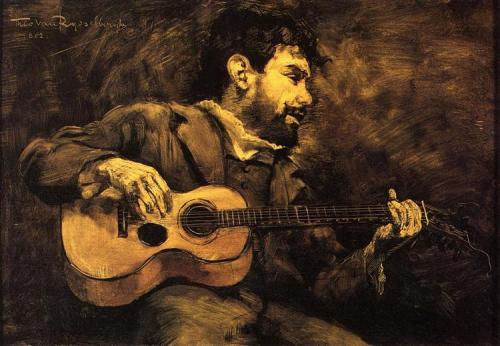
for Daniel, despite his
occasional jabs
transcribed for guitar, Bach’s Cello Suite no 4
becomes an entirely other experience, listen
less transformationally, the original key, E flat,
is transcribed, altered, to the key of C, you
won’t even notice
from an introspective, however lively often,
utterance, I hear here, rather, a serenade,
before a balcony, before the balustrade of
a blushing señorita, demure beneath her
modest mantilla, quivering behind a
fluttering matching fan, at the sincerity,
and artistry of her courter, his
unadulterated, and utterly vulnerable
pursuit, an unmistakable expression of
his devotion, ability, agility, and eventually,
his worth, which is, incidentally, what art
is, when achieved, always irresistible, even
miraculous
plus who wouldn’t surrender everything
to this guitarist, apart even from his art
R ! chard