Richibi’s Weblog
Just another WordPress.com weblog
July 15, 2020
The Story of Phaeton (V) – Ovid
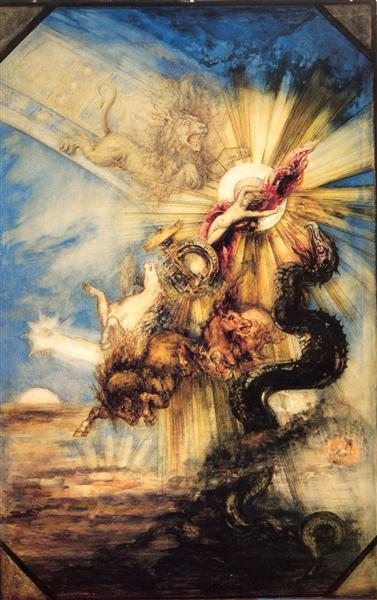
“Phaethon“ (1878)
Gustave Moreau
________
Mean-while the restless horses neigh’d aloud,
Breathing out fire, and pawing where they stood.
Tethys, not knowing what had past, gave way,
And all the waste of Heav’n before ’em lay.
Tethys, a Titaness, from the original
race of gods, before the Olympians,
who seems to have some sort of
controlling force in the heavens,
and concern for the regularity of its
movements, though I haven’t yet
figured out her specific purpose,
position, in the scheme of things
They spring together out, and swiftly bear
The flying youth thro’ clouds and yielding air;
They, the horses
The flying youth, Phaeton
With wingy speed outstrip the eastern wind,
And leave the breezes of the morn behind. “
the eastern wind, Eurus, which you
might remember from the Creation
of the World
The youth was light, nor cou’d he fill the seat,
Or poise the chariot with its wonted weight:
wonted, usual, the chariot is lighter
now that only Phaeton’s lesser
weight is in it rather than that of his
heavier father
poise, superb word here suggestive
of the delicacy, the precariousness,
of the operation, not to mention its
grace
But as at sea th’ unballass’d vessel rides,
unballass’d, without ballast,
unstable, destabilized
Cast to and fro, the sport of winds and tides;
So in the bounding chariot toss’d on high,
The youth is hurry’d headlong through the sky.
see above
Soon as the steeds perceive it, they forsake
Their stated course, and leave the beaten track.
The youth was in a maze,
you can hear the etymology of amaze
here, was in a maze, caught up in a
conundrum, completely disoriented
nor did he know
Which way to turn the reins, or where to go;
Nor wou’d the horses, had he known, obey.
had he known, Phaeton didn’t know,
as his father would have, his horses
Then the sev’n stars first felt Apollo’s ray,
And wish’d to dip in the forbidden sea.
the sev’n stars, the Pleiades, a star
cluster, closest to the earth, would
resort to the coolness of the sea,
supposedly, upon being subjected
to the heat of Apollo’s ray, or rays
forbidden, probably forbidding
The folded serpent next the frozen pole,
Stiff and benum’d before, began to rowle,
The folded serpent, the constellation
Serpens
And raged with inward heat, and threaten’d war,
And shot a redder light from ev’ry star;
a redder light, the brightest star,
indeed a double star, in the
constellation Serpens, is called
Alpha Serpentis, we now, with our
greater understanding of the
cosmos, call such stars red giants
because of a distinctive ring they
present around their core for
reasons of thermodynamics, Ovid
is using this cosmic peculiarity
here for his own poetic purposes
Nay, and ’tis said Bootes too, that fain
Thou woud’st have fled, tho’ cumber’d with thy wane.
Bootes, or Boötes, is yet another
constellation, like Serpens, in the
northern sky
cumbered, encumbered
wane, to lose its vigour
Th’ unhappy youth then, bending down his head,
Saw Earth and Ocean far beneath him spread.
His colour chang’d, he startled at the sight,
And his eyes darken’d by too great a light.
darken’d, blinded, by too great a light
Now cou’d he wish the fiery steeds untry’d,
untry’d, o, that he had not attempted to
take on the fiery steeds, Phaeton rues,
nor to have ridden at all the Chariot of
the Sun
His birth obscure, and his request deny’d:
had Phaeton only left [h]is birth obscure,
not demanded to know who his father
was, and been denied, been deny’d, this
horrifying proof of it would not be now
so threatening
Now wou’d he Merops for his father own,
Merops, Clymene‘s husband, Phaeton‘s
stepfather, Phaeton would now willingly
accept, own, Merops as his father, and
give up his claim to being son of the
Sun god
And quit his boasted kindred to the sun.
kindred, originating from the same family,
spirit
So fares the pilot, when his ship is tost
In troubled seas, and all its steerage lost,
He gives her to the winds, and in despair
Seeks his last refuge in the Gods and pray’r.
after a lifetime’s consideration, I’ve
determined there are only two things
one can do when confronted with a
dire situation, pray for grace, and
make sure your tie’s on right’s stepfather
Phaeton, one extrapolates, is doing
at least one of these two things, the
rest being up to the Gods, his last
refuge
stay tuned
R ! chard
July 11, 2020
The Story of Phaeton (IV) – Ovid
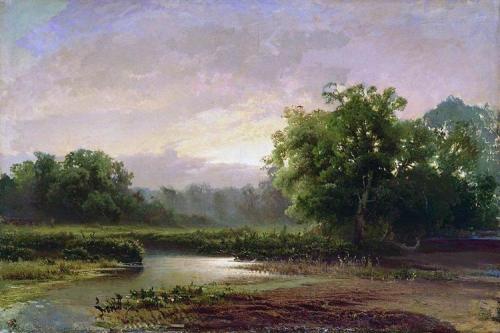
“Dawn“ (1873)
Fyodor Vasilyev
_______
Thus did the God th’ unwary youth advise;
Helios / Phoebus / Apollo tells his
son Phaeton, th’ unwary youth,
that he shouldn’t try to ride the
Chariot of the Sun himself
But he still longs to travel through the skies.
Phaeton, however, is inclined to
disregard his father’s advice
When the fond father (for in vain he pleads)
At length to the Vulcanian Chariot leads.
Vulcanian, of Vulcan, god of fire,
metal, metalworkers
Vulcan, according to Ovid here,
built the Chariot of the Sun
A golden axle did the work uphold,
the axle is the principal part, the
beam between the wheels, that
holds the chariot together, that
did the work, which is to say
the chariot, uphold
Gold was the beam, the wheels were orb’d with gold.
The spokes in rows of silver pleas’d the sight,
The seat with party-colour’d gems was bright;
the chariot was made of precious
metals and gems, was therefore
bright, resplendent
Apollo shin’d amid the glare of light.
Apollo, Sun god, would surely, as
well as the chariot, be radiant,
glowing
note that the Sun god is called
Apollo here, where earlier he’d
been called Phoebus, the Latin
name replacing the Greek, but
upon further investigation I found
that it was Dryden who’d made
the switch, Ovid had called the
Sun god Phoebus in the original
Latin text
The youth with secret joy the work surveys,
Phaeton is beside himself, eager
with anticipation
When now the moon disclos’d her purple rays;
purple rays, tinged with the colours
of dawn
see above
The stars were fled, for Lucifer had chased
The stars away, and fled himself at last.
Lucifer, the Morning Star, the
planet Venus, as it appears in
the East before sunrise
having suspected Dryden of having
replaced with Lucifer another name
from the original Latin text, I was
surprised to discover that Lucifer
had been indeed translated faithfully
from Ovid’s poem, which means that
the Christian name we’re familiar
with as another name for Satan has
to have been adopted from the
Ancients and modified to fit the new
Christian mythology, the biblical
narrative
Lucifer, a god in his own right in
Antiquity, had been the son of
Aurora, goddess of the Dawn
do you love it
Soon as the father saw the rosy morn,
And the moon shining with a blunter horn,
blunter, less incandescent, dulled
by the advancing light
horn, a lesser phase of the moon,
when it is either waxing or waning,
thus resembling a horn
He bid the nimble Hours, without delay,
Bring forth the steeds; the nimble Hours obey:
the Hours, or Horae, goddesses
of the Seasons, horae is the
Greek word for seasons
From their full racks the gen’rous steeds retire,
retire, come away, from their stalls
in the stables
Dropping ambrosial foams, and snorting fire.
ambrosial, especially fragrant, or
tasty
Still anxious for his son, the God of day,
To make him proof against the burning ray,
His temples with celestial ointment wet,
Of sov’reign virtue to repel the heat;
celestial ointment, ambrosia,
elixir of the gods
sov’reign virtue, exceedingly effective
attribute
Then fix’d the beamy circle on his head,
beamy circle, radiant halo of
solar rays
And fetch’d a deep foreboding sigh, and said,
“Take this at least, this last advice, my son,
Keep a stiff rein, and move but gently on:
The coursers of themselves will run too fast,
Your art must be to moderate their haste.
Drive ’em not on directly through the skies,
But where the Zodiac’s winding circle lies,
Along the midmost Zone; but sally forth
Nor to the distant south, nor stormy north.
The horses’ hoofs a beaten track will show,
But neither mount too high, nor sink too low.
That no new fires, or Heav’n or Earth infest;
Keep the mid way, the middle way is best.
Nor, where in radiant folds the serpent twines,
Direct your course, nor where the altar shines.
serpent twines, serpentine, tortuous
entanglements
altar, probably alter, or other, light
sources, the moon, for instance,
the Morning Star, do not be
distracted by bright lights,
Phoebus / Apollo advises
Shun both extreams; the rest let Fortune guide,
And better for thee than thy self provide!
Fortune, or Fortuna, goddess of Fate,
will be of greater help to you, Phoebus
/ Apollo tells his son, than you, thy self,
can provide for yourself
compare this last fatherly advice,
incidentally, to that of Polonius to
Laertes, his own son, act I, scene
3, lines 55 to 81 in Shakespeare’s
Hamlet, proof that Shakespeare
was not only well acquainted
with Ovid, but also much
admired him
See, while I speak, the shades disperse away,
Aurora gives the promise of a day;
Aurora, goddess of the Dawn
I’m call’d, nor can I make a longer stay.
I’m call’d, the time has come to
mount the Chariot of the Sun,
the morning breaks, I must, or
you must, in my stead, go
Snatch up the reins; or still th’ attempt forsake,
And not my chariot, but my counsel, take,
While yet securely on the Earth you stand;
Nor touch the horses with too rash a hand.
Let me alone to light the world, while you
Enjoy those beams which you may safely view.”
should you choose to my counsel, take,
from the Earth you may safely view my
beams while I alone … light the world,
Phoebus / Apollo implores his son
He spoke in vain; the youth with active heat
And sprightly vigour vaults into the seat;
And joys to hold the reins, and fondly gives
Those thanks his father with remorse receives.
for better, or for worse
stay tuned
R ! chard
July 7, 2020
The Story of Phaeton (III) – Ovid
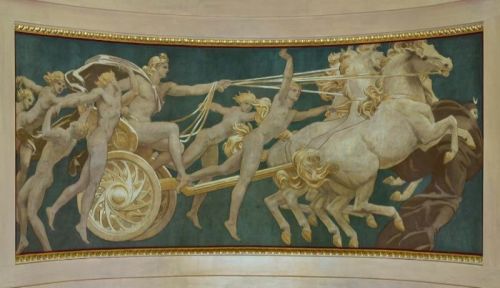
“Apollo in His Chariot with the Hours“ (1922–25)
John Singer Sargent
__________
The God repented of the oath he took,
the God, Helios / Phoebus / Apollo,
father of Phaeton, with Clymene,
Phaeton’s mother
the oath, to grant Phaeton his wish
in order to prove his paternity
For anguish thrice his radiant head he shook;
“My son,” says he, “some other proof require,
Rash was my promise, rash is thy desire.
I’d fain deny this wish, which thou hast made,
Or, what I can’t deny, wou’d fain disswade.
fain, willingly, gladly
what I can’t deny, his oath
disswade, dissuade
Too vast and hazardous the task appears,
Nor suited to thy strength, nor to thy years.
Thy lot is mortal, but thy wishes fly
Beyond the province of mortality:
Beyond the province of mortality,
into immortality, for which Phaeton
is not equipped, being human, his
lot is mortal
There is not one of all the Gods that dares
(However skill’d in other great affairs)
To mount the burning axle-tree, but I;
the axle-tree, the bar that joins the
wheels of the chariot, is burning
because it transports the sun
Not Jove himself, the ruler of the sky,
That hurles the three-fork’d thunder from above,
Dares try his strength: yet who so strong as Jove?
not even Jove / Jupiter / Zeus, god of
gods, and of Thunder, will attempt to
mount the burning axle-tree, despite
his immense strength, superior to
anyone’s
The steeds climb up the first ascent with pain,
And when the middle firmament they gain,
the middle firmament, noon, the
middle of the day, where the sun
reaches its zenith
If downward from the Heav’ns my head I bow,
And see the Earth and Ocean hang below,
hang, suspended in the heavens
Ev’n I am seiz’d with horror and affright,
And my own heart misgives me at the sight.
Helios / Phoebus / Apollo admits
to fear of vertigo
A mighty downfal steeps the ev’ning stage,
And steddy reins must curb the horses’ rage.
Tethys herself has fear’d to see me driv’n
Down headlong from the precipice of Heav’n.
Tethys, a Titaness, of the race of
Giants, who were defeated during
the Giants’ War
what I’ve learned in the meantime
is that the Giants, the Titans, had
actually ruled the cosmos before
being defeated by the Olympians,
something Ovid had misrepresented
in his retelling, where he suggests
that they were upstarts, rather,
mortal, however gigantic, who were
trying from the Earth, Hills pil’d on
hills, on mountains mountains … /
To make their mad approaches to
the skie, in order to unseat the
gods of Olympus
the Titans, as it turns out, were
immortals, who ruled the cosmos
before being ousted by the
Olympians, Jove / Jupiter / Zeus
and his cohorts, and relegated,
most of them, to the Underworld,
though Tethys herself seems to
have made it out, and been
reconciled with, at least, the
Sun god
should I point out that to try to set
out in one, however comprehensive,
manuscript, a mythology that had
endured for going on a thousand
years was likely to reflect some
inconsistencies, some inaccuracies,
not to mention the dictates of not
only cultural, but also political
considerations, we’ll have to
forgive Ovid, or not, it appears,
his transgressions
Besides, consider what impetuous force
Turns stars and planets in a diff’rent course.
Helios / Phoebus / Apollo continues
to speak, warning his son Phaeton
of the strong, impetuous, and
unpredictable, currents that [t]urn,
jostle, stars and planets
I steer against their motions;
that’s what I have to deal with,
Helios / Phoebus / Apollo
cautions, these motions,
these irascible, interplanetary,
interstellar, streams
nor am I
Born back by all the current of the sky.
neither am I born back, which is
to say borne back, carried back,
guided back, by any regular,
orderly, current of the sky, by any
rhythm, of the days, for instance,
or of the, however intransigent,
hours, that could, potentially,
redirect his path
But how cou’d you resist the orbs that roul
In adverse whirls, and stem the rapid pole?
roul, roll, swirl
adverse whirls, of the winds, like
ocean currents, that stem, are
created by, are the source of, as
in the stem of plants, the rapid
pole, or pull, to rhyme with roul,
a bit, I think, of a poetic stretch
But you perhaps may hope for pleasing woods,
And stately dooms, and cities fill’d with Gods;
While through a thousand snares your progress lies,
Where forms of starry monsters stock the skies:
dooms, eventualities, a wonderful
conjunction here of stately, or
exalted, expectations, with the
more dire threat of a thousand
snares, or starry monsters, that
the word doom would usually
suggest
For, shou’d you hit the doubtful way aright,
even if you stay on the right track,
even if you hit the … way aright
The bull with stooping horns stands opposite;
you’ll have to confront [t]he bull,
Taurus
Next him the bright Haemonian bow is strung,
Haemonian, of Thessaly, a region
still of Greece
the Haemonian bow, representative
of Sagittarius
And next, the lion’s grinning visage hung:
the lion, Leo
The scorpion’s claws, here clasp a wide extent;
The scorpion, Scorpio
And here the crab’s in lesser clasps are bent.
the crab, Cancer
an array of astrological configurations
obstruct the sky
Nor wou’d you find it easie to compose
The mettled steeds, when from their nostrils flows
The scorching fire, that in their entrails glows.
mettled, spirited
Ev’n I their head-strong fury scarce restrain,
When they grow warm and restif to the rein.
Ev’n I, Helios / Phoebus / Apollo, can
barely, scarce, hold them back, restrain
them, when they grow … restif, restive,
unable to keep still
Let not my son a fatal gift require,
don’t require of me a fatal gift,
Phaeton’s father pleads, a gift
that will destroy you
But, O! in time, recall your rash desire;
You ask a gift that may your parent tell,
a gift that may your parent tell,
that is meant to determine, to
prove, your descent
Let these my fears your parentage reveal;
And learn a father from a father’s care:
Look on my face; or if my heart lay bare,
Cou’d you but look, you’d read the father there.
were you to just look at my face,
see my concern, you should be
able to make out that I’m your
father, Helios / Phoebus / Apollo,
says
Chuse out a gift from seas, or Earth, or skies,
[c]huse, choose
For open to your wish all Nature lies,
Only decline this one unequal task,
For ’tis a mischief, not a gift, you ask.
unequal task, a challenge that
is too great for Phaeton
You ask a real mischief, Phaeton:
Nay hang not thus about my neck, my son:
don’t hang about my neck, Helios
/ Phoebus / Apollo tells his son,
you don’t need to try to cajole me
I grant your wish, and Styx has heard my voice,
Helios / Phoebus / Apollo has
sworn an oath on Styx, the
goddess, the river, an
unshakable promise, which
he intends to deliver
Chuse what you will, but make a wiser choice.”
now it’s up to you, Phaeton, for
better or for worse, to decide
R ! chard
July 3, 2020
“The Story of Phaeton” (II) – Ovid
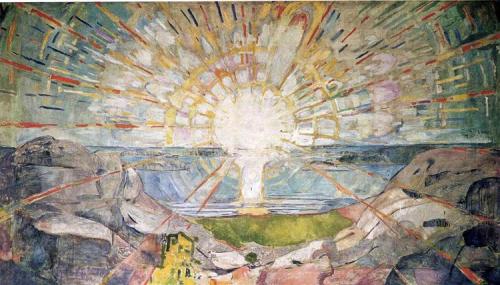
“The Sun“ (1911 – 1916)
Edvard Munch
_______
The Sun’s bright palace, on high columns rais’d,
The Sun, Helios / Phoebus / Apollo
With burnish’d gold and flaming jewels blaz’d;
The folding gates diffus’d a silver light,
And with a milder gleam refresh’d the sight;
since the folding gates of the bright
palace shimmered with a silver light
rather than with the glow of the gold
and flaming jewels of the palace itself,
their milder gleam was easier on the
eyes, refresh’d the sight
Of polish’d iv’ry was the cov’ring wrought:
the palace was covered with polish’d
wrought ivory
The matter vied not with the sculptor’s thought,
the execution of the palace was
everything that its sculptor, its
architect, had had in mind to
create
For in the portal was display’d on high
(The work of Vulcan) a fictitious sky;
Vulcan, god of fire, metal, smiths,
metalworkers
at the entrance to the palace, the
portal, Vulcan had painted the ceiling,
he’d display’d on high … a fictitious
sky, I suspect Dryden must’ve had
Michelangelo and his ceiling of the
Sistine Chapel in mind during his
translation of this passage of Ovid
A waving sea th’ inferiour Earth embrac’d,
inferiour, Earth, surging from under the
greater masses of water dominating it,
especially after the flood, is, therefore,
beneath the waving sea, inferiour to it
And Gods and Goddesses the waters grac’d.
remember that Ovid is describing a
painting here, on the ceiling at the
entrance, the portal, to the palace
of the god of the Sun
Aegeon here a mighty whale bestrode;
Aegeon, marine god, god of storms,
note the similarity of the name with
that of the Aegean Sea, but which
came first, the chicken or the egg,
the god or the expanse of water,
remains, as far as I’ve been able
to determine, undetermined
Triton, and Proteus (the deceiving God)
Triton, another god of the Sea, you’ll
remember him coming to the aid of
Neptune, his father, in settling the
waters after the flood at the request
of Jove / Jupiter / Zeus
Proteus, still another sea god,
described as deceiving, for his
ability to effortlessly, and
spontaneously, change his shape,
from which, incidentally, we get
the adjective protean, for easily
changeable, or versatile
With Doris here were carv’d, and all her train,
Doris, sea goddess, and all her train,
her fifty daughters, if you’ll remember,
are carv’d, etched, given graphic
representation
Some loosely swimming in the figur’d main,
figur’d, painted, depicted, drawn
main, the open ocean, but, probably
also here, the main, or central, part
of the painting itself
While some on rocks their dropping hair divide,
their hair divide, they loosen strands
of their wet hair
And some on fishes through the waters glide:
sea gods and goddesses are often
shown riding sea creatures, dolphins,
seahorses, even whales, see Aegeon
above
Tho’ various features did the sisters grace,
A sister’s likeness was in ev’ry face.
the sisters, the Nereids, all have different
features, but a family resemblance, sister’s
likeness, can always be detected in each
individual sibling’s rendering
On Earth a diff’rent landskip courts the eyes,
Earth doesn’t look, court[ ] the eyes,
at all like what’s painted on the
palace’s ceiling
landskip, landscape
Men, towns, and beasts in distant prospects rise,
distant prospects, from a distance, one
can see [m]en, towns, and beasts
appear, rise, arise
And nymphs, and streams, and woods, and rural deities.
nymphs, consigned, it appears, to
earthly duties, streams, and woods,
are not a feature of the Sun god’s
palace
O’er all, the Heav’n’s refulgent image shines;
the Heav’n’s refulgent, brightly shining,
image, expression, is manifest [o]’er all,
everywhere, the rays of the sun cast a
light on everything
On either gate were six engraven signs.
again I’m reminded of a Renaissance
wonder, Lorenzo Ghiberti‘s gilded bronze
doors for the Florence Baptistery, which
Michelangelo himself called the Gates of
Paradise, a work nearly as famous, then
and now, as his own Sistine Chapel ceiling
Ovid would never have known of these
masterworks, of course, having lived
over a millenium earlier, but I suspect
John Dryden, a cultured man, a couple
of hundred years later than these
cultural icons, would no doubt have
been fully aware of them, much as we,
however disinterested we might be,
can’t help but have heard of, say,
Rembrandt, Chopin, Charles Dickens,
for instance, though they be, similarly,
centuries separated from us
my point is that, without knowledge of
the original Latin, Dryden‘s cultural
heritage must’ve slipped, I think,
consciously or not, into his
translation, for better, or for worse
it should be remembered, however,
that Dryden was writing for an early
18th Century audience, much as I
am presently doing myself with
Dryden for a 21st, and maybe also
similarly skewing his idiom to better
adapt it to our own time, for better,
also, or for worse
Here Phaeton still gaining on th’ ascent,
gaining on th’ ascent, going faster
and faster, climbing higher and
higher
To his suspected father’s palace went,
suspected father, Phaeton doesn’t
yet know if Helios / Phoebus / Apollo
is indeed his father
‘Till pressing forward through the bright abode,
He saw at distance the illustrious God:
He saw at distance, or the dazling light
Had flash’d too strongly on his aking sight.
had Phaeton not been as far, at
distance, from what he was seeing,
the illustrious God, the dazling, or
dazzling, light would’ve hurt his
eyes, hurt his aking, or aching,
sight
The God sits high, exalted on a throne
Of blazing gems, with purple garments on;
Tyrian, surely, purple, a hue we’ve
seen here before, indicative of
stature, of imperial, if not even
divine, as in this instance,
pedigree
The Hours, in order rang’d on either hand,
And Days, and Months, and Years, and Ages stand.
Here Spring appears with flow’ry chaplets bound;
Here Summer in her wheaten garland crown’d;
Here Autumn the rich trodden grapes besmear;
And hoary Winter shivers in the reer.
this is no longer a picture, but the
real thing, Phoebus / Apollo / Helios
sits high, exalted on a throne / Of
blazing gems, with purple garments
on, while Time and all of the Seasons
hold court around him
Phoebus beheld the youth from off his throne;
That eye, which looks on all, was fix’d in one.
Phoebus, who sees everything, who
looks on all, beholds, fixes his eye on,
his son
He saw the boy’s confusion in his face,
Surpriz’d at all the wonders of the place;
And cries aloud, “What wants my son? for know
My son thou art, and I must call thee so.”
Phaeton, according to Phoebus /
Apollo / Helios‘ forthright admission,
is truly his son
“Light of the world,” the trembling youth replies,
“Illustrious parent! since you don’t despise
The parent’s name,
despise, refute
some certain token give,
That I may Clymene’s proud boast believe,
Nor longer under false reproaches grieve.”
your word is good, Phaeton allows,
but incontrovertibly, now, prove it,
some certain token give, he
challenges
The tender sire was touch’d with what he said,
And flung the blaze of glories from his head,
flung the blaze of glories from his head,
reduced the intensity of his presence,
the impact of his charisma, took off
his dazling crown, if only, maybe,
metaphorically, to be father to his son
And bid the youth advance: “My son,” said he,
“Come to thy father’s arms! for Clymene
Has told thee true; a parent’s name I own,
And deem thee worthy to be called my son.
As a sure proof, make some request, and I,
Whate’er it be, with that request comply;
By Styx I swear, whose waves are hid in night,
And roul impervious to my piercing sight.”
an oath upon Styx is incontrovertible,
like swearing on a Bible, as earlier
noted
The youth transported, asks, without delay,
To guide the sun’s bright chariot for a day.
Phaeton wants to drive his father’s
car, the sun’s bright chariot, how
contemporary, how immediate,
how timeless
stay tuned
R ! chard
June 28, 2020
“The Story of Phaeton” – Ovid
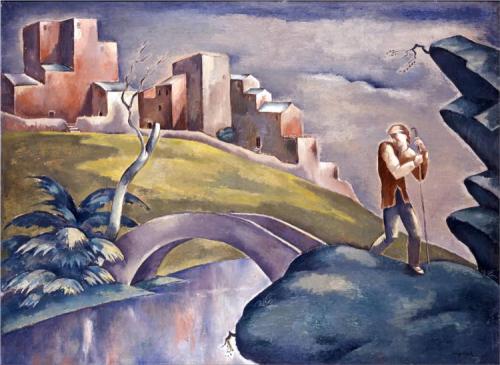
“Landscape with a Palace“ (1916)
Eugeniusz Zak
________
Her son was Epaphus, at length believ’d
The son of Jove, and as a God receiv’d;
without proof, it could not have been
absolutely determined, during this
ancient mythological era, that
Epaphus, son of Io become Isis, was
indeed the son of Jove / Jupiter / Zeus,
though that’s what at length, eventually,
came to be believed
and as such Epaphus was
With sacrifice ador’d, and publick pray’rs,
He common temples with his mother shares.
both Isis and Epaphus are worshipped
in common, in the same places, and
with a similar degree of devotion
Equal in years, and rival in renown
With Epaphus, the youthful Phaeton
Like honour claims;
Phaeton, another youth, [e]qual in
years to Epaphus, and in renown,
as famous, [l]ike honour claims,
puts forward, his own illustrious
heritage
and boasts his sire the sun.
the sun, Phoebus / Apollo, god,
among a number of other things,
of that very orb
His haughty looks, and his assuming air,
The son of Isis could no longer bear:
Thou tak’st thy mother’s word too far, said he,
And hast usurp’d thy boasted pedigree.
Epaphus, son of Isis, challenges
Phaeton, says that his mother’s
claim that her consort was the
god of the Sun is false, and that
he, Epaphus, is only promoting
the fabricated story of his high,
his boasted, pedigree, ancestry
Go, base pretender to a borrow’d name.
Epaphus delivers a double whammy,
base pretender, borrow’d name, ouch
Thus tax’d, he blush’d with anger, and with shame;
But shame repress’d his rage:
tax’d, confronted
repress’d his rage, Phaeton didn’t
slug Epaphus
the daunted youth
Soon seeks his mother, and enquires the truth:
is he truly the son of the god of the
Sun, Phaeton asks his mother, nearly
intolerable drama must surely follow,
turning on this burning question
Mother, said he, this infamy was thrown
By Epaphus on you, and me your son.
He spoke in publick, told it to my face;
Nor durst I vindicate the dire disgrace:
Even I, the bold, the sensible of wrong,
Even I, Phaeton asserts, the sensible
of wrong, as he describes himself, the
impatient of improprieties, however
bold, quick to respond, impetuous,
might he be, durst not, dared not,
vindicate, validate, the dire disgrace,
Epaphus‘ profoundly distressing insult
Restrain’d by shame, was forc’d to hold my tongue.
I was unable, Phaeton says, too
[r]estrain’d by shame, humiliated,
to even answer
To hear an open slander, is a curse:
But not to find an answer, is a worse.
a worse, we would say just worse,
but note that worse, here, is not a
noun, but the adjective for curse,
which has been elided, left out, a
worse curse, which, included,
would’ve altered, however, the
metre, the pentameter, and thus,
the poetry, style having trumped,
for better or for worse, in this
instance, the substance
a, incidentally, is the first beat of the
iamb, which is to say, the weak beat,
while worse, is the second, the one
with the accent, the determining
thump, a worse, da, dum, an iamb
Dryden didn’t have, in other words,
much choice, were he wanting to
be a poet, but to deftly press his,
surely masterful, grammar, to fit
his meaning to his, however
constricting, verse
If I am Heav’n-begot, assert your son
By some sure sign;
assert your son, acknowledge him,
[b]y some sure sign, Phaeton
demands of his mother
and make my father known,
at the same time, make … known,
identify, Phaeton continues, point
him out, my father
To right my honour, and redeem your own.
He said,
it is the honour[able] thing to do,
the required thing to do, [h]e said,
to restore, [t]o right, our reputations
and saying cast his arms about
Her neck, and beg’d her to resolve the doubt.
a son imploring his mother, can
anything be more poignant
‘Tis hard to judge if Clymene were mov’d
More by his pray’r, whom she so dearly lov’d,
Clymene, wife of Helios, or Phoebus /
Apollo, sun god, mother of Phaeton
Or more with fury fir’d, to find her name
Traduc’d, and made the sport of common fame.
Traduc’d, translated, transmitted
common fame, the casual, everyday
sport, entertainment, however
inappropriate, however malicious,
of many
She stretch’d her arms to Heav’n, and fix’d her eyes
On that fair planet that adorns the skies;
that fair planet that adorns the skies,
the sun, though Dryden must’ve
known the sun wasn’t a planet, nor
Ovid, for that matter, literary licence
having given style, here again, sway
over substance, for better, it’ll be up
to you to say, or for worse
literary licence, where style
overtakes substance
Now by those beams, said she, whose holy fires
Consume my breast, and kindle my desires;
girlfriend, I have to here interject, your
temperature is, ahem, showing, you’re
sounding, however uncharacteristically,
awfully intemperate, aroused, [c]onsume
my breast indeed, kindle, you audaciously
request, my desires
By him, who sees us both, and clears our sight,
By him, the publick minister of light,
I swear that Sun begot thee;
Clymene swears an oath upon the
very sun, her sire, the publick minister
of light, the very priest of illumination,
of clarity, for everyone, the sun’s
manifest incarnation
if I lye,
Let him his chearful influence deny:
don’t shine on me, Helios / Phoebus /
Apollo, him, Helios / Phoebus / Apollo
himself, Clymene cries, if I lye, lie, if I
tell an untruth
Let him no more this perjur’d creature see;
Let him, let yourself, Helios / Phoebus /
Apollo, be unable any longer to see me,
perjur’d creature that I, Clymene, am
And shine on all the world but only me.
obliterate me, she defies, from your
purview, let the world receive your
rays, but not myself
If still you doubt your mother’s innocence,
His eastern mansion is not far from hence;
With little pains you to his Leve go,
And from himself your parentage may know.
Leve, where Helios / Phoebus /
Apollo lives
With joy th’ ambitious youth his mother heard,
And eager, for the journey soon prepar’d.
Phaeton is off on his mission
He longs the world beneath him to survey;
he wants to see the world from the
perspective of the sun, an astronaut,
a dreamer, pulsing with ambition
To guide the chariot; and to give the day:
to drive his father’s car, chariot, how
contemporary, how immediate
From Meroe’s burning sands he bends his course,
Meroe, a city on the Nile, you’ll
remember that we’re still in Egypt,
where Io / Isis prevails, with Epaphus,
her son, the one who started all this
Nor less in India feels his father’s force:
the sun, his father’s force, is no less
vigorous in India than it is, he, Helios
/ Phoebus / Apollo, is, in Egypt
His travel urging, till he came in sight;
His travel urging, impatient to speed
up his pace, hastening his metaphorical
horses
And saw the palace by the purple light.
purple light, evening, though purple
is also, since antiquity, the colour of
royalty, Phaeton is perhaps seeing
both, the palace, at evening
see above
R ! chard
June 25, 2020
“The Eyes of Argus transform’d into a Peacock’s Train” – Ovid
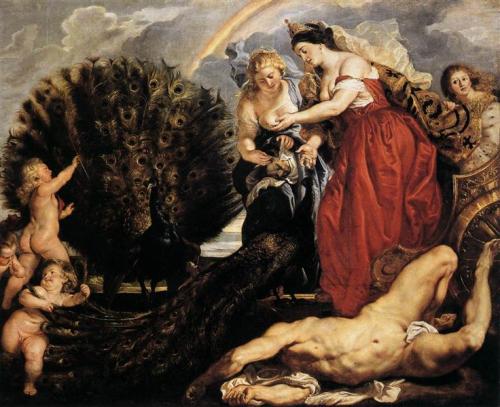
“Juno and Argus“ (c.1611)
Peter Paul Rubens
______
While Hermes pip’d, and sung, and told his tale,
The keeper’s winking eyes began to fail,
The keeper, Argus, of Io, nymph
become heifer
And drowsie slumber on the lids to creep;
‘Till all the watchman was at length asleep.
all the watchman, all of Argus‘ eyes,
were closed, asleep, at length, after
a time
Then soon the God his voice, and song supprest;
the God, Hermes, messenger of the
gods, on a mission from Jove /
Jupiter / Zeus to save Io, nymph
become heifer
his voice, and song supprest, Hermes
stopped talking, stopped playing his
song, his music
And with his pow’rful rod confirm’d his rest:
his powerful rod, the caduceus, with
which Hermes could both waken those
asleep as well lull the wakeful to
slumber
Without delay his crooked faulchion drew,
faulchion, now spelled falchion,
is a short sword with only one
sharp edge, a sort of sickle
since falchions go back only to the
13th Century, Dryden‘s translation
from the Latin has to be an
anachronism
just saying
And at one fatal stroke the keeper slew.
Down from the rock fell the dissever’d head,
Opening its eyes in death; and falling, bled;
And mark’d the passage with a crimson trail:
Thus Argus lies in pieces, cold, and pale;
And all his hundred eyes, with all their light,
Are clos’d at once, in one perpetual night.
These Juno takes, that they no more may fail,
And spreads them in her peacock’s gaudy tail.
see above
Juno, wife of Jove / Jupiter / Zeus,
queen, therefore, of the gods and
goddesses
Impatient to revenge her injur’d bed,
Juno had been offended by the fact
that Jove / Jupiter / Zeus had
transgressed
She wreaks her anger on her rival’s head;
her rival, Io
With Furies frights her from her native home;
Furies, also known as Erinyes,
goddesses of vengeance, the
oldest of all the deities, they live
in Erebus, the Underworld, look
frightful, snakes in their hair, bat’s
wings, and haunt, unsettle, the
disrespectful, the insolent, those
who betray, are not true to, their
word
frights, frightens
And drives her gadding, round the world to roam:
her, Io, nymph become heifer
to gad, to wander
Nor ceas’d her madness, and her flight, before
She touch’d the limits of the Pharian shore.
Pharian, relating to Pharos, island off
the coast of Alexandria, notable for
its lighthouse, itself called Pharos,
one of the Seven Wonders of the
Ancient World
At length, arriving on the banks of Nile,
Wearied with length of ways, and worn with toil,
She laid her down;
She laid her down, she laid herself
down, stopped, stayed in place
and leaning on her knees,
Invok’d the cause of all her miseries:
the cause of all her miseries, Jove /
Jupiter / Zeus, who’d abandoned
her, Io, to the wrath of Juno, his
wife, when she’d discovered him
to be unfaithful
And cast her languishing regards above,
For help from Heav’n, and her ungrateful Jove.
She sigh’d, she wept, she low’d; ’twas all she cou’d;
And with unkindness seem’d to tax the God.
to tax, to accuse, to make
responsible for
Last, with an humble pray’r, she beg’d repose,
Or death at least, to finish all her woes.
repose, relief, Io, nymph become
heifer, has completely had it
Jove heard her vows, and with a flatt’ring look,
In her behalf to jealous Juno spoke,
a flatt’ring look, a seductive approach,
toward Juno, his reproachful wife
He cast his arms about her neck, and said,
Dame, rest secure; no more thy nuptial bed
This nymph shall violate;
Dame, or Madam
by Styx I swear,
Styx, one of the five rivers that
separate Earth from the
Underworld, also one of the
earliest goddesses, after whom
the river itself was named, who
had, significantly, sided with Jove /
Jupiter / Zeus during the Giants’
War, for which, upon having won,
Jove / Jupiter / Zeus ordained that
all oaths be sworn upon her, Styx,
much as we, in our own day, swear
upon Bibles
this all precedes, note, Bibles
And every oath that binds the Thunderer.
the Thunderer, Jove / Jupiter, Zeus,
god, indeed, of Thunder
The Goddess was appeas’d;
The Goddess, Juno
and at the word
Was Io to her former shape restor’d.
The rugged hair began to fall away;
The sweetness of her eyes did only stay,
Tho’ not so large; her crooked horns decrease;
The wideness of her jaws and nostrils cease:
Her hoofs to hands return, in little space:
little space, the blink of an eye
The five long taper fingers take their place,
And nothing of the heyfer now is seen,
Beside the native whiteness of the skin.
Erected on her feet she walks again:
And two the duty of the four sustain.
rather than walk on four feet, Io
now stands erect, [e]rected, on
two
She tries her tongue; her silence softly breaks,
And fears her former lowings when she speaks:
she can hardly believe she’s
become, not just a nymph,
but indeed
A Goddess now, through all th’ Aegyptian State:
And serv’d by priests, who in white linnen wait.
Io has become the Egyptian
goddess Isis
but that’s an entirely other story
stay tuned
R ! chard
June 22, 2020
“The Afternoon of a Faun” – Debussy / Nijinsky / Nureyev

“Faun and Nymph“ (1867)
Pál Szinyei Merse
________
to take a break, for a moment, from the
travails of Io, a heifer still, though her
father, Inachus, is aware of the situation,
and Hermes, messenger of the gods, is
out, on the orders of Jove/ Jupiter / Zeus,
to save her, and, at the same time,
inspired by the music Hermes tells Argus,
her many-eyed keeper, Pan, god of the
wilds, has been playing, with reeds he’s
been left with of Syrinx, the nymph he
would’ve loved had she not been
transformed into rushes, as imagined by
Debussy in his evocative Syrinx for solo
flute, as highlighted in my last instalment,
I could not not remember Debussy‘s
other similarly mythological, and intimately
related, work, his Prelude to the Afternoon
of a Faun, as modified itself by Vaslav
Nijinsky, legendary dancer and
choreographer, into an event that verily
shook the early 20th Century
retitled, L’après-midi d’un faune, The
Afternoon of a Faun in English, the
performance captures everything one
would gather from Ovid’s myths of its
primitive, primal, sensibilities
the faun, needless to say, is representative
of Pan, god of the wild, woodlands, a satyr,
part instinct, part man, see above
watch Rudolf Nureyev, then, his equally
celebrated successor, take on the role
Nijinsky made famous, without any
alterations made to the original 1912
production, however improbably,
though entirely successfully, we’re in
Paris, May 29, though transposed,
faithfully and superbly, to New York,
Broadway, 1979
proceed, however, at your own discretion,
The Afternoon of a Faun is steaming, it’s
about what happens when a young buck’s
fancies, implacable and irrepressible, turn
to love, not for the scrupulous, where does
love begin, it asks, and lust retire, or is it
the other way around, where does yin, in
other words, meet, become, yang
these are questions that more and more
begin to come up, you’ll find, in Greek
and Roman, and most other ancient,
for that matter, mythologies, something
that isn’t at all touched upon in the
Abrahamic traditions, Christanity, Islam,
Judaism, monotheistic, though they’re
at least as old, where nature, the place
of animals, vegetation, land, water, our
intimate interconnection with them,
don’t much, for better or for worse,
come up
I miss the wonder of the more
pantheistic, the pagan, perspective
enjoy
R ! chard
June 17, 2020
The Transformation of Syrinx into Reeds
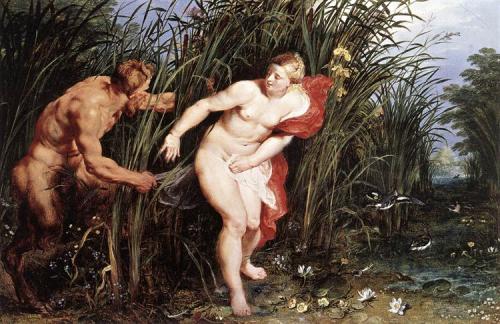
“Pan and Syrinx“ (1617 – 1619)
Peter Paul Rubens
__________
Then Hermes thus:
Hermes, messenger of the gods,
addresses Argus, keeper of Io,
who’s been transformed by Jove,
god of gods, into a heifer, though
she remains daughter, ever, of
Inachus, river god, to tell the
story of his rare, beguiling reeds
A nymph of late there was
Whose heav’nly form her fellows did surpass.
here we go again with nymphs,
beautiful, irresistible, however
ever innocent, prey, due, indeed,
to their very beauty, their very
innocence, to lustful, inordinate
desires, in these instances,
markedly divine
deities, I point out again, make
up their own rules
The pride and joy of fair Arcadia’s plains,
Arcadia, apart from being an
actual area of Greece, is also
the ideal, in our historical
imagination, of an utopia,
much as is the lost island of
Atlantis
Belov’d by deities, ador’d by swains:
Syrinx her name, by Sylvans oft pursu’d,
Sylvans, could only be, though
I’ve been unable to find actual
confirmation of my opinion,
wood spirits, forest entities,
satyrs, goat men, and such
As oft she did the lustful Gods delude:
Syrinx could often, or oft, delude,
or fool, ward off, the lustful Gods
The rural, and the woodland Pow’rs disdain’d;
satyr yourself, Syrinx would’ve
impudently taunted
With Cynthia hunted, and her rites maintain’d:
Like Phoebe clad, even Phoebe’s self she seems,
Cynthia, is Phoebe, both also known
as Diana, goddess of the Hunt, you’ll
remember Phoebe / Diana from her
connection to Daphne, who earlier
here was transformed into a laurel
Syrinx sounds an awful lot, incidentally,
like another version of Daphne
So tall, so streight, such well-proportion’d limbs:
The nicest eye did no distinction know,
But that the goddess bore a golden bow:
the only difference between Syrinx
and Cynthia / Phoebe / Diana was
that Syrinx didn’t have, bear, a
golden bow
Distinguish’d thus, the sight she cheated too.
had she borne a golden bow, Syrinx,
[d]istinguish’d thus, would’ve cheated
the sight, looked identical, to the
beautiful, it is inferred, goddess
Descending from Lycaeus, Pan admires
The matchless nymph, and burns with new desires.
Pan, god of the wild, woodlands
Lycaeus, Latin spelling of Lykaion,
is a mountain in Arcadia
A crown of pine upon his head he wore;
And thus began her pity to implore.
But e’er he thus began, she took her flight
So swift, she was already out of sight.
Nor stay’d to hear the courtship of the God;
But bent her course to Ladon’s gentle flood:
Ladon, a river in Arcadia
flood, rushing, though gentl[y],
water, rhymes in the preceding
verse, you’ll note, with God
There by the river stopt, and tir’d before;
Relief from water nymphs her pray’rs implore.
Syrinx, once by the river stopt, seeks
the help of, assistance, [r]elief from,
the nearby water nymphs, her
consorts
Now while the lustful God, with speedy pace,
Just thought to strain her in a strict embrace,
Pan, like Phoebus / Apollo, or
Jove / Jupiter / Zeus before him,
is, as well, and characteristically,
a lustful God
He fill’d his arms with reeds, new rising on the place.
And while he sighs, his ill success to find,
his ill success, his thwarted,
ineffective, enterprise
The tender canes were shaken by the wind;
And breath’d a mournful air, unheard before;
the reeds that Pan gathered in his arms,
shaken by the wind, create a mournful
air, a melancholy music
That much surprizing Pan, yet pleas’d him more.
though Pan might’ve been much
surpriz[ed] by the sorrowful sounds
he heard, he was more pleas’d by
them than startled
Admiring this new musick, Thou, he said,
Who canst not be the partner of my bed,
At least shall be the confort of my mind:
Thou, Syrinx
And often, often to my lips be joyn’d.
in a kiss of consolation
He form’d the reeds, proportion’d as they are,
Unequal in their length, and wax’d with care,
They still retain the name of his ungrateful fair.
the instrument Pan devised from
the tender canes he fashioned
from the unaccommodating reeds,
what we now name the Pan flute,
was called in Ancient Greece a
syrinx, in honour of the
recalcitrant nymph
listen, coincidentally, to Debussy
tell the story, for solo flute,
however, which is to say, on a
modern instrument, for our having
long ago abandoned at a
professional level the original pipe,
though it remains, apparently, as a
folk instrument in more agrarian,
communities around the world, for
shepherds, one would imagine, to
while away the hours while tending
to their, however wayward, sheep
R ! chard
June 14, 2020
“The Transformation of Io into a Heyfer” (V) – Ovid
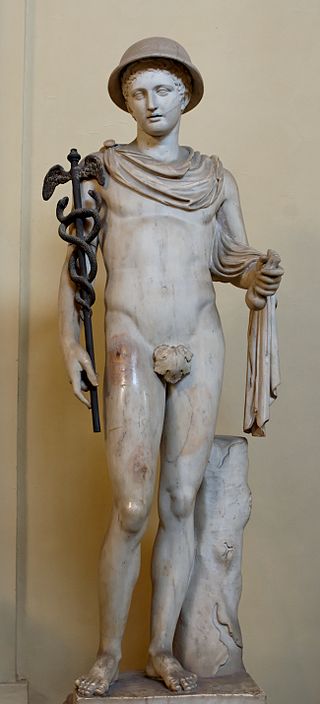
Statue of Hermes (Vatican Museums)
___________________
though Io might still have been “not
out of the woods”, when last we saw
her, there remained nevertheless
her original suitor, Jove, god of gods
Now Jove no longer cou’d her suff’rings bear;
But call’d in haste his airy messenger,
The son of Maia, with severe decree
To kill the keeper, and to set her free.
The son of Maia, Hermes, messenger
of the gods
Maia, one of the Pleiades, playmates
of Artemis, goddess of the Hunt,
daughters, also, of Atlas, famously
condemned, he, to hold up the
heavens for eternity
With all his harness soon the God was sped,
Hermes, no sooner equipped,
[w]ith all his harness, livery,
attire, was sped, got under
way
His flying hat was fastned on his head,
Wings on his heels were hung, and in his hand
He holds the vertue of the snaky wand.
vertue, virtue, but having retained,
still in 1717, its root, vertu, French
for virtue, benefit
Hermes is usually shown wearing
[h]is flying hat, [w]ings on his heels,
a snaky wand, identifying accessories
snaky wand, his caduceus
see above
The liquid air his moving pinions wound,
pinions, the feathers of a bird’s wing
wound, to injure, but also to wrap
around, according to its two
differing pronunciations
And, in the moment, shoot him on the ground.
to rhyme with wound, note
Hermes has landed, but apparently
uncomfortably
Before he came in sight, the crafty God
His wings dismiss’d, but still retain’d his rod:
dismiss’d, put aside, made invisible,
[h]is wings
That sleep-procuring wand wise Hermes took,
But made it seem to sight a sherpherd’s hook.
though Hermes kept his rod, he made
it look, seem to sight, like a shepherd’s
staff, hook
With this, he did a herd of goats controul;
controul, control
Which by the way he met, and slily stole.
by the way, as he walked along
slily stole, deities make up their
own rules
Clad like a country swain, he pip’d, and sung;
And playing, drove his jolly troop along.
swain, young man
With pleasure, Argus the musician heeds;
Argus heeds the musician, again
an inverted sentence, in order to
rhyme with
But wonders much at those new vocal reeds.
vocal reeds suggests Pan pipes
here, a wind instrument consisting
of several tubes of increasing length
placed side by side, where the piper
creates the melody by moving his
lips, her lips, from embouchure to
embouchure, the openings through
which to blow
And whosoe’er thou art, my friend, said he,
Up hither drive thy goats, and play by me:
Argus asks Hermes to stay, drive thy
goats away, [u]p hither, he directs,
and play thy instrument, keep him
company
This hill has browz for them, and shade for thee.
browz, browse, matter, twigs, shoots,
upon which goats might graze
The God, who was with ease induc’d to climb,
to climb, [u]p hither, in order to drive
the goats
Began discourse to pass away the time;
And still betwixt, his tuneful pipe he plies;
betwixt, meanwhile
plies, continues
And watch’d his hour, to close the keeper’s eyes.
his hour, his opportune moment
the keeper, Argus, over Io
With much ado, he partly kept awake;
the calming effect of the Pan pipes
was making it hard, much ado, for
Argus to stay awake
Not suff’ring all his eyes repose to take:
never allowing, suff’ring, all his eyes
to close, repose to take, at the same
time
And ask’d the stranger, who did reeds invent,
And whence began so rare an instrument?
how do you do that, Argus asks,
which leads to an interpolated story,
wherein Hermes, before we learn
much more about Io, answers the
questions
stay tuned
R ! chard
 Richibi's Weblog