“Death is nothing at all…” – Henry Scott Holland



But now they only block the sun
They rain and snow on everyone
So many things I would have done
But clouds got in my way
I’ve looked at clouds from both sides now
From up and down, and still somehow
It’s cloud illusions I recall
I really don’t know clouds at all
Moons and Junes and Ferris wheels
The dizzy dancing way you feel
As every fairy tale comes real
I’ve looked at love that way
But now it’s just another show
You leave ’em laughing when you go
And if you care, don’t let them know
Don’t give yourself away
I’ve looked at love from both sides now
From give and take, and still somehow
It’s love’s illusions I recall
I really don’t know love at all
Tears and fears and feeling proud
To say “I love you” right out loud
Dreams and schemes and circus crowds
I’ve looked at life that way
But now old friends are acting strange
They shake their heads, they say I’ve changed
Well something’s lost, but something’s gained
In living every day
I’ve looked at life from both sides now
From win and lose and still somehow
It’s life’s illusions I recall
I really don’t know life at all
I’ve looked at life from both sides now
From up and down and still somehow
It’s life’s illusions I recall
I really don’t know life at all”
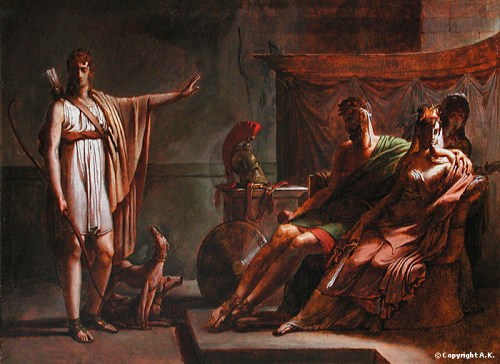
“Phaedra and Hippolytus“ (1802)
_____________
Phaedra, according to Greek myth, fell
in love with her stepson, and, of course,
ruined, for everyone, everything
she’s been represented in music by
composers from, at least, Rameau,
1733, to, here, now, Benjamin Britten,
1976, by way of even Tangerine
Dream, 1973, however peripherally,
and the hits just keep on coming
in literature, the story goes back to
Euripides, 480 – 406 BCE, through
Jean Racine, 1639 – 1699, poet at
the court of Louis XlV, the version
that I studied in French Literature,
along with, in English, Shakespeare,
who was doing courtiers, rather,
and royalty there, then, incidentally,
instead of the Continent’s iconic
Mediterranean figures – it remains
my favourite play in my mother
tongue, next to, for me, its only
other equal, “Cyrano de Bergerac“
but I’d never seen a production of
“Phaedra“ until this searing,
modern, rendition, set in, relatively
contemporary, Greece, London,
and Paris, with the irrepressible,
the irresistible, Melina Mercouri,
torrid temptress, the very goddess
Hera, here, and Anthony Perkins,
perfect as her suitor, a youth still,
pulsing with a young man’s
unbridled intentions
sparks fly, from moment to
incendiary moment – I had often
to pause to catch my breath –
portents of an inescapable, and
eventually epic, indeed mythic,
apocalypse
watch, if you dare
R ! chard
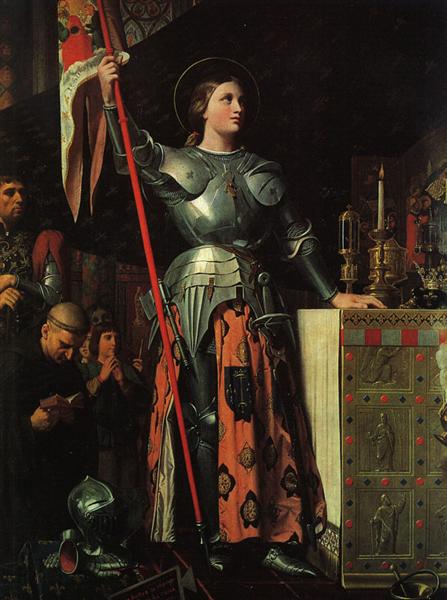
“Joan of Arc upon Coronation of Charles VII in the Cathedral of Reims“ (1854)
____________________
many years ago, while I was volunteering
at our hospital’s palliative care unit, nearby,
recently installed as a response to, among
other pressing preoccupations, but most
urgently then, the AIDS crisis, I was asked
to sit by a lady in profound distress, her
family, Western Buddhists, would go to
lunch while I would sit by her to comfort
her as much as I could
she was dishevelled, of course, completely
disconcerted, all ajitter, lost, and evidently
confused, in her profound isolation, not to
mention in the crumpled state of her
harried bed, unable to communicate, or
reason
I found a chair, sat by her with earnest
concentration, my partner had died
there, only recently, on that very unit,
and I was expressing, to all of those
concerned in his unparalleled care,
my unlimited appreciation
I lay a hand gently upon her arm, to let
her feel, at least, the safety that my
touch could allow, to let it settle on
her, however removed might be her
remaining consciousness, began to
sing quietly a chant I’d been intoning
from a creed I’d turned to for comfort
in my own personal anguish, at the
loss of my own friend, a call, an
invocation, the continuous iteration
of a line that brought solace, Om Nama
Shivaya, I prayed, over and over again,
with the greatest intention, whatever
that phrase might’ve, I’ve forgotten,
meant
she relented, found her space, little by
little she became, as though grace had
descended upon her, calm, by however
infinitesimal degrees, while I continued,
now, my hopeful, helpful, it appeared,
manifestly mystical, intervention
she had become restful, I’d
accomplished essentially, I gathered,
my primary mission, though I
continued, with some sense, perhaps
even a glow, of personal pride, my
soulful incantation
then in a voice not much louder than a
whisper, but much less distraught than
a moan, she began to join in with row,
row, row your boat, tunefully, over and
over again, accommodating herself,
though, naturally, exceedingly weakly,
to my rhythm, I felt I was experiencing,
right there, and then, through the
power of cadence, a miracle
when I looked back, upon hearing
behind me a rustle, standing at the
door was her family, wrapped in
equal consternation
here’s something with someone singing
in several inscrutable languages for
most of us, mostly, words from historical
texts, in Greek, Latin, Olde English,
Japanese, and French, “I Was Born For
This“
that title, of one of the segments of a
longer work, “Journey“, by a contemporary
composer, Austin Wintory, is indeed a
translation of Joan of Arc‘s words on the
cross, “Ne me plaignez pas. C’est pour cela
que je suis née.”, do not pity me, she says,
I was born for this, Joan of Arc, my own
personal Jesus
Shostakovich has an entire symphony,
his 14th, composed of music to
accompany classic poems, all in a
variety of foreign, to him, tongues, but
translated back into Russian for his
purpose in this particular, and not
uncommon, instance, a nevertheless
pointed reference to music as a superior,
more direct, communication – note, here,
the word, communication – it, the 14th,
is profound, extraordinary, read here
first, then listen
R ! chard
 Richibi's Weblog