Chopin / Debussy – Preludes
R ! chard
psst: I found Rachmaninov to be still
caught up in the Romantic
Period – identifiable melodies,
less eccentric tonalities – the
better to, still, pull at your
heartstrings, Debussy, is more
clinical, cerebral, pointing the
way towards, I think, jazz
say, added the required substance,
the missing transcendental
element, turning his otherwise
mere digital pyrotechnics into
utter poetry, into prestidigitatorial
magic
two, a scherzo
you tell me

But now they only block the sun
They rain and snow on everyone
So many things I would have done
But clouds got in my way
I’ve looked at clouds from both sides now
From up and down, and still somehow
It’s cloud illusions I recall
I really don’t know clouds at all
Moons and Junes and Ferris wheels
The dizzy dancing way you feel
As every fairy tale comes real
I’ve looked at love that way
But now it’s just another show
You leave ’em laughing when you go
And if you care, don’t let them know
Don’t give yourself away
I’ve looked at love from both sides now
From give and take, and still somehow
It’s love’s illusions I recall
I really don’t know love at all
Tears and fears and feeling proud
To say “I love you” right out loud
Dreams and schemes and circus crowds
I’ve looked at life that way
But now old friends are acting strange
They shake their heads, they say I’ve changed
Well something’s lost, but something’s gained
In living every day
I’ve looked at life from both sides now
From win and lose and still somehow
It’s life’s illusions I recall
I really don’t know life at all
I’ve looked at life from both sides now
From up and down and still somehow
It’s life’s illusions I recall
I really don’t know life at all”
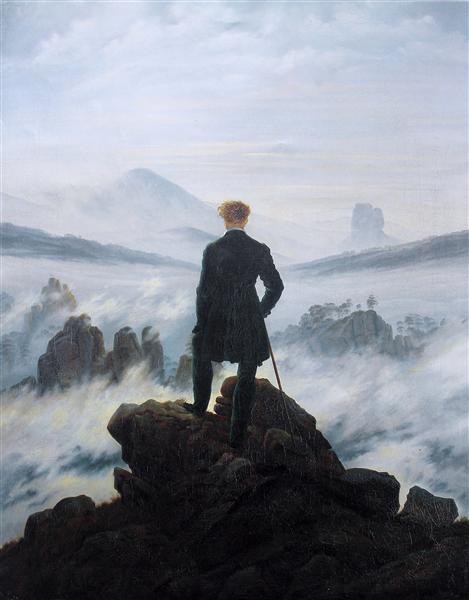
“The Wanderer above the Sea of Fog“ (1818)
_____________
if Beethoven built the Church, along
with Goethe maybe, of Romanticism,
and be assured Romanticism is an
ideology, a moral outlook, a
motivational perspective, much like
the economy is nowadays,
supplanting any more humanistic
imperatives, Brahms put up one of its
Cathedrals, just listen, the First Piano
Concerto is a monument, as mighty
as the Cologne Cathedral musically,
right next to Bonn, incidentally,
Brahms‘ birthplace
with the disintegration of the
supremacy of the Catholic deity
at the onset of the Protestant
Reformation, Luther, Calvin,
Henry Vlll and all that, bolstered
by new discoveries in scientific
speculation, that the earth wasn’t
flat, for instance, that it revolved
around the sun rather than the
other way around, contradictory,
though convincing, voices began
to abound, excite question
in the 18th Century, the Age of
Reason, the Christian Deity fell,
never effectively to be put back
together again, see for Its final
sundering, Nietzsche
in France, after the Revolution,
the Church was officially removed
from political consideration,
countermanding its centuries of
morally heinous depredations,
the United States had already at
its own Revolution separated it
from State
Romanticism was an answer to
a world wherein there might not
be a God, a world with, however,
a spiritual dimension, to respond
to the clockwork universe
envisioned by the earlier epoch,
the Enlightenment, a world where
everything could be categorized,
analyzed, predicted
Romanticism called for the
inclusion of inspiration in the mix,
there are more things in heaven
and earth, Horatio, than are
dreamt of in your philosophy,
as Shakespeare would, for
instance, have it – “Hamlet”,
1.5.167-8
poets became prophets thereby,
if they could manage it, very
oracles, the world was blessed
with, at that very moment,
Beethoven, far outstripping the
likes of, later, for example, Billy
Graham, or other such, however
galvanizing, proselytizers,
whose messages would’ve been
too, to my mind, literal
for music cannot lie, obfuscate,
prevaricate, music cannot be
fake
and then there was Schubert,
and Chopin, Tolstoy, Dickens,
Elizabeth Barrett Browning,
Robert, her husband,
Tchaikovsky, Caspar David
Friedrich, the Johann Strausses,
Byron, Shelley, Keats, whose
artworks, all, are as profoundly
in our blood, our cultural system,
as, if not more so than, our
present information about the
details of our Christian myths,
despite a superfluity of them
even, throughout the long
indeed Middle Ages, and right
up to, and including, the still
fervent then Renaissance, for
better or for worse still, for us
what Romanticism did, and
specifically through the work
of these seminal artists, was
give each of us a chance,
show us how to come
through trial and tribulation,
what a faith does, any faith
it said, here, this is my dilemma,
and this is how I deal with it
for me, Beethoven’s 32nd
Piano Sonata is, soundly, the
epitome of that, but listen to
Brahms put a stamp on it
with undaunted authority
we might be ultimately of no
consequence in an indifferent
universe, they say, but, hey,
this is what we can do, and
do gloriously, while we are
at it
Woody Allen picks up the
purpose in our own recent
20th Century, following in
the earnest footsteps of his
Existential mentor, the much
too dour, I think, Ingmar
Bergman
but that’s another story
entirely
meanwhile, listen
also watch, the conductor here,
a complete delight, is right out
of “Alice in Wonderland“, I
promise you’ll love it
R ! chard
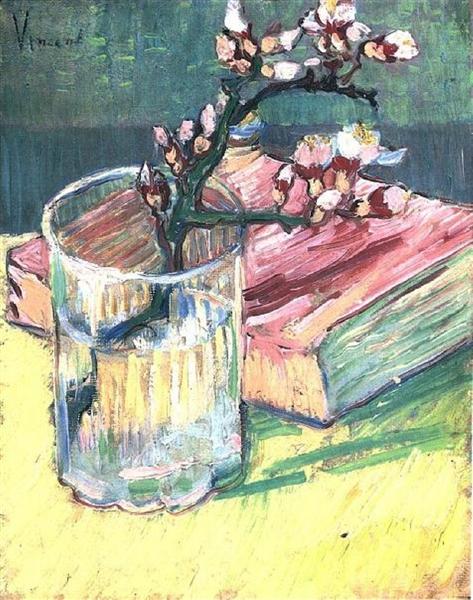
“Blossoming Almond Branch in a Glass with a Book“ (1888)
__________
if Tchaikovsky’s 2nd Piano Sonata hasn’t
remained in the canon, if it isn’t one of
the pieces you’ve heard if only through
the grapevine, it’s, I suspect, cause it’s
essentially not an advance on other more
prescient works in the form, other more
oracular compositions
Beethoven had paved the way for the
Romantic Period, nearly invented it,
established incontrovertibly the
dimensions of the sonata, notably its
purpose, its structure, Schubert had,
however belatedly, confirmed it, with
works equal to his, and even, here
and there, superior, listen
but having reached the summit of
what a sonata could say, the form
little by little withered in its several
Romantic permutations, Tchaikovsky
here, for example, and became mere
elaborations upon a waning theme
rather than exciting, and revelatory,
productions
the sonata would survive, but
transformed by another era,
Impressionism, Tchaikovsky would
as well, of course, but not through
his sonatas
his Second, however, is not not
worth a listen, would you pass,
for instance, on a less celebrated,
perhaps, van Gogh, see above
Tchaikovsky’s, therefore, Second
R ! chard
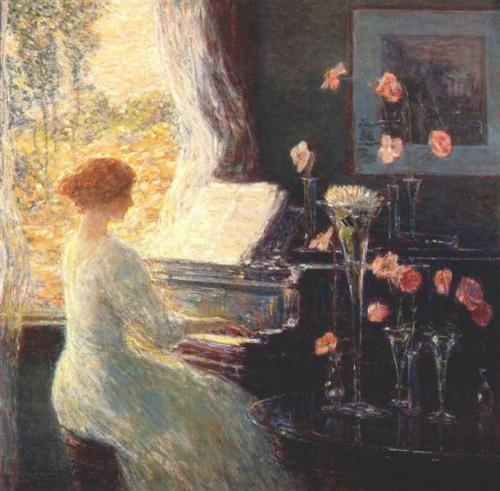
___________
for Sarah and Rachel, the daughters
of the son of a dear cousin, after a
belated lunch recently, two young
girls, 14, 16, in bloom, as Proust
would say, who speak not only
music, but French and English,
fluently, I checked – perhaps
even German, their Oma
lives with them – they also
play the flute, the piano,
and sing, what could be
I ask you, more beautiful,
two young girls in bloom,
indeed in very blossom
or am I being too French
the form of the sonata had been established
decisively during the Classical Period, out
of the rudiments of Bach’s own such pieces,
Mozart and Haydn had given the concept its
final shape, its structure, three or four
contrasting movements, by definition all
entertainments
Beethoven kicked the entertainment part
right out of the ball park, made his show
into a veritable transcendental meditation,
rather than to merely applaud, audiences
gasped, were meant to be awed, as I still
ever am by his musical speculations
but by definition as well, a sonata is a
piece for a single instrument, therefore
inherently introspective, whether the
player has an audience or not, soloists,
note, play easily on their own
even an accompanied sonata, as violin
sonatas often are, for instance, or this
one for two pianos, would lose the
intimacy of a solo piece, for having
someone playing, however compatibly,
over one’s shoulder
in other words, a piano sonata is, by
definition, a monologue, a soliloquy,
where notes tell the story that words
would intimately, even confessionally,
in poetry, convey
the emotions that are elicited from
a piece are as real as they would
be from any literary alternative,
except that they’re quickened, like
aromas, through the senses, rather
than through divisive, by definition
confrontational, logic
rosemary reminds me always, for
instance, of one of my departed
aunts, like the taste of a madeleine
dipped in tea opened the door for
Proust to an entire earlier epoch,
the seed, the subject, of his
disquisition on Time, “À la
recherche du temps perdu“, “An
Exploration into Elapsed Time“,
my own translation, none of the
published proffered titles
having rendered the subtlety
of the shimmering original
rosemary, in other words, speaks,
if even only to me
listen to Tchaikovsky’s First Piano
Sonata, in C# minor, opus 80, one
of only two of his, what do you
hear, think, feel
R ! chard
 Richibi's Weblog