Richibi’s Weblog

Just another WordPress.com weblog

Category: poetry to ponder

Beethoven piano sonata no 32, opus 111‏


when I was a young boy my sister returned
from school with a catechism the nuns had
given her, if there’s anything you’d like to
know, she said, the answer will be in here,
touting it triumphantly

we all laughed at her of course, being a
family of sceptics

but in the following sonata, Beethoven’s
transcendent no 32, opus 111, I believe
that’s exactly what you get, that catechism,
something with all the answers

there are only two movements in the 32nd,
an oddity to say the least, it will end not on
a joyous note, as was the traditional manner,
but on a much more contemplative one

midway I never manage not to break down

the first movement is fast, chaotic, succinct,
the following one tentative, orderly, expansive,
exploratory as opposed to rash, humble as
opposed to demanding

dichotomies, in other words, abound the
more profoundly you let the pattern sink
into you, the more you spend time with
the music

for me it is man, woman, it is chaos, grace,
right, wrong, evil, good, sin, retribution,
war, peace, intolerance, mercy, love

it is also the very steps of our passage
through those life choices

when life has been for me too much of a
struggle this sonata has come along, in
those most private and most vulnerable
moments, invariably to hold my hand,
thanks be duly to Beethoven, philosopher,
poet, mystic, guardian angel, sage

if there’s anything you’d like to know, I
affectionately quote, and presently
ardently remind you, the answer will
be in this cathechism

if you can keep your eye off the pianist,
who is evidently, and indeed enviably,
in its throes

we’ll want to see more of Yeol Eum Son

Richard
Nemo – “Ennead I” by Plotinus (8)‏

 
Date: Thu, 7 Mar 2013 16:48:26 +0000
To: Richibi’s Weblog
From: comment-reply@wordpress.com
Subject: [New comment] “Ennead I” by Plotinus
 
It’s very touching story, Richard. Thanks for sharing. Though the last sentence is a bit anti-climatic, since I have as much reverence for Proust as you Plato. 🙂
 

For how long did you volunteer in the palliative care unit?

 
so many pathways have opened up, Nemo,
in our conversation, I’d determined to tackle
them in their chronological order despite
the immediacy, for me, of each question,
each philosophical paradox you might
propose, the order of your submissions 
 
but this reply of yours has me still laughing,
indeed guffawing, and I didn’t want to forego
the possibility of transferring the spontaneity
and exhilaration of the moment if in delivering
my response swiftly I could, timing talks, in 
other words, too
 
that our views would be so diametrically
opposed, my Proust your Plato, is, I think,  
hilarious, even, I believe, maybe karmic
 
  
another story, another, for me, it appears,
maybe parable, while grieving I’d taken
time off work, cause work, of course, itself
had lost all meaning, why would I hurt in a
world I no longer wanted to even live in,
I had majored in Camus, had been
prodoundly influenced by his L’Étranger“,
The Stranger“, and was drowning in the
 
to while away the time somewhat productively
– I’d understood that to merely sit and wait
would not of itself allow me to die, and I wasn’t
about to myself wittingly end it, the conclusion
I’d reached from another revelatory moment,
but that’s another story – I took on a job as a
census worker, going from door to door,
some hundreds of them, if not thousands, 
in my neighbourhood, introducing myself
each time as their census taker, “This is
the census”, I said 
 
have you even sensed the sibilants, Nemo, 
in that sentence, if you haven’t yet already
counted them, for that matter there are 
even more in this corollary one
 
I lisp, not in a pronounced manner but,
I’m aware, somewhat noticeably, found
out that my father also did, though strangely
I’d never registered it, my mother after he’d
died, in a conversation with me, noted it 
 
try saying “This is the census” some
hundreds if not thousands of times, Nemo,
the joke becomes cosmic, and indeed it did,
I knew God, or the entity that responded to
my prayers, was about, it was the moment
at which I first smiled, I think I might even
have giggled  
 
 
I worked, or rather, I ministered, at palliative
care for ten years, to answer your other
question 
 
 
cheers 
 
Richard
 

psst: despite our profound, it appears,
          philosophical divergences, Nemo,
          let’s be friends, I would not hold
          your views against you, all roads,
          I believe, lead to Rome, so long as 
          it doesn’t block altogether one’s
          path    
 
          also philosophers must always be
          open to the next question, for none
          of them, they know, can ever be
          definite, the lesson is in the 
          conversation, and I’m having here
          a great time 
 
          thank you 


poetry without words

this little tyke and his dog are right out of
irresistibly, in either case, engaging
 
the music however, instead of the completely
unrelated rock song clanging away here,
should’ve been the much more apt
“Pastorale” Sonata of Beethoven, I think, 
which catches to my mind entirely the
innocent, carefree, effervescent and
unadulterated spirit of the the tyke, of any
man or woman about to discover the world,
any world, no matter how young or old we,
any of us, are 
 
 
wishing you only ever wonders
 
Richard  
 
psst: this is also an apology for a particularly
          lax text in my last instalment, wherein
          I should’ve made the Pastorale” 
          particularly shine but didn’t, here I
          think I make amends, you might
          actually, and incontrovertibly
          profitably, listen


Beethoven – “Pastorale” Sonata, no 15, opus 28‏

from the very beginning of this musical series I’ve
been wanting, looking forward to, highlighting
somewhere, somehow, this incandescent piece
by Beethoven, but hadn’t yet found either a
complete nor, more significantly, a worthy
interpretation, though one briefly came and
went in a blazing virtual, as it were, transit, that
would’ve been perfect, and may now be never 
seen again, o, vast, too vast, eternity   
 
here Konstantin Semilakovs, not even a finalist at
Competition last September, 2012, the competition
must’ve been severely tough, plays an enchanted
rendition 
 
Beethoven is at the height of his euphoria here,
after his 7th sonata, his opus 10, no 3, he’d
followed through with his still resounding 8th, 
hisPathétique“, opus 13, through several
significant others to just before this one his
 
the Pastorale“, his opus 28 – “pastorale”,
incidentally, usually retains the German spelling,
for the feminine word in German “Sonate”, and
it is generally pronounced, with an enunciated
“e”, that way – is in all of music the piece I find
the most enchanting, I call it my “Johnny
Appleseed” sonata for its youth, freshness,
exhilaration, sense of adventure, infinite and
effervescent possibility, there isn’t a single
adagio here, note, just, at the very slowest,
an andante, a normal walk, there’s too much
wonder and fascination in the music to slow 
anything here down
 
you’ll note that Beethoven doesn’t too much
sway from the rigours of Classical structure,
the beat doesn’t significantly, nor even
infinitesimally much alter, though there are
some idiosyncratic Romantic liberties taken,
not an uncommon occurrence, by the interpreter,
fully redeemed however by his magical, meticulous 
rendition
 
nor does Beethoven touch tonality, we remain
always in the same key, each according to its
own movement
 
repetition is also there in spades, but you get
there only after he’s taken you through a veritable
rabbit hole, like Alice, and you don’t even know
where you are, where you started, but there you
are again suddenly, to your enchanted wonder,
but already he’s starting you up again for another
apparently iteration, o joy, o even ecstasy  
 
 
note intimations of Prokofiev already a century
earlier in the third movement, the sprightly
scherzo (allegro assai)”, note the eccentricity
of the syncopation, already the future is here,
spreading its nascent but fully burgeoning
wings into even our very own 21st Century,
decisively, we will not hang Beethoven out
to dry, that’d be like losing Shakespeare
     
 
the elements of Classicism, to summarize, 
remain strong with Beethoven, even essential
to his conception of music, the profound
difference is with the impact of the piano,
soft, loud, the hold petal, his use of volume,
his use of, from solemn to effervescent, pace 
 
with these opportune tools he changed the
face of music, channeling through them his
profound, his supremely inspired, genius,
becoming along the way and incontestibly
the Homer, the highest priest and most
revered elder, of Western music, to this very
day unchallenged, still not outshone, nor
even ever yet matched, just listen 
 
 
Richard   
 
psst: you might want to compare this Beethoven  
           with Schubert’s  “Wanderer” Fantasy, for
           their itinerary spirit


Brice Maiurro/John Donne on bugs‏

who says poetry isn’t supposed to be delightful,
poetry is delightful, exhilarating, inspirational,
the good stuff is 
 
I couldn’t resist sending again some utterly
ingenious Brice Maiurro, an absolute wunderkind
in my estimation, consistently artful and unfailingly
entertaining, topical, terse and dependably
insightful ever 
 
John Donne seemed an obvious comparison to me
here 
 
Brice Maiurro sees no reason not to swat the fly
apart from their equally existential, and essentially
blameless each, journey
 
John Donne is after the girl, the fly is the conjunction
of their blood, “suck’d” from each, and therefore
sacred, a “marriage temple”, he calls it, though she
remains apparently unimpressed
 
literary history however was, and is, and I, for at least
one, had never forgotten it, him  
 
nor probably them
 
thanks Brice, thanks John   
 
 
Richard  
 
                       ____________________


1.

as i watched
this fly
land on the beer
on my dresser
he clasped his hands
together

this fly
prays more than
i do

2.

he swarms
around my head
and near my ears
as my blood boils
and i think about
murder

he just wants
attention

he just wants
to be seen
and heard
and loved

3.

how come
i never
encounter a fly
when other people
are around?

4.

this fly moves
in a severely unorthodox way
zig-zagging
and writing through the
stale air

either he governs
his own motion
or something else does

he lands
just to take off again
he goes
to the same place
twice

there is a method
to his madness
i don’t know what

what keeps him
doing the
same quaint thing
over
and again?

5.

if i swat at him
recklessly
i will never kill him
i have to watch him

i have to understand him
at least a little
if i want to absolve him
of his horrid fly life

(is it horrid?
i can’t fly.)

he grows to trust me
it feels like:

he lands on my bed
then the fabric
of my pajamas
then my knee
then my bare chest

6.

after i killed him
i lifted my pillow
where i found him dead

i picked up his lifeless corpse
and his legs moved
pain
i euthanized him
from the suffering i began
and set him outside
of my window

i’m not cut out for this

life is so big
and i’m flying desperately
in chaotic patterns
landing in the same spot
over and again

 
              Brice Maiurro  
 
            ______________________


Mark but this flea, and mark in this,
How little that which thou deniest me is ;
It suck’d me first, and now sucks thee,
And in this flea our two bloods mingled be.
Thou know’st that this cannot be said
A sin, nor shame, nor loss of maidenhead ;
     Yet this enjoys before it woo,
     And pamper’d swells with one blood made of two ;
     And this, alas ! is more than we would do.

O stay, three lives in one flea spare,
Where we almost, yea, more than married are.
This flea is you and I, and this
Our marriage bed, and marriage temple is.
Though parents grudge, and you, we’re met,
And cloister’d in these living walls of jet.
    Though use make you apt to kill me,
     Let not to that self-murder added be,
     And sacrilege, three sins in killing three.

Cruel and sudden, hast thou since
Purpled thy nail in blood of innocence?
Wherein could this flea guilty be,
Except in that drop which it suck’d from thee?
Yet thou triumph’st, and say’st that thou
Find’st not thyself nor me the weaker now.
    ‘Tis true ; then learn how false fears be ;
    Just so much honour, when thou yield’st to me,
    Will waste, as this flea’s death took life from thee 


                                                John Donne  (1572-1631) 


“Snow White And The Seven Dwarfs”‏

enchanted movie for children of all ages, that
means especially you, Manolito, that means
especially you, Aidan
 
you might however notice, in a more analytical
vein, the introduction of German Expressionism
already in more popular culture, Nolde, Kirchner,
even some Edvard Munch, the Norwegian, in the
bold, garish colours that expressed horror and
perversion for them following the First World War,
and did the same for Walt Disney later if you’ll
consider the evil queen’s mirror and mask, or
van Gogh branches in the threatening forest, flat
surfaces, notably on faces for instance, touched
with only daubs of colour for only perfunctory
shading and character, prefiguring incidentally,
Andy Warhol‘s Pop Art
 
artists talk to each other
 
  
musical atonalities, also, show up, to attest to
modernity, in the music tooted out by the pipe
organ, delivering ornery pipes and a climactic
cuckoo who can only emit a shrill, discordant 
screech, we can thank especially Prokofiev,
the popinjay among the atonalists, for that,
with necessary nods to, for their more
theoretical groundwork, the more exacting
Stravinsky and the too dour, not to mention
for many too dire, Schoenberg  
 
Walt Disney was introducing modern art not so
surreptitiously at all to the larger popular culture,
acclimatizing children especially to the new
upended and revolutionizing art, crayons at
the behest of individuality 
 
 
you’ll also find interesting that Snow White 
succumbs to an apple, much like Mother Eve, 
both of whom are absolved, it’s worth pointing 
out, by nothing other than transcendental,
transformational, regenerative and ever
inspirational, Love
 
think about it  
 
 
Richard


“A TOAST” – Brice Maiurro‏

though I’ve tried to restrain myself from too
effusive appreciation of this inspired poet,
again tonight, a not especially eventful
though completely pleasant New Year’s
Eve night, watchIng the effervescent
movie, Charade“, with the ebullient
Audrey Hepburn and the equally suave
and captivating Cary Grant, at my mom’s,
inadvertently, a lesson in new, incidentally,
media savvy, foregoing antiquated television
for entertainment from her computer, I got
back home to the following Internet alert 
from evidently my presently favourite poet 
 
how could I wish anyone upon reading it, I
thought, a better New Year
 
I cede therefore to this supremely articulate
poet, who’s taken the time and his gift to
fashion a wish that I couldn’t’ve, nor had I,
articulated any better, had I found, I’m
sure, so instigating and grand a spirit
 
I had to pass it along
 
 
Richard  
 
                 _________________                     


lift up your spirits!
to this cataclysmic evening!
this parade!
of howling wolves! and monkeys!
to the altered perspectives!
of angels!
and their subjective
paradise!

 
let our warped worlds come together!
like pangea in reverse!
  
let all religions reside within us all!
and all around us!
 
this is my wish for you.
and all of you.
 
let us toast!
to the fact our irises
are all different colors!
and our pupils are
all
the
same!
 
let’s get lost!
in the rambunctious sound
of
actual
reality!
 
and remind our souls
that love
is not just romance:
it is
every breath
the flowers give us
and each one
we return to them!
 
parks
that are dead
in winter
and alive
with lush green grass
and wide-
eyed people
in summers!
 
let’s toast!
 
to the smell of rain!
to the taste of laughter!
forever! tonight!
and ever after!
 
 
           Brice Maiurro


Barbara Stanwyck/Gary Cooper‏ – “Ball of Fire”

Barbara Stanwyck has never been for me
a favourite, more testosterone mostly than
her leading men, but when a cousin asked
about a New Year’s Eve gift recommendation
for his wife, for whom she is a favourite, how
could I resist 
 
this perfect little treasure, Ball of Fire“, is
what I found, with Gary Cooper no less, who’s
always had testerone enough indeed for
everybody, even as an academic and
milquetoast grammarian
 
 she is a gangster’s moll  
 
the script is scintillating, he corrects someone’s
split infintives, not once but several times, how
could I not love it 
 
she was nominated for an Oscar in what appears
to have been, for its display of female icons, a tight
year, but for this movie Gary Cooper wasn’t even
mentioned  
 
he won the Oscar that year instead for Sergeant
York“, indisputably probably deserving it 
 
 
incidentally, Ball of Fire is a riff on Snow White 
and the Seven Dwarfs“, these reorganizations in
art are not uncommon nor unusual, fairy tales and
Biblical references for instance resound always
especially profoundly in reinvented updates
 
here Prince Charming is already living with the
dwarves, Snow White is at the very least scarlet,
but it all ends up the same, of course, utterly ever
charming 
 
 
have a happy, and prosperous, new year 
 
Richard


“EDWARD HOPPER*” – Brice Maiurro‏

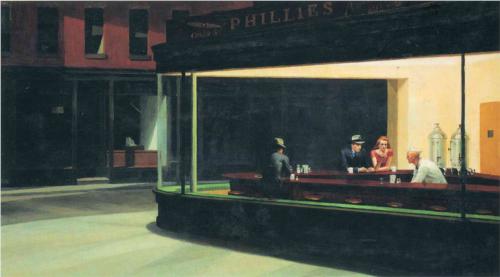
nighthawks.jpg!Blog

Nighthawks (1942)

Edward Hopper

___________

here‘s another gem from Brice Maiurro, of which
there are many, too many to daily share, I’d
sound like too much of an addled fan, or worse,
an unbridled sycophant, though soon that might
be already too late

I’ll commend you rather to his rich and growing
website, FLASHLIGHT CITY BLUES, ardently

the following poem ‘s to do with Edward Hopper,
remember Edward Hopper, for the sake of, nudge,
nudge, always revelatory comparison

EDWARD HOPPER*” is an ekphrastic poem

ekphrasis is poetry about art,
that’s where I got my formal start,
my poetry is still trying to sprout
wings under my perhaps too literal prose

Richard

______________

EDWARD HOPPER*

*based on the notes of American artist Edward Hopper and his wife Jo

Night
+ brilliant interior of
cheap restaurant.

Bright items:

cherry wood counter
+ tops of surrounding
stools; light on metal tanks
at rear right;

brilliant streak
of jade green tiles
3/4 across canvas-
at base of glass
window
curving around the
corner.

Light walls,

dull
yellow
ocre
door
into kitchen right.

Very good looking
blond boy
in white (coat, cap)
inside counter.

Girl in red blouse,

brown hair

eating sandwich.

Man night hawk
(beak)
in dark suit,
steel grey hat,
black band,
blue shirt (clean)
holding cigarette.

Other figure
dark
sinister
back-
at left.

Light side walk
outside
pale greenish.

Darkish red brick
house opposite.

Sign across
top of restaurant,
dark-
Phillies 5c cigar.

Picture of cigar.

Outside of shop dark,
green.

Note:
bit of bright
ceiling
inside shop

against dark of
outside street

-at edge
of stretch
of top
of window.

Brice Maiurro

Eva Cassidy‏

Eva Cassidy seems to have been an angel who
flew too close to the ground, maybe you have
even yourself known one or two of these, I
certainly have, and ever of course have been
for the inordinate grace so profoundly grateful,
despite the hardship, the anguish, of having
lost them
 
here she sings Somewhere Over The Rainbow“,
an inspirational perennial, and makes it fresh and
improbably again wonderful
 
here also however is her sad but instructive story
quality apparently reaches ever its intended level
 
 
may your new year be such that you may also
fly over the very rainbow that you dream of 
 
 
Richard