Richibi’s Weblog

Just another WordPress.com weblog

Category: people to ponder

Easter Oratorio – J.S.Bach
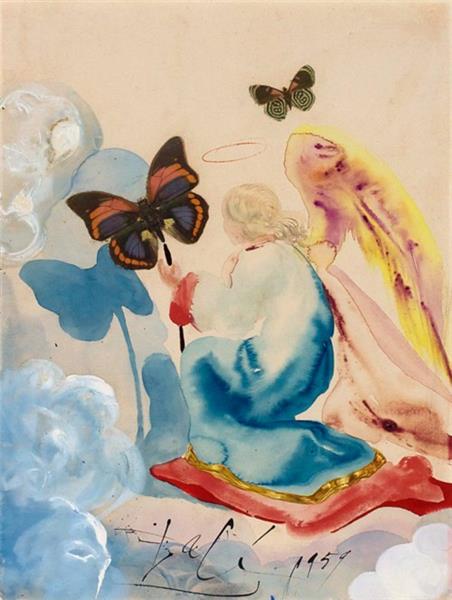
easter-angel-1959.jpg!Large

   “Easter Angel (1959) 

          Salvador Dali

               _______

                                  for Elizabeth, 
                                      who needs an oratorio right now,
                                           and who takes great comfort, 
                                                 she tells me, in this music


if The Seven Last Words of Our Saviour 
on the Cross is not a divertimento, it 
nevertheless didn’t come out of nowhere,
and a clue to its inspiration lies in the 
eventual transposition of the orchestra 
only piece to, a few years later, the piece 
with voice, its oratorio

Haydn had heard his original composition
rendered in a nearby provincial town, where
they’d added lyrics, however saccharine, to
the score, and he thought it entirely effective 
and appropriate, had new less sanctimonious 
lyrics composedand gave us what we now 
hear

oratorios go back quite a while, not 
surprisingly, they are quintessentially 
religious music, meant to inspire, a 
familiar convocational ploy, Bach and 
Handel made them especially immortal
in the early 18th Century

listen to Bach’s Easter Oratorio to see,
to hear rather, the connection to Haydn,
though you might not even notice much
significant difference, they’ve as many 
movements more or less, nine for Haydn,
Bach’s has eleven, but all the forces are 
the same, and in the same order

that Bach’s oratorio would be more 
joyous is not surprising, the occasion for 
the Easter Oratorio is one of celebration,
where The Words is more lugubrious, it 
describes a portentous demise, dance 
rhythms therefore are not in the former 
inappropriate

its dances, however, are rather gavottes
and sarabandes instead of the later 
minuets, a not not instructive alteration 
when you think that minuets not much
later than Haydn had become waltzes,
more about that later

in the Easter Oratorio“, the story is told
by the singers, whereas in The Seven 
Last Words“, the music is doing the 
telling, secured by the fact that the piece
was originally written without singers

The Words is more dramatic, more
use of contrasting volumes and tempi,
the piano hadn’t been invented at the 
time of Bach, long notes couldn’t be 
accommodated on the harpsichord,
which determined the pace of the plot,
the piano allowed with its soft pedal 
a moderation in volume, and with its 
hold pedal a moderation of a note’s 
resonance, which allowed for more 
expansive expression, which led 
eventually, nearly inescapably, to 
the Romantic Period, after passing, 
of course, through, Mozart and
Haydn

but listen to what Bach can do 
without these later interventions,
proof that a poet can inspire with 
merely matchstick, the second 
aria itself – My soul, the spice that 
embalms you shall no longer be 
myrrh – for soprano and baroque 
flute, spare as it is instrumentally, 
is manifestly entirely worth the 
priceless price of admission 


R ! chard
Divertimento no 17, K334 – Mozart

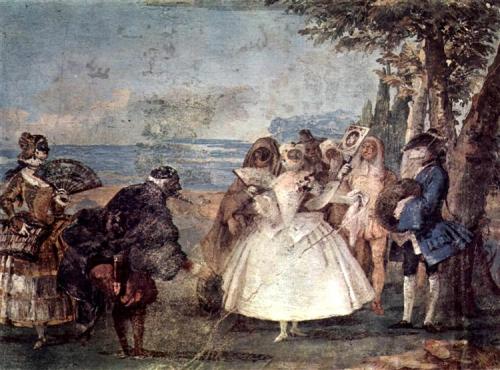
minuet-with-pantaloon-and-colombine-from-the-room-of-carnival-scenes-in-the-foresteria-1757.jpg!Large.jpg

Minuet with Pantaloon and Colombine, from the Room of Carnival Scenes
                                                                                                       in the Foresteria (1757)

     Giovanni Domenico Tiepolo

             ________________

already I can hear you asking, why is
The Seven Last Words“, with its nine
already movements, not a divertimento,
you’ll cry 

a divertimento is an entertainment, it 
doesn’t have the gravitas of Haydn’s 
composition, a sacred work, a 
divertimento is meant to delight

The Seven Last Words“, therefore,
by definition is not a divertimento,
it’s a completely different idea of a
piece with several movements, it 
has profoundly ulterior intentions,
following, rather, in the tradition of
Bach’s oratorios, though it had 
originally been conceived without 
words, the prelate in this work 
would be doing the talking

the piece gives itself a theme, a 
focus, a project, creating something 
like chapters in a book 

or think of the Stations of the Cross 
a metaphorically more apt, perhaps, 
unifying principle, instead of just a 
series of disparate airs, like singles 
were on albums until Pink Floyd 
similarly revolutionized music with 
a topic during my generation, The
Wall, with a little preparatory help
albeit, from the Beatles, earlier,
our friends

here’s Mozart, nevertheless, in order 
to compare, his Divertimento no 17,  
K334giving the aristocracy what 
they still, in 1780, wanted, something 
courtly

you’ll notice there are not just one 
but two minuets in the program, both 
with recapitulations, sure sign that 
we’re still in the Classical Era, though 
the minuet will die off as quickly as 
the divertimento will in the following 
decades, relics, both, of an earlier era

and indeed this is Mozart’s last for 
small orchestra, divertimenti would be 
composed from here on as merely 
tributes to an earlier period and its 
musical formulas

masses and oratorios would go the same 
way, incidentally, with some resurgence 
in the following centuries from a couple 
of Catholic organists who left profound 
influences individually on later centuries

but more about them later

meanwhile, here’s Mozart, feel the 
gentility, his genuflexion to propriety 
rather than to faith


R ! chard

“The Seven Last Words of Our Saviour on the Cross”, opus 51 – Joseph Haydn

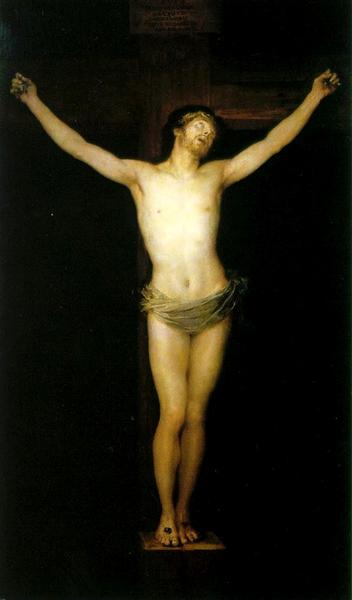
crucified-christ-1780.jpg!Large.jpg

                  “Crucified Christ (1780) 

                          Francisco Goya

                                 _______

Haydn’s Opus 51 was commissioned 
for the Oratorio de la Santa Cueva, the 
Holy Cave Oratoryin Cádiz, Spain,
church, as the name suggests, built 
partially underground, it would be
performed, the Opus 51, for the Good 
Friday service of 1787, Haydn therefore 
put his Opus 50 on hold, six string 
quartets, to finish this ecclesiastical 
work on time

what had been required was a work for 
small orchestra to inform the Seven 
Last Words of our Saviour on the 
Cross, it would therefore have at least
segments, movements, and would be 
divided by the elaboration of the 
bishop upon the significance of these 
individual “Words”, or, in fact,
statements, see this example 

Haydn added an introduction, and a 
finale in the form of an earthquake,
quite, I think, wittily and ever so 
appropriately

nearly simultaneously, Haydn 
composed the orchestral 
arrangement for string quartet, and 
later for orchestra and voice, for, in
other words, an oratorio

to my mind “The Seven Last Words 
of Our Saviour on the Cross” is 
Haydn’s crowning achievement, in 
all of its iterations

you’ll note that there is even first of 
all a title, and the title asks for 
something quite specific, indeed 
words, which the composer would
have to render musically, somehow, 
he’d need drama, something of a 
musical narrative, no minuets

all of the movements, apart from 
the end ones, are variations on 
slow – adagio, lento, largo, even 
grave – and how do you keep an 
audience, or in this case a 
congregation, happy, or even 
interested, with seven potentially 
lugubrious adagios in a row, all 
profoundly melancholy

only Shostakovich has managed 
to do that since, which I’ll talk 
about at some point later

Haydn also undoubtedly inspired 
Beethoven here with the 
consequences of so many 
movements, the possibility of 
extending a musical intention
into something resembling,
indeed, a book, a story, the 
introduction of narrative, 
essentially, into our musical 
history, which is to say, music
as literature 

the orchestral version of “The 
Seven Last Words” is performed 
here at the very Oratorio de la
Santa Cueva, the string quartet
version, played not only better 
than I’ve ever heard it played
before, but better even than any 
other quartet I’ve ever heard, 
period, includes the commentaries 
in German by an attendant prelate,
as intended in the original 
composition 

the movements’ “Seven Words” are 
indicated in Latin, not, incidentally, 
the  language of “Our Saviour”, and 
move from “Lord, why have you 
forsaken me” to “If it is Your will, 
then let it be done”

the last version presented here is 
the oratorio, for orchestra and
voice  

all of them, utterly inspiring

listen


R ! chard 

        (to be, incontrovertibly, continued,
         this piece is too loaded with 
         substance, it is transformational)

January 30, 2018

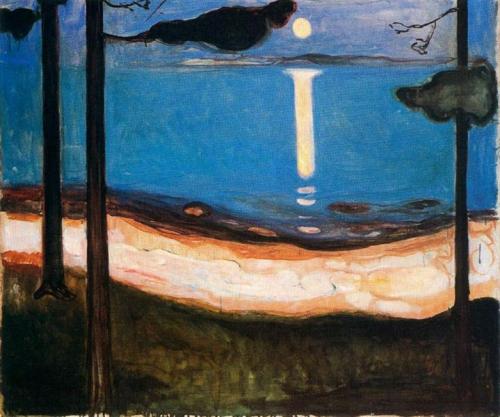
moon-light-1895.jpg!Large

        Moon Light (1895) 

               Edvard Munch

                    ________

my mom texted me this morning that
the moon would be  “BLOODY RED IN 
COLOUR….because “, she added, “earth
🌏 will be between sun and moon …last
happened 152 years ago ….moon closest
to earth 🌏

I haven’t told her yet that from my 
window I’ll be singing, as the moon  
rises above the mountains in the 
east, Casta Diva“, Norma’s song 
to the moon

chaste Goddess, she appeals, who 
bathes these sacred trees in silvery 
light, bless us with your grace, we
are not not in need of it

maybe you’ll sing along


Norma is a Druidic priestess, 
representing her community, which 
has been overtaken, and is now ruled,
by the Romans, she bears already, 
however, two children of a Roman 
military official, Pollione, who has 
fallen for her maid, Adalgisa, sparks 
fly in every direction, both personal 

and political, Adalgisa ‘ll keep the 
kids eventually, and both Norma and 
Pollione will go the pyre, the very 
height of Romantic fervour, check it
out, it’s extraordinary, with Joan 
Sutherland in this, dare I say, 
classic performance

but first of all, Casta Diva itself, by  
the inimitable Maria Callas 

and may the moon be your guide


R ! chard

String Quartet no. 38 in E♭major, Op. 50, No. 3 – Haydn

fullsizeoutput_3f4.jpeg         

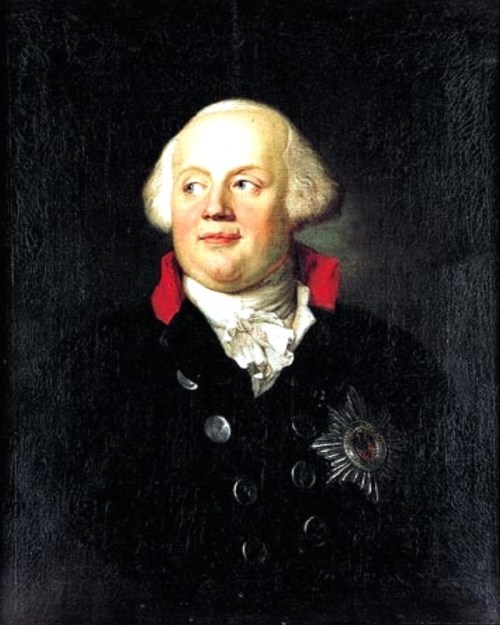
         Frederick William II of Prussia

                      ______________

if there’s a difference that I can detect 
between both these “Prussian” string
quartets, the No. 21 of Mozart, Haydn’s
38th, the somewhat more boisterous 
voice of the youthful Mozart up against 
the more deferential, the more precisely 
filigreed, manner of Haydn, the more 
consummate courtier of the two via his 
actual, and constant, presence at the 
Esterházy court

Mozart is somewhat less genteel, less
mercurial, I think

both sets, six in each, were originally 
dedicated to the King of Prussia,
William ll, Haydn’s in 1787, Mozart’s 
in 1789, though each had unfortunate 
legal, and controversial outcomes 

it’s not so much the specificity of each
other’s talent at this point that settles 
their ultimate significance, but that 
their invention, the form, the structure,  
has lasted already two hundred years, 
the might of their prowess has inspired 
inexhaustibly our culture

Mozart and Haydn built the house that
our music now stands on, working, of 
course, from earlier, even glorious, 
standards, culture  – music, art, 
literature – is like a tree, growing 
organically from its local soil, our
Western earth has become 
historically especially significant,  
we could be listening to Chinese 
opera for instance now had we been 
born, however arbitrarily, in that 
culture, for better or for worse we are 
in our ever evolving ours, our 21st 
global century, and the Classical Era 
is pretty well where it all began for us 

it was also called the Age of 
Enlightenment, Mozart and Haydn 
were doing their particular part

let me add that the term “Classical”
applies only to the music of that 
period, it is not the period of 
Classical art, for instance, nor of
Classical literature, the term 
“Classical” refers to the originality
of the product and its historical
resilience, we speak of Classical 
Greece, for instance, for its 
sprouting of our Western culture,
our literature, our sculpture, our
architecture, our very philosophy

after the Age of Enlightenment, we 
get the Romantic Period

wait till you hear about that


R ! chard 

String Quartet no 19 in C major, K465 (“Dissonance”) – Mozart

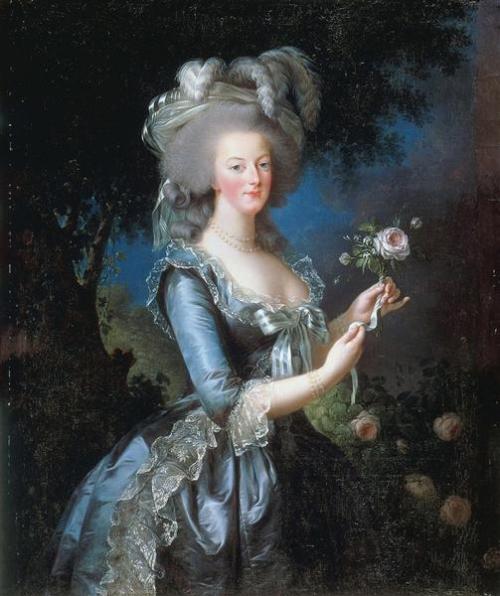
queen-marie-antoinette-of-france-1783.jpg!Large

                    “Queen Marie Antoinette of France (1783)  

                              Louise Elisabeth Vigee Le Brun

                                           ______________

if Mozart’s 19th String Quartetthe last of 
his Haydn Quartets, the six he indeed 
dedicated  to Haydn, sounds less 
deferential than one would have thought 
for the period, it should be remembered 
that the American Revolution had just
taken place, in 1776, the French one was 
about to, in 1789, and even the more 
aristocratic houses in Europe would not
have been unaffected, Mozart was young,
29, and astir with confidence and bravura,
it was 1785

Haydn had had his moment earlier, his
Opus 20, which went on to revolutionize 
music if not countries, but had retreated 
to a less emboldened political stance 
as he grew older, while concentrating 
rather on his more important muse, and 
refining his ear for precise, pure music,
which is to say devoid of any but polite
sentiments, delight and lyrical 
melancholy only

in Mozart’s 19th String Quartet, even the 
minuet is peremptory, not something 
you’d especially want to dance to,
however musically accomplished

he starts the first movement with, of all 
things, an adagio, however briefly, which 
could’ve been disastrous, you need to 
know what you’re doing when you open
with a lament

incidentally, all the instruments in the
opening adagio are playing in different 
keys, resolved when the allegro kicks 
in, this is why it’s called “Dissonance”,
something in and of itself of a 
rebellious act 

the 19th is also twice the length of 
Haydn’s nearest earlier one, his Opus 42,
expansive rather than terse, for whatever
that might mean, the point is to keep us
throughout interested, which he does, 
they do

Mozart is prefiguring hereincidentally,
Beethoven, with his audacity, his 
sense of an ideological mission, and  
he’s mightily impressive

listen


R ! chard

String Quartet no. 14 in G major, K. 387, (“Spring”) – Mozart

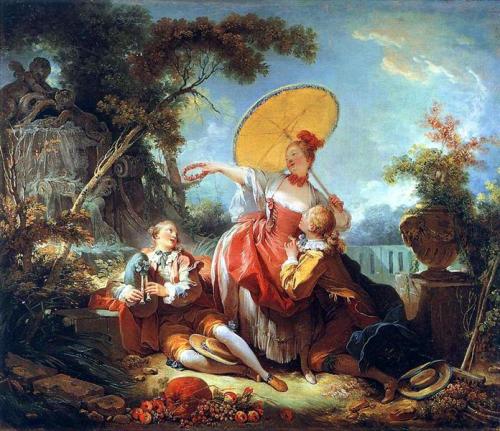
the-musical-contest-1755.jpg!Large     
     “The Musical Contest (c.1754 – 1755) 

            Jean-Honoré Fragonard

                     ____________

right about this time, 1782 to 1785, Mozart 
was writing his Haydn Quartetssix of 
them, in the very fashion, not incidentally, 
of Haydnas a tribute to the master, the 
father, the very originator of the string 
quartet 

here’s the first of them, a not at all 
unimpressive tribute

Mozart follows the master in kind, the
number of movements, the selection
of tempi, there’s even again a minuet,
an aristocratic prerequisite, note even 
the delicate, the deferential, endings,  
to all, not just one, of the movements,
a trait indicative of Haydn, his courtly, 
courteous reserve before any too
personalized spotlight, however 
manifest his brilliance – noblesse, 
in other words, oblige

Mozart follows immaculate suit

you might find it difficult to distinguish
between Mozart and Haydn, I do, the 
differences are so subtle as to be 
nearly, for the most part, 
indistinguishable, their periods overlap, 
their contexts were not at all dissimilar, 
just even Vienna as their musical core

the aristocracy was still, evidently, in 
charge, however henceforth briefly, 
and paying the bills, and the mood 
required remained respectful, polite, 
unpolitical, which both composers
dutifully obliged, neither subjecting 
himself to any constraints around 
his higher manifest destiny, his 
irresistible muse, the pursuit of 
pure, and unadulterated, music

this will unfurl, see, for instance,
Shostakovich


R ! chard

String Quartet no 35 in D minor, Op 42 – Haydn

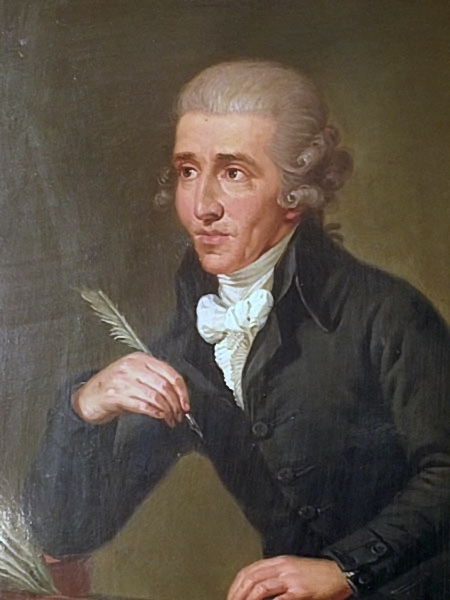
Haydnportrait

                         “Joseph Haydn (ca. 1791) 

                              Ludwig Guttenbrunn

                                   _____________


                                             for, especially, Collin

Haydn’s Opus 42 was written in 1785,
he would’ve been 53, which might 
explain his return to a less 
ideologically driven music than his 
earlier more vociferous compositions, 
one gets more conservative, nearly by 
definition, as one gets older

there is no vehemence in this quartet,
it is meant to merely delight listeners, 
lords and ladies looking to be 
impressed, there is no call to arms
here, there’s even a minuet

the final movement, the presto, might
seem urgent, but is rather, I think,  
engaging than peremptory, more 
entertaining than adamant

there’s only one string quartet in the 
Opus 42, usually there are six in 
Haydn’s opuses, or opera, the piece 
is also terse, a wonderland of 
extraordinary music within the span 
of, however improbably, just 13 
minutes

Haydn seems to be giving us his idea 
of the string quartet, a nearly Platonic
proposition, in a nutshell

Plato thought that there was an ideal 
string quartet somewhere up there in
an ordering space, a mystical 
system of specifically representative 
entities, determining the accuracy of
definitions, religions presently 
struggle with that, the inflexibility of 
their intractable propositions, Haydn 
was giving us something to think 
about, a string quartet to define the 
very ages

note the recurrence of the original 
theme always with all of its 
permutations

note the rhythmic consistency, 
though the several movements are
decidedly, and effectively, divided 
according to their strict tempos

note that all, though here and there
a strident note may appear, the 
tonality, the key, the modality, is  
constant

this will change

but for now we have the very essence 
of the Classical Period

and it’s hot 


R ! chard

psst: to a friend who’s become impressed 
          by my choice, incidental of course, 
          of cellists, I would suggest it has  
          more to doperhaps, with its sonority,  
          the low thrum of their instrument, it 
          can really unsettle one’s kundalini,   
          the sleeping serpent at the base of 
          the spine, and not so much the   
          individual cellist, maybe
            

String quartets, Op.20 – Joseph Haydn

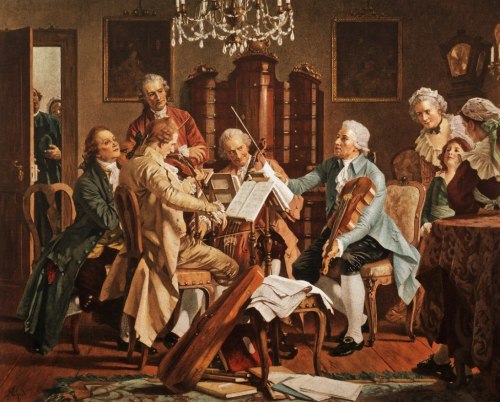
HaydnPlaying

  Joseph Haydn playing string quartets 

          Anonymous 

                (Staatsmuseum, Vienna)

             _______

upon first hearing the first movement only 
even of the opus 20, no 5 of Haydn, I was 
immediately struck by the more determined, 
insistent, peremptory strokes of the strings,
something not especially appropriate in an 
aristocratic setting, where the music should
be polite, reserved, nearly unobtrusive, a 
music composed for performance here 
rather than as an after dinner mint

the second and third movements return to 
a more conventional, which is to say courtly,
tone, but the end of the fourth movement is
also, and more virulently, vociferous

what’s up 

you might view this as the very beginning 
of the Classical Period, the stately 
institutions of not only the aristocratic 
social experiment, but also of the very 
world order were being debated, personal
opinion was beginning to supersede 
convention, the very core of the upcoming
Romantic Era, which saw the rights of the 
individual installed rather than the voice
of an imperial, or an indeed spiritual,
authority

Haydn was expressing his musical, and
dare I say Delphic, anima, his inspired 
spirit, setting the stage for what was to 
come, however historically blindly, the
French Revolution was coming up


I have a beef with the third movement, 
the adagio, however lovely – it’s right 
out of Bach, without anywhere any 
apparent attribution, I object to that 

is this a tribute, or an appropriation,
or does it matter, you tell me, I think
it’s, again however lovely, and ever
so influential, not only not right, but 
neither as lovely as the sublime 
BWV1031, a complete and utter
serenity, a sin of the sons against 
the fathers, or is it, rather, our 
indifferent patrimony, like putting 
moustache on the Mona Lisa 


the opus 20, no 2, is, for reasons I
won’t get into, a later work, it is 
throughout vociferous, peremptory,
insistent, adamant, assertive, 
vehement, uncompromising, it’s 
nearly even Beethoven, it’s, in
other words, a scorcher, like 
Beethoven, it takes no prisoners 

check it out, it’s only 1772 and the 
earlier model of civilizational order 
isn’t any longer holding, opus 20,
no 2 is an augury, an omen of what
is to come, which is, of course, the 
very task of the poet 


R ! chard

String Quartet no 15 in E flat major, op. 9, no. 2 – Haydn

minuet-1756.jpg!Large

   Minuet (1756) 

          Giovanni Domenico Tiepolo

                   _______________

by 1769, Haydn had settled into a form 
for his string quartet that would become
definitive, four contrasting movements
in a particular key, to give the work 
cohesion

his Opus 9, no 2 retains a movement 
devoted to dance, the second, the 
“Menuetto”, but the essential 
conditions of the Classical string 
quartet are met

earlier, Haydn had referred to his 
compositions as “divertimenti a 
quattro”, divertimenti for four, 
players, of course, now he 
acknowledged, indeed installed, 
the concept of the string quartet, 
its earliest incarnation, as such 

though the outer movements are 
competent – the first using its 
initial off-beat musical motif a 
bit too often for my taste, and 
its repeat portions too similar, 
like someone repeating the same 
information you’ve been given
and unnecessarily extending the 
conversation with too few 
intriguing elaborations, too few 
arresting developments, the 
second, polite, and, thankfully, 
distinctive – the third, the 
“adagio – cantabile”, will knock
however, your socks off, a line 
of music is explored in all its 
tortured beauty to utterly 
transcendental effect


there is a spot in music, often an 
adagio for me, where one thinks, 
I have been there, this is me, and 
one throughout space, time, 
responds to the language of 
another, one melts, and finds 
one’s connection with humanity

therefore music, therefore, indeed, 
all art, thanks to all those who 
chose to share with us their,
however ever eccentric, 
inspiration, thanks to their, our, 
ingrained, ineffable, desire, 
indeed capacity, to communicate,
even across the ages, to, indeed, 
transcend 


but I’ve digressed

listen


R ! chard