Richibi’s Weblog

Just another WordPress.com weblog

Category: people to ponder

a grab bag of love songs‏


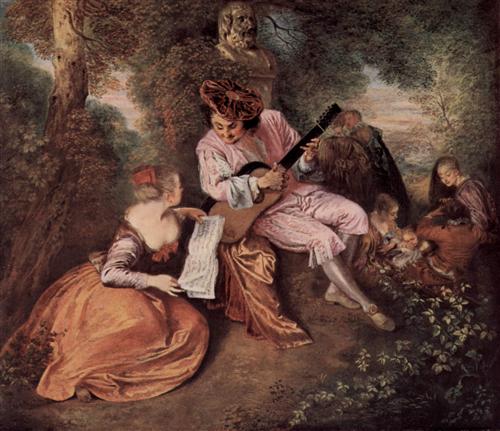
 "The Scale of Love" - Antoine Watteau

The Scale of Love ( c.1717)

Antoine Watteau

______

a clutch of other pop songs that have
moved me in March

for its unabashed servility, Mon Dieu – Johanne Lefebvre

please, God, she says, let my lover be
with me still even for a short time, time
to tell each other of how we adore each
other, time to create for ourselves
memories, six months, three months,
two, one month only, let him remain,
time to begin or time to end, time to
glow or time to even suffer, please,
God, don’t take him away

for its irresolute resolution, I’ve Been Loving You Too Long
Emmanuel Nwamadi

for its recriminations, self-flagellation, Jealous Guy – Kevin Bazinet

for its out-of-control hormones, Sing – Liana Bureau
and Dominic Dagenais

Richard

March: “Black March” – Stevie Smith‏

"The Frozen Pool, March" - Willard Metcalf

The Frozen Pool, March (1909)

Willard Metcalf

_______

in this wonderful film about Stevie Smith,
Glenda Jackson is the celebrated poet,
whose poem, “Black March“, I’ve chosen
to introduce the new month

you’ll love also Mona Washbourne in it,
as Stevie’s beloved aunt

the site presents the film in numbered
episodes, which seamlessly flow if you
don’t touch your dial, but should you,
just click on the episode number, one
of eleven, when you return

Richard

psst: you might also want to compare
this story with that of Emily
Dickinson in The Belle of Amherst“,
another, unconventionally then,
unmarried woman, for which Julie
Harris got a richly deserved Tony
in 1977

read all about it in one of my recent
blog
s

_________________

Black March

I have a friend
At the end
Of the world.
His name is a breath

Of fresh air.
He is dressed in
Grey chiffon. At least
I think it is chiffon.
It has a
Peculiar look, like smoke.

It wraps him round
It blows out of place
It conceals him
I have not seen his face.

But I have seen his eyes, they are
As pretty and bright
As raindrops on black twigs
In March, and heard him say:

I am a breath
Of fresh air for you, a change
By and by.

Black March I call him
Because of his eyes
Being like March raindrops
On black twigs.

(Such a pretty time when the sky
Behind black twigs can be seen
Stretched out in one
Uninterrupted
Cambridge blue as cold as snow.)

But this friend
Whatever new names I give him
Is an old friend. He says:

Whatever names you give me
I am
A breath of fresh air,
A change for you.

Stevie Smith

“The Belle of Amherst”‏

Emily Dickinson

Emily Dickinson

_______

a couple of my Internet interests intersected
recently to bring me this theatrical gem, this
outright treasure

there’d been a few poems of Emily Dickinson
I’d read in my poetry class, none particularly
affecting, while at the Tonys on another site
Julie Harris was winning the ’77 award for
best actress for her role as that very poet, in
a superb evocation, The Belle of Amherst“,
of Dickinson’s life, available, I, to my delight,
indeed erudition, discovered, elsewhere still
on the Internet, straight from the original
Broadway stage

Julie Harris was the very stuff of Tonys, so
was the production

watch, don’t not watch

you’ll want to run back to your Emily
Dickinsons afterwards, even

here’s one

If I can stop one heart from breaking,
I shall not live in vain;
If I can ease one life the aching,
Or cool one pain,
Or help one fainting robin
Unto his nest again,
I shall not live in vain.

Emily Dickinson

Richard

the Tonys, 1976, ’77‏

the Tony Award Medallion

the Tony Award Medallion

___________

the Tonys have become for me what
the Rubinstein Competition was
last
spring, or was it summer, an addiction

in ’76 “A Chorus Line” essentially won
everything
, the closest thing to it was
“Chicago”, which, if I remember, got
nothing, undeservedly, but how do
you top a titan, A Chorus Line has
never been bested, you came out
dancing

it’s ’77 though, now, and Lily Tomlin
gets a special Tony
for a show that
couldn’t be called either a play or a
musical, Appearing Nitely was a
revelation

watch Lily Tomlin receive her award,
you’ll see what I mean

just click

Richard

Tonyana‏

the Tony Award Medallion

the Tony Award Medallion

______________

meanwhile back at the Tonys, 1972,
Phil Silvers wins an award for Best
Actor in a Broadway Musical

surely deservedly, he could’ve won
one right here

Richard

a gift from Brain

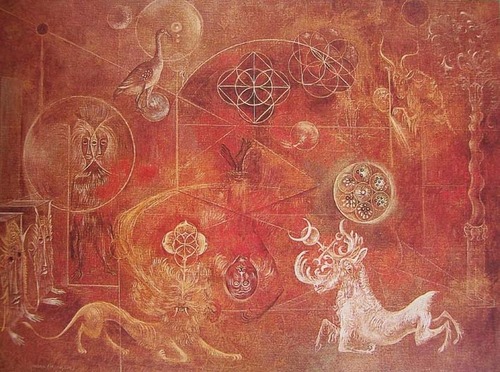
Leonora Carrington - "The Burning of Giordano Bruno" (1964)

“The Burning of Giordano Bruno (1964)

Leonora Carrington

_______

the last entry at The Other Side of the Brain
was the following poem, which delivers such
thunder that I couldn’t help appropriating it
for my own purposes

forgive me, Brain, but with this one you’ve
been too much of an inspiration

thanks

________________

What He Thought

for Fabbio Doplicher

We were supposed to do a job in Italy
and, full of our feeling for
ourselves (our sense of being
Poets from America) we went
from Rome to Fano, met
the mayor, mulled
a couple matters over (what’s
a cheap date, they asked us; what’s
flat drink). Among Italian literati
we could recognize our counterparts:
the academic, the apologist,
the arrogant, the amorous,
the brazen and the glib—and there was one
administrator (the conservative), in suit
of regulation gray, who like a good tour guide
with measured pace and uninflected tone narrated
sights and histories the hired van hauled us past.
Of all, he was the most politic and least poetic,
so it seemed. Our last few days in Rome
(when all but three of the New World Bards had flown)
I found a book of poems this
unprepossessing one had written: it was there
in the pensione room (a room he’d recommended)
where it must have been abandoned by
the German visitor (was there a bus of them?)
to whom he had inscribed and dated it a month before.
I couldn’t read Italian, either, so I put the book
back into the wardrobe’s dark. We last Americans
were due to leave tomorrow. For our parting evening then
our host chose something in a family restaurant, and there
we sat and chatted, sat and chewed,
till, sensible it was our last
big chance to be poetic, make
our mark, one of us asked
“What’s poetry?
Is it the fruits and vegetables and
marketplace of Campo dei Fiori, or
the statue there?” Because I was
the glib one, I identified the answer
instantly, I didn’t have to think— “The truth
is both, it’s both!”, I blurted out. But that
was easy. That was easiest to say. What followed
taught me something about difficulty,
for our underestimated host spoke out,
all of a sudden, with a rising passion, and he said:
The statue represents Giordano Bruno,
brought to be burned in the public square
because of his offense against
authority, which is to say
the Church. His crime was his belief
the universe does not revolve around
the human being: God is no
fixed point or central government, but rather is
poured in waves through all things. All things
move. “If God is not the soul itself, He is
the soul of the soul of the world.” Such was
his heresy. The day they brought him
forth to die, they feared he might
incite the crowd (the man was famous
for his eloquence). And so his captors
placed upon his face
an iron mask, in which
he could not speak. That’s
how they burned him. That is how
he died: without a word, in front
of everyone.
And poetry—
(we’d all
put down our forks by now, to listen to
the man in gray; he went on
softly)—
poetry is what

he thought, but did not say.

Heather McHugh

______________

this made me think that God is an
adjective not a noun, an attribute,
not a commandment, “God is no
fixed point or central government,
but rather is poured in waves
through all things”

cheers, Richard

psst: I’ve made the choice to leave out
the poem’s purported paragraphs
for their being indiscriminate in
every Internet reproduction

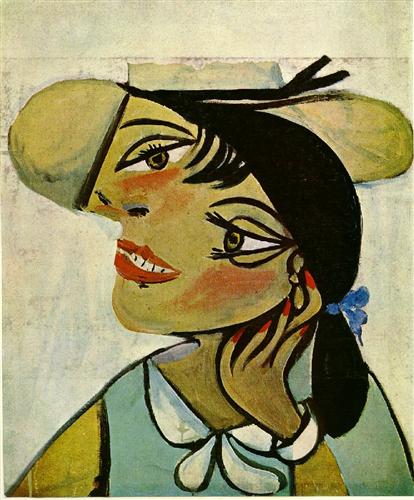
Pablo Picasso/Gertrude Stein

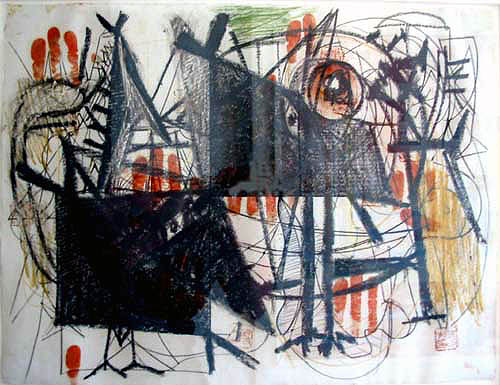
Pablo Picasso - "Untitled" (1923)

Untitled (1923)

Pablo Picasso

________

Gertrude Stein was a friend of Pablo Picasso,
you can see it in her prose, a disordering of
traditional practices, perspectives and
proportions

in loving repeating she writes

As I was saying loving repeating being is in a way earthly being. In some it is repeating that gives to them always a solid feeling of being. In some children there is more feeling and in repeating eating and playing, in some in story-telling and their feeling. More and more in living as growing young men and women and grown men and women and men and women in their middle living, more and more there comes to be in them differences in loving repeating in different kinds of men and women, there comes to be in some more and in some less loving repeating. Loving repeating in some is a going on always in them of earthly being, in some it is the way to completed understanding. Loving repeating then in some is their natural way of complete being. This is now some description of one.

Gertrude Stein

_________________

in my poetry course the Modernists keep on
coming, quite a few I’ve found impenetrable
and obtuse, I can see their points, but find
them pedantic and trivial

similar sentiments greeted the Impressionists
when they came out, so I’m watching myself

it’s easy to digest Picasso‘s painting now,
but even when I was a boy he was
controversial, now everyone admires him

Gertrude Stein not so much, writing is not
painting

they are both, I believe, returning to the
language of innocence, putting together
their world as children do, getting their
information in overlapping concepts,
trying to make their way through the
muddle

a five-year-old would talk like that, a
five-year-old would paint like that,
both are sorting out their new world,
the world that had been so profoundly
disturbed, disjointed

they were returning to the disarray,
and consequent irregular grammar,
of children, making their own kind
of common sense, trying to get their
bearings, after all, even God had
died, see Nietzsche on that

and, for better or worse, finally,
they’ll leave you behind, the children,
whose world, then, is it worth attending

Richard

psst: as a boy I asked my dad, while
interminably, I thought, fishing,
how long it would take the
minnow to grow into the
required fish, how’s that for
not illogical observation
Bill and Flossie Williams

Arshile Gorky - "Hitler invades Poland" (1939)

Hitler Invades Poland (1939)

Arshile Gorky

________

it must be understood that World War l
changed everything, the old order,
orders, had been discredited, new
states were formed, territories allotted,
-isms proliferated, the arts had to, of
course, reflect that, and did, as many
-isms were hatched in the art world
as in the political world, indeed,
many more

which is why much of it at first
seems questionable, practitioners
were learning anew how to talk, paint,
make music, they were creating a new
conceptual universe to replace the one
that had been roundly discredited, the
one that had been around in the West
for the last two thousand years

therefore Schoenberg, therefore
Picasso, and therefore Finnegan’s
Wake
“,
for instance

we’ve been studying American
Modernists in the classes on the
Internet I’m taking
, none of whom
I find interesting, and I’m, contrary
to all expectations, losing even my
early enthusiasm for the much too
thorny, I think, Emily Dickinson

but here’s another abstruse poet
that I like in this poem

though I much prefer his wife
Flossie’s sardonic reply
, which
follows

________________

This Is Just To Say (1934)

I have eaten
the plums
that were in
the icebox

and which
you were probably
saving
for breakfast

Forgive me
they were delicious
so sweet
and so cold

William Carlos Williams

________________

Flossie’s Reply (1934)

Dear Bill: I’ve made a
couple of sandwiches for you.
In the ice-box you’ll find
blue-berries–a cup of grapefruit
a glass of cold coffee.

On the stove is the tea-pot
with enough tea leaves
for you to make tea if you
prefer–Just light the gas–
boil the water and put it in the tea

Plenty of bread in the bread-box
and butter and eggs–
I didn’t know just what to
make for you. Several people
called up about office hours–

See you later. Love. Floss.

Please switch off the telephone.

Florence Williams

____________

go Florence, I say, but you can
see, of course, why I’d say that

Richard

the Argentinian tango‏

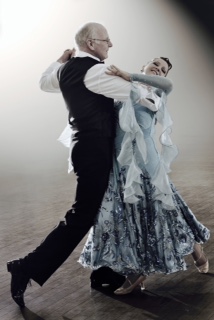
Jane and John

Jane and John

______

through the magic of the Internet, new
old friendships abound, with the click
of a connection I found the key to
erstwhile friends, who, it turns out,
are now ballroom dancers, pictured
above

can you dig it

she suggested an Argentinian tango I
might like

I am countering with another

meanwhile watch also what they’re
doing on Avenida Florida in Buenos
Aires
, where miracles, trust me,
happen
, just click

Richard

psst: do try all of this at home

finding poems

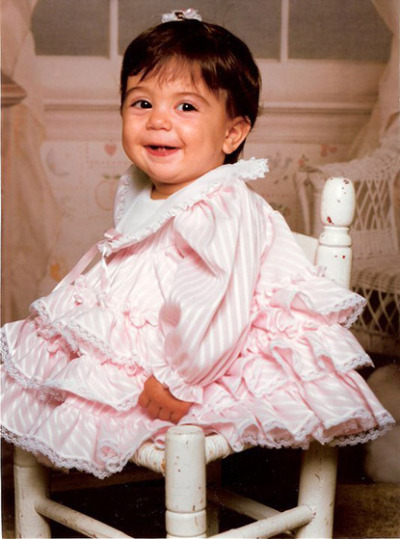
Jennifer Bricker

Jennifer Bricker

_______

you look for poems, you find poems

this morning a friend sent me this one

can a person be a poem

you tell me

Richard