Richibi’s Weblog

Just another WordPress.com weblog

Category: music to ponder

Cello Concerto no 2 in D major – Haydn

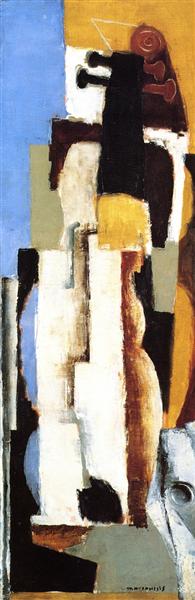
a-cello-1921.jpg!Large

         A Cello (1921)

        Louis Marcoussis

             ___________

between Bach’s transcendent Suites for
Cello and Beethoven’s reinvention of that 
instrument, two only cello works occupy
the last half of that century, both by
Haydn

his Second, however, Concerto, written 
several years later than his First, 1783, 
indeed nearly twenty years later, seems 
to me less accomplished, though ever, 
nevertheless, unimpeachably, and 
impressively, Haydn 

the first movement is long, long works 
only until you start thinking it’s long

the initial melody in the adagio, the 
second movement, struck me as artificial, 
saccharine, though Haydn weaves magic, 
not unexpectedly, still, and  
continuously, around it in its 
development, his elaboration of it

and the pace of the third movement, 
following the second, is disconcerting 
rather than surprising, rather than, 
were it effective, delightful

Mozart wrote a Cello Concerto too, 
apparently, but, if so, it is lost

otherwise we’re on to the next historical
epoch, Beethoven’s, after this inauspicious 
turn at this generation for the cello, lost 
for a while among the more assertive 
instruments of that prim, and proper,
Classical Era


R ! chard

Cello Concerto no 1 in C major – Joseph Haydn

st-george-and-the-dragon.jpg!Large

     “St. George and the Dragon (c.1470) 

                Paolo Uccello

                    ________

it isn’t easy for me to leave Bach behind
whenever I start listening to him, I could 
ride his musical train forever

but the middle of the 18th Century did, put 
him aside, for about a hundred years, until 
Mendelssohn rediscovered him

Bach’s Cello Suites were themselves only 
reinstated in the 1930s by Pablo Casals,
the Classical 18th Century had considered 
Bach too fussy, his pieces, they thought, 
were technical exercises rather than 
actual entertainments, form was  
overtaking, for them, function 

there’s a wonderful book about all this,
The Cello Suites“, written by Eric Siblin, 
a Canadian journalist, which is not only 
amazingly informed and probing, but also 
beautifully written, it holds a place of 
honour on my bookshelf, along with other 
inspired, and inspiring, texts

not only was Bach set asunder, dismissed,
during the Classical Era, but all of the 
formative music also he had written, for 
cello, violin, keyboard, in other words,
the entire curriculum

which, since Bach’s reinstatement, has 
become, paradoxically, the very  
foundation for learning these instruments

imagine playing a tune with the right 
hand, then a few notes later, picking 
it up in the left hand while the right 
hand keeps on going, imagine what
that does to your fingers, never mind  
to your mind, that’s what his Two-Part
Inventions are all about, fifteen of 
them, eight in major keys, seven in
minor, consider the technical 
difficulties, intricacies, imposed 
both compositionally and upon 
the harried performer 

then Bach follows through with his 
Three-Part Inventions to top it all 
off, for the keyboard at least, and 
only for the moment – there’ll still 
be his transcendental Goldberg 
Variations” among other 
incandescent masterpieces – 
wherein one juggles three tunes at 
time, and all of them in the same 
assortment of fifteen contrasting, 
foundational, keys, the “Inventions
 – if you can do that, you’re on your 
way, one would think, to knowing 
entirely what you’re doing

but time marches on, the Classical
Era hits, Haydn takes over, not
unimpressively

the same thing happened in my 
generation to Frank Sinatra via 
the Beatles, not to mention, a little 
later, to either, with Pink Floyd

listen to Haydn’s First Cello Concerto,
note the bravura inherent in the 
composition, this is not Bach’s 
meditative music, the very Romantic 
Period is, through Classical reserve, 
expressing already its imminence, 
individual prowess is taking over 
from community, which is to say 
religious, affiliation, the same way 
the Renaissance artists, Duccio
GiottoFra AngelicoFilippo Lippi
Uccello had stood out, incidentally, 
from their brethren in the standard 
communal art schools dedicated to 
decorating the ever burgeoning 
churches sprouting out in the still
fervent European environment 

musical, though unaristocratic, 
talents, this time, were beginning, 
within German context, to flex 
their decidedly not unimpressive 
muscles, and gaining some 
significant purchase

and who wouldn’t when a Cello 
Concerto would’ve sounded like 
this, listen


R ! chard
Cello Suite no 5 in C minor – J.S. Bach

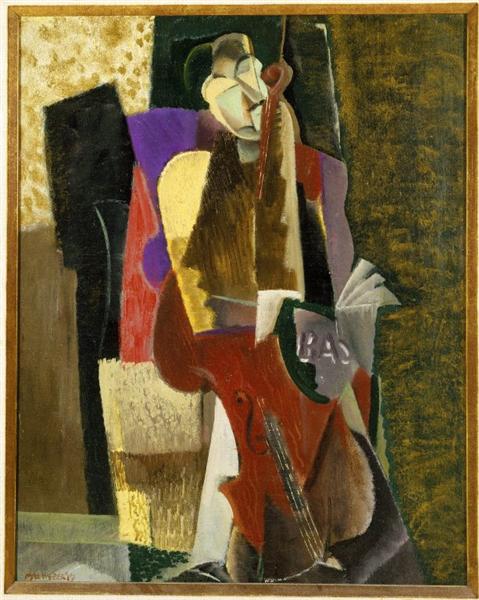
the-cellist.jpg!Large

        The Cellist (c.1917) 

              Max Weber

                 ______

what struck me immediately upon hearing
the bow’s very first strokes on the violin in 
this Fifth Cello Suite of Bach was that the 
mood was not only brashly Romantic, but 
quite specifically Russian Romantic, right 
up there with Dostoyevskyand Fiddler 
on the Roof, dark brooding colours at 
first, followed by long plaintive musical 
phrases, you can even hear the sound of 
the steppes, I thought, stretching out into 
the endless distance, this performance,  
surmised, is not, other than 
compositionally, Baroque, not to mention 
not even German 

yet as played by Mischa Maisky, it’s one 
of the best versions of the Fifth I’ve ever 
heard, and if it works, who’s to complain

but more context – Bach never gave not 
only textural indications, but not even 
tempos to his pieces, apart from the 
very dance terms that identify the 
movements, so what, therefore, is the 
specific pace, you’ll ask, of a courante, 
for instance, you tell me, I’ll reply

in other words, the modular terms were 
significantly looser in the early 18th 
Century than later, when metronome 
markings would begin to demand more
accurate replication of the artist’s 
explicit specifications – Beethoven 
especially made sure of that, by 
requiring accurate renderings of his   
mood or pace indications, largo,  
allegro, andante, for instance, still less  
strict than the stipulation later for exact 
musical beats per minute – trying to 
keep pace with a prerecorded tape, for 
example, as in again the industrially 
driven, which is to say emotionally 
indifferent, context of the seismic 
Different Trains“, masterpiece of a 
more technically conditioned era

I don’t think that Bach would at all have
been disappointed that the heirs of his 
fervent, though more genteelcreations 
might’ve morphed into something 
profound for other groups, be they 
national, or of a class, or of even a 
generation, of people, which is to say 
that these works have superseded 
their merely regional intent, and have 
reached beyond space and time, the 
very purview of music, to speak a 
common and cooperative, indeed a
binding, language

I said to my mom the other day that if
we all sang together, we could save
the world


R ! chard

psst: Maisky’s encore,, incidentally, is from  
          the Bourrée” of Bach’s Third Cello  
          Suitenote this contrastingmore  
          courtly – more refinement, more 
      reserve – rendition, you can even 
          hear, not to mention see, in this
          particular instance, not Russian 
          steppes, but European trees on 
          their baronial estates, if you lend  
          an attentive ear

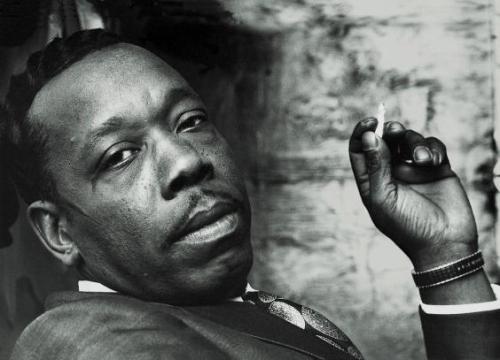
on the harmonica – Slim Harpo

SlimHarpoSmoking

 Slim Harpo (1924 – 1970)

          ______

                                           for Barbara

having read my musings on the guitar‘s 
superior practicality, easy portability,  
as a carry-along instrument on the range, 
a friend replied, “how about a cowboy
with a harmonica“, and mentioned Slim
HarpoI told her I’d look into it, how 
could I not, though I’d never at all 
ever heard of Slim Harpo

here’s Slim Harpo, he’s a treat

but a harmonica, finally, is too brash
an instrument to easily fashion out 
of it love songs, so I’ll hold onto my
guitar 

you’ll note that despite the entirely 
different style of music from the 
Classical stuff I’ve been bringing 
up, the three essentials, tonality,
tempo, and reiteration still apply,
this trinity is the foundation of all 
of our Western musical culture,  
the output changes only according
to geographical place and time 
within those European parameters 

Asia has its own, indeed several, 
distinct musical idioms 

Slim‘s is manifestly the American  
Deepest South

enjoy


R ! chard

what’s up in Belgrade, Serbia – Pepe Romero

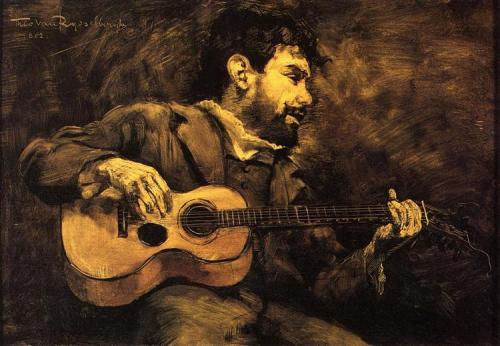
dario-de-regoyos-playing-the-guitar-1882.jpg!Large

   Dario de Regoyos Playing the Guitar (1882) 

          Theo van Rysselberghe

                 ______________

                                                          for Donna

struck by the intimacy, the emotional 
resonance of the guitar, more outward,
more confessional, than introspective, 
like the cello, I wondered at the reasons,
speculated merely, but with, to my mind, 
unobjectionable conclusions finally, just 
this side of actual proof of my, however 
provisional nevertheless, conclusions

the guitar, I thought, when a friend 
wrote about her especial appreciation 
of it, is to both North and South 
Americans a much more integral part
of our history, cowboys carried them 
out on the range, be it American or 
Argentinian

why, I wondered

well, I figured, it doesn’t have, first 
of all, a bow, and it’s easy to carry,
a piano would, of course, be right 
out of the question

and later in the evening, around a 
fire, a cowboy can wrap his very
soul around this metaphor he’s 
holding, and speak of his love and 
his loneliness

you could try the same thing with a
mandolin, maybe, but it has, I think, 
too playful a string to be ever so
meaningful and intimate

it seems, as well, that you can play 
more than one note at a time on the
guitar, the thumb and at least one 
other finger, to achieve harmonies 
other instruments, including the 
cello, can’t – I could never play two 
notes at a time, for instance, on my 
flute when I was flaying it 

though I recently found out you can 
play two notes together, at a time,
though with great difficulty, on the 
violin, which could shoot all of my 
theories into the water

stay tuned


listen to Pepe Romero, meanwhile,
astound you with first of all Rodrigo’s
“Concierto de Aranjuez” – you’ll melt 
at the adagio – then with Francisco
Tárrega’s “Memories of the Alhambra”
a piece that’s already written deep in 
your bones, I promise you’ll

quiver

enjoy


R ! chard

Cello Suite no 4, in E flat (trans. to C for guitar) – Bach

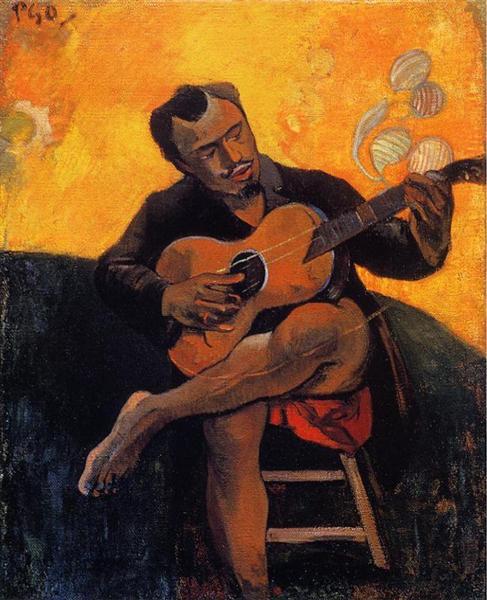
the-guitar-player-1894.jpg!Large

       The guitar player (1894) 

                Paul Gauguin

                    ________

                                               for Daniel, despite his 
                                                               occasional jabs


transcribed for guitar, Bach’s Cello Suite no 4 
becomes an entirely other experience, listen

less transformationally, the original key, E flat,
is transcribed, altered, to the key of C, you 
won’t even notice 

from an introspective, however lively often,
utterance, I hear here, rather, a serenade, 
before a balcony, before the balustrade of 
blushing señorita, demure beneath her 
modest mantilla, quivering behind a  
fluttering matching fan, at the sincerity,  
and artistry of her courter, his 
unadulterated, and utterly vulnerable 
pursuit, an unmistakable expression of 
his devotion, ability, agility, and eventually, 
his worth, which is, incidentally, what art 
is, when achieved, always irresistible, even 
miraculous

plus who wouldn’t surrender everything 
to this guitarist, apart even from his art


R ! chard

Cello Suite no 3, in C major – Bach

narcissus(1)-1.jpg!Large.jpg

        “Narcissus (c.1599)

                Caravaggio

                     ______

what struck me about this most extraordinary
performance of Bach’s Third Cello Suite was 
nothing to do with the Suite itself, but with 
the work of the camera, right out of 
Caravaggio, I thought, a bona fide Baroque
artist also, what could the cameraman have 
known

stark contrasts, an absolute focus on the 
subject without much set decoration, no
consideration for extraneous, though 
perhaps effective, decorative elements 
to cloud the pictorial issue 

this is not at all Bach, incidentally, who 
relies on accompaniment, feeder notes, 
to shed light on the essential melody, 
often even nearly indistinguishable 
from the main statement 

both are considered Baroque, Bach,
Caravaggio, but I won’t be getting into 
it right nowit’s a long, and tortuous 
story

otherwise note, indeed, in Bach, the 
reiteration of clusters of music, forward 
propulsions, with incremental tonal 
variations, moving the melody forward, 
something lost during the later, more 
frivolous, Classical Period, but recovered 
eventually, two generations down, by 
Beethoven, kind of like children resemble 
their grandparents much more than they 
do their actual folks

eventually that becomes Minimalism, see,
for instance, Steve, Different Trains“, 
Reich


R ! chard

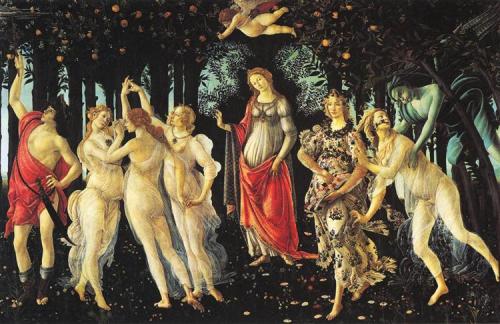
to spring

primavera-1478(1).jpg!Large.jpg

     Primavera” / “Spring (1478) 

              Sandro Botticelli

                   _________

according to long tradition, the 21st of March
has been the first day of spring, but yesterday,
the 20th, two people in separate encounters,
told me that spring had started that very day,
throwing my entrenched supposition out the 
window, for better or for worse

regardless, spring has now, surely decidedly, 
sprung

here’s Beethoven celebrating it, though the 
title, Spring“, was probably not his, others 
mostly gave his works their nicknames, for 
their own, usually associative, reasons – his
“Moonlight” Sonata also, for instance – but  
that’s been ever enough for me, it’s the 
music that ultimately matters, I think

the “Spring” Sonata, opus 24 then is for 
violin and piano, his 5th such, written in 1801, 
it is an early piece, full still of the verve we’ve 
heard here already in his Opus 5, no 1 for Cello
and Piano, with his musical phrases flying 
right through the bar lines and off the very
page

Kyung Wha Chung plays the violin, she 
remains after all these years my very 
favourite violinist 

enjoy

and have the greatest of springs, 
whenever you might want to start it


R ! chard

different trains – Reich / Bach

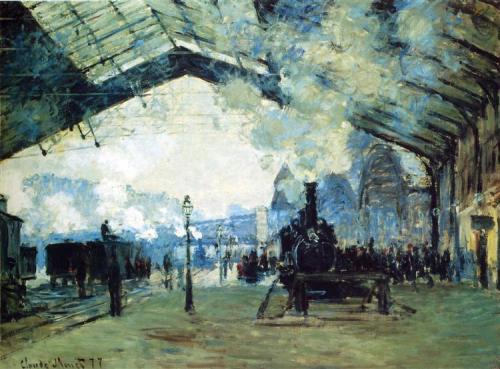
saint-lazare-gare-normandy-train.jpg!Large   

     “Saint-Lazare Gare, Normandy Train (1887) 

            Claude Monet

                   ________

since I’m on the subject of trains, let me
once again highlight a piece that, to my 
mind, is one of the most significant 
works of the 20th Century, Steve Reich’s
Different Trains“, an extraordinary 
homage to the victims of the Holocaust 

it is in three movements, America – 
Before the War”, “Europe – During the 
War“, andAfter the War“, Reich
recounts his impressions of train trips
that marked him throughout, therefore
this is an autobiographical work, as 
well as being an historical document,
and add to that a profoundly moving 
musical meditation on a pivotal 
moment in our history

I used to say that if you’re going to 
open your mouth, you should be 
either entertaining or informative,
preferably both, otherwise keep 
your mouth shut, many took 
offense, I must’ve been 
insufferable

but, I would opine, life is short, 
you’ll have to, I’m afraid, deal 
with your own shortcomings

Reich here has no shortcomings,
though at first you think this might 
be a long trip, with so many 
repeated musical clusters, not to 
mention the strident atonality, it  
soon becomes evident that this  
piece is amazing, a personal and
powerful evocation of a particular 
transformational event seen 
through the eyes of an innocent,
an American child, a poet, 
experiencing, however 
metaphorically, the horror of this
defining moment

style and content, information and 
entertainment, indissolubly gel to 
deliver an unforgettable experience, 
my own such pivotal moment 
would’ve been the Cold War air raid 
shelters, the nuclear threat

Reich holds on to Classical 
conditions by a mere thread, tempo, 
however variable, is solid throughout 
as a rock, dictated by the prepared 
tape that the instrumentalists must
follow rhythmically like a clock

another divergence from the 
Classical model is that tonality  
and recapitulation, apart from the 
repetition of musical clusters, is 
entirely jettisoned 

note, however, the same use of 
repeated clusters in Bach, to 
simulate propulsion, the 
minimalism of the 20th Century is
already prefigured in Bach’s stuff

plus ça change, as we say in French,
there is nothing really new, in other
words, under the sun


in the spirit of juxtaposing items
to discover much more than the 
sum of their parts, listen to Bach’s 
Second Suite, in D minor, for 
inspirational clarification 


R ! chard

psst: there were no trains at the time 
          of Bach, I should note, they were 
          a product of the later 19th-Century,
          its Industrial Revolution, see, for 
          instance, here, or above

French Suite no 3 in B minor – Bach

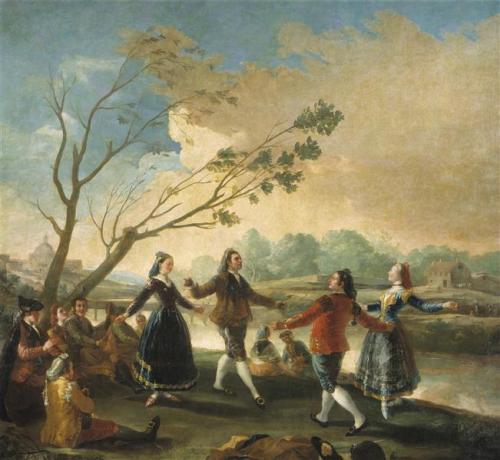
dance-of-the-majos-at-the-banks-of-manzanares-1777.jpg!Large.jpg

   “Dance of the Majos at the Banks of Manzanares (1777)

           Francisco Goya

                _________

upon reading up somewhat on the different
Bach Suites, I’ve provisionally concluded
that the earlier English Suites, 1715 to 1720,
were a modification of the established form 
of the suite, which would not have included 
a prelude, which isn’t, indeed, a dance

the Cello Suites follow, ahem, suit

but by the French Suites, 1722 to 1725, Bach 
is eschewing – Gesundheit – the prelude, but 
inserting, however, an air in his Fourth – an  
air is not either a dance – and mixing up  
their order in the later Suites, a minuet, for 
instance, in the last one of them, his Sixth,  
coming up after the gigue, which sports even
also a polonaise, where in his Fifth, Bach adds  
a loure, I ask you, a slow French gigue, to his  
bristling concoction

the terms French and English, incidentally, 
were added only after Bach’s demise, for 
diverse and uncorroborated reasons, so 
that these titles probably don’t mean much 
to a contemporary audience, who can’t tell, 
anyway, our gavottes from our bourrées

the music of Bach is like that of no other 
composer, he owns essentially the Baroque
Period, having, in fact, wrenched the Era 
from the painters, who’d established it in 
art to such a degree that it defined its
earlier historical phase

with Bach, the torch is handed over to 
music, from then on until the 
Impressionists, the period is defined 
by composers, both Classical, then 
Romantic, with some poets holding 
some sway 

the technique that dominates the music 
of Bach is that of counterpoint, where 
a tune is repeated in the harmonization
a few beats from its first iteration, 
vocally, we call that singing in canon

his music is introspective, as though 
the player were privately meditating,
it has the playfulness of Mozart, but
Mozart is expressive, not interior,
therefore nowhere near as spiritual,
Beethoven will return with a 
profundity that matches Bach’s, but 
with much more Sturm und Drang, 
tempestuous moral struggle, much  
less resignation, ouch, watch

listening to Bach for me is like getting 
on a train, and just letting the rhythm
of the wheels sustain me, as I watch,
indeed introspectively, the surrounding 
countryside, stopping at the musical 
journey’s several halts, its intervals, 
until its final destination, which 
despite, or even because of, taking 
sometimes hours, is nevertheless  
endlessly satisfying, and never  
ever less than, however improbably, 
inspiring

here’s Bach’s Third French Suite
you’ll note it includes an idiosyncratic 
“trio”, not strictly a recognized dance
either – leave it to the saucy French, I   
say, to consider interpolating a trio


R ! chard